Kennedy vs. Khrushchev: Thirteen Days of Nuclear Brinkmanship
The Kennedy vs. Khrushchev standoff over Soviet missiles in Cuba brought the world closer to nuclear war than any moment before or since, and both leaders knew it.
Read Wikipedia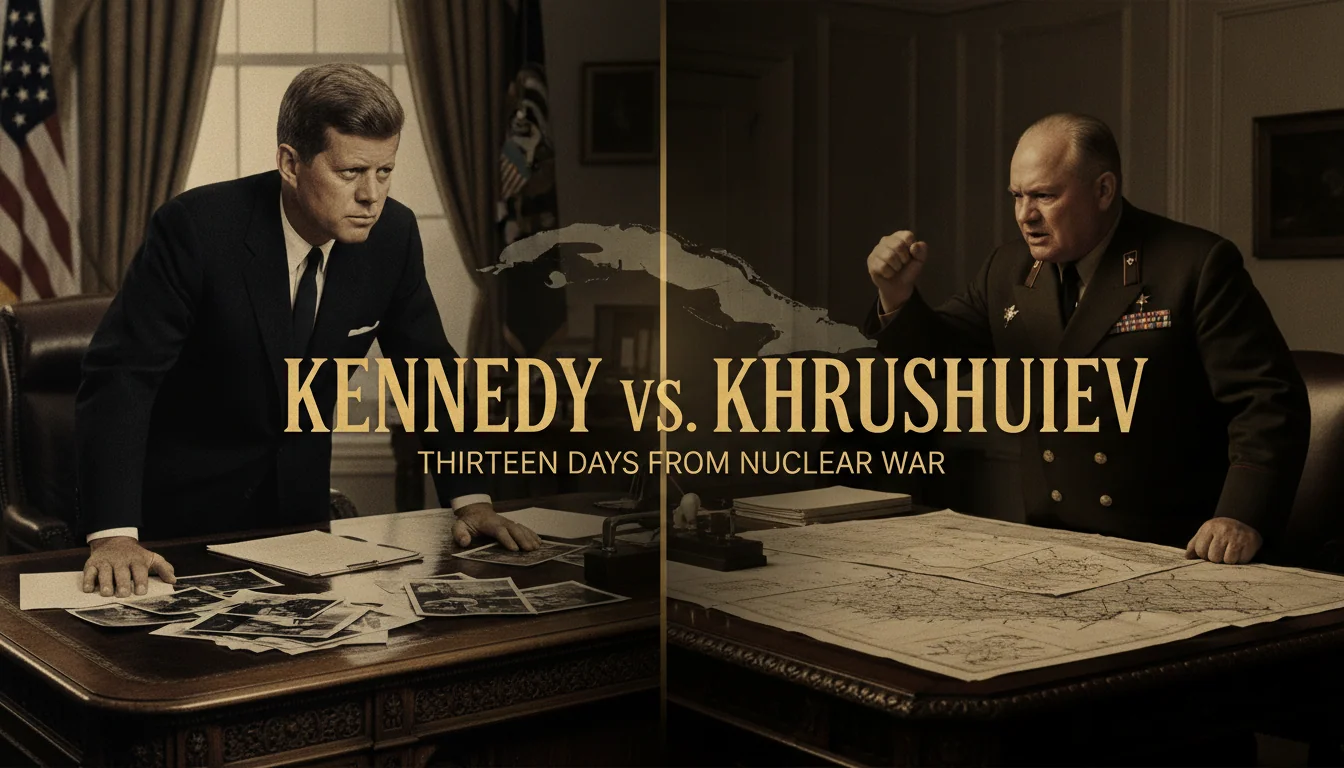
For thirteen days in October 1962, two men who had never fully trusted each other found themselves holding the fate of the planet in their hands. John F. Kennedy, the young American president still smarting from a humiliating summit with his Soviet counterpart the year before, and Nikita Khrushchev, the blustering, unpredictable premier who had gambled on secretly arming Cuba with nuclear missiles, spent nearly two weeks maneuvering around a crisis that came closer to nuclear war than any other moment in the atomic age. Neither man wanted that outcome. Both came dangerously close to it anyway.
What They Were Actually Fighting About
On October 14, 1962, an American U-2 spy plane photographed Soviet construction crews building missile launch sites in Cuba, just ninety miles from Florida. The missiles being installed, medium and intermediate range ballistic weapons capable of striking most of the continental United States within minutes of launch, represented the first time the Soviet Union had placed nuclear weapons outside its own borders on this scale. For Kennedy, discovering the missiles violated what he considered an implicit understanding that the Western Hemisphere remained outside direct Soviet military reach, and it happened only a year after the disastrous Bay of Pigs invasion had already embarrassed his young administration and, in Khrushchev's own later account, convinced the Soviet premier that Kennedy was weak enough to be pushed.
For Khrushchev, the missiles served two purposes at once. They protected Cuba, and Fidel Castro's fledgling communist government, from what Khrushchev genuinely believed was an imminent second American invasion attempt following the Bay of Pigs failure. And they partially closed a real strategic gap: the United States already had Jupiter missiles stationed in Turkey and Italy, within easy striking range of Soviet territory, and Khrushchev calculated that placing comparable weapons in Cuba would even the geopolitical scoreboard rather than dramatically escalate it. Kennedy and the American public saw it very differently, as a reckless and deceptive provocation planted secretly in America's own backyard.
Kennedy's Case
Kennedy's position deserves real sympathy. He had inherited a fragile Cold War balance and, only eighteen months into his presidency, had already been humiliated once at the Bay of Pigs and again at a hostile 1961 Vienna summit, where Khrushchev had reportedly bullied and lectured him for hours over Berlin. Discovering nuclear missiles secretly installed just off the Florida coast was, by any reasonable standard, a direct challenge that a sitting American president could not simply absorb without response.
Kennedy's decision to impose a naval "quarantine" around Cuba, a deliberately softer legal term than "blockade," which under international law could have been read as an act of war, showed real restraint under enormous internal pressure. His own military advisors on the Joint Chiefs of Staff pushed hard for immediate air strikes or a full invasion of Cuba, options that later intelligence assessments suggest would very likely have triggered a nuclear exchange, since Soviet field commanders in Cuba, unbeknownst to Washington at the time, already had tactical nuclear weapons and standing authority to use them against an invading force. Kennedy resisted his own generals, choosing the quarantine as a slower, more controllable escalation, a decision historians now widely credit with keeping the crisis survivable.
Khrushchev's Case
Khrushchev's position also deserves fair treatment, however reckless the initial gamble looks in hindsight. He had watched the United States surround the Soviet Union with missile bases in Turkey, Italy, and elsewhere for years without triggering a comparable crisis, and he genuinely believed, based on Castro's own repeated warnings and the Bay of Pigs precedent, that Cuba faced a real and near-term invasion threat that only a nuclear deterrent could stop. From Khrushchev's own account, later relayed in his memoirs, protecting the Cuban revolution and rebalancing what he saw as an unfair nuclear asymmetry were his primary motives, not simply provoking the United States for its own sake.
Once the crisis became public and the stakes became unmistakably clear, Khrushchev also showed real flexibility that Kennedy's own advisors noted with some relief. His October 26 letter to Kennedy, a long, emotional, and by most accounts personally drafted communication, proposed removing the missiles in exchange for an American pledge not to invade Cuba, a comparatively moderate ask given the danger both sides faced. When a second, more hawkish letter arrived the following day demanding the additional removal of American missiles from Turkey, Kennedy's team chose, on the advice of his brother and close aide Robert Kennedy, to respond only to the first, more workable letter, a diplomatic maneuver historians call the "Trollope ploy," while privately agreeing to the Turkish missile withdrawal Khrushchev's second letter had actually demanded.
The Clashes
The thirteen days were punctuated by moments that came close to spinning out of anyone's control. On October 27, an American U-2 pilot, Major Rudolf Anderson, was shot down and killed over Cuba by a Soviet surface-to-air missile fired without direct authorization from Moscow, an act that some of Kennedy's advisors argued demanded immediate retaliation. Kennedy held back, reasoning correctly that Khrushchev likely had not personally ordered the shootdown and that an American strike in response could ignite exactly the war both leaders were trying to avoid.
That same day, unknown to either leader at the time, a Soviet submarine near the American quarantine line, designated B-59, lost radio contact with Moscow while being harassed by American depth charges intended only as a signal to surface, not an attack. Believing war might already have started, the submarine's captain and political officer moved to authorize launching a nuclear-armed torpedo, a decision that under Soviet protocol required agreement from all three senior officers aboard. One of them, Vasili Arkhipov, refused to concur, and the launch was called off. Arkhipov's refusal, information that only became public decades later, is now credited by many historians as one of the single closest points to accidental nuclear war in the entire crisis.
Behind the scenes, Robert Kennedy met secretly with Soviet ambassador Anatoly Dobrynin on October 27, delivering the offer that ultimately broke the deadlock: the missiles in Cuba would go, the United States would pledge not to invade Cuba, and the Jupiter missiles in Turkey, though publicly described as unrelated and already scheduled for obsolescence, would be quietly withdrawn within months, provided the arrangement never became public. Khrushchev accepted the terms and announced on October 28 that the missiles would be dismantled.
The Verdict: Who Won, and What It Cost
In the court of public opinion at the time and for decades afterward, Kennedy won decisively. The world saw a young American president standing firm against a nuclear-armed Soviet Union and forcing a public Soviet retreat, an image that boosted Kennedy's domestic standing enormously and became a defining moment of Cold War mythology. What the public did not learn until much later was that Kennedy's win was also a negotiated trade, not a pure capitulation by Khrushchev, since the secret Turkish missile withdrawal meant Khrushchev got a real concession in exchange for backing down publicly.
Khrushchev's cost was steeper and more personal. He had gambled on a bold stroke and, from the Soviet public's perspective, appeared to have blinked first and withdrawn the missiles under American pressure, an image that damaged his authority within the Soviet leadership. Combined with a string of other setbacks, including agricultural failures and increasingly erratic policy decisions, the humiliation of the missile crisis's public framing contributed directly to Khrushchev's ouster by his own Politburo colleagues in October 1964, less than two years later.
The pattern of a public winner and a private, costlier reckoning recurs across history's great confrontations, much like the way the War of the Currents between Tesla and Edison produced a clear technical verdict while leaving the men behind it with very different fates, or how Hamilton and Burr's duel turned a single confrontation into a permanent verdict on both men's careers. Kennedy kept the missiles out of Cuba and kept the secret trade hidden long enough to claim the public triumph outright. Khrushchev kept Cuba safe from invasion, which had been his stated goal from the start, and lost his own job for the trouble of getting there. The missiles went home. The men who sent them there did not come out of it evenly.
Quick Answers
Common questions about this topic
Who won the Cuban Missile Crisis, Kennedy or Khrushchev?
Kennedy is widely seen as the public winner, since the Soviet missiles were removed from Cuba under international observation while the American concession, a secret withdrawal of Jupiter missiles from Turkey, stayed hidden for decades. Khrushchev did secure his stated goal of protecting Cuba from invasion, but at a domestic political cost that contributed to his removal from power less than two years later.
What were Kennedy and Khrushchev actually fighting about?
The immediate dispute was the Soviet Union's covert placement of nuclear-armed medium and intermediate range missiles in Cuba, ninety miles from the American coast, discovered by U-2 reconnaissance photographs in October 1962. Behind that lay a broader Cold War contest over the balance of nuclear power and influence in the Western Hemisphere.
Did the US secretly agree to remove missiles from Turkey?
Yes. Kennedy's brother Robert Kennedy privately assured Soviet ambassador Anatoly Dobrynin that the United States would remove its Jupiter missiles from Turkey within months, on the condition the arrangement stayed secret. The missiles were withdrawn in 1963, but the secret trade was not confirmed publicly for decades.
How close did the crisis actually come to nuclear war?
Very close by most historians' assessments. A Soviet submarine near the naval quarantine line, B-59, came within one dissenting officer's veto of launching a nuclear torpedo after losing contact with Moscow, and American U-2 pilot Rudolf Anderson was shot down and killed over Cuba on October 27, an event that nearly triggered a retaliatory strike Kennedy chose not to order.

Hear Both Sides
Chat with history's fiercest rivals and decide who was right.
Create your free account →No card required. Talk to anyone in history with 8 free credits a day. Some features require a paid plan.
Join the HistorIQly Club
Get smarter about the past.
Weekly stories, deep dives, and exclusive content straight to your inbox.