Rocketman vs. History: How Accurate Is the Elton John Biopic?
Rocketman accuracy is a mixed verdict: Taron Egerton's 2019 Elton John biopic gets the emotional architecture right but plays loose with chronology, specific events, and the sequence of the music.
Read Wikipedia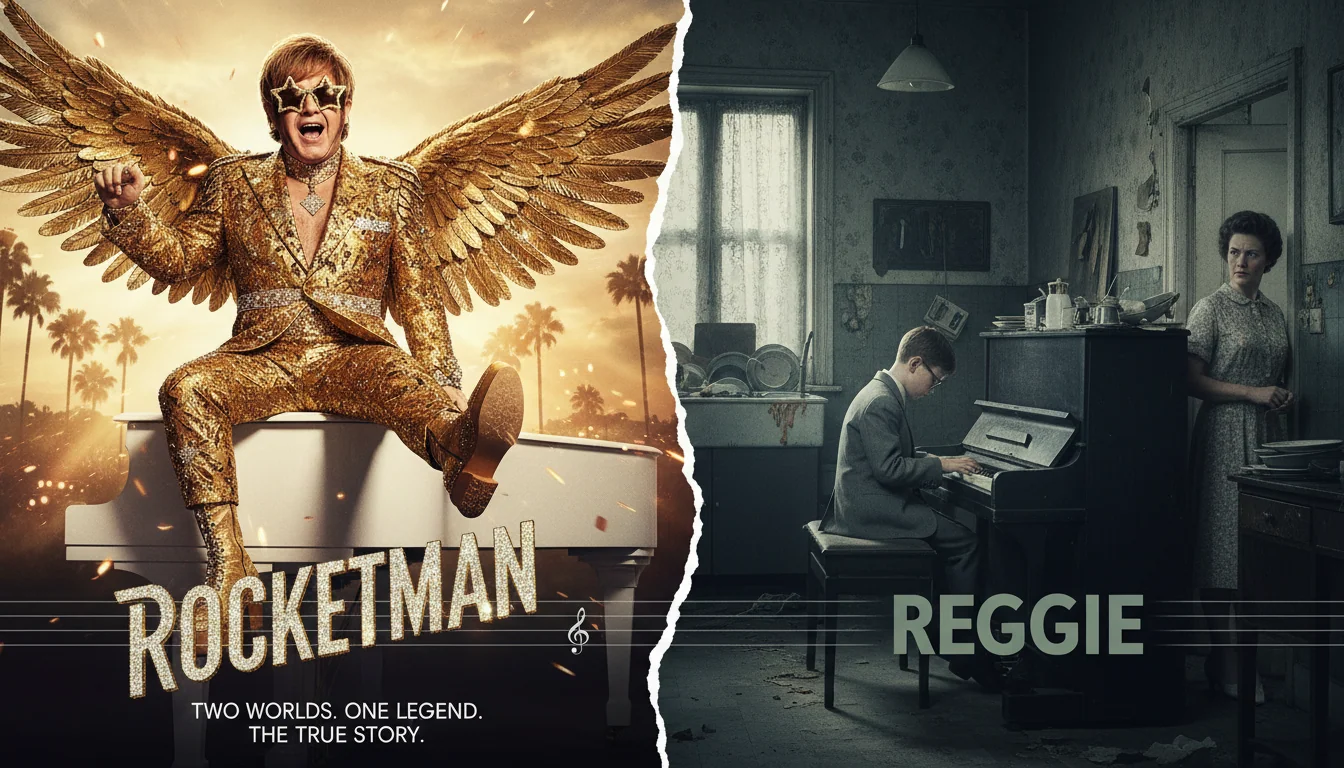
Rocketman accuracy depends on which standard you apply. The filmmakers called it a "fantasy musical film" before it opened. They were telling the audience something useful: this is not going to follow the rules of a conventional biopic. The music would happen when it needed to happen emotionally, not when the songs were written or released. Taron Egerton would perform the songs himself, in costume, in crowd scenes, in rooms that belong to Elton John's inner life rather than to his documented history.
That framing is honest, and it matters for evaluating what came next. Where Rocketman earns its accuracy, it is genuinely reliable. Where it invents, it tends to invent in service of emotional truth rather than random dramaturgy. The question worth asking is where the line falls.
What Rocketman got right
The basics are solid. Elton John's birth name is Reginald Kenneth Dwight. He grew up in a council house in Pinner, northwest London, with a mother named Sheila and a father, Stanley, who was distant and regarded a musical career as beneath the family. The emotional temperature of that household in the film is, by Elton's own accounts in interviews and his autobiography, accurate.
The partnership with Bernie Taupin. The collaboration between Elton and Taupin is one of the film's most reliable sequences. They did meet through a music publisher's response to an ad in the New Musical Express around 1967. Their working method - Taupin writing lyrics that he then handed to Elton, who set them to music without extended discussion - is documented and depicted accurately. Their relationship was and remains a close friendship, not a romance, which the film handles correctly.
"Your Song." The 1970 breakthrough is treated as a watershed. It was. Elton's live debut at the Troubadour in Los Angeles in August 1970 was a genuinely significant moment, reviewed by Robert Hilburn in the Los Angeles Times in terms that established his profile. The film's rendition of the show as a turning-point event is historically supportable.
John Reid. Reid was both Elton's manager and his romantic partner. He did go on to manage other major acts and was a significant figure in British music industry history. His role in Elton's commercial rise is not exaggerated.
The addiction arc. By the mid-1980s, Elton had a serious dependency on cocaine and alcohol and struggled with bulimia as well. He entered treatment and achieved sobriety around 1990. He has discussed this extensively in public and in his memoir. The film's depiction of the downward arc and recovery is grounded in real events.
The estrangement from his father. Stanley Dwight was largely absent from Elton's life and is not recorded as having supported his son's career. Elton has described their relationship as cool and complicated. The film's portrayal is in keeping with what he has said publicly.
His sexuality. Elton came out publicly as bisexual in a 1976 Rolling Stone interview. His sexuality was a complicated matter of public and private identity for years before that. The film's depiction of a man who suppressed this during his rise is consistent with his own accounts.
What Rocketman got wrong
"Crocodile Rock" at the Troubadour. The 1970 Los Angeles debut scene is one of the film's most kinetic sequences. But the central song in it, "Crocodile Rock," was not recorded until 1972 and not released until early 1973. Playing it as though it existed in 1970 is the kind of anachronism the fantasy frame allows the filmmakers to feel justified in making. It remains a clear factual error for anyone tracking the actual history.
The meeting with John Reid. The film places their first meeting at the Troubadour debut in 1970. The documented specifics of when they actually first met are unclear from public sources, but the film's version is a dramatically constructed scene rather than a documented event. Reid was working in the music industry in the UK during this period, and the timeline of when he and Elton first encountered each other is more complicated than the film suggests.
The rehabilitation frame device. The film opens with Elton in a full fantasia-costume attending a rehabilitation group session and narrating his life story in flashback from there. This is a narrative structure invented for the film. His actual entry into treatment in 1990 did not involve anything resembling this framing.
The "Your Song" moment with his grandmother. The scene in which a young Reginald plays a just-composed "Your Song" for his grandmother is a touching piece of invented family warmth. His grandmother Ivy Harris was reportedly supportive of his music. The specific scene is a construction.
The suicide attempt staging. Elton's 1975 suicide attempt is real and he has spoken about it. The film depicts this in a specific visual way - involving a pool, a party setting - that draws from elements of what he has described but turns it into cinematic theater. The broad event is real; the specific staging is the film's invention.
Musical chronology throughout. Beyond "Crocodile Rock," the film places songs in emotional contexts that do not correspond to when they were written. "Saturday Night's Alright for Fighting" predates the career period in which the film positions it. The fantasy-musical framing permits this by design, but it means that anyone watching for a documentary record of how Elton's catalog developed will come away with an inaccurate picture.
What the fantasy framing actually means
The standard for evaluating Rocketman is not the same standard applied to a straightforward biopic. The film announces its own rules at the outset and plays by them. Those rules involve emotional fidelity rather than documentary accuracy.
The emotional terrain of the film - the loneliness underneath the performance, the addiction as armor against intimacy, the search for parental approval that never fully arrives - reflects what Elton has said about his own life in years of interviews and in Me, his 2019 autobiography. Where the film invents, it invents in service of themes that Elton himself has articulated. The fantasy is not random.
Elton John was a producer on the film. His longtime partner David Furnish co-produced it. The result is essentially an authorized impression of a life - as Elton understands it and wants it understood - rather than an independent historical account. That is neither a condemnation nor a complete endorsement. It means the film is most reliable on emotional truth and least reliable on precise sequence.
The score
The specific events of Elton John's career from 1967 to 1990 require a separate research effort if you are using Rocketman as a starting point. The film will give you the rough shape, the key relationships, the emotional stakes. It will not give you the accurate year of a recording, the documented sequence of a meeting, or a clear line between what Elton lived and what the screenwriters dramatized.
For a film that announced its terms clearly from the opening frame, that is not quite a failure. It is the thing the film said it was going to be.
Historical Accuracy Score: 6/10. Reliable on the emotional architecture and major relationships. Loose on chronology, specific events, and the sequence of the music. Earns its category of fantasy by being transparent about it from the beginning. For music biopics that tried a more conventional approach, see our fact-checks on Bohemian Rhapsody and Walk the Line.
Quick Answers
Common questions about this topic
Is Rocketman historically accurate?
It is partially accurate on the emotional terrain and key relationships but takes significant liberties with chronology and specific events. The filmmakers called it a 'fantasy musical film' from the outset, which is accurate - the movie uses Elton's catalog expressionistically, placing songs in scenes that predate their actual composition or release.
Did Elton John meet John Reid at the Troubadour?
The film depicts them meeting at Elton's famous 1970 Troubadour debut in Los Angeles. The specifics of when and where they actually first met are difficult to verify precisely from public records, but John Reid was working in the music industry in the UK at various points in 1970, and the film's dramatization of the encounter is a construction rather than a documented event.
Did Elton John really attempt suicide?
Yes. Elton John has publicly discussed a genuine suicide attempt around 1975. The film depicts this event with considerable dramatic license regarding the specific setting and staging. The broad outline is real; the visual presentation is cinematic invention.
What did Rocketman get most wrong?
The most clear factual errors involve musical chronology: 'Crocodile Rock' is played at the 1970 Troubadour show, but the song was not released until 1972. The film also invents the rehabilitation group frame device and compresses events from across decades into a single emotional arc.

Debate the Accuracy with the Real Figures
Ask the real people what Hollywood got wrong about their lives.
Create your free account →No card required. Some figures and features require a paid plan.
Join the HistorIQly Club
Get smarter about the past.
Weekly stories, deep dives, and exclusive content straight to your inbox.