Rasputin and the Romanovs: What He Actually Did at Court
Rasputin held no government post. Here is what the record shows he actually did at the Romanov court, and where the mad monk legend takes over.
Read Wikipedia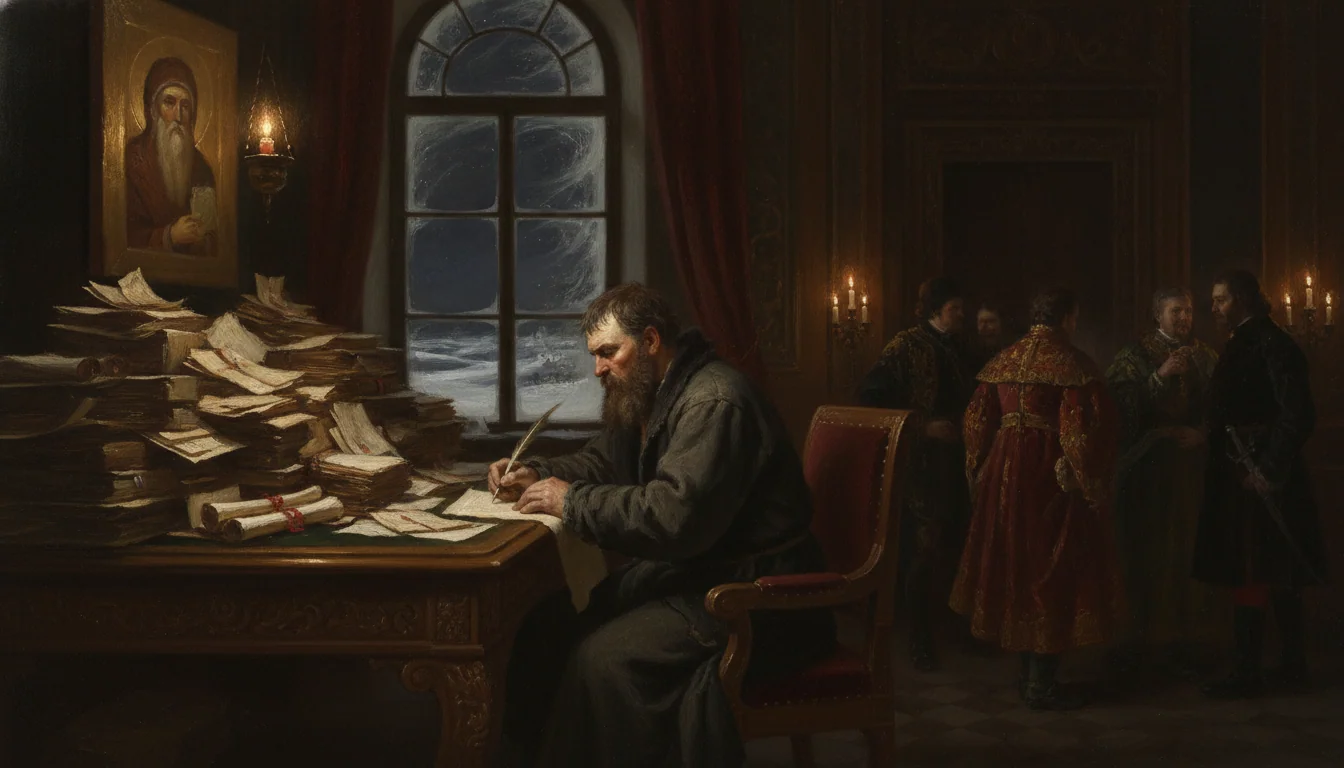
Grigori Rasputin never sat on a government council, never held a ministerial title, and never signed a single state document. Popular memory has turned him into the man who secretly ran Russia, a hypnotic mystic pulling strings behind the throne while the empire burned. The real story is narrower and, in its own way, stranger: a barely literate Siberian peasant with no formal position gained enough informal leverage over one anxious empress to reshape who held power in the Russian government, simply by being trusted in a room others could not enter.
The court and the stakes
By the time Rasputin reached St. Petersburg in the mid-1900s, the Romanov dynasty had ruled Russia for three centuries as an autocracy that brooked no real check on the tsar's authority. Nicholas II inherited that system without his father's stomach for it. He was indecisive, easily swayed by whoever spoke to him last, and married to Alexandra, a German princess raised in England whose devout Orthodoxy shaded into mysticism under pressure.
The pressure was severe. Alexei, the couple's only son and heir, had hemophilia, a condition that made ordinary childhood bruises potentially fatal and that court physicians of the period could do almost nothing to treat. The dynasty's entire succession rested on a boy who might die from a fall. Layer onto that the strain of the First World War, which Russia was losing badly by 1915, and the imperial court became a pressure cooker: a fragile heir, a war going wrong, and a monarch increasingly absent from the capital.
The players
Rasputin arrived in the capital already carrying a reputation as a wandering starets, a lay figure of spiritual intensity outside the formal church hierarchy. He was introduced to the imperial couple around 1905, reportedly through a pair of Montenegrin-born grand duchesses with their own taste for mysticism, who thought he might be exactly what the desperate Alexandra needed.
He was. During at least one severe bleeding crisis, most notably at the imperial hunting lodge at Spala in 1912, Alexei's condition appeared to improve after Rasputin's involvement, whether through calming the boy, through advice that happened to avoid aspirin's blood-thinning effects, or through effects historians still debate. Whatever the mechanism, Alexandra's faith in him became total and, crucially, extended well beyond medicine.
Around them stood a court full of people who wanted him gone: government ministers who resented an outsider's influence, Orthodox clergy who distrusted his unordained authority, and Duma politicians who saw him as a symbol of everything rotten in the autocracy. Prime Minister Pyotr Stolypin tried to have him investigated and pushed out of the capital around 1911, and was overruled. Stolypin's assassination later that year, unrelated to Rasputin, removed one of the few officials willing to confront him directly.
What he actually did at court
This is where the documented record and the legend diverge most sharply, because what Rasputin actually did was surprisingly bureaucratic. He recommended people. Alexandra listened. Nicholas, especially after 1915 when he left St. Petersburg to take personal command of the army at the front, often deferred to his wife's judgment on domestic appointments by letter.
Much of his daily routine at court had nothing dramatic about it at all. His apartment on Gorokhovaya Street became a waiting room for petitioners: merchants seeking contracts, families seeking exemptions from military service, minor officials seeking promotion, all hoping a scrawled note from Rasputin to the right minister might move their case along. Okhrana surveillance logs describe a steady stream of visitors passing through, and several officials later testified that a note or a word from Rasputin genuinely did carry weight, precisely because everyone at court knew he had Alexandra's ear. It was less sorcery than an informal patronage network, running on favors and reputation rather than any office he held.
The clearest documented pattern is what contemporaries called the ministerial leapfrog: a rapid churn of prime ministers and interior ministers during the war years, several of whom historians and Duma critics at the time linked to Rasputin's favor or disfavor, relayed through Alexandra's correspondence with Nicholas. Alexander Protopopov, appointed interior minister in 1916, was widely understood at court to be part of Rasputin's circle. On the ecclesiastical side, several bishops, including Pitirim, who became Metropolitan of Petrograd, owed their advancement in part to Rasputin's backing, a fact that scandalized clergy who considered an unordained peasant an inappropriate kingmaker for the church.
None of this made Rasputin a policymaker. He did not draft legislation, did not attend cabinet meetings, and did not command any institution. What he had was access: Alexandra's ear, and through her, a channel to the throne that bypassed every normal filter of ministerial advice. In a system this centralized, that channel alone was enough to make or break careers.
He was also, from around 1912 onward, under near-constant surveillance by the Okhrana, the imperial secret police, who filed detailed daily reports on his visitors, his drinking, and his movements. Those files are among the best primary sources historians have for his actual daily life at court, and they show a man juggling favor-seekers, petitioners, and society women rather than plotting grand strategy.
The gossip vs the record
Here is where the two versions of Rasputin split apart most clearly.
The gossip said he was sleeping with Empress Alexandra herself. The record does not support it. What survives are Alexandra's letters to him, deeply devotional in tone and addressed to a spiritual guide she believed could save her son, not a lover. Those letters became public partly through the efforts of Sergei Trufanov, a former monk known as Iliodor who had once supported Rasputin and turned bitterly against him, publishing a memoir that reportedly included copies of the correspondence. Historians who have studied the letters generally read them as sincere religious anguish, weaponized by enemies who understood exactly how damaging they would look out of context.
The gossip said Rasputin ran drunken orgies as a matter of course. The record includes at least one specific, documented episode: a March 1915 evening at the Yar restaurant in Moscow where Rasputin, drunk, loudly boasted about his influence over "the old lady" at court, in front of an undercover police detail whose report survives. That single, verified incident did enormous damage to his reputation and to the crown's, precisely because it was real and precisely because it was one of the few times the gossip and the paper trail lined up.
The gossip said he was a sorcerer whose body resisted death, poisoned, shot three times, and still alive when he went into the icy river. This part comes almost entirely from Felix Yusupov's own later memoirs, written after the fact by a man with every incentive to make his own story more dramatic. The original autopsy has not survived intact, and modern forensic historians who have examined what remains of the record are skeptical that it clearly proves he was still breathing when his body was dumped through a hole cut in the ice of the Malaya Nevka in December 1916.
The fallout
Rasputin was murdered on the night of December 16 to 17, 1916, by a small circle that included Yusupov, an aristocrat married into the extended imperial family, Grand Duke Dmitri Pavlovich, a Duma deputy named Vladimir Purishkevich, and a physician who supplied poison that, by most accounts, did not work as intended. When it failed, Rasputin was shot, reportedly fleeing into the courtyard before Purishkevich brought him down. His body was recovered from the river days later.
The killers expected gratitude. What they got was exile to their own estates, since Nicholas could not bring himself to prosecute a member of his extended family and a serving military officer, and public sympathy for the murderers ran high across Russian society, a telling sign of how thoroughly Rasputin's presence at court had poisoned the monarchy's standing. It did not save the dynasty. Within a few months, revolution forced Nicholas to abdicate, and the informal power Rasputin had wielded through one trusting empress vanished along with the throne that had housed it.
The mad monk legend survives because it is a better story than a Siberian peasant quietly reshuffling the Petrograd bureaucracy through friendly letters. But the documented record, ministerial appointments, Okhrana surveillance files, and Alexandra's own devotional correspondence, tells a version that is arguably more unsettling: no sorcery required, just one exhausted mother's trust and a system with no safeguard against where she chose to place it.
For two other moments when Russia's imperial court turned on its own, see the Mayerling Incident and Catherine the Great's coup against her own husband.
Quick Answers
Common questions about this topic
Did Rasputin really control the Russian government?
Not directly. He held no office and signed no decrees. His influence ran through Empress Alexandra, who trusted his judgment on ministerial and church appointments and relayed his opinions to Nicholas II, especially after 1915 when Nicholas took personal command of the army and left domestic governance largely to her.
Was Rasputin actually a monk?
No. He was never ordained and held no formal church position. He was a Siberian peasant who adopted the manner of a wandering starets, a lay holy man in the Russian Orthodox tradition, which is a status the church itself viewed with lasting suspicion.
Did Rasputin really survive poison and gunshots before he drowned?
That is the legend built on Felix Yusupov's own later memoirs, and it may be exaggerated for effect. The original autopsy record has not survived intact, and modern historians who have reviewed the surviving evidence are skeptical that it clearly shows he was still alive when his body went into the river.
What happened to the men who killed him?
Felix Yusupov and Grand Duke Dmitri Pavlovich faced no criminal trial. Nicholas II exiled them to their estates, a mild punishment that reflected how much sympathy the murder attracted even inside the imperial family. The monarchy itself collapsed within a few months.

Summon the Court
Chat with the monarchs and courtiers at the heart of the scandal.
Create your free account →No card required. Some figures and features require a paid plan.
Join the HistorIQly Club
Get smarter about the past.
Weekly stories, deep dives, and exclusive content straight to your inbox.