Saturday Night vs. History: How Accurate Is the SNL Origin Film?
Saturday Night 2024 accuracy checked: Jason Reitman dramatizes SNL's chaotic first broadcast. We fact-check Lorne Michaels, the cast, and what the film invents.
Read Wikipedia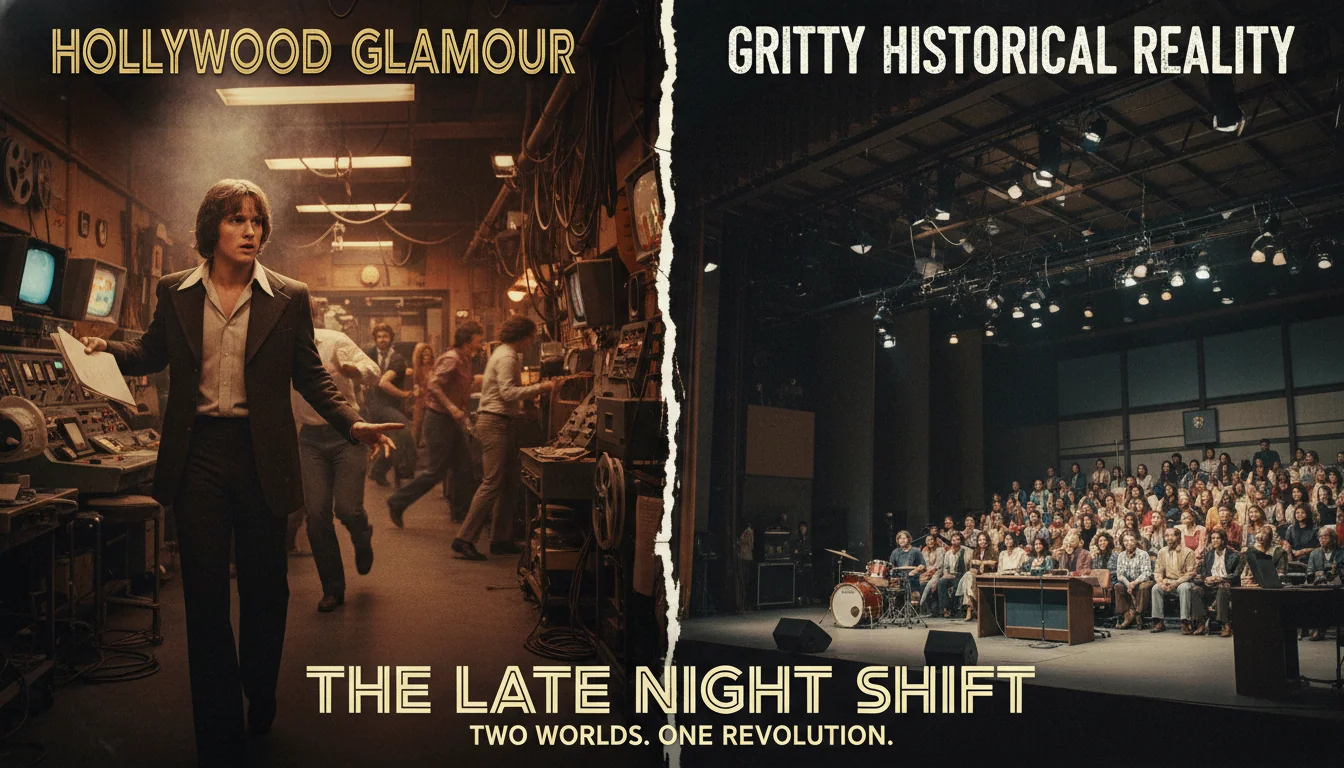
On October 11, 1975, at 11:30 p.m. Eastern time, a new show appeared on NBC. Nobody was quite sure what it was. The network had put a young Canadian producer named Lorne Michaels in charge of filling late-night Saturdays, given him a modest budget and a cast of unknowns, and more or less stepped back to see what happened. What happened was the first episode of what would become the longest-running sketch comedy program in American television history.
Jason Reitman's 2024 film compresses the founding of Saturday Night Live into a single unit of time - the 90 minutes before that first broadcast. It is an appealing formal conceit, and Gabriel LaBelle's portrait of the 30-year-old Michaels is the film's clearest success. As history, it is mostly sound, with some dramatic inventions that deserve separating from fact.
What the film gets right
Lorne Michaels was genuinely young and genuinely under pressure
Lorne Michaels was born on November 17, 1944. He was 30 years old on October 11, 1975. That detail matters because the film hinges on the audacity of someone barely out of his twenties building a live television institution from scratch in a matter of months.
The timeline is real. NBC's VP of Late Night, Dick Ebersol - himself only 28 at the time - had been tasked with programming the weekend late-night slot that Johnny Carson refused to cover. Ebersol championed Michaels' pitch, which was built around live performance, an ensemble cast of unknowns, and a format closer to theatrical revue than to traditional television variety. The resistance from NBC suits who wanted something safer and more commercial is well-documented.
The film's portrait of Michaels as charming, calculating, and genuinely visionary while also being very aware of how precarious his position was gets this right. He was not bluffing his way through - he understood television in ways the executives didn't - but he was also operating without a safety net.
The Not Ready for Primetime Players were real
The founding cast the film depicts - Chevy Chase, Dan Aykroyd, John Belushi, Jane Curtin, Garrett Morris, Laraine Newman, and Gilda Radner - were real, virtually unknown in October 1975, and chosen by Michaels over NBC's preference for more established names. None of them had significant national profiles. Belushi was coming from the National Lampoon stage show. Aykroyd was a Canadian comedian Michaels knew. Radner had worked with Michaels in Toronto.
The show's first-episode host, George Carlin, was a genuine comedy star by 1975, but he was kept separate from the cast in the variety-host tradition. The film correctly captures that the cast members were the show's engine, not the host.
The NBC bureaucracy really was a problem
The film's central conflict - Michaels fighting a network machinery that didn't understand what he was making - reflects a documented reality. NBC's standards and practices office had extensive notes on nearly everything in the first show. The network's legal and censorship departments intersected with almost every sketch. The late-night slot was low-priority enough that senior executives weren't watching closely, but the institutional resistance to anything genuinely strange was constant.
The show went out live partly because that was cheaper, partly because Michaels insisted that liveness was integral to the concept. The network would have been happier with tape.
The title confusion was real
The film correctly notes that the show launched as NBC's Saturday Night, not Saturday Night Live. ABC had launched a competing variety program, Saturday Night Live with Howard Cosell, the same autumn. The NBC's at the front was a branding concession. The show only became Saturday Night Live in 1976 when Cosell's program was cancelled.
Chevy Chase's unusual status was accurate
Chase was never formally a Not Ready for Primetime Player in the same way the others were. His primary role in the first season was as Weekend Update anchor, and he had a writing credit as well as a performing one. The film captures this correctly: Chase occupied a slightly different rung in the cast hierarchy, which fed ongoing tensions with Belushi in particular. His early departure from the show after Season 1, which is not depicted in the film but explains the interpersonal friction it does show, was rooted in exactly the kind of status asymmetry the film portrays.
What the film exaggerates or invents
The final-90-minutes frame is a dramatic compression
The real chaos of SNL's first season unfolded over months, not a single pre-show window. Many of the conflicts the film dramatizes in those 90 minutes would more accurately have played out over weeks of rehearsal, writing sessions, and casting decisions in September and early October 1975.
Reitman's formal choice, concentrating everything into one frantic night, is effective cinema. It is not documentary. Specific arguments, crises, and confrontations shown in the film cannot be verified from the historical record, and several are clearly invented or heavily fictionalized to give the structure dramatic momentum. For another film that uses a compressed time frame to dramatize a real media crisis, see September 5 vs. history, which applies the same 90-minute-unit approach to the Munich Olympics broadcast.
John Belushi's resistance to the material was more complicated
The film depicts Belushi as specifically resistant to certain material on the night - a familiar enough portrayal of the mercurial performer. The historical picture is more nuanced. Belushi was difficult throughout the entire first season, not just on opening night. His objections were often about creative control rather than about specific sketches. Compressing this into one night-before confrontation sharpens a real trait into a single dramatic beat.
The backstage-network power struggle is personalized for narrative convenience
The NBC executives in the film are consolidated into a small number of antagonists for clarity. The actual institutional resistance to Saturday Night's format was more diffuse and less sinister - it was the friction of a new idea moving through a large bureaucracy that was not actively hostile so much as uncomprehending. Films need villains; the historical truth was subtler.
The first episode's immediate reception was not triumph
The film's arc builds toward an implied vindication in that first broadcast. The historical reality is that the first episode of Saturday Night received mixed immediate reviews. Critics were intrigued but uncertain. NBC executives were not immediately converted. The show's cultural authority built over the following year, not overnight.
Historical accuracy score
7 out of 10.
The core facts - the cast, the network, the timeline, the title confusion, Michaels' age and vision - are solid. The general atmosphere of creative ambition struggling against institutional inertia matches the documented record well. What the film invents is the specific drama of those 90 minutes, which nobody can verify or refute in granular detail.
The film does something useful: it makes the founding of SNL feel contingent rather than inevitable. The real first season was genuinely uncertain, messy, and nearly cancelled multiple times. Saturday Night catches that anxiety accurately even when it invents the incidents that embody it. For how Hollywood handles another founding story of a technology institution under similar pressure, see The Social Network vs. history.
George Carlin hosted the first episode. Billy Preston and Janis Ian were the musical guests. Chevy Chase said "Live from New York, it's Saturday Night" to open the first cold open. All of this is in the historical record, and all of it is in the film. That's a reasonable ratio of accuracy to invention for a film that was never trying to be a documentary.
Quick Answers
Common questions about this topic
What is Saturday Night (2024) about?
Saturday Night is a 2024 film directed by Jason Reitman. It dramatizes the 90 minutes before the very first broadcast of Saturday Night Live on October 11, 1975. Gabriel LaBelle plays Lorne Michaels, the 30-year-old Canadian producer who assembled the show and fought NBC for the time slot, the format, and the cast.
How accurate is Saturday Night (2024)?
The film captures the general shape of the story accurately - SNL really was assembled under chaotic conditions by a young producer with a resistant NBC bureaucracy, and most of the personalities depicted were real. But it compresses events, invents specific confrontations, and dramatizes the final 90 minutes in ways the historical record cannot confirm. It earns about a 7 out of 10 for historical faithfulness.
Who hosted the first episode of Saturday Night Live?
The first host of Saturday Night Live (then called NBC's Saturday Night) was the comedian George Carlin, on October 11, 1975. The show's regular performers - the Not Ready for Primetime Players - did not host; they performed in sketches. The musical guests for the first episode were Billy Preston and Janis Ian.
Why was the show originally called NBC's Saturday Night and not Saturday Night Live?
The show launched as NBC's Saturday Night to avoid a name conflict with ABC's Saturday Night Live with Howard Cosell, which premiered around the same time. The NBC show formally adopted the Saturday Night Live name in 1976 after Cosell's show was cancelled.

Debate the Accuracy with the Real Figures
Ask the real people what Hollywood got wrong about their lives.
Create your free account →No card required. Talk to anyone in history with 8 free credits a day. Some features require a paid plan.
Join the HistorIQly Club
Get smarter about the past.
Weekly stories, deep dives, and exclusive content straight to your inbox.