The Shergar Kidnapping: Ireland's Unsolved Horse Heist
The Shergar kidnapping saw armed men steal the world's most famous racehorse from an Irish stud farm in 1983. No ransom was paid, no body found, no charges filed.
Read Wikipedia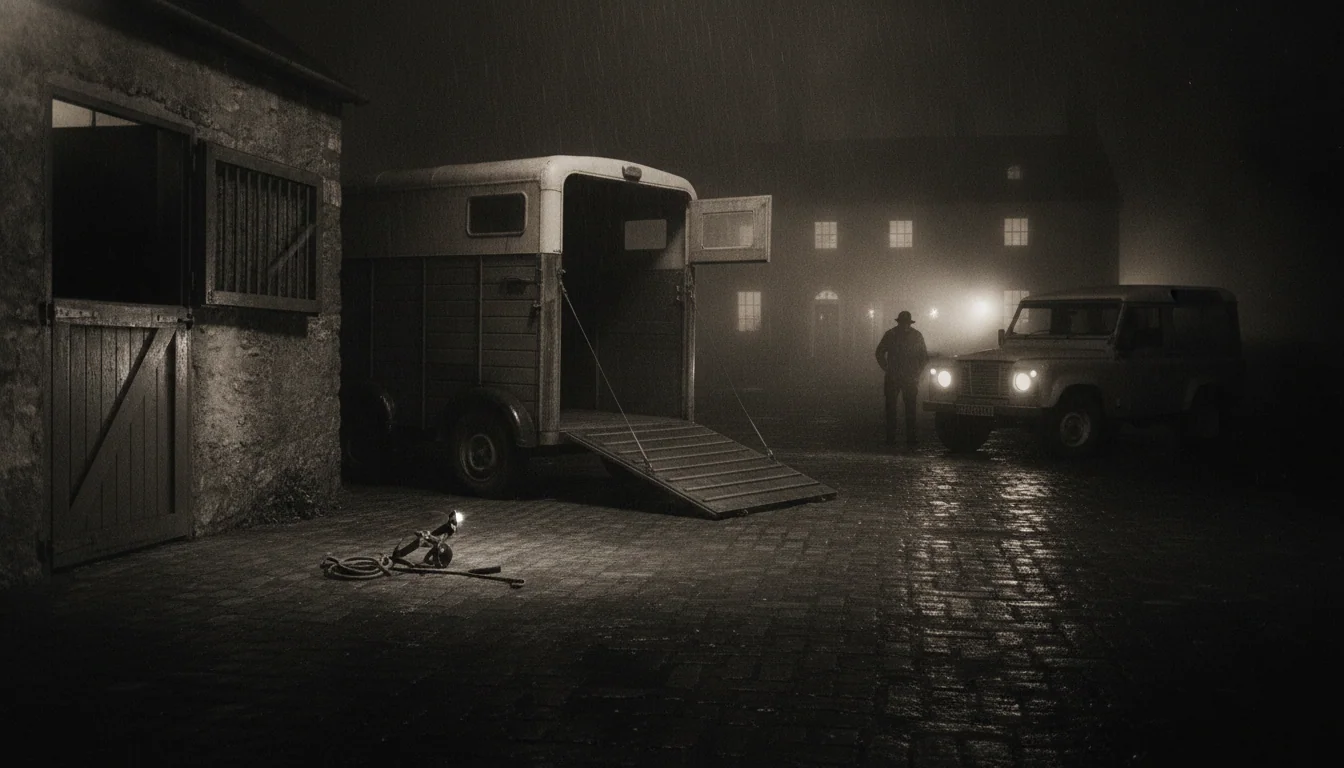
On the night of February 8, 1983, three armed men drove a horsebox up to the Ballymany Stud in County Kildare, forced their way past the head groom at gunpoint, and loaded a sleeping stallion into the trailer. By morning, the horse was gone, and the Shergar kidnapping had cost Ireland the most famous racehorse in the world.
Shergar was not just any thoroughbred. Two years earlier he had won the 1981 Epsom Derby by ten lengths, the largest winning margin in the race's two-century history, a performance so dominant that bookmakers stopped taking bets on him before the final furlong. Retired to stud, he was valued at roughly 10 million pounds and syndicated among 35 shareholders, with the Aga Khan, the hereditary imam of the Ismaili Muslims and one of horse racing's wealthiest owners, holding the largest stake. Stealing him was not like stealing a car. It was like stealing a national monument that happened to breathe.
A theft built for chaos
The men who took Shergar knew exactly what they were doing, at least at the start. They arrived after dark, when the head groom, James Fitzgerald, was alone at the stud with his family. They pistol-whipped him into cooperation, forced him to load the 1,000-pound stallion into an unfamiliar trailer (a task that can take hours even with a horse's trust), and drove off into the Kildare countryside with Fitzgerald's family held as insurance against an early alarm.
Fitzgerald was released hours later and immediately raised the alarm, but here the case took its first disastrous turn. Rather than notifying the Garda Siochana, the Irish police, the stud's manager first called the syndicate's insurance broker. Precious hours passed. By the time Irish police were formally alerted and roadblocks considered, the horsebox carrying the world's most recognizable racehorse had vanished into a landscape full of farm lanes, back roads, and sympathetic cover close to the border with Northern Ireland.
The ransom that never worked
The kidnappers, believed by Irish and British intelligence to be a Provisional IRA active service unit seeking funds for weapons purchases, demanded 2 million pounds for Shergar's safe return. But the ransom scheme ran headfirst into a structural problem the kidnappers had apparently not anticipated: Shergar did not have one owner. He had 35, spread across Ireland, Britain, and continental Europe, each holding a fractional share and none possessing sole authority to negotiate or pay.
The syndicate, along with insurers who had underwritten Shergar's value, refused to engage on the kidnappers' terms. Some shareholders reportedly wanted to pay. Lloyd's of London, which had insured Shergar for a portion of his value, took the position that paying ransoms for kidnapped animals set a dangerous precedent and effectively refused to fund a payout. The Aga Khan's own representatives were wary of legitimizing a Provisional IRA fundraising operation.
Phone contact between the kidnappers and a racing-industry intermediary acting informally as a go-between continued for several days. The callers grew audibly frustrated as the syndicate structure prevented any single decisive answer. Within roughly a week of the theft, the calls stopped entirely. Investigators have long believed this silence marks the point at which the kidnappers, unable to monetize an asset they could not sell, control, or feed indefinitely without detection, killed the horse.
An investigation compromised from day one
The Garda investigation into Shergar's disappearance has been criticized for decades, and even senior Irish police officials have since acknowledged serious mistakes. The initial delay in notification cost critical hours. When police did respond, some officers reportedly treated the case with more curiosity than urgency, uncertain whether a horse theft, however famous the horse, warranted the same emergency response as a kidnapping of a person.
There was also the matter of jurisdiction and politics. The Irish Republic and Northern Ireland shared a porous border that Provisional IRA units used constantly to move people, weapons, and money beyond the reach of either police force. If Shergar had been moved north within hours, as many investigators believe, he was effectively beyond Garda jurisdiction and into a region where the Royal Ulster Constabulary was consumed with the broader Troubles and had limited capacity or motivation to prioritize a stolen racehorse.
No arrests were ever made. No trial ever took place. The case remains formally open, filed among the Garda Siochana's unsolved major crimes, though in practical terms it has not moved in decades.
What former paramilitaries have said
Over the years, several people connected to republican paramilitary circles have offered fragments of an account, none confirmed, several contradicting each other. A journalist investigating the case in the 1990s obtained testimony from a self-described participant claiming Shergar had panicked violently inside the horsebox within a day of the theft, injuring a leg, and that the kidnappers, unable to treat the injury or control the animal, shot him and buried the body in a bog somewhere near the border, likely in County Leitrim or just across it.
Journalists who have investigated the case over the decades, drawing on interviews with people connected to republican paramilitary circles, have generally concluded that the horse was almost certainly killed within days, not held for the extended period the ransom calls implied. Ireland's boglands, which have historically preserved buried remains for centuries under the right anaerobic conditions, have never yielded a positive identification, despite periodic searches acting on various tips over the decades.
The bloodstock world after Shergar
The kidnapping permanently changed how the racing industry insures and protects valuable stallions. Studs across Ireland and Britain installed round-the-clock security, alarm systems, and in some cases armed guards for top bloodstock. Insurance policies were rewritten to explicitly address kidnap-and-ransom scenarios for animals, a category that had barely existed as a distinct underwriting problem before 1983.
The case also became a lasting embarrassment for the Irish state, symbolizing both the reach of paramilitary crime into ordinary civilian and commercial life during the Troubles and the limits of an underfunded police force operating along a border it could not fully control. Irish tabloids ran Shergar theories for years afterward, some outlandish (Libyan intelligence, Colonel Gaddafi's alleged grudge against the Aga Khan, was floated and dismissed by serious investigators), most simply variations on the IRA-panic-and-burial account.
Why the case endures
Part of what keeps the Shergar case alive in public memory is the strangeness of the crime itself. Kidnappings of people, however tragic, follow a recognizable emotional logic: a family desperate to pay, a captor with something to gain by keeping the victim alive and negotiable. Shergar's case broke that logic almost immediately. He was too valuable to sell openly, since every bloodstock expert in Europe could recognize him on sight from his distinctive white blaze and white socks. He was too expensive to feed and stable in secret indefinitely. He was owned by too many people to produce the single decisive payer the kidnappers needed.
In effect, the kidnappers stole an asset that had value only as long as its owners cooperated, and its owners' fractured structure made cooperation impossible. Shergar's fame, the very quality that made him worth stealing, is also what made him impossible to profitably hold.
Four decades on, no remains have surfaced, no prosecution has occurred, and the specific spot where Shergar died, if the panic-and-burial accounts are accurate, remains unknown even to some who claim to have been present. It is a case with an agreed-upon likely ending and no confirmed physical evidence to close it, a horse racing legend who won by ten lengths and vanished without a trace.
For another case where a valuable target's very fame doomed a ransom negotiation, see the Lindbergh baby kidnapping, and for another mystery where a body was never found despite decades of searching, see the disappearance of Amelia Earhart.
Quick Answers
Common questions about this topic
What happened to Shergar?
Shergar, the 1981 Epsom Derby winner, was stolen at gunpoint from the Ballymany Stud in County Kildare on the night of February 8, 1983. He was never recovered. Most investigators believe the Provisional IRA carried out the kidnapping and killed the horse within days after the syndicate that owned him refused to negotiate a ransom.
Was a ransom ever paid for Shergar?
No. The kidnappers demanded 2 million pounds, but Shergar was owned by a 35-member breeding syndicate led by the Aga Khan, and the group could not agree on how to respond. Negotiations collapsed within days, and the kidnappers stopped making contact entirely.
Was anyone ever arrested for the Shergar kidnapping?
No one has ever been charged. Irish police, the Garda Siochana, treated the case as a Thoroughbred theft rather than a paramilitary crime for the first critical days, hampering the investigation. Several IRA-linked informants later claimed knowledge of the crime, but no prosecution ever followed.
Has Shergar's body ever been found?
No remains have ever been recovered. Former IRA members have given conflicting accounts over the decades, including claims that the horse panicked and was shot within 24 hours of the theft, then buried in an unmarked location in County Leitrim or across the border. None of these accounts have been forensically confirmed.

Want to Interrogate the Suspects?
Chat with historical figures and uncover the truth behind history's greatest mysteries.
Create your free account →No card required. Some figures and features require a paid plan.
Join the HistorIQly Club
Get smarter about the past.
Weekly stories, deep dives, and exclusive content straight to your inbox.