The Jessica Chambers Mississippi Burning: A Haunting Unsolved Case
The Jessica Chambers Mississippi case began December 6, 2014: the 19-year-old was found ablaze on a rural road. Two trials, no conviction. The case remains cold.
Read Wikipedia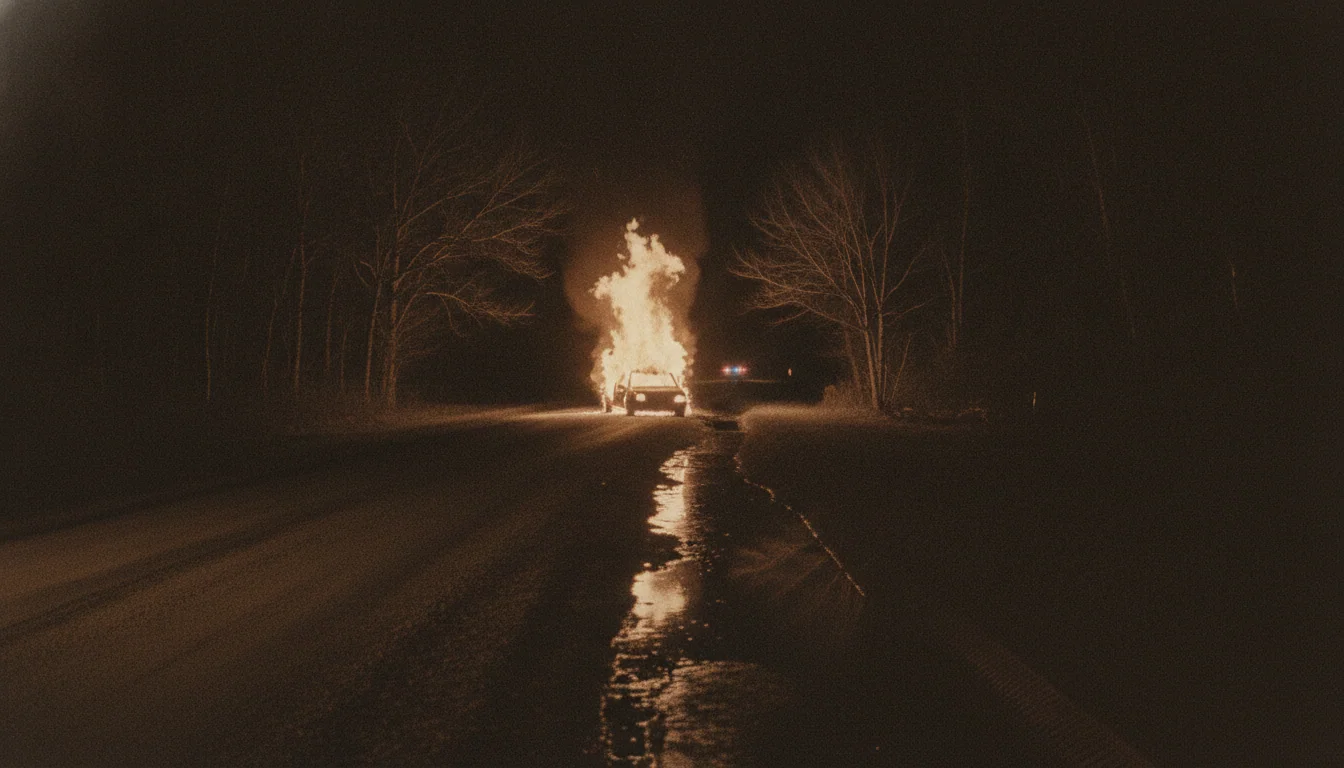
On the evening of December 6, 2014, Jessica Chambers drove away from a convenience store in Courtland, Mississippi and disappeared into the county roads she had known her entire life. She was 19 years old. Less than an hour later, a passing driver found her on fire on Herron Road, stumbling toward him from her burning car, most of her body scorched by an accelerant and flame.
She was alive. Barely. She managed to speak to the first responders who reached her before the ambulance arrived, trying to communicate something about what had happened to her. Then she was transported to a hospital in Memphis, and on the morning of December 7, she died from burns covering more than ninety percent of her body.
More than eleven years later, no one has been convicted of killing her. The Jessica Chambers Mississippi case is cold. The questions it raised have never been answered in any court, and the trials that were supposed to answer them ended without resolution - leaving a small Mississippi community, and a family, suspended in a particular kind of unfinished grief.
What happened on Herron Road
Courtland is an unincorporated community in Panola County in northwestern Mississippi, the kind of place where the main road takes less than a minute to drive from end to end. Jessica Chambers had lived in the area her whole life, and on the evening in question she had been in contact with multiple people by phone throughout the day. Her movements were later reconstructed partly through cell phone records and partly through witnesses who had seen her.
She had stopped at a local convenience store. Later that evening her car ended up on Herron Road, a gravel road through rural land. What happened there has never been conclusively established. She was doused with lighter fluid and set alight while still alive. Her car was also on fire. Whatever occurred had occurred with terrifying speed.
The first person on scene found her walking on the road, still in flames. He beat the fire out with his hands. Emergency services arrived and transported her to the Regional Medical Center in Memphis, where a team treated burns that covered almost her entire body. She died early on December 7.
The Panola County Sheriff's Department was joined almost immediately by the FBI and ATF, which signaled how unusual the case was from its first hours. Fire investigation is a specialized discipline, and the deliberate use of accelerant on a human being indicated a targeted act.
The dying words and what they meant
Before she lost consciousness at the scene, Jessica managed to communicate something. Her father, Ben Chambers, who arrived during the emergency, and several first responders testified in court that she said the name "Eric."
The prosecution's argument at both subsequent trials was that this was an attempt to identify her attacker. They argued she was naming Quinton Tellis - either by a first name he used or by a name her acquaintance knew him by. The defense argued she was calling for a friend named Eric Gwanalt, who was investigated and cleared of any involvement.
Courts have long recognized the evidentiary weight of dying declarations, grounded in the principle that a person facing imminent death has little reason to deceive. But dying declarations are also subject to the obvious difficulty that they are made under extreme physical distress, by someone who may be unable to speak clearly, to listeners who are simultaneously managing a medical emergency. What Jessica actually said - and who she was naming, if anyone - was disputed at both trials and never established to the satisfaction of a jury.
Quinton Tellis and the cell phone evidence
Investigators identified Quinton Tellis, who was in his mid-twenties, through cell phone data. Records showed his phone and Jessica's phone had been in communication multiple times on the evening of December 6. Location data placed him in the area of Herron Road around the relevant time. He and Jessica had a brief prior relationship.
Tellis had a prior criminal record, and in 2015 he was also charged in Louisiana in an unrelated case: the murder of a woman named Meing-Chen Hsiao, who had been stabbed to death in Monroe, Louisiana. He was eventually convicted in that case and sentenced to life in prison without the possibility of parole.
His arrest in the Jessica Chambers case came in late 2015. Mississippi prosecutors charged him with capital murder.
Two trials, no conviction
The first trial opened in September 2017 in Batesville, Mississippi and lasted several weeks. The prosecution laid out its case: cell phone records placing Tellis near the scene, GPS positioning data, testimony about his relationship with Jessica, and the dying-words account from her father and first responders.
The defense challenged each element. Cell phone GPS data carries a margin of error. The dying words had alternative interpretations. Physical evidence from the fire was limited by what the fire itself had destroyed. After days of deliberation, the jury deadlocked, with reports afterward placing the final count at eleven in favor of conviction and one holdout who voted for acquittal.
Mississippi prosecutors decided to retry the case. The second trial began in early 2018. This time the jury acquitted. Tellis, already serving his Louisiana life sentence, was not retried again. An acquittal on the record means he cannot be charged again for Jessica's murder in Mississippi.
Whatever the jury found in the second trial, it is now permanent.
What the investigation left behind
Law enforcement committed substantial resources to the case over several years. The FBI, the ATF, the Mississippi Bureau of Investigation, and the Panola County Sheriff's Department all participated in the investigation. That investment did not produce a conviction.
Part of the difficulty is structural to fire cases. An accelerant-based attack that burns both a person and a vehicle destroys evidence as a byproduct. What physical traces remained after Herron Road were fragmentary, and the surviving evidence did not meet the threshold required for a unanimous jury verdict.
The community context added complications. Courtland and Panola County have histories of complicated relationships between residents and law enforcement, and witness cooperation was not always complete in the ways investigators needed. Information moved through the community in ways that did not always translate into usable testimony.
The case attracted sustained national media coverage, partly because the circumstances were unusually brutal and partly because the community dynamics raised larger questions. That attention did not produce the evidentiary break investigators needed.
The case today
As of 2026, the Jessica Chambers case is listed as unsolved. No new suspects have been publicly named. The primary suspect has been acquitted, which removes him from further prosecution for this offense. The Panola County Sheriff's Office has maintained the case is open, but open in the context of cold cases means filed rather than actively investigated with fresh leads.
Her family has continued to speak publicly about the case in the years since. Ben Chambers has given interviews and appeared at memorials. The experience of families in long-unsolved cases - the public permanence of grief that has no resolution, the repeated engagement with media cycles that rise and fall without delivering answers - is one of the less-examined costs of cases that go cold.
Jessica Chambers was a teenager in a small town who, by accounts from people who knew her, was in the process of figuring out her life. She had been working toward a GED. She had the ordinary textures of a 19-year-old's world: relationships, friendships, plans that did not survive the night of December 6.
The question of who set her on fire on Herron Road remains, officially and legally, unanswered. The person responsible has not been identified to any standard the criminal justice system recognizes. The fire on that gravel road consumed more than a young woman's life. It consumed the evidence that might have explained it.
The Jessica Chambers case shares certain features with other American cold cases that went through the full machinery of investigation and prosecution without resolution - among them the New Bedford Highway murders of the late 1980s, where a lead suspect died before trial, and the JonBenét Ramsey case, where relentless media attention never produced a conviction. In all of these cases, the absence of a final answer is not for want of effort. It is, simply, what happened.
Quick Answers
Common questions about this topic
Who killed Jessica Chambers?
No one has been convicted of Jessica Chambers's murder. Quinton Tellis was tried twice - the first trial ended in a hung jury in 2017, the second in an acquittal in 2018. The case remains officially unsolved and cold.
What did Jessica Chambers say before she died?
Jessica was barely able to speak due to her severe burns. Her father and several first responders testified that she said 'Eric' - prosecutors argued she was naming Quinton Tellis by a first name or nickname. The defense argued she was calling for a friend named Eric. The exact meaning was never established to the jury's satisfaction.
Who was Quinton Tellis?
Quinton Tellis was a man in his mid-twenties who had briefly dated Jessica Chambers. He was arrested in 2015 after investigators traced his contact with her through cell phone records on the night she was killed. He was tried twice for her murder but acquitted in the second trial in 2018.
Why did the trials fail to convict anyone?
The prosecution's case was largely circumstantial. Physical evidence from the fire was limited, cell phone records placed Tellis near the scene, and the dying-words testimony was disputed. The first trial ended 11-1 for conviction but the second resulted in acquittal. With no new evidence and double jeopardy now attaching, the case went cold.

Want to Interrogate the Suspects?
Chat with historical figures and uncover the truth behind history's greatest mysteries.
Create your free account →No card required. Some figures and features require a paid plan.
Join the HistorIQly Club
Get smarter about the past.
Weekly stories, deep dives, and exclusive content straight to your inbox.