Spencer vs. History: How Accurate Is the Princess Diana Biopic?
Spencer movie accuracy reviewed: Pablo Larrain labels the film a fable, but how much of Kristen Stewart's portrait of Diana at Sandringham is grounded in documented history?
Read Wikipedia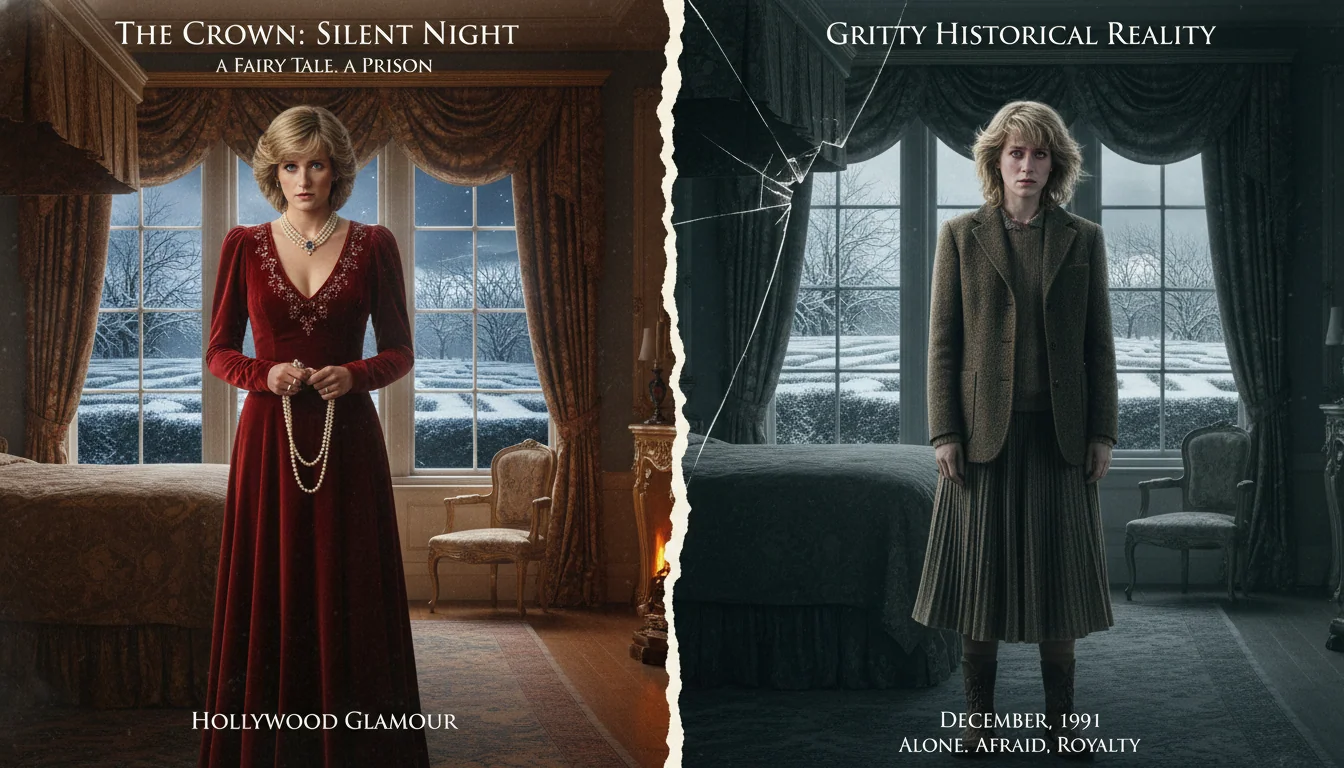
Pablo Larrain opens Spencer with a title card that reads: "A fable from a true tragedy." It is an unusual disclaimer for a biographical film, and it is worth taking seriously. Larrain is not claiming to show what happened at Sandringham in December 1991. He is claiming to show what it might have felt like from inside, using publicly documented emotional reality as a foundation and invention as structure.
Kristen Stewart's performance earned wide critical praise and an Academy Award nomination. This Spencer movie accuracy review asks how much of what Kristen Stewart is performing corresponds to the historical record, and how much to an intelligent artistic interpretation of it.
The answer, as with most biopics that announce their fictional intentions at the outset, is both.
What Hollywood Got RIGHT
The marriage was in ruin by December 1991
Spencer is set at a fictional reconstruction of the Christmas gathering at Sandringham. By December 1991, the marriage of the Prince and Princess of Wales had ceased to function as any kind of real partnership. Charles had resumed his long-standing relationship with Camilla Parker Bowles. Diana had conducted an affair with James Hewitt, which ended that year. The couple occupied separate emotional and increasingly physical spaces within whatever residence they shared.
The crucial documentary source is Andrew Morton, who had spent 1991 recording hours of conversations with Diana in which she described the loneliness, the eating disorder, suicide attempts, and the collapse of the marriage with devastating clarity. Morton's book, Diana: Her True Story, was published in June 1992, six months after the Christmas depicted in Spencer. The emotional interior the film depicts was real and documented.
Diana's bulimia is accurately represented
Spencer shows Diana bingeing and purging. This is historically accurate and not embellished. Diana discussed her bulimia in the Morton recordings and in her 1995 Panorama interview with Martin Bashir, attributing it to helplessness and isolation in her early married years. She said it began around 1982, approximately a year after the wedding, and the disorder lasted for much of her time as Princess of Wales.
The film's depiction does not sentimentalize this. The scenes are clinical and unglamorous, which reflects Diana's own framing of the disorder as a form of self-destruction rather than vanity.
The experience of Sandringham as a trap
Spencer's most pervasive motif is the feeling of confinement within Royal ritual. Diana's schedule is managed by unseen staff. Her weight is apparently monitored. Her freedom of movement is constrained by protocol and expectation. Multiple Diana biographers - including Tina Brown in The Diana Chronicles and Sally Bedell Smith in Diana in Search of Herself - document Diana's persistent and documented sense that Royal residences operated as oppressive environments, places where the machinery of the institution constantly processed and observed her.
Whether the surveillance depicted in the film - its almost Gothic formality, its institutional coldness - was practiced in precisely that form is uncertain. That Diana experienced Sandringham as a kind of beautiful cage is not.
Charles's emotional withdrawal and the Camilla attachment
The film presents Charles as having privately withdrawn from the marriage and prioritized the life he wanted over the one he had. This is historically defensible. By 1991, Charles and Camilla were in regular contact and their relationship had resumed with some permanence. Multiple biographers, and subsequent documentary evidence including published correspondence, confirm this. The film does not exaggerate the fact of Charles's emotional absence from the marriage.
Diana's relationship with her sons
Spencer depicts Diana's attachment to her sons William and Harry as warm, playful, and a source of genuine survival within an otherwise suffocating environment. This is consistent with every account of Diana's motherhood. Multiple sources, including those sympathetic to the Royal family, describe Diana as an unusually devoted and affectionate mother for a woman of her position and era. Her relationship with her children was the most stable and uncomplicated part of her Sandringham experience.
What Hollywood Got WRONG
The Anne Boleyn parallel is invented
Spencer gives Diana a biography of Anne Boleyn and implies she identifies with the earlier queen consort who was found inconvenient by the institution and destroyed by it. Boleyn even appears as a vision at one point.
This is entirely invented. There is no documented record of Diana studying Boleyn specifically or identifying herself with her in any surviving correspondence, journal, or testimony from this period. As historical metaphor it is pointed - both women were married to men named Charles at pivotal moments, both were found inconvenient by the Crown - but it is screenwriter Steven Knight's literary construction, not Diana's documented psychology.
The pearls subplot has no factual basis
The film constructs a dramatic thread around a pearl necklace that Charles has apparently given both Diana and Camilla. Diana's reaction to this is one of the film's emotional set pieces.
This specific incident has no documented basis in the historical record. No biographer or journalist covering the period has recorded it. It is a visual device designed to externalize the emotional reality of Charles's relationship with Camilla, and as a device it works on its own terms, but it did not happen.
The film's further implication - that the pearls may carry some connection to Anne Boleyn's history - has even less basis in any available record of Diana's jewellery collection or provenance.
The divorce was not already decided in December 1991
Spencer frames the Sandringham Christmas as a kind of formal farewell, as if everyone present understood that an ending had already been reached. The formal separation of the Prince and Princess of Wales was not announced until December 1992, a full year after the film's events. The divorce was not finalized until August 1996.
Whether Charles had privately decided the marriage was over by December 1991 is not answerable from available documentary sources. The film's suggestion that the conclusion was already present in the room at Sandringham is a retrospective cinematic choice. It projects knowledge available in 1996 back onto a moment in 1991, which changes the character of what the film is showing.
Most of the specific scenes are invented
Spencer's most vivid sequences - Diana's midnight escape to her family's former home at Park House across the fields, confessional conversations with a sympathetic Royal dressmaker, the particular exchanges with palace staff - are dramatized inventions. The film is not based on a first-person account of that specific Christmas. Knight and Larrain have constructed a plausible emotional dramatization from documentary sources about Diana's general state during that period, not from a transcript or eyewitness record of what actually occurred over those particular days.
This is not deception. The title card announced the film's fictional intentions. It is simply worth stating clearly: the specific scenes, as depicted, did not necessarily happen.
Historical Accuracy Score: 5.5/10
Spencer is unusual among biographical films because it earns a middling accuracy score while remaining a thoughtful and honest piece of work. The 5.5 reflects not deception but declared ambition. Larrain is not pretending to transcribe history. He is building a psychological portrait using documented emotional truths as foundation and invented incident as architecture. Those are different enterprises.
What the film gets most right: the documented state of Diana's marriage and mental health in 1991, the accuracy of her eating disorder, her experience of Royal life as suffocating, and Charles's emotional attachment to Camilla.
What it gets most wrong: the Anne Boleyn conceit, the invented pearls incident, and the film's framing of December 1991 as a conclusion already reached rather than a point in a deterioration that would take another full year to surface publicly.
Watch Spencer the way you would watch an intelligent novel inspired by true events - with the title card in mind, and with the knowledge that the emotional portrait is grounded even when the specific scenes are not.
For other biographical films fact-checked against the historical record, see our reviews of Judy (2019) and Walk the Line.
Quick Answers
Common questions about this topic
What is Spencer about?
Spencer (2021) is Pablo Larrain's psychological drama depicting Princess Diana's Christmas weekend at Sandringham in 1991, when her marriage to Prince Charles was visibly collapsing. Kristen Stewart plays Diana. The film describes itself as 'a fable from a true tragedy' and does not claim to be a documentary reconstruction of actual events.
Did Princess Diana have an eating disorder?
Yes. Diana documented her bulimia in tape-recorded conversations with journalist Andrew Morton in 1991, published as Diana: Her True Story in 1992, and discussed it publicly in her 1995 BBC Panorama interview with Martin Bashir. The disorder began around 1982 and persisted for much of her married life.
How accurate is Spencer overall?
Spencer scores well on emotional truth and less well on specific incident. The collapse of the marriage, Diana's eating disorder, and her profound sense of isolation within Royal life are all historically documented. The Anne Boleyn parallel, the ghost sequences, and most specific dramatic incidents are invented or heavily embellished.
Did Charles and Diana formally separate before Christmas 1991?
No. Their formal separation was announced in December 1992, a full year after the events depicted in the film. The film's framing - that the end was already decided and understood by those at Sandringham - is a retrospective dramatic choice rather than a documented historical fact.

Debate the Accuracy with the Real Figures
Ask the real people what Hollywood got wrong about their lives.
Create your free account →No card required. Some figures and features require a paid plan.
Join the HistorIQly Club
Get smarter about the past.
Weekly stories, deep dives, and exclusive content straight to your inbox.