The Fabelmans vs. History: How Real Is Spielberg's Autobiographical Film?
Spielberg's The Fabelmans is drawn from his own childhood, but how much is real? We fact-check the historical accuracy of this deeply personal autobiographical film.
Read Wikipedia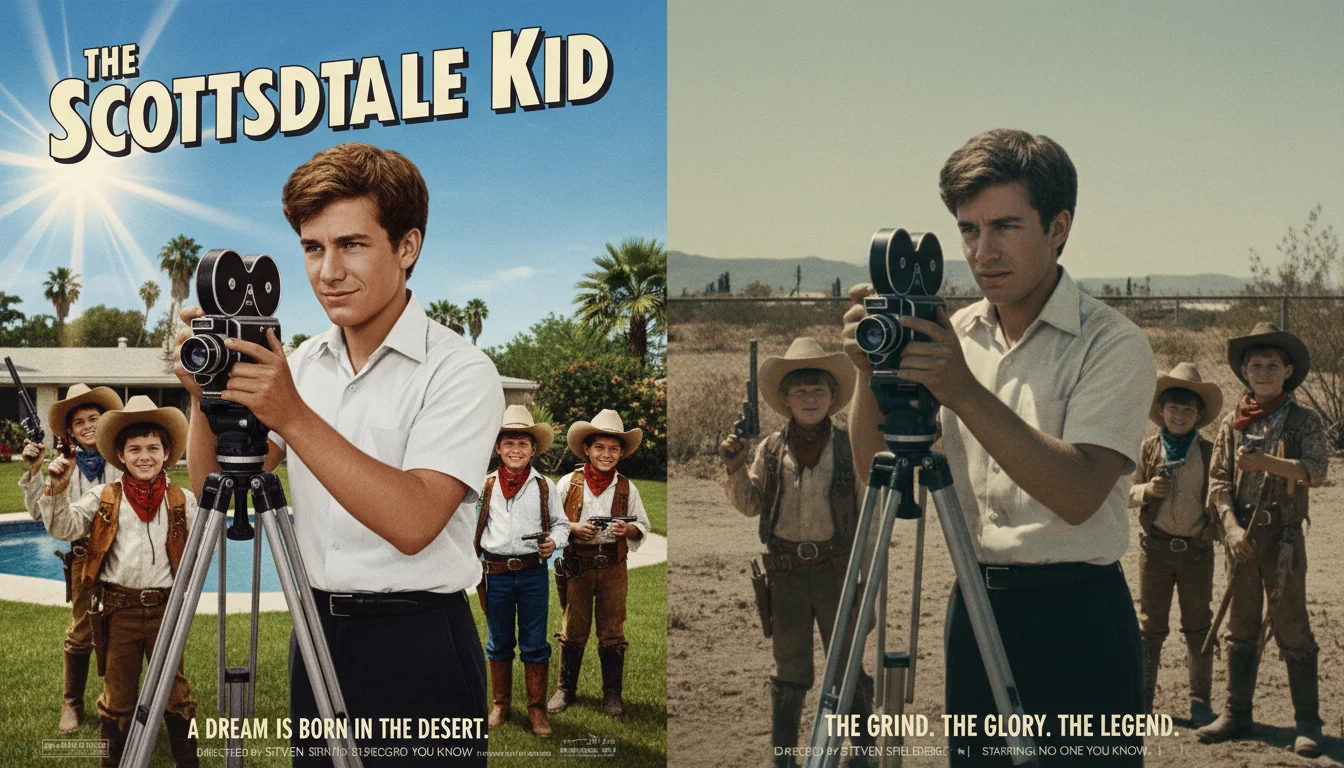
In November 2022, Steven Spielberg released the most personal film of his career. The Fabelmans is the story of Sammy Fabelman, a boy who grows up making movies while his family slowly falls apart - a story Spielberg has described, with unusual directness, as being about his own life. The film is beautiful, controlled, and clearly therapeutic. It is also, as with any autobiographical film made by a master of cinematic emotion, a document shaped as much by art as by memory.
Spielberg wrote the script with Tony Kushner and directed the film at age 75. It stars Gabriel LaBelle as Sammy, Michelle Williams as his piano-playing mother Mitzi, Paul Dano as his engineer father Burt, and Seth Rogen as Bennie Loewy, the close family friend whose presence destabilizes the marriage. The film covers roughly 1952 to 1965.
How closely does it match what actually happened?
What Hollywood Got RIGHT
The family moves are real
The Fabelman family in the film travels from New Jersey to Phoenix, Arizona, and then to the Saratoga area of Northern California - three distinct chapters of the film, three distinct American settings. This matches Spielberg's actual biography closely. Arnold Spielberg's engineering career required the family to relocate multiple times. Spielberg has described these moves in interviews as formative and disorienting, and the film captures that uprooting with precision.
The desert Arizona chapter, with its sense of exile and hot light, and the California chapter, with its more hostile suburban culture, both feel rooted in memory rather than invention.
Arnold Spielberg was a computer engineer, and the marriage did break down
Burt Fabelman works on mainframe computers, carries himself with engineer's precision, and is affectionate but emotionally unavailable in the ways that highly technical people often are. This matches the documented profile of Arnold Spielberg, who worked on computers for GE and later IBM and has been described in interviews by his son as brilliant, methodical, and somewhat emotionally remote.
The marriage between Arnold and Leah Adler broke down over years and ended in divorce in 1966. The film's depiction of a marriage that was never quite equal - her enormous creative hunger versus his contented competence - is consistent with Leah Adler's own accounts in interviews she gave before her death in 2017. She was famously candid about the tension in the marriage and her own desires.
Anti-Semitic bullying at the California school happened
The film's California school sequence, in which teenage Sammy endures bullying from a pair of muscular anti-Semites, is among its most precise and uncomfortable passages. Spielberg has spoken about experiencing anti-Semitic harassment as a teenager in California. The detail of one bully forcing Sammy to film him as a heroic figure for a school project - so that the bullying becomes a kind of conscription of the filmmaker's talent - is a remarkable invention, but the anti-Semitism itself is not invented.
Spielberg grew up in decades when American Jewish families moving into suburban communities encountered casual and sometimes explicit hostility. The film does not overstate this.
Young Spielberg really did make amateur films
Sammy Fabelman spends much of the film making Super 8 war movies, Westerns, and documentary-style short films with neighborhood kids and family members. This is well-documented. Young Spielberg made dozens of amateur films as a teenager, several of which survive. His 1964 war film Escape to Nowhere and the 40-minute Firelight, which anticipated Close Encounters of the Third Kind, were made before he was eighteen. He submitted work to local contests and screened films for neighbors.
The film's portrayal of a boy whose camera becomes a way of controlling a chaotic life rather than just a hobby is consistent with what Spielberg has described in interviews over fifty years.
What Hollywood Got WRONG (or Heavily Dramatized)
The "discovery" through home movies is almost certainly a narrative device
The film's most emotionally devastating sequence is the one in which teenage Sammy, editing footage from a family camping trip, begins to notice in the background of the images that his mother and Bennie are in love. He sees it in a movement, a glance, a moment of unguarded tenderness that the camera caught and his parents did not know he had captured. He then watches it over and over, first in horror and then in something approaching grief.
It is extraordinary filmmaking. Whether it happened is a different question.
Spielberg has offered different versions of this self-discovery in interviews over the years. The home-movie sequence as depicted - the precise, photographic epiphany while splicing film - is almost certainly a compression or dramatization of a more diffuse realization that accumulated over months or years. Artists tend to give their autobiographies the clarity of great scenes. Real life delivers the same information in fragments, without a defined reel.
"Bennie Loewy" is a composite and his relationship is simplified
Seth Rogen's Bennie is warm, gentle, and clearly in love with Mitzi. The film presents him as the Fabelman family's permanent houseguest and Burt's best friend - a man who is genuinely good and genuinely destructive at the same time. He is based on a real person who was close to the Spielberg family, but the film's treatment collapses a complicated, long-running emotional situation into a more cinematically legible shape.
Leah Adler's real relationship with this individual was reported in interviews to have been a deep and important friendship that caused real pain in the marriage. The film sharpens the emotional geometry for maximum effect.
The John Ford scene is almost certainly embellished
The film closes with Sammy arriving at a Hollywood studio, meeting an elderly director (played by David Lynch as John Ford), and receiving a lesson about the horizon line in cinema: keep it in the bottom third when the sky is interesting, in the top third when the ground is interesting, put it in the middle only if you want boring pictures.
Spielberg has told versions of this story for decades. The director in earlier tellings has sometimes been identified differently or left unnamed. The on-screen identification as John Ford, the specific dialogue, and the precise staging are almost certainly reconstructed from a vaguer, more passing encounter - or possibly combined from several. John Ford died in 1973, and his studio years were largely behind him by the time Spielberg would have had any access to Hollywood lots.
The lesson itself, about the horizon line, is real and correct and almost certainly comes from Spielberg's actual early education. Who delivered it in exactly those words, in exactly that room, is less certain.
The timeline is compressed
The film covers roughly thirteen years in two hours, which requires combining events, aging characters at slightly different rates than real life, and giving certain periods far more screen time than others. The California school section in particular is concentrated into a single school year that covers events that probably unfolded across two or three. The timeline of the parents' separation is dramatized to provide a clean act structure.
This is not a flaw, exactly - it is what film narrative requires - but viewers looking for a literal year-by-year record of Spielberg's childhood will not find it here.
Historical accuracy score: 7/10
The Fabelmans is honest about its autobiographical nature while being a work of art rather than a deposition. The broad facts - the family, the moves, the divorce, the bullying, the obsessive filmmaking - are real and well-documented. The mechanism of the story, the home-movie discovery, the meeting with Ford, the exact shape of Bennie's relationship with Mitzi - these are shaped by the demands of cinema. The film is far more accurate than most Hollywood biopics, which routinely fabricate events wholesale, a tendency well documented in analyses of films like Schindler's List and The Iron Lady. But it is also the work of a man who has spent six decades learning how to make audiences feel exactly what he wants them to feel at exactly the right moment.
What The Fabelmans is most honest about is the thing it cannot document at all: the experience of being a child in a family that is slowly, quietly coming apart, and reaching for a camera because controlling what you see through the viewfinder is the only thing that feels stable. That truth is not verifiable. It is not the kind of thing that shows up in archives. It is also, clearly, the truest thing in the film.
Quick Answers
Common questions about this topic
How autobiographical is The Fabelmans?
Very. Spielberg has stated in interviews that the film is drawn closely from his own childhood and adolescence. Sammy Fabelman is Spielberg, Burt Fabelman is his father Arnold (a computer engineer), Mitzi Fabelman is his mother Leah Adler, and the family's moves through New Jersey, Arizona, and California all match Spielberg's biography. That said, events are dramatized, compressed, and in some cases embellished for storytelling.
Did Spielberg's parents really get divorced?
Yes. Arnold Spielberg and Leah Adler divorced in 1966. The film depicts the marriage's breakdown over the course of the family's time in Arizona and California, which broadly matches the timeline. The cause cited in the film - Mitzi's emotional involvement with her husband's best friend - is consistent with Spielberg's own descriptions in interviews.
Did Spielberg really meet John Ford?
Spielberg has told a version of this story in interviews over the years - a brief meeting with an elderly Hollywood director who gave him the horizon-line lesson. The identity of the director in the original stories has varied, and the meeting as depicted in the film, including its specifics and the John Ford identification, is almost certainly dramatized rather than a verbatim recreation.
When was The Fabelmans released?
The Fabelmans premiered at the Toronto International Film Festival in September 2022 and received a wide theatrical release in November 2022. It was nominated for Best Picture and Best Director at the 95th Academy Awards (2023), and Spielberg won Best Director at the 80th Golden Globe Awards.

Debate the Accuracy with the Real Figures
Ask the real people what Hollywood got wrong about their lives.
Create your free account →No card required. Some figures and features require a paid plan.
Join the HistorIQly Club
Get smarter about the past.
Weekly stories, deep dives, and exclusive content straight to your inbox.