The Order vs. History: How Accurate Is the Jude Law Domestic Terror Film?
The Order (2024) accuracy check: the Jude Law Netflix thriller gets the FBI's domestic terror investigation broadly right, though it compresses the group's true scale and mutes The Turner Diaries.
Read Wikipedia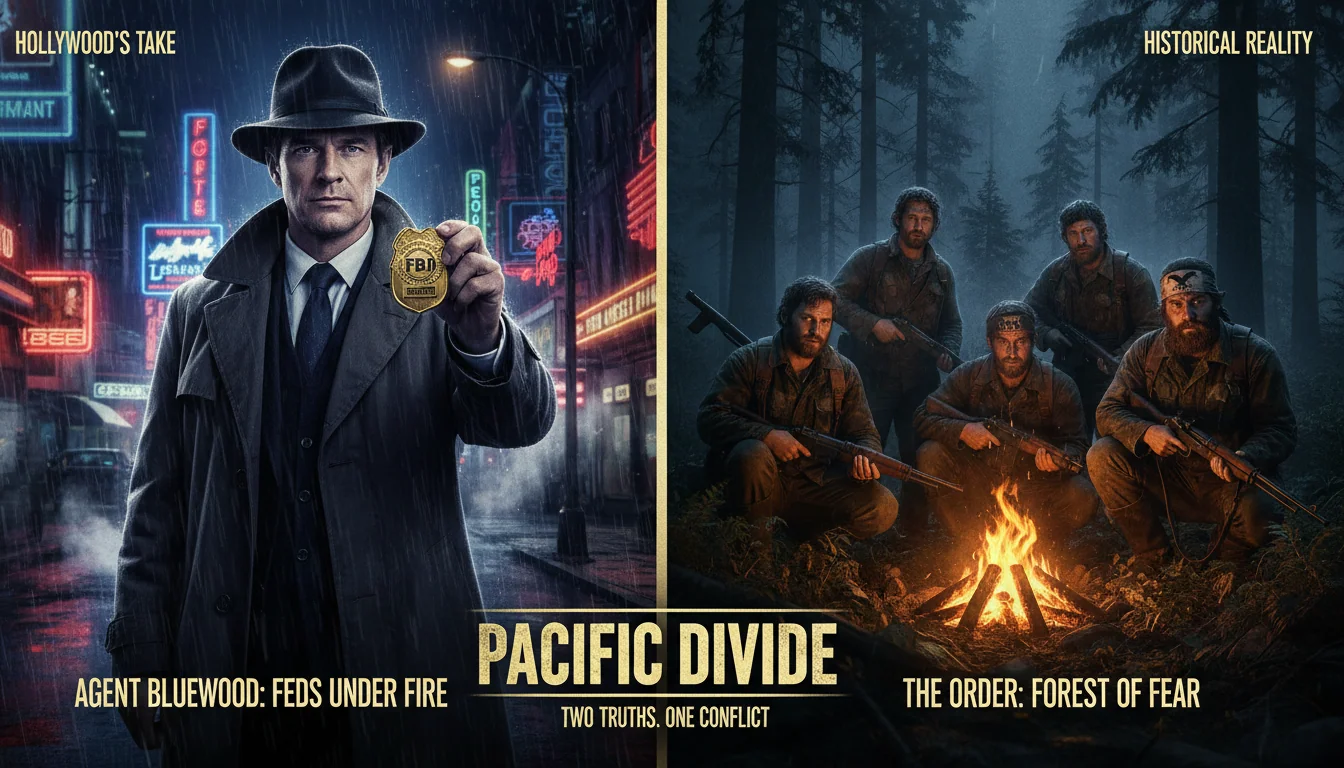
By the summer of 1984, a small cell of white supremacist extremists operating out of the American Northwest had committed more than a dozen armed robberies, funded a network of far-right organizations across the country, and assassinated a prominent Jewish radio personality in his own driveway. The FBI, still primarily organized around foreign espionage and traditional organized crime, had largely failed to notice until the body count was already climbing.
The Order, the 2024 Netflix thriller directed by Justin Kurzel, brings this story to a wide audience for the first time. The Order 2024 accuracy question is worth examining carefully, because the real history is stranger than anything invented for it. Jude Law plays an FBI agent drawn into the investigation of a violent white nationalist cell led by a charismatic ideologue played by Nicholas Hoult. The film is tight, atmospheric, and unnerving in the right ways. It is also the kind of film whose true story is worth tracing, because the reality is stranger than anything a screenwriter invented.
What Hollywood Got RIGHT
The Order was real, and its crimes were real
The organization at the center of the film, known historically as The Order or the Bruder Schweigen (German for "Silent Brotherhood"), was founded in Metaline Falls, Washington, in 1983 by Robert Jay Mathews. It was a small, disciplined cell united by a virulently antisemitic and white-nationalist ideology, many members influenced by William Luther Pierce's 1978 novel The Turner Diaries, which describes a violent overthrow of the U.S. government.
The group began with counterfeiting, graduated to bank robbery, and by June 1984 had executed an armored car heist near Ukiah, California, that netted approximately $3.6 million - at the time the largest armored car robbery in American history. The film captures this escalating arc accurately: these were not random criminals. They had a doctrine, a chain of command, and a plan to use the money to fund a race war.
The murder of Alan Berg
On June 18, 1984, Alan Berg, a Jewish talk radio host known in Denver for baiting far-right callers and refusing to let them retreat from their positions, was shot to death in the driveway of his home. Members of The Order carried out the killing. Berg's murder is one of the film's central events, and the portrayal - a targeted assassination, not a robbery gone wrong - matches the documented record. The killers considered Berg a symbol of Jewish influence on American media, and the killing was planned and deliberate.
Several Order members were eventually convicted for their roles. One of them, David Lane, later became one of the most-cited figures in white nationalist circles, known for a slogan still circulating in extremist spaces decades after his death in federal prison in 2007.
The Whidbey Island standoff
Robert Mathews was tracked by the FBI to a house on Whidbey Island, Washington, in December 1984, following the unraveling of the group through an informant and physical evidence left at a robbery scene. A two-day standoff ended when the house caught fire and Mathews refused to surrender. He was 31 years old. The cause of the fire - whether from FBI illumination flares, from Mathews himself, or from the substantial ammunition stockpile in the building - has been disputed ever since.
The film's climactic confrontation draws on this event and preserves the ambiguity. Mathews is not presented as a simple monster but as a true believer who saw no path that did not end in the fire, which is consistent with what those who knew him described.
The FBI's jurisdictional confusion
One of the film's more understated accuracies is its portrait of an FBI still structured around Cold War assumptions encountering a domestic threat it lacked the conceptual vocabulary to name. Agents in the film argue about who owns the investigation, what charges apply, and how to classify what they are looking at. This friction is historically documented. The domestic terrorism infrastructure the United States now takes for granted did not exist in 1984, and the FBI's response to The Order was improvised in real time.
What Hollywood Got WRONG
The FBI agent is a composite
Jude Law's character is not directly based on any single historical figure. The primary real-world investigator was Special Agent Wayne Manis, who ran much of the FBI's operational response to The Order. The film's agent is given different personal circumstances, a different emotional trajectory, and a different relationship to the investigation. Some elements may reflect Manis's experience; others are clearly invented to give the film a protagonist with narrative arc.
The group's scale is compressed
The historical Order, at its peak, had approximately 23 core members and a considerably wider circle of associates and donors. The film, for narrative efficiency, presents the organization as smaller and more intimate than it actually was. The money raised in the Ukiah robbery was distributed to far-right organizations across the country - the National Alliance, Aryan Nations, and others - in amounts the film does not fully account for. The broader network was the real objective; the film focuses on the center at the expense of the periphery.
The Turner Diaries connection is muted
The Turner Diaries, the novel that Mathews and many Order members treated as an operational blueprint, appears only obliquely in the film. Its central role - its status as the actual script for what the group was trying to do - is underplayed. The book also directly inspired the 1995 Oklahoma City bombing carried out by Timothy McVeigh, who had pages of it on his person when arrested. The film stops short of making this lineage fully visible, which lets the ideology feel more improvised and less systematic than the historical record indicates.
The timeline feels compressed
The Order's operational period ran from 1983 through late 1984. The film's pacing implies a tighter window, which suits thriller structure but slightly misrepresents how long the group operated before the FBI understood what it was dealing with. More than a year passed between the organization's founding and Mathews' death, during which time it carried out robberies across multiple states, produced counterfeit currency, and moved millions of dollars to allied organizations largely undetected. The FBI's investigation only gained real traction after a member was arrested in connection with a counterfeiting charge and began cooperating.
Historical Accuracy Score: 7.5/10
The Order gets the essential facts right. The crimes happened, the ideology was real, Alan Berg died exactly as depicted, and Mathews died in a fire rather than surrender. Kurzel does not glamorize the group or soften its motivations - the film presents white nationalist violence as what it was: planned, ideological, and coldly deliberate.
What the film gets most right: the texture of the group's belief system, the authentic character of its violence, and the institutional slowness of the federal response.
What it gets most wrong: the compression of the organization's actual scale and the muted handling of The Turner Diaries as the ideological engine behind everything the group did.
It is a solid dramatization of a seriously underreported chapter of American domestic extremism. The story it tells is true enough, and specific enough about who these people were and what they believed, that the fiction is uncomfortable in the right places. For the FBI procedural films that bracket this era, see our fact-checks on Public Enemies and The Untouchables.
Quick Answers
Common questions about this topic
Is The Order (2024) based on a true story?
Yes. The Order is based on the real domestic terrorist organization known as The Order or the Silent Brotherhood (Bruder Schweigen), founded by Robert Jay Mathews in 1983. The group carried out a series of armored car robberies and assassinated Jewish radio host Alan Berg in 1984. The film draws primarily from Kevin Flynn and Gary Gerhardt's 1989 book The Silent Brotherhood.
Who was Robert Jay Mathews?
Robert Jay Mathews was a white supremacist from Metaline Falls, Washington, who founded The Order in 1983. He led the group through a series of robberies, including an armored car heist netting approximately $3.6 million near Ukiah, California. He died in a fire on Whidbey Island, Washington in December 1984 after a two-day FBI standoff.
Did The Order really kill Alan Berg?
Yes. Denver radio talk show host Alan Berg, known for confrontational interviews with far-right callers, was shot to death in the driveway of his home on June 18, 1984. Members of The Order were convicted for the murder. Berg's killing is a central event in the film.
What happened to The Order members after Mathews died?
Following Mathews' death in December 1984 and the unraveling of the group through FBI infiltration, most senior members were arrested. Several were convicted on racketeering charges under the RICO statute and received lengthy sentences. Some served their time and were released; others died in federal custody.

Debate the Accuracy with the Real Figures
Ask the real people what Hollywood got wrong about their lives.
Create your free account →No card required. Talk to anyone in history with 8 free credits a day. Some features require a paid plan.
Join the HistorIQly Club
Get smarter about the past.
Weekly stories, deep dives, and exclusive content straight to your inbox.