A Time Traveler's Guide to Belle Epoque Buenos Aires, 1900
Belle epoque Buenos Aires in 1900: tango is being born in tenement courtyards, immigrants are flooding the port, and Argentina believes it will be a world power.
Read Wikipedia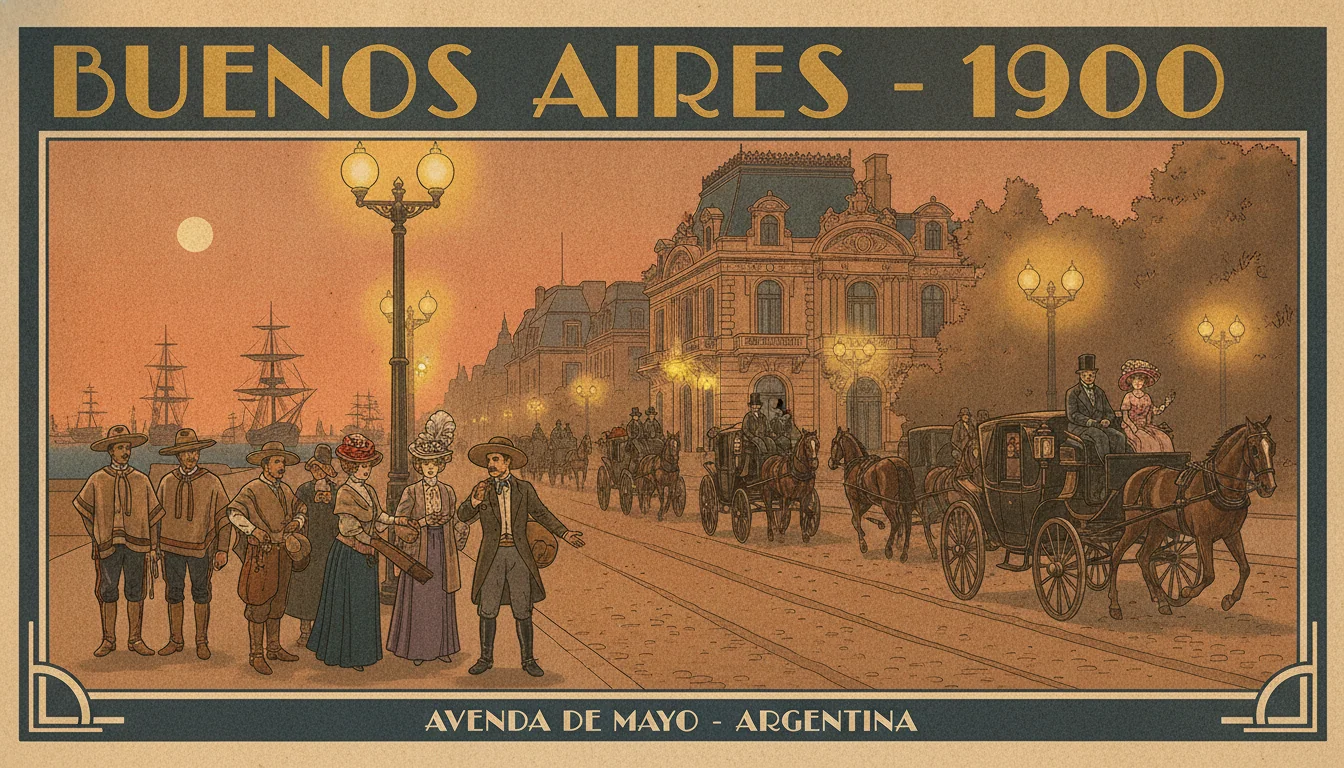
Step off the steamship at the port of Buenos Aires in the year 1900 and the first thing you notice is the noise. Then the smell. Then the sheer variety of languages being shouted in every direction simultaneously. A city that barely existed sixty years ago is now one of the fastest-growing in the world, and it is doing absolutely nothing quietly.
Buenos Aires in 1900 has a population of roughly 800,000 people and is adding to that number every week. The steamship that brought you here is one of dozens making regular runs from Genoa, Barcelona, Lisbon, and Hamburg, offloading immigrants onto a customs pier that cannot process them quickly enough. Argentina has just emerged from the financial crisis of the early 1890s and has recovered into something close to triumphant prosperity. Beef, wheat, wool, and leather are flowing through the port in volumes that are making certain men here very rich. Some of those men are building mansions in Palermo. Some are funding the construction of the Teatro Colon, which is not yet finished. Almost all of them are acquiring French things.
Before you leave the waterfront, get your bearings: you are in one of the most cosmopolitan cities in the Southern Hemisphere, dressed in European clothes, carrying money that the local exchange will accept at competitive rates, and about to walk into a city that genuinely believes it will be, within a generation, one of the great capitals of the world. In 1900, the evidence supports the belief.
What kind of city you are entering
Buenos Aires in 1900 is not colonial in any sense that still carries cultural weight. Independence has been secure for nearly a century, and the generation that romanticized the wars of liberation has been replaced by one that reads French newspapers and argues about Italian opera.
The city is physically in the middle of reconstruction. The wide central boulevard known as Avenida de Mayo, modeled directly on the Avenue de l'Opera in Paris, opened in 1894 and is still the social spine of the city. Walking it from the Casa Rosada at the east end to the Congress building at the west takes you through outdoor cafes, newspaper kiosks, tobacco vendors, and street-level commerce that indicates a city with money and nowhere quiet to put it.
The urban core is dense, European, and anxious to demonstrate its European credentials. The outer neighborhoods are less polished and more interesting. La Boca, near the port, is Italian in everything except geography. You will hear Genoese dialect, smell cod and chimichurri in roughly equal measure, and see houses painted in the bright mismatched colors that Genoese immigrants brought from home - the paint sourced, according to local legend, from leftover boat supplies. The tango is being born in La Boca and in the conventillo tenement courtyards nearby, emerging from a collision of African-Argentine milonga rhythms, Cuban habanera, and Italian melodic influence. It is currently considered scandalous. Do not mention it to anyone of social standing unless you want a very short conversation.
Your cover story
Your safest identity in Buenos Aires in 1900 is a European traveler attending to some aspect of the beef or wheat export business, or a journalist from a Spanish or Italian paper researching the Argentine immigration boom. Either story explains your money, your accent, and your foreignness without requiring you to navigate Argentine internal politics.
Do not claim to be British unless you are prepared to be immediately absorbed into a dense network of British commercial families who have been operating here since the 1840s. The British effectively run most of the railways, control significant portions of the banking and utility sector, and have formed social clubs that function as small transplanted suburbs of London. They will expect you to know people they know. If you cannot produce the right names, you will be viewed with polite suspicion for the rest of your stay.
Claiming Italian origin is straightforwardly reliable. One third of the city's population is Italian-born, and the community is too numerous and varied to subject any newcomer to detailed social interrogation. You can be from Milan or from Calabria; both are well represented and neither will trigger excessive scrutiny.
If you speak Spanish and claim to be from Spain, be prepared to have opinions about 1898. Spain lost Cuba and the Philippines to the United States two years ago, and the Argentine Spanish community, which is substantial, has feelings about this. Listen before you speak.
Getting around
Buenos Aires in 1900 has a functioning tram network with electric lines running through the central city. Take the tram along Avenida Corrientes to reach the theatre district. Take it south toward La Boca if you want to see the port neighborhoods at close range. For longer distances, hire a horse-drawn carriage from the ranks outside the large hotels on the Avenida de Mayo.
The streets of the city center are paved and maintained reasonably well. Beyond the central grid, conditions deteriorate. Mud is a constant presence during the rainy months - roughly April through October - and the outer neighborhoods sit on clay soil that becomes treacherous after rain. Bring boots heavier than you think you need. The areas beyond the city's infrastructure are unsafe at night.
Three things you must see
The port at dawn
Stand on the customs pier in the early morning and watch the immigration processing. Ships arrive with hundreds of passengers who have been at sea two to three weeks from Southern Europe. Processing agents work through names, nationalities, and occupations in multiple languages. The people stepping off those ships are predominantly young, predominantly Italian or Spanish, and a large proportion of them do not yet speak Spanish. They are looking for something in a city that is still deciding what it will be. This is what a continental civilization looks like when it is in the middle of assembling itself.
Avenida de Mayo at night
After 9 p.m., when the heat of the day has broken and the electric streetlights have come on, the boulevard becomes the social center of the city. Families walk, cafes are full, newspaper offices sell their evening editions at street kiosks, and the pavement is more crowded than it was at noon. The Cafe Tortoni, which has been operating on this street since 1858, is the correct place to drink coffee and observe the spectacle. Order a cafe con leche. Sit in the front room, not the back. The back room fills later with intellectuals who will argue until midnight.
Recoleta
Walk north of the center to see where Buenos Aires has put its money. The mansions of Recoleta are French Second Empire in style, recently built, and extravagantly maintained. The families who own them made their fortunes in cattle, land, and government contracts. The Recoleta Cemetery is worth an hour: a city of elaborate above-ground marble tombs and ornamental ironwork, one of the most distinctive civic spaces in South America.
Food, drink, and the social rules around both
Buenos Aires in 1900 already has a very strong opinion about beef. The parrilla, the charcoal grill that has become the national cooking method, is in its confident prime. Order a bife de chorizo or a costilla at any restaurant with an open kitchen. The quality is not the result of luck - Argentina's cattle industry is in its golden age, the animals are grass-fed and abundant, and the beef is genuinely excellent at every price level.
Wine is plentiful and inexpensive, primarily red wines from the Mendoza region. Do not drink the tap water unless it comes from a sealed vessel. The city's supply has improved considerably since the cholera outbreaks of the 1880s, but it is not reliable enough for a visitor's immune system. Stick to bottled mineral water, wine, and properly brewed coffee and tea.
Accept yerba mate when it is offered. It will be offered. In working-class neighborhoods and in any home where you are a guest, declining mate is a social slight. The correct procedure is to hold the gourd firmly, drink all the liquid through the metal straw in a single pass without moving the straw, and hand it back. Do not thank the host between rounds - that signals you are finished. If you are not finished, say nothing and wait.
Politics, and what not to say about them
Do not offer opinions on Argentine internal politics. The country has recently emerged from years of political instability and financial crisis, and the factional divisions of the 1890s have not fully healed. The current president, Julio Argentino Roca, is in his second term. Opinions about Roca run from reverence to contempt, and the specific source of the contempt - his military campaigns against indigenous populations in Patagonia during the early 1880s, called the Conquest of the Desert - is a subject on which your hosts will have arranged positions long before you arrived. You will not have enough local context to navigate this correctly. Listen, express interest, and avoid commitment.
What you are actually watching
Buenos Aires in 1900 is at a particular historical moment that its residents cannot know is temporary. The wealth is real but it is built on commodity prices and British capital that will not remain at 1900 levels indefinitely. The immigration boom will produce, within two decades, a labor movement powerful enough to close the port and unsettle the ruling class. The elegant French-style buildings going up in Recoleta will outlast the confidence that funded them.
For roughly ten years on either side of 1900, though, Buenos Aires is one of the most genuinely dynamic cities on the planet: loud, fast, multilingual, wealthy, and completely convinced of its own future. For a traveler who can handle the mud, the noise, and the mate, there are worse places to be.
If you find yourself wanting to compare notes on Belle Epoque Buenos Aires against other cities at their confident peak, see A Time Traveler's Guide to Belle Epoque Paris, 1900 and A Time Traveler's Guide to 1920s Paris, where the same optimism had returned after the catastrophe of the war.
Quick Answers
Common questions about this topic
What was Buenos Aires like in 1900?
Buenos Aires in 1900 was one of the wealthiest and fastest-growing cities in the Western Hemisphere, with a population of around 800,000 and rising sharply due to mass European immigration. The city was constructing Haussmann-style boulevards, grand theatres, and European-style cafes. It was, in the phrase of the time, the Paris of South America - and the comparison was not entirely promotional.
Was tango already popular in 1900?
Tango was just emerging from the conventillo tenement courtyards, port bars, and working-class neighborhoods of Buenos Aires and Montevideo around 1900. It was considered disreputable and was strongly associated with immigrant working-class culture, particularly Italian and African-Argentine influences. It did not become socially respectable or travel to Europe until after 1910.
Was Argentina really one of the richest countries in the world in 1900?
By most economic measures, yes. Argentina in 1900 had one of the highest GDP per capita figures in the world, driven by beef, wheat, and hide exports through the port of Buenos Aires. The phrase 'rich as an Argentine' circulated in European cities. The country's wealth supported a massive public building program and attracted enormous flows of European immigration, particularly from Italy and Spain.
What languages would you hear in Buenos Aires in 1900?
Spanish is the official language, but in 1900 you would also hear Italian in La Boca and several other neighborhoods - Italian-born residents outnumbered Spanish-born ones in parts of the city. French was the prestige language of the educated elite and the dominant foreign tongue in high-end shops and hotels. The Buenos Aires Spanish of 1900 already carried the Italian-inflected rhythm that distinguishes the Rioplatense accent today.

Need Advice from Someone Who Lived There?
Get firsthand accounts from people who actually lived through these moments in history.
Create your free account →No card required. Talk to anyone in history with 8 free credits a day. Some features require a paid plan.
Join the HistorIQly Club
Get smarter about the past.
Weekly stories, deep dives, and exclusive content straight to your inbox.