Time Traveler's Guide to Cold War Berlin, 1961
A cold war Berlin time travel guide for August 1961: when the Wall goes up overnight and the city splits forever. Essential reading before you cross Checkpoint Charlie.
Read Wikipedia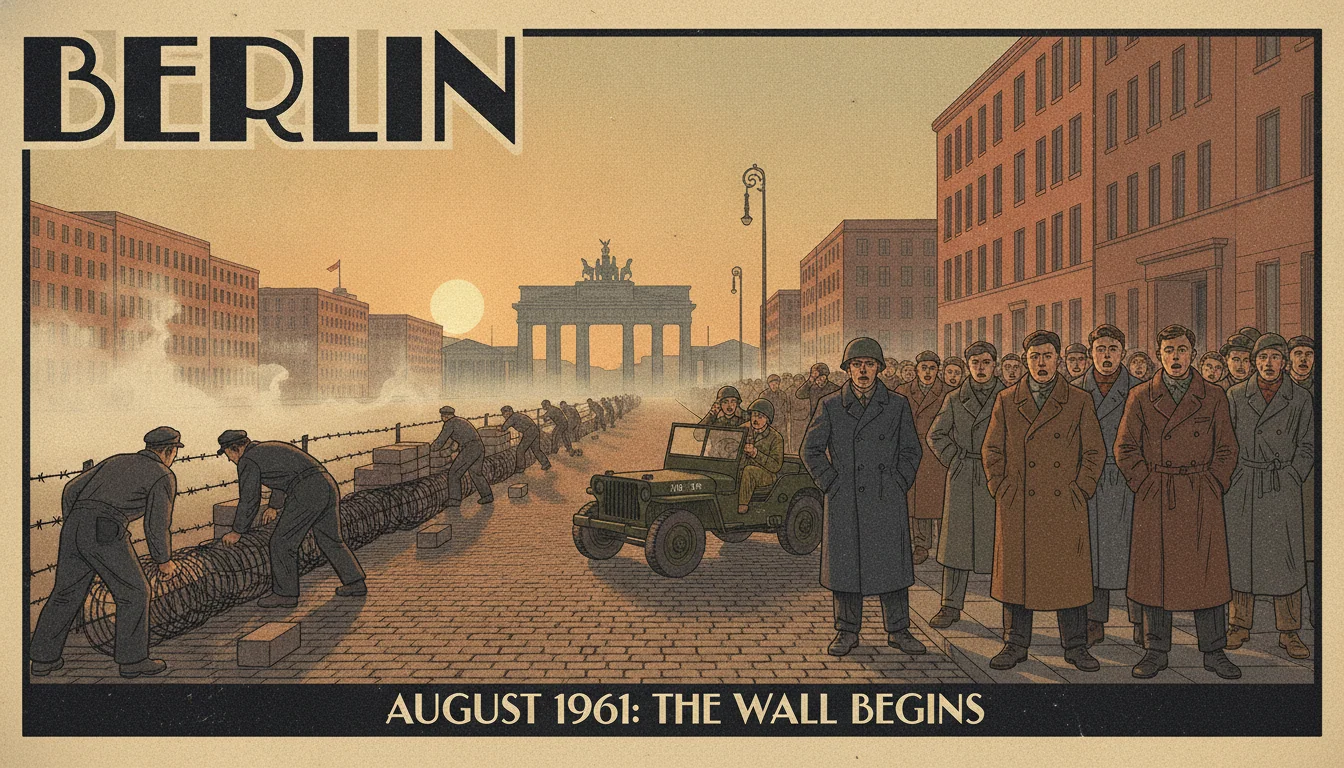
You have picked an interesting time to visit Berlin. The year is 1961, which means you are either very early or very late, depending on which side of August 13 you arrive.
Before that date, Berlin is a wounded city but a functioning one. The four-power occupation arrangement - American, British, and French sectors in the West, Soviet in the East - has held since 1945, and despite sixteen years of tension, a citizen can still board a U-Bahn train in East Berlin and emerge in the West. This is the safety valve that has allowed East Germany to tolerate Communism without mass revolt. Roughly three and a half million people have used it to leave since the war ended.
After August 13, the valve closes. The concrete blocks go up overnight. The barbed wire follows. Within weeks, the Wall becomes real, permanent, and lethal.
Time your visit carefully.
Getting in
If you are arriving in West Berlin, you will fly into Tempelhof Airport, one of the great monuments of 1930s modernist ambition and Nazi architectural overreach. The terminal building was designed in the shape of a spread eagle, which is either impressive or appalling depending on your view of the decade it was built in. Tempelhof has a special place in Berliner mythology: it was where the Allied airlift landed during the Soviet blockade of 1948-49, and the local people still speak of it with the particular warmth reserved for things that saved their lives.
Arriving by rail is more complicated. West Berlin is an island inside East German territory, and trains cross the border with all the theatre that Ulbricht's regime can muster. Your documents will be inspected several times. Do not joke with the border guards. They do not have a sense of humor, or if they do, they have been professionally trained to suppress it.
If you are crossing into East Berlin from the West, Checkpoint Charlie on Friedrichstrasse is your point of entry. American and Allied military personnel use it. Civilians and tourists use it too, in daylight hours, with the correct documentation. A guard will examine your passport with the specific expression of a man who suspects you are not who you claim to be but cannot yet prove it. This is standard. It is not personal. Smile modestly and do not volunteer information.
West Berlin: the implausible city
The first thing that strikes visitors about West Berlin in 1961 is how aggressively alive it is. The logic of a half-city surrounded by hostile territory should produce paralysis. Instead it has produced something closer to the opposite: a concentrated energy, a sense that because anything could end at any moment, everything is being experienced at full volume.
The Kurfurstendamm - Ku'damm to anyone who lives here - is the main commercial street of West Berlin, and it is conspicuously prosperous in a way that is partly genuine and partly deliberate. West Berlin is a showroom for capitalism, heavily subsidized by the Federal Republic in Bonn and by the Americans, who understand that a drab West Berlin would be excellent propaganda for the other side. The shops are stocked, the cafes are full, and the jazz clubs on the side streets stay open until hours that would constitute a public morality crisis in the East.
The American military presence is visible and, to some Berliners, reassuring - to others, merely an indication of how precarious their situation actually is. GIs in uniform move through the streets. The Stars and Stripes flies over Clay Headquarters in Zehlendorf. General Lucius Clay, who oversaw the airlift in 1948, returns as Kennedy's personal representative in 1961 and his presence is both symbolic and genuinely stabilizing.
The cultural life of West Berlin in 1961 is extraordinary and slightly feverish. Artists, musicians, and writers are drawn here precisely because the city is expensive to leave - Berliners receive tax advantages to stay - and because the pressure of the situation produces a kind of creative urgency. The Berlin Philharmonic under Herbert von Karajan is the finest orchestra in the world, or at least one of two or three reasonable candidates for the title.
Accommodation is not difficult to arrange. Hotels in the western sectors range from the grand to the adequate. Avoid discussing politics with strangers until you understand who you are talking to. This is not paranoia; it is appropriate situational awareness for a city where the Stasi runs informants on the West side as well as the East.
East Berlin: the other city
Crossing into East Berlin at Checkpoint Charlie requires patience, paperwork, and a willingness to be searched if the guards feel like it. What you find on the other side is not what the propaganda promised.
East Berlin is the official capital of the German Democratic Republic, and it has been rebuilt since the war with a specific political aesthetic: wide ceremonial boulevards, Stalinist monumental architecture, and enormous photographs of Party functionaries at intervals that ensure you do not forget who is in charge. Stalinallee - soon to be renamed Karl-Marx-Allee after the de-Stalinization that followed Khrushchev's 1956 speech - is impressive in the way that all authoritarian architecture is impressive, which is to say it is impressive and deeply unpleasant.
The shortages are real. Goods that are casually available on the Ku'damm - coffee, certain foods, quality clothing - require connections, coupons, or queuing in East Berlin. The Soviet-style planned economy produces particular absurdities: a city block may have no sugar on a Tuesday and surplus turnips on a Wednesday. Locals have developed a complex informal economy of exchange and substitution.
The Stasi - the Ministerium fur Staatssicherheit, the Ministry for State Security - operates at a density that has no real equivalent in any other police state of the era. Roughly one in sixty East German adults will become, at some point, an informant. Your hotel staff may be among them. Your fellow visitors to the Berliner Dom may be. This is not atmosphere; it is documented post-1989 fact. Do not say anything in East Berlin that you would not say in front of the people responsible for saying it.
August 13 and after
If you have timed your visit to be present on the night of August 12-13, 1961, you will experience one of the defining moments of the Cold War in real time. The decision to seal the border was made at a Warsaw Pact meeting in early August. East German soldiers and workers begin stringing barbed wire and placing concrete blocks in the pre-dawn hours of Sunday, August 13.
The Western powers respond with protests, diplomatic notes, and carefully restrained military movements. They do not knock the Wall down. They have implicitly accepted, since 1945, that East Berlin is the Soviet sphere and that military intervention over a border sealing would risk a war that nobody wants. Mayor Willy Brandt of West Berlin, furious and barely containable, demands stronger action. He does not get it.
Within days the barbed wire is supplemented by concrete. Within weeks the first version of the Wall is solid enough to require serious effort to breach. East German border guards - the Grenztruppen - are given shoot-to-kill orders for anyone attempting to cross without authorization.
The first deaths at the Wall begin almost immediately.
Practical survival notes
If you are in West Berlin, your dollars or Deutsche Marks are good everywhere. Tip your cafe waiter in the American style; they appreciate it and the city is full of Americans. Do not flash currency in East Berlin; the exchange rate games are technically illegal and practically unavoidable, and the wrong transaction with the wrong person will have consequences.
Dress conservatively in East Berlin. Standing out is not in your interest. A Western-style raincoat is fine. A fur coat and statement handbag will attract attention you do not want.
The food on the Western side is genuinely good. Berlin has a long tradition of hearty Central European cooking - Eisbein (braised pork knuckle), Currywurst (a post-war invention, the split sausage with curried tomato sauce, already iconic in 1961), Berliner Weisse beer with a shot of raspberry syrup. The food in the East is also fine, simply harder to obtain in variety.
The U-Bahn in West Berlin runs efficiently. Some stations pass under East Berlin territory and do not stop - ghost stations, sealed off, with East German guards visible on the platforms for exactly this kind of transit. The visual is arresting and melancholy and entirely real.
Why this city, this year
Berlin in 1961 is the physical manifestation of an argument about how human beings should organize themselves, conducted at temperature by two nuclear-armed superpowers through the medium of one divided city. It is exhausting, exhilarating, and deeply strange.
The Wall that goes up in August 1961 will stand for 28 years. The city will live inside that division, adapt to it, build a culture around it, and then one November night in 1989 watch it come down to the sound of hammers and crowds whose disbelief has tipped over into joy.
In 1961, that ending is invisible from where you stand. What is visible is the city itself: both halves of it, each convincing itself that the other will eventually come around.
They are both partially right. They are both going to wait a long time to find out.
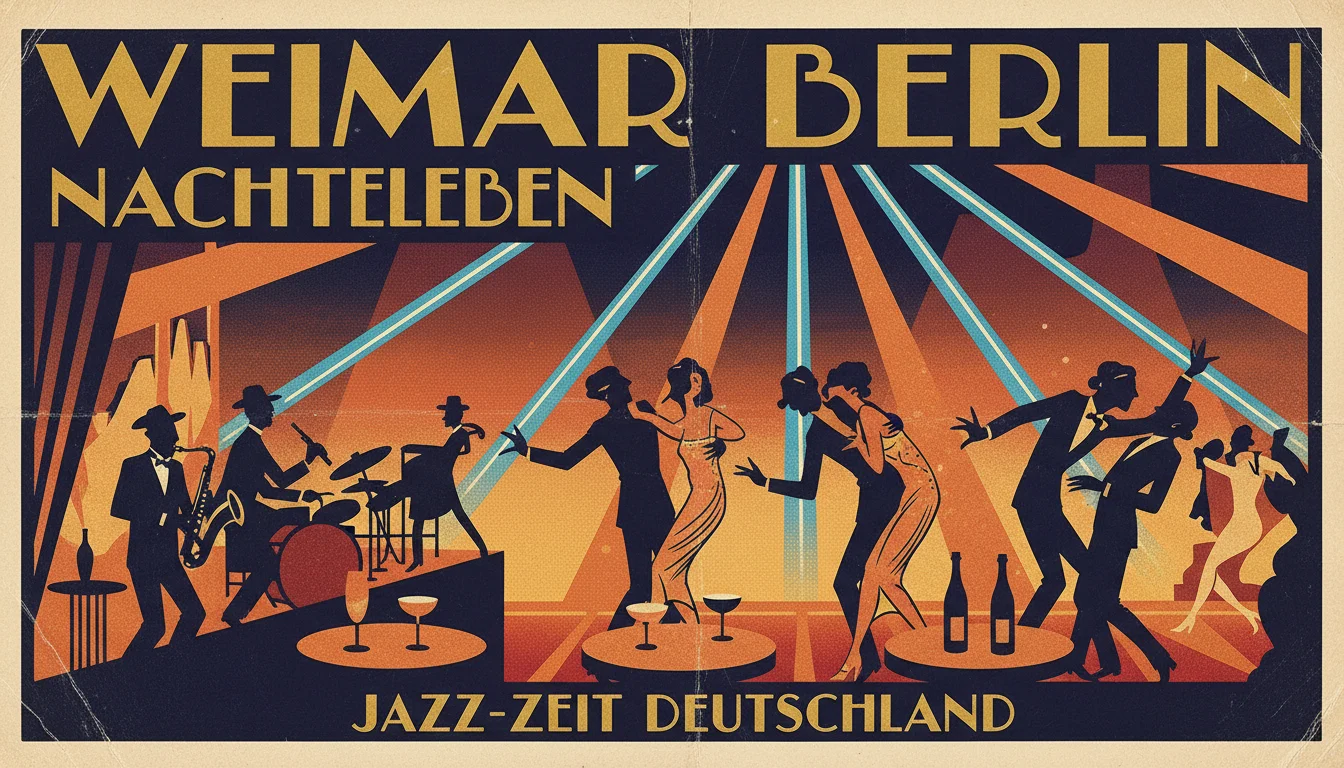
If you want to understand how the city got to this point, see our time traveler's guide to Weimar Berlin, 1929 - the republic that ended and made the Wall possible. For the other side of the Iron Curtain's grip on a European capital, our guide to Stalinist Moscow, 1937 shows the system Berlin was now formally divided against.
Quick Answers
Common questions about this topic
Why was 1961 such a pivotal year in Berlin?
On August 13, 1961, the East German government began constructing the Berlin Wall, sealing off West Berlin from East Germany overnight. Before that date, East Germans could still cross into the Western sectors; after it, the border became lethal. The Wall transformed a divided city into a geopolitical flashpoint that defined the Cold War for the next 28 years.
How dangerous was Berlin in 1961?
West Berlin was technically safe for Western visitors but surrounded on all sides by East Germany, creating a bizarre island of Western life 100 miles inside the Eastern Bloc. East Berlin was accessible to Western visitors via Checkpoint Charlie but under constant Stasi surveillance. Border crossings were bureaucratically complicated and occasionally physically risky if anything went wrong.
What currency did you need in 1961 Berlin?
West Berlin used the West German Deutsche Mark, which was widely supplemented by US dollars among Allied military personnel and tourists. East Berlin officially used the East German Mark (Ostmark), officially set at parity with the West German Mark but worth far less on any realistic exchange. Currency smuggling was common and criminal. Western visitors were required to exchange a minimum amount of West Marks for Ostmarks when entering the East.
What was Checkpoint Charlie?
Checkpoint Charlie was the crossing point on Friedrichstrasse in central Berlin designated for Allied military personnel and foreign civilians passing between West and East Berlin. It became the most photographed border crossing in the world. The famous confrontation between American and Soviet tanks occurred there in October 1961, two months after the Wall went up.

Need Advice from Someone Who Lived There?
Get firsthand accounts from people who actually lived through these moments in history.
Create your free account →No card required. Talk to anyone in history with 8 free credits a day. Some features require a paid plan.
Join the HistorIQly Club
Get smarter about the past.
Weekly stories, deep dives, and exclusive content straight to your inbox.