A Time Traveler's Guide to Cairo, 1925
Cairo 1925 history: three years after nominal independence, the city blends European boulevards, medieval souks, Tutankhamun fever, and fierce nationalist politics.
Read Wikipedia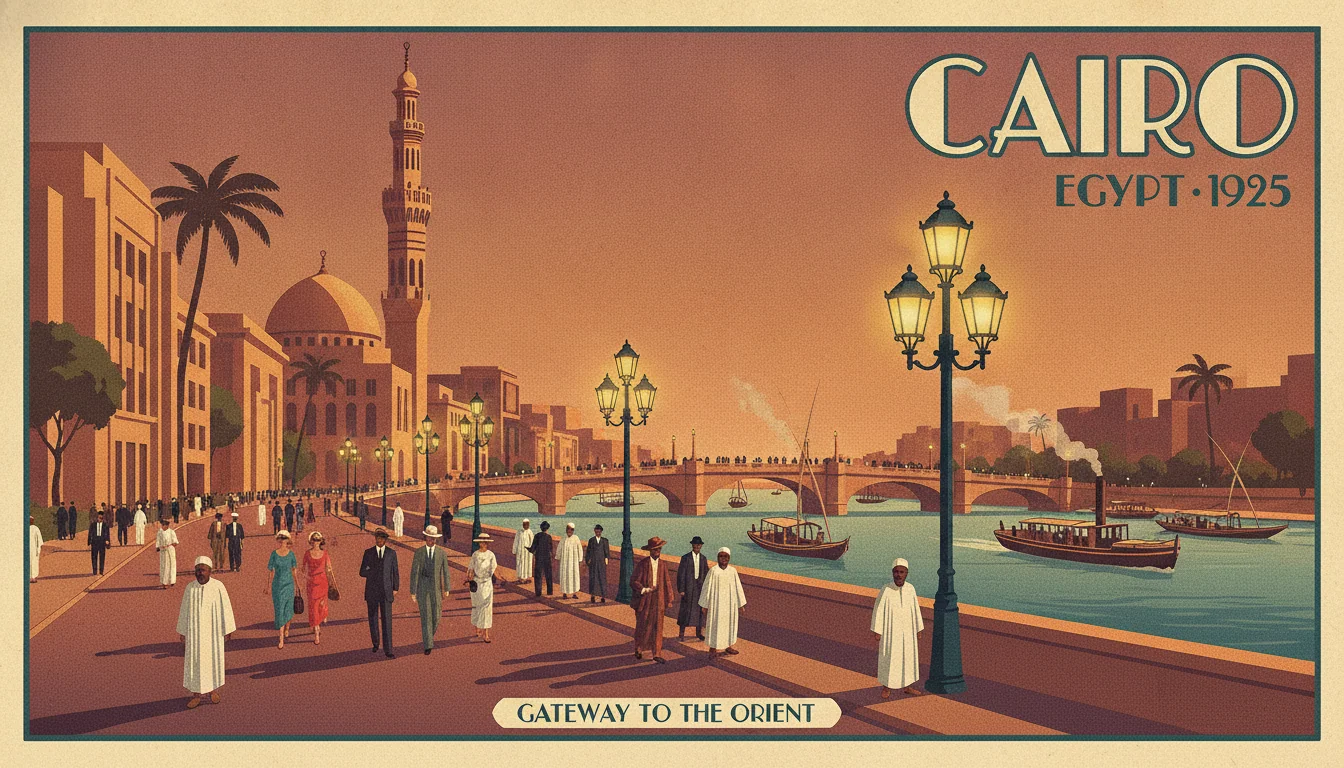
Cairo in 1925 is not a museum. It has never been less like a museum than it is right now. The city is mid-transformation: one quarter Art Nouveau hotels and European department stores, one quarter medieval Arab city that has been operating continuously since the 10th century, and the whole thing wrapped in a politics that is moving fast and carrying a great deal of anger with it.
Egypt has been technically independent for three years. Nobody on the streets fully believes it yet, and the British officers you will see in the lobby of Shepheard's Hotel are not there on holiday.
Cairo 1925 history shapes every aspect of your visit, from who greets you warmly to who regards you with the cool assessment reserved for the occupier's guests.
The good news: Cairo in 1925 is electric with it. The discovery of Tutankhamun's tomb three years ago has made the Nile the center of the world's imagination. Every European and American newspaper has a correspondent based here. The coffeehouse arguments are ferocious, the corniche is beautiful in the evening, and the food, if you know where to eat, is extraordinary.
Here is what you need to know before you arrive.
Understand the city you are entering
Cairo in 1925 is several cities layered over each other.
The first is the European city: Ismailia district, Gezira island, the wide boulevards built from the 1860s onward by Khedive Ismail, who wanted a Paris on the Nile. This is where the big hotels sit - Shepheard's on Ezbekiyya Gardens, the Continental-Savoy, the Semiramis on the Corniche - along with European banks, department stores, and the trams that run in regular routes along the main streets. The streets here are wide enough for motorcars, and there are quite a few of them.
The second is Islamic Cairo: the older city north and east of the European quarter, threading through medieval mosques, souks, and minarets that go back to the Fatimid period. Fatimid Cairo in 970 AD - this same city nearly a thousand years younger and newly founded - gives a sense of where this medieval quarter originated. This is where the Khan el-Khalili bazaar operates, where Al-Azhar University has been training Muslim scholars for nearly a thousand years, and where the streets narrow to a width that two loaded donkeys can barely pass.
The third is a political city that sits over both: nationalist Cairo, where the Wafd party meetings happen, where the Arabic-language press is printed, where the conversations about full independence from Britain are serious and urgent. You will not see this city easily as a foreign visitor. You will feel it in the way certain conversations stop when you enter a room.
Your cover
You want to be a foreign tourist connected to archaeology or journalism. Both are everywhere in 1925 and both are expected to be curious about everything.
If you speak English, you are assumed to be British by default, which is not entirely comfortable in a city that has reasons to resent the British. Claiming Swiss, American, or French nationality is easier. Americans are welcomed warmly in 1925: they have money, they are not the occupiers, and the Egyptian press has been following American popular culture with interest.
Carry a Thomas Cook guidebook. The Thomas Cook office on Ezbekiyya Square is an institution. Tourists with Cook's vouchers are immediately legible as a known type, which protects you from ambiguity.
Do not arrive without knowing approximately where you will stay. The major hotels fill quickly from October through April, which is the tourist season. In June you have more choice, but the heat means you will want an electric fan, and the better rooms on the Corniche side have a breeze.
Dress for a climate and a context
Cairo in summer is brutally hot: temperatures above 38 degrees Celsius are common from May to September. The European community wears light linen suits for men and loose cotton dresses with high collars for women. You will see Egyptian men in gallabiyyas in the street markets and a mixture of European and Ottoman-influenced dress among the educated middle class.
Do not wear shorts in public anywhere except the pool at the Gezira Sporting Club. Do not wear sleeveless garments in the Islamic quarter or near mosques. The dress standards of the city are in transition - younger Cairenes in the European quarter dress almost entirely in Western styles - but this is not universally true, and misreading where you are is easy.
Carry a hat at all times. The midday sun will disable you within an hour without one. A broad-brimmed straw hat is correct for daytime, a lighter felt hat for evening.
Three things you absolutely must do
The Egyptian Museum
The Egyptian Museum on Tahrir Square opened in 1902 and contains the most concentrated collection of pharaonic material in the world. In 1925, the Tutankhamun artifacts are arriving in batches from Luxor as Carter's excavation proceeds, and the curators are still finding room for them. The golden treasures you can see elsewhere only in photographs are beginning to accumulate in the rooms off the first floor.
Go early, before ten in the morning, when the heat is still manageable and the tour groups have not yet arrived. The predynastic and Old Kingdom galleries in the ground floor north wing are quieter than the Tutankhamun rooms and, in their own way, more unsettling. Statues that have been staring at the wall for four thousand years have a particular quality.
Khan el-Khalili at dusk
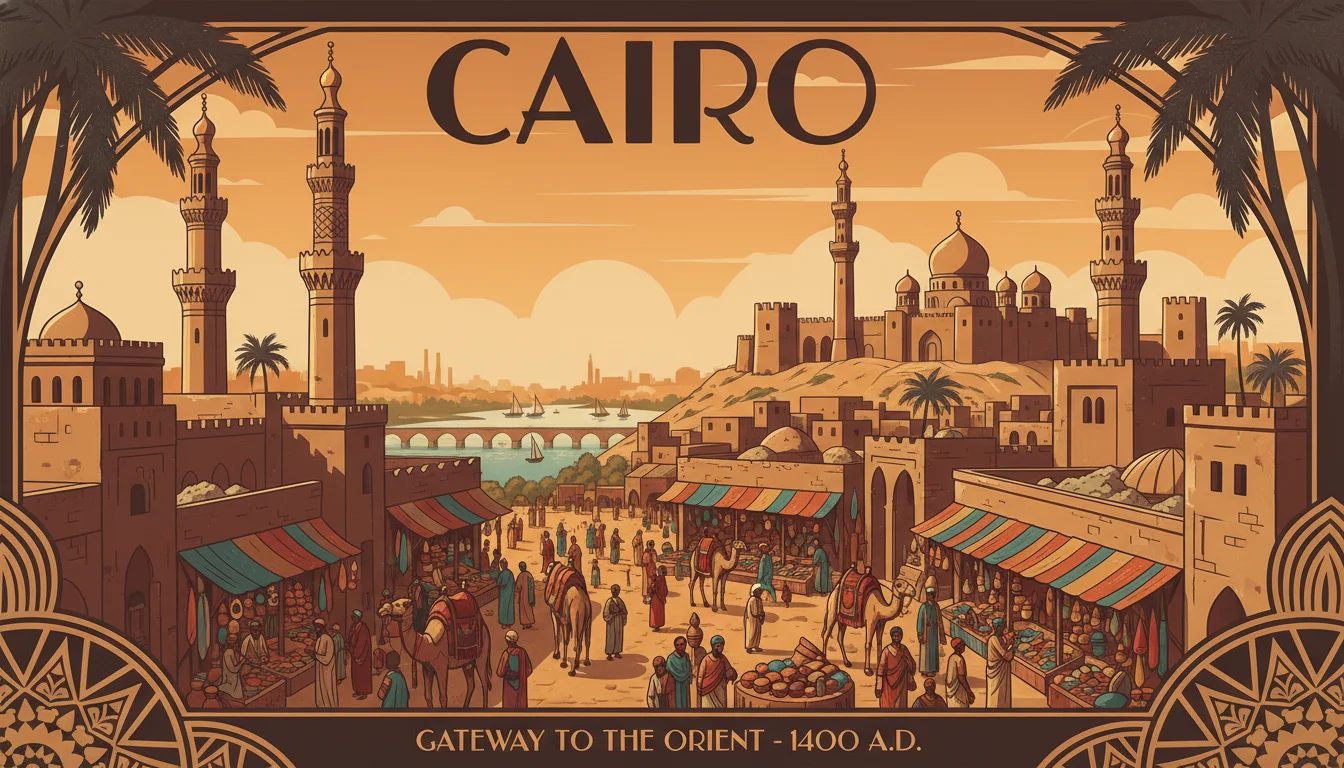
The Khan el-Khalili is one of the oldest continuously operating markets in the world, established in the late 14th century on the site of a Fatimid-era caravanserai. Mamluk Cairo at its 1400 peak - when the Khan's predecessor was newly built - shows the city at the height of the civilization that created what you are walking through. At dusk, when the worst of the heat has lifted, it becomes something genuinely extraordinary: lanterns in the alleyways, the smell of incense and spice, coppersmiths hammering at trays, textile sellers calling from their doorways, and a web of coffee-houses where men have been sitting and arguing since the Mamluk period.
Do not go alone on your first visit. Find a guide recommended by your hotel, pay the fee without haggling (you are paying for safety and orientation, not a commodity), and let them take you through the deeper lanes that tourists do not reach. The souvenir market near the main entrance is a performance. The market behind it is the real thing.
Do not buy antiquities from anyone in the bazaar, however authentic they look, however low the price. The Egyptian authorities are increasingly active on this, and you do not want to carry something across the border that becomes a problem.
The Nile at evening from Qasr al-Nil Bridge
The bridge connecting downtown Cairo to Gezira Island was completed in 1872 and still has its original Egyptian Revival stonework. At six in the evening, when the light on the Nile turns the water the color of hammered copper and the feluccas are coming in from their daytime runs, it is one of the most beautiful urban views in the world.
Stand on the bridge for thirty minutes. Watch the feluccas. Watch the corniche carriages. Watch the city do what it does at the end of the day. You are in a place where the Nile has been the organizing fact of civilization for six thousand years, and on a good evening at Qasr al-Nil you can feel the whole length of that fact pressing up through the stone under your feet.
What to eat and where
Cairo in 1925 has two entirely separate food worlds, and you should visit both.
The European world: Shepheard's famous Long Bar serves cold beer and passable European cooking. Groppis patisserie, which has been operating on what will later be called Talaat Harb Square since the early 1920s, serves the best pastries in Cairo and excellent coffee. The Gezira Sporting Club has a dining room where you can get a decent steak and escape the tourist track.
The Egyptian world: find a fuul stall on a side street in the morning and eat fuul medames, slow-cooked fava beans with olive oil and cumin, with fresh bread. Have koshary from a street counter at midday. In the evening, look for a restaurant in the streets off Al-Muizz that serves roasted pigeon and grilled vegetables. The pigeon is stuffed with rice and herbs and has been the street food of Cairo for centuries. You will not find it at Shepheard's.
Do not drink tap water. Do not eat food from stalls near the market drains. Typhoid and dysentery are real and relatively common. Stick to food that has been recently cooked over heat, or to places with obvious European clientele and therefore European-standard kitchens.
The politics you will bump into
Cairo's nationalist politics are not abstract in 1925. The Wafd party under Saad Zaghloul won the parliamentary elections of 1924 overwhelmingly, only to have Zaghloul resign under British pressure after the assassination of General Sir Lee Stack in November 1924. The incident poisoned Egyptian-British relations for years.
In 1925 the political temperature is high. Newspapers sell out daily with coverage of the parliamentary battles, the constitutional arguments, and the British presence. You will hear strong opinions expressed in cafes by men who have no reason to soften them for a foreign visitor.
Listen. Do not argue. The grievances you are hearing about are real and have been accumulating for decades. The correct response is interest, not debate. You are not responsible for the British government's decisions, and making that clear early in a conversation will get you considerably further than trying to defend or explain them.
Cairo in 1925 rewards the visitor who pays attention. It is beautiful, exhausting, politically alive, and operating on a frequency that is entirely its own. The pyramid plateau at Giza, visible on a clear morning from the roof of your hotel, has been there for four thousand five hundred years. The city arguing in the streets below it has been there, in one form or another, for most of that time. Both deserve your full attention.
Quick Answers
Common questions about this topic
What was Cairo like in 1925?
Cairo in 1925 was a genuinely cosmopolitan city navigating the early years of nominal Egyptian independence, declared in 1922. The city mixed European-style hotels, tramways, and department stores in the downtown quarter with the medieval labyrinth of Islamic Cairo. French was the language of the educated elite, English was the language of the British occupation, and Arabic was everyone else's. The discovery of Tutankhamun's tomb in 1922 had made the city the center of the world's attention.
Was Egypt independent in 1925?
Nominally yes. Britain declared Egyptian independence on February 28, 1922, and Ahmed Fuad became King Fuad I. In practice, Britain retained control over the Suez Canal Zone, foreign affairs, and the defense of Egypt. British troops remained. The Wafd nationalist party, led by Saad Zaghloul until his death in 1927, was the dominant political force pushing for full independence, which would not come until after World War II.
What was happening with Tutankhamun's tomb in 1925?
Howard Carter had discovered the antechamber of Tutankhamun's tomb in November 1922 and spent years carefully excavating its contents. In October 1925, Carter opened the innermost coffin and examined the pharaoh's mummy for the first time. The process was painstaking and slow: tourists and journalists descended on Luxor in enormous numbers throughout the 1920s hoping to see what Carter was uncovering.
Was Cairo safe for foreign visitors in 1925?
Reasonably so for Europeans in the tourist and hotel districts. The nationalist movement's energies were directed at political change rather than violence against foreign tourists, who were an important part of the economy. Petty theft, aggressive touts, and heat-related illness were the main practical hazards. The European quarter around Ezbekiyya Gardens was heavily policed and well-lit. Venturing alone into the older quarters of the city required more care.

Need Advice from Someone Who Lived There?
Get firsthand accounts from people who actually lived through these moments in history.
Create your free account →No card required. Some figures and features require a paid plan.
Join the HistorIQly Club
Get smarter about the past.
Weekly stories, deep dives, and exclusive content straight to your inbox.