Time Traveler's Guide to Qing Beijing, 1750
Your guide to Qing Beijing in 1750: the Qianlong Emperor's capital of one million people, organized by ethnicity, rank, and a hairstyle law that carried the death penalty.
Read Wikipedia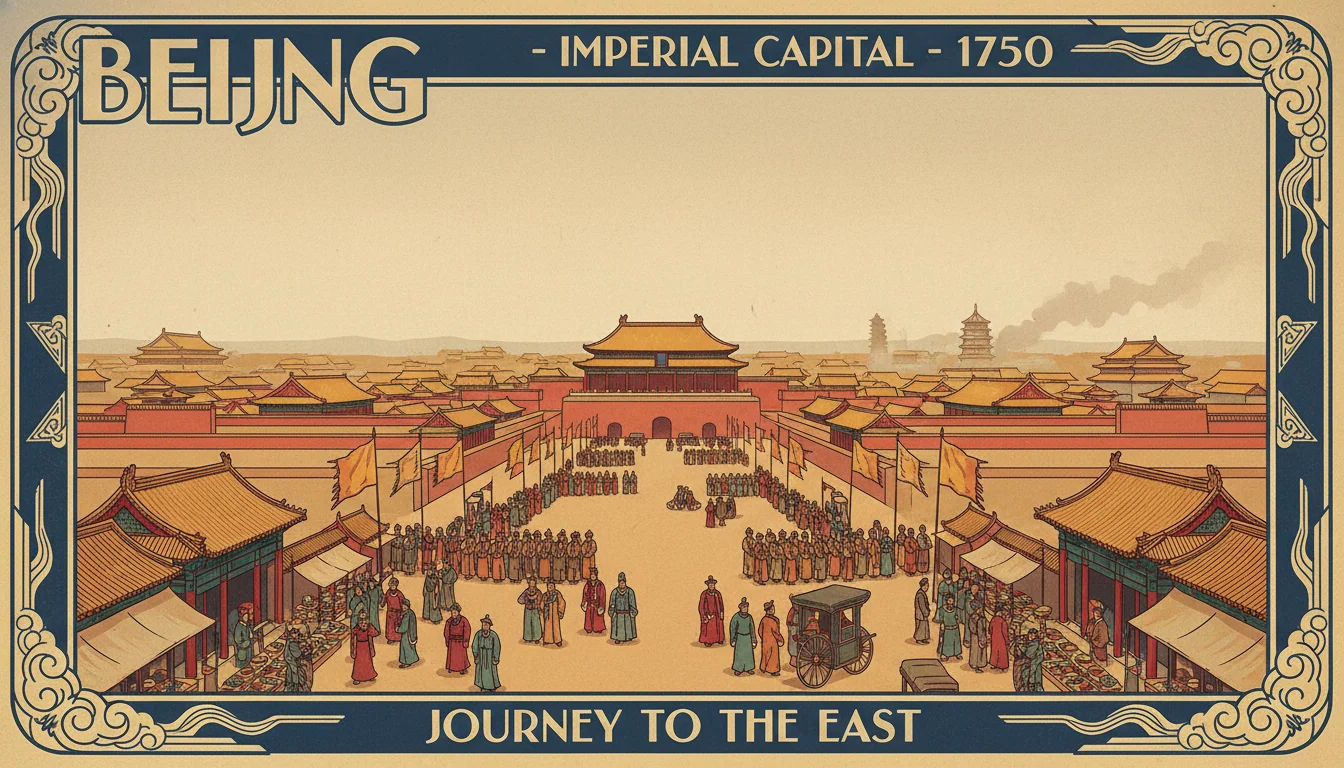
The Qianlong Emperor has been on the throne for fifteen years when you arrive, and the empire he governs is by most measures the largest, wealthiest, and most administratively sophisticated in the world. China in 1750 produces roughly a quarter to a third of global GDP. The capital, Beijing, holds somewhere between 700,000 and one million people, organized by an elaborate hierarchy of ethnicity, rank, and obligation that you will need to understand quickly if you intend to leave under your own power.
The first problem is your hair.
The queue
Qing law requires all Han Chinese men to shave the front portion of their head and braid the remaining hair into a long queue hanging down the back. This was imposed when the Manchu Qing conquered China in the 1640s and codified under the slogan "lose your hair, keep your head; keep your hair, lose your head." By 1750 it has been the law for a century, so virtually every Han man you see is wearing it. Manchu men wear a similar style naturally.
You are visibly not wearing it. Depending on your appearance and how quickly an official notices you, this will either be dismissed as a foreign barbarian's ignorance or treated as defiance of imperial law. The safest approach is to acquire a hat and keep it on. Hatlessness and hairlessness together are more conspicuous than either alone.
Manchu bannermen are the ethnic ruling class and have an unfortunately wide discretion in how they respond to perceived slights. You do not want one of them to decide you are making a statement.
Who runs what
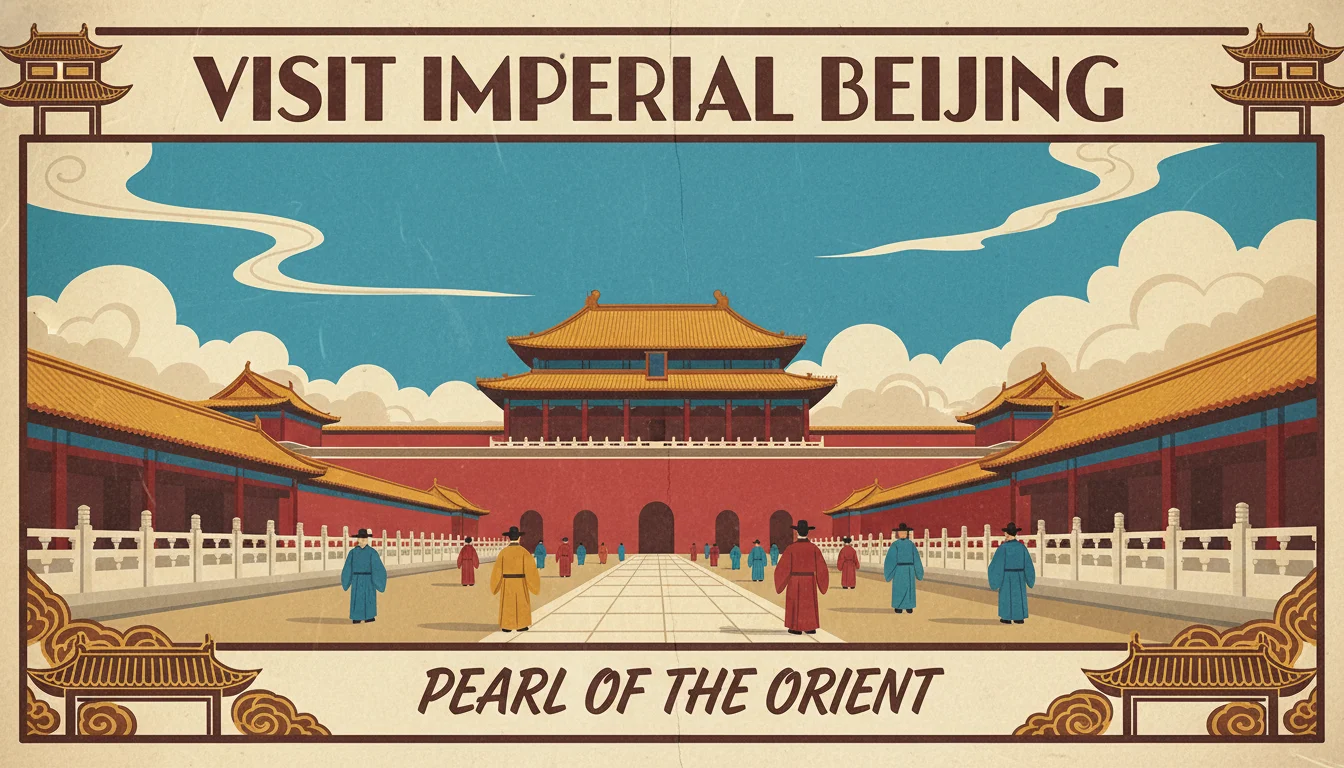
Beijing is divided spatially by the very hierarchy you need to navigate. The innermost ring is the Forbidden City (Zijincheng), the vast palace complex housing the emperor, his family, thousands of servants, concubines, officials, and eunuchs. You cannot enter. The outer walls of the palace complex are visible from the streets of the Imperial City surrounding it; the gates are guarded; the appropriate response to being near them is to keep moving.
Around the palace complex lies the Inner City (Neicheng), where the Eight Banners Manchu, Mongol, and Han Bannermen have their designated residential compounds. Bannermen are the hereditary military caste of the Qing state, supported by imperial stipends. By 1750, many of them have not fought in a generation and have developed a reputation for leisurely kite-flying and cricket-keeping. They are still the ruling ethnic class and they know it.
The Outer City (Waicheng) to the south is where most of the commerce, temples, theaters, and non-bannerman residents are concentrated. This is where you want to be.
The markets
Qianmen, the main southern gate of the Inner City, leads into the most active commercial district you will encounter. The street market extending south from Qianmen - the area that will later develop into Dazhalan - is already a dense tangle of shops, tea houses, medicine stalls, bookshops, and theater entrances. The noise level is significant. The smells of frying dough, coal smoke, and open drains are equally significant.
Fabric merchants, lacquerware dealers, silk brokers, and vendors selling snacks roasted on clay pots line the main roads. Porters carry enormous loads suspended from shoulder poles. Sedan chairs bearing officials cut through the foot traffic. Mules and donkeys pull carts of coal and grain from the southern warehouses.
Money: the main currency is copper cash coins with square holes, strung in groups of a thousand (one guan, roughly equivalent to a tael of silver). Silver ingots in standardized weights are used for larger transactions. If you carry anything resembling foreign coinage, you will attract the wrong kind of attention.
Food and drink
The cuisine of northern China in 1750 is emphatically not what you are imagining if your reference point is a modern Chinese restaurant. There are no chili peppers in northern dishes; capsicum had not yet penetrated Beijing cooking. Flavor comes from soy, vinegar, sesame paste, fermented bean paste, ginger, and garlic.
Wheat dominates over rice in the north. You will find steamed buns (mantou), dumplings (jiaozi), noodles in broth, and sesame flatbreads (shaobing) on every block. Mutton hotpot is available in winter, the dish that will persist largely unchanged into the present. The Manchu imperial court has been developing a version of what will become Peking duck, but you will not encounter this outside the palace.
Drink everything hot if you drink it at all. Tea is the universal beverage - green and oolong varieties predominate in the north. Baijiu grain spirits exist but will remove the enamel from your teeth and your memory from your head simultaneously. The water supply, drawn from wells fed by the canal system, is reliably dangerous unless boiled.
The Lama Temple and the major sites
The Yonghe Palace on the northeastern edge of the Inner City was converted from a former imperial residence into a Tibetan Buddhist lamasery in 1744, just six years before your visit. Its transformation into a major religious site is recent enough that the construction smell has barely faded. It houses hundreds of monks from Mongolia and Tibet and contains a spectacular 18-meter sandalwood Buddha that was installed with considerable ceremony. You can visit as a worshipper without creating an incident.
The Temple of Heaven complex in the Outer City - the circular Hall of Prayer for Good Harvests, the Circular Mound Altar - is where the emperor performs the critical annual rituals of heaven worship. Ordinary people do not enter during ceremonies, but the temple grounds are park-like and accessible outside the imperial ritual calendar.
North of the Forbidden City, Coal Hill (Jingshan) is a man-made mound of excavation spoil created during the Forbidden City's original construction in the early 15th century. On its summit are several pavilions. From there, looking south, you can see the entire roof line of the palace complex stretching toward the horizon in ochre tiles and gold finials. It is one of the great urban views in human history. Take a moment.
What the emperor is building
Qianlong is in the middle of a massive expansion of the Old Summer Palace (Yuanmingyuan), a garden complex about eight miles northwest of the city center. He has commissioned European-style buildings designed by Jesuit missionaries - hybrid structures that mix Baroque fountains with Chinese pavilions. The Jesuits who designed them, notably Giuseppe Castiglione and Michel Benoist, occupy a peculiar position at court: useful for their technical skills, valued as curiosities, watched with consistent suspicion.
If you can somehow arrange access to Yuanmingyuan, go. The garden is at its magnificent peak; the Opium War-era British and French forces who will burn it to rubble in 1860 are a century away.
Entertainment
Peking Opera (jingju) is just beginning to coalesce as a distinct form from regional opera traditions in this period. What you will find in the theaters south of Qianmen is a mix of regional styles - highly stylized vocal performance, acrobatics, percussion-heavy music - performed by troupes of male actors (female performers are banned from public stages under Qing law). The performances are long, the tea house theaters are full of conversation and movement, and the audience behavior is far more participatory than anything you may be used to.
Storytellers hold small crowds in teahouses with extended narrative performances. Street acrobats, trained animal acts, and chess players occupy the open spaces near the markets.
Getting out alive
The single most important behavioral rule in Qing Beijing is the kowtow. When in the presence of any official of significant rank, the expected greeting is to kneel and touch your forehead to the ground. Foreigners have famously refused this protocol and created diplomatic incidents lasting years. If you are not a foreign diplomat and simply a traveler of unclear status, the practical advice is to adopt whatever prostration everyone around you is adopting, and adopt it quickly.
The Qing bureaucracy is extraordinarily efficient at identifying and detaining people who don't fit the classification system. Foreigners are expected to be in Canton, trading under the supervision of licensed Hong merchants. A foreigner wandering Beijing in 1750 without a diplomatic pretext or Jesuit affiliation has no obvious category and will attract official attention within days.
Your exit strategy should be established before you arrive. The Grand Canal to the south connects Beijing to the Yangtze Delta and eventually to Canton. That is how goods and officials move. It is also how you move.
Leave before anyone has time to file the paperwork.
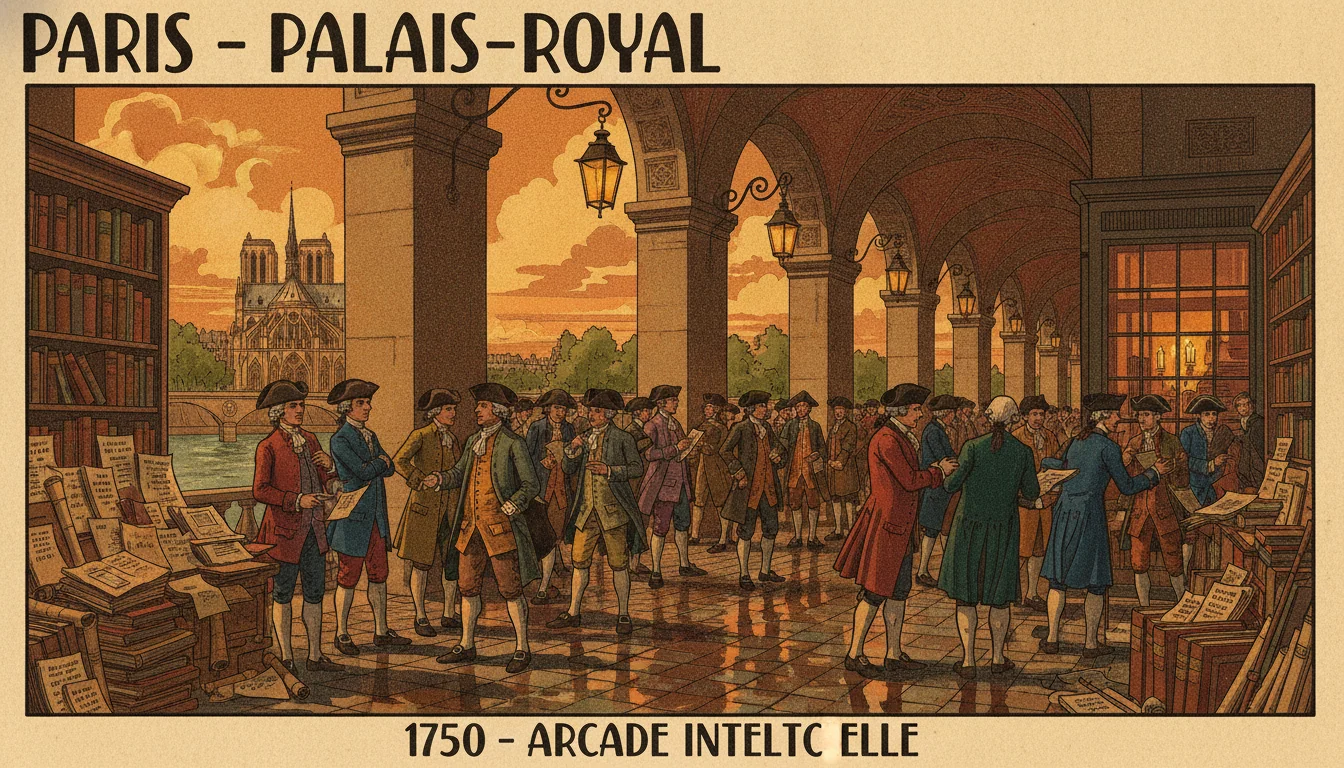
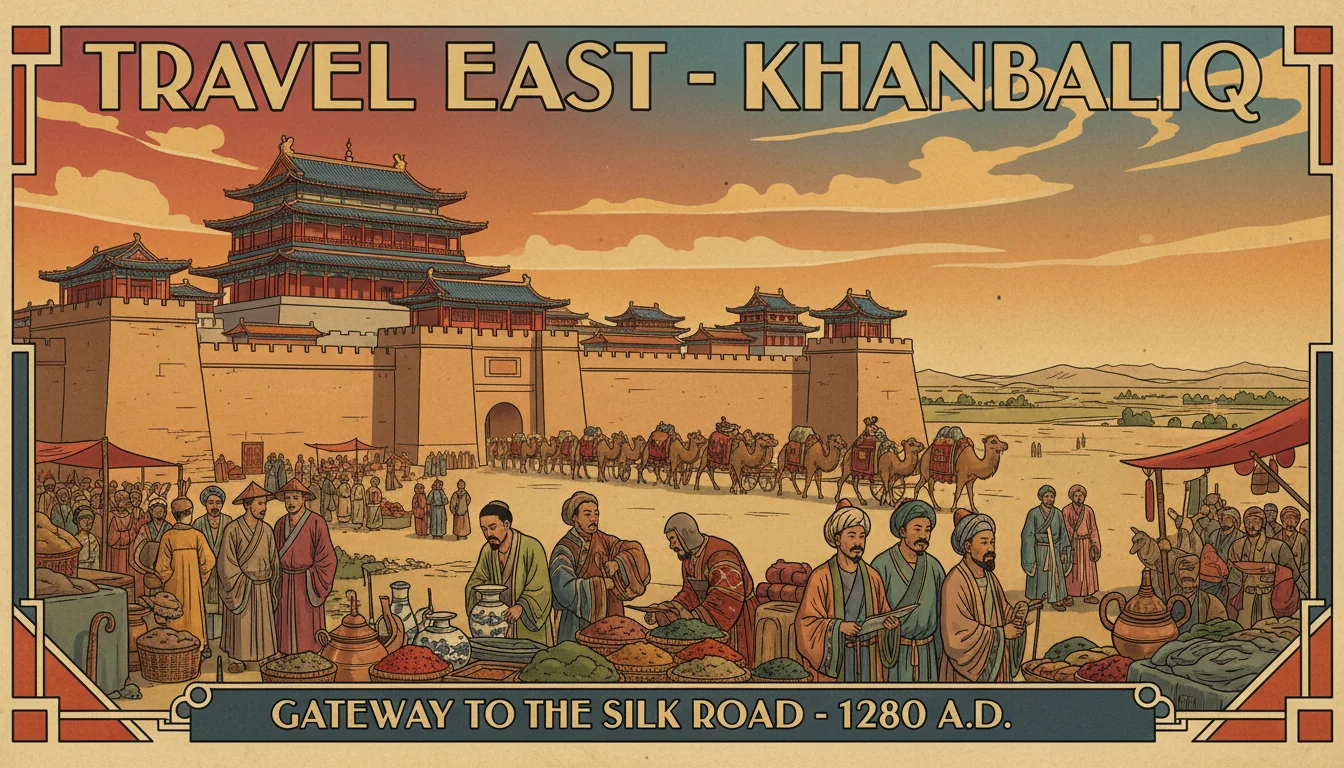
For the earlier Mongol capital on the same site, see our guide to Yuan Khanbaliq in 1280. For a contemporary empire to compare with the Qing at its peak, see Mughal Delhi in 1650.
Quick Answers
Common questions about this topic
Who ruled China in 1750?
The Qianlong Emperor (r. 1735-1796), the fourth Qing emperor, ruled China in 1750. His reign is considered the high point of the Qing dynasty in terms of territorial extent and imperial wealth. He was a prolific poet, an aggressive military campaigner, and a voracious art collector. By 1750 he had been on the throne for fifteen years and was expanding the empire's western borders into Central Asia.
What language would you need in Qing Beijing?
Mandarin Chinese was the practical language for everyday commerce and most public life in Beijing. Manchu, the language of the ruling ethnic group, was the official court language and was used in official documents, but by 1750 many Manchu bannermen had largely shifted to Mandarin in daily life, much to the emperor's documented frustration. Knowing Mandarin was essential; Manchu was a bonus.
What was the queue hairstyle law?
The Qing dynasty required all Han Chinese men to shave the front of their head and braid the remaining rear hair into a long queue (pigtail) as a sign of submission to Manchu rule. The law was enforced under penalty of death. Manchu men wore the style naturally. For a foreign visitor, failing to conform would immediately mark you as an outsider and potentially a criminal.
Could foreigners visit Beijing in 1750?
Barely, and only under strict conditions. Foreign merchants were confined to the trading port of Canton (Guangzhou) in the south. Diplomatic missions to Beijing were occasionally permitted but tightly controlled, requiring participants to perform the kowtow (full prostration) before the emperor. Jesuits maintained a presence at the imperial court as astronomers and artists, but they were there at the emperor's pleasure and could not move freely.

Need Advice from Someone Who Lived There?
Get firsthand accounts from people who actually lived through these moments in history.
Create your free account →No card required. Some figures and features require a paid plan.
Join the HistorIQly Club
Get smarter about the past.
Weekly stories, deep dives, and exclusive content straight to your inbox.