Time Traveler's Guide to Ancien Regime Paris, 1750
Ancien Regime Paris in 1750 is the intellectual capital of the world - Voltaire, the Encyclopedie, the salons - and one of the most dangerous, foul-smelling cities.
Read Wikipedia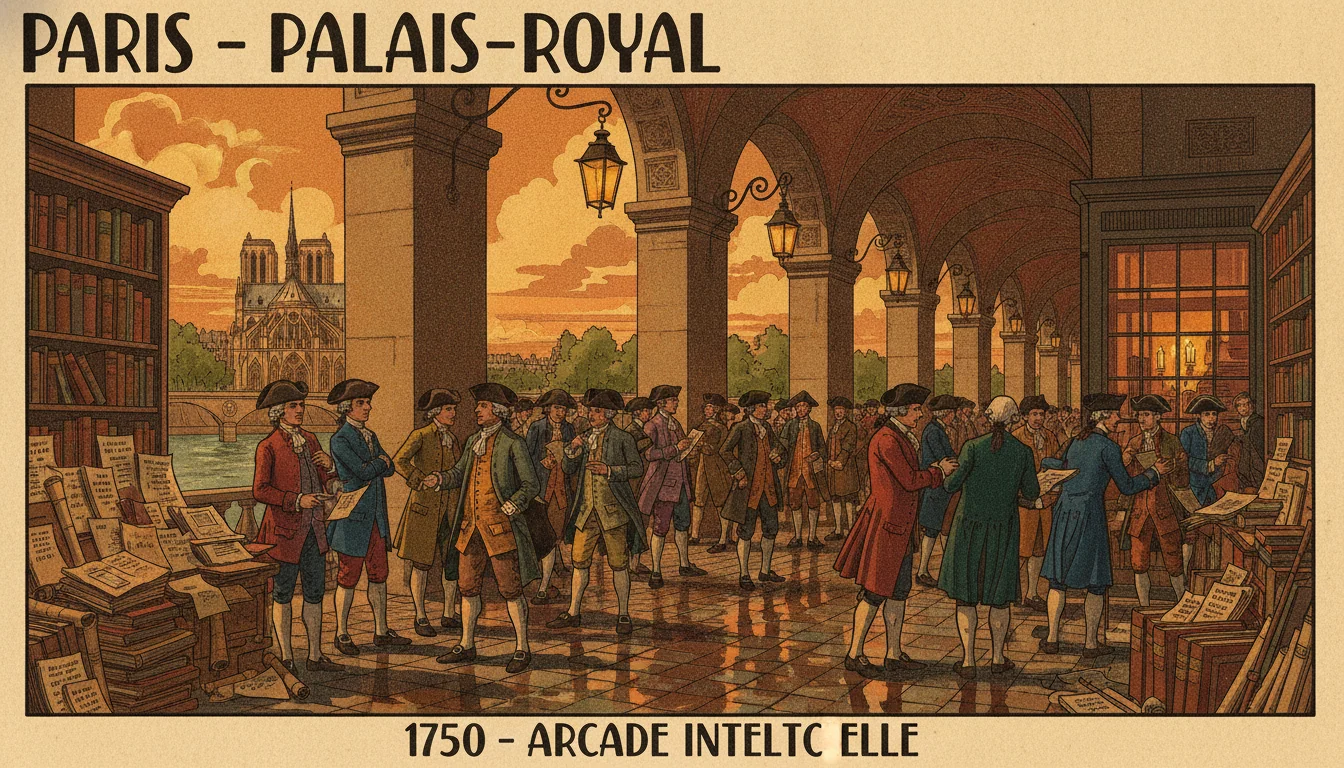
You have arrived in the right city at the right decade. Paris in 1750 is, by a significant margin, the most intellectually exciting place in the Western world. Denis Diderot is assembling the first volume of the Encyclopedie in a rented apartment. Voltaire is writing from exile outside the country he cannot live in without offending it. Jean-Jacques Rousseau has just arrived from Geneva and has not yet invented the ideas that will consume the revolution. The salons of Madame Geoffrin and Madame du Deffand are in full operation. The world is being remade in French, and the factory floor is this city.
It is also filthy, dangerous, and smells like a large animal that has been dead for several days. You will need to prepare.
Getting your bearings
Ancien Regime Paris in 1750 is a city of roughly 550,000 people, one of the two or three largest in Europe, contained within a rough ellipse defined by the old walls and the new tax barrier being constructed around the city's edge. It is vastly denser than you are used to. Buildings rise six and seven stories along narrow medieval streets that were never designed for the volume of people, horses, carts, sedan chairs, and livestock that now use them.
The Seine runs east to west through the center, and the Ile de la Cite in the middle of the river holds Notre-Dame cathedral, the old royal palace buildings, and a maze of crowded housing. The Palais-Royal, north of the Louvre and belonging to the Orleans branch of the royal family, is the nearest thing the city has to a public intellectual square - its arcades contain bookshops, coffeehouses, and vendors of every kind, and arguments start there at any hour.
The Louvre itself is not a museum in 1750. It is partly occupied by royal administration, partly used as housing for artists sponsored by the crown, and partly abandoned to squatters. The Versailles palace, about twenty kilometers southwest, is where the court of Louis XV actually lives. Paris has not had a resident monarch since Louis XIV moved the court to Versailles in 1682, and the city's relationship with its own king is consequently somewhat abstract.
How to survive the streets
The first rule of 1750 Paris is to travel by day if you can possibly arrange it. The city has street lighting - oil lamps hung on ropes over the center of major streets - but coverage is incomplete and the lamps go out unpredictably. The alleys and passages that cut between main streets are dark by nine in the evening and extremely unpleasant company. Robbery is routine. The watch is not.
The second rule is to get off the main thoroughfares when large vehicles are approaching. The streets on the left and right banks - the Rue Saint-Antoine, the Rue Saint-Jacques, the Rue Saint-Honore - carry enormous volumes of cart traffic, coaches, and occasionally cattle herds being driven to the central markets. Pedestrians have no right of way in any functional sense. People are injured and occasionally killed by coaches.
Hire a fiacre, one of the horse-drawn rental cabs, for any journey of more than a few blocks if you can afford it. Or walk quickly in the gutter, which is where pedestrians have tacitly been assigned. Do not walk in the center of any paved road if you value your coat.
The smell is significant and consistent. The Seine is used for everything: drinking water intake, laundry, waste disposal, and the tanning operations in the Faubourg Saint-Marcel that process animal hides and generate a smell that has no modern equivalent outside of a processing plant running at breakdown capacity. The street gutters run with a mixture of rainwater, horse urine, kitchen waste, and contents from chamber pots emptied from windows above. There is a warning shout - "Gare l'eau" - that precedes this last event, but it is not always delivered in time.
Where to eat and drink
The cafes are your friends. The Cafe de Procope on the Rue de l'Ancienne Comedie is the oldest and most famous: founded in 1686, it serves coffee, tea, chocolate, lemonades, and light food. Voltaire comes here regularly, as does Jean-Jacques Rousseau. Benjamin Franklin will later become a fixture. The clientele is a mix of bourgeois professionals, writers, actors from the Comedie-Francaise across the street, and students who nurse a single coffee for three hours while conducting an argument about free will or fiscal policy.
Coffee is the intellectual fuel of the Enlightenment. Coffeehouses by 1750 have become the information infrastructure of Paris: news is read aloud, pamphlets circulate, and discussions about philosophy shade into discussions about the government with a directness that would be impossible at Versailles. The police know this and have placed informers in the main cafes. Assume you are being listened to and moderate your comments about the king accordingly.
For actual food, look for a traiteur, a cook-shop that sells prepared dishes to take away or eat on the premises. Markets at Les Halles sell bread, vegetables, and fish; the bread is dark and substantial and forms the majority of most Parisians' diet. If someone offers you the chance to eat at a private home rather than a public establishment, accept. The cooking of even a modest bourgeois household in 1750 Paris is likely to be better than what the public eating establishments provide.
Wine is cheaper than coffee and considerably safer than the water. Drink wine.
The intellectual scene
If you have any capacity at all to move in bourgeois or aristocratic circles, the salons are the destination. Madame Geoffrin on the Rue Saint-Honore holds a dinner for writers and artists on Wednesdays, a tradition that has been running since the 1730s. Diderot, d'Alembert, Helvetius, and the philosophes who are building the Encyclopedie can be found there. She is practical, businesslike, and entirely unfazed by controversy, which is why everyone wants to be invited.
Madame du Deffand on the Rue Saint-Dominique hosts a more aristocratic gathering with a sharper literary edge. She is going blind, deeply skeptical of sentiment, and corresponds with Voltaire across the Swiss border with a frankness that would be impossible in any public letter. Her salon is wittier and more socially conservative than Geoffrin's.
The Encyclopedie project, which Diderot began assembling in 1745 and will publish its first volume in 1751, is the central intellectual fact of the decade. It is an attempt to compile all human knowledge - science, craft, philosophy, technology - in a single organized work, and it is also a sustained campaign against religious authority and arbitrary political power. The church and the royal censor know this and are already nervous. By 1759 the Encyclopedie will be officially suppressed, only to continue publication underground through a network of printers in Switzerland and the French provinces.
Politics and danger
Louis XV is on the throne and has been since 1715. He is 40 years old in 1750, still capable of decisive action, but increasingly influenced by his chief mistress, the Marquise de Pompadour, who is also a genuine political operator and a patron of the Enlightenment writers. The government is not a tyranny in the modern sense, but the mechanisms of arbitrary power are real.
The lettre de cachet is a royal warrant, sealed with the king's seal, that authorizes imprisonment without trial and without stated term. It is used against political and religious dissenters, but also by families to imprison inconvenient relatives. Voltaire was briefly in the Bastille in 1717 and again in 1726 for his writings. The Bastille, whose towers you can see from the east side of the city, holds political prisoners in some comfort (they are allowed to bring servants and furniture) but indefinitely. Do not write pamphlets criticizing the government, the church, or powerful aristocrats under your own name.
The police operate under the Lieutenant General of Police, an office that combines the functions of public order, censorship enforcement, and political intelligence. Paris has about a thousand police in 1750, a number that sounds reasonable until you consider the city's half-million inhabitants. Much of the actual order-keeping is done informally, through neighborhood hierarchies and a general culture of visible community. The police focus on the politically dangerous more than the merely criminal.
Before you leave
Visit the Jardin du Palais-Royal. Walk along the Seine on the quays, where booksellers have been setting up their stalls for decades and where you can find the clandestine pamphlets that the official trade does not carry. Look at the facade of Notre-Dame, which is fully intact and operational in 1750, and whose gargoyles and medieval stonework are already more than 500 years old. Go to a performance at the Comedie-Francaise, where the plays of Moliere and Racine are in regular repertory and where the audience participates with the enthusiasm of people who have no television.
Leave before the bread riots. They are coming.
For more survival guides to cities that were changing faster than their residents knew, see our guides to visiting Venetian Venice at its peak and the Time Traveler's Guide to Revolutionary Boston, 1773.
Quick Answers
Common questions about this topic
What was Paris like in 1750?
Paris in 1750 had a population of around 500,000 to 600,000, making it one of the largest cities in Europe. It was the intellectual center of the Enlightenment, home to Voltaire, Rousseau, Diderot, and the Encyclopedie project. It was also crowded, foul-smelling, and dangerous, with open sewers, no street lighting outside wealthy districts, and a police force that mixed public order with political surveillance.
What was the Encyclopedie?
The Encyclopedie, ou dictionnaire raisonne des sciences, des arts et des metiers was a massive reference work edited by Denis Diderot and Jean le Rond d'Alembert. The first volume appeared in 1751. It aimed to compile all human knowledge and was laced with skeptical and anti-clerical commentary, making it politically explosive. Louis XV's government suppressed it twice.
What were the Paris salons?
The salons were regular gatherings hosted by educated aristocratic or upper-bourgeois women, called salonnières, at which writers, philosophers, and scientists met to discuss ideas. The most famous included those of Madame Geoffrin, who hosted Diderot and the Encyclopedists, and Madame du Deffand, who corresponded with Voltaire and Horace Walpole. The salons were the social infrastructure of the French Enlightenment.
Was Paris dangerous in 1750?
Yes. Street crime was common, especially after dark. There was no organized police patrol of the kind modern cities use; the guet, the night watch, was understaffed and unreliable. Neighborhoods like the Faubourg Saint-Antoine could be dangerous even in daylight. The dreaded lettre de cachet - a royal warrant for imprisonment without trial - meant even wealthy visitors were not fully safe from arbitrary detention.

Need Advice from Someone Who Lived There?
Get firsthand accounts from people who actually lived through these moments in history.
Create your free account →No card required. Some figures and features require a paid plan.
Join the HistorIQly Club
Get smarter about the past.
Weekly stories, deep dives, and exclusive content straight to your inbox.