A Time Traveler's Guide to Delhi, 1857
Your survival guide to Delhi in 1857: the Sepoy Mutiny, the last Mughal emperor's court, and the four months that ended an empire and started another.
Read Wikipedia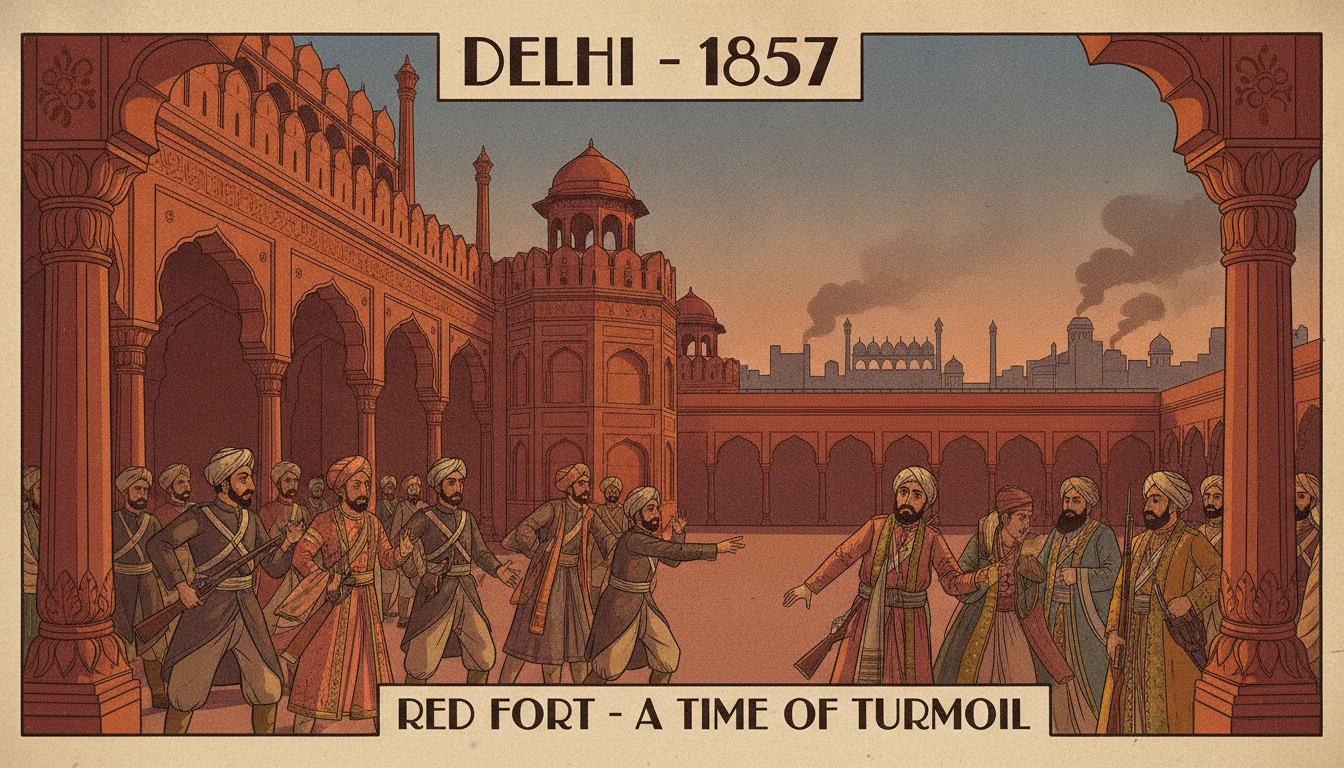
Set your time machine for Delhi in the summer of 1857, and understand upfront that you are not visiting a tourist attraction. You are visiting the epicenter of a rebellion that will end one empire and midwife another. If you want to see the last gasp of Mughal grandeur and the opening act of the British Raj in the same few months, this is the trip. If you want a relaxing holiday, pick a different century.
What is actually happening
In May 1857, sepoys, Indian soldiers serving in the British East India Company's Bengal Army, mutinied at garrison towns north of Delhi over a combination of long-simmering grievances: religious and cultural disrespect, harsh discipline, resentment over annexation policies that had swallowed Indian kingdoms, and the notorious immediate trigger, cartridges rumored to be greased with cow and pig fat, offensive to Hindu and Muslim soldiers alike. The mutineers marched to Delhi and persuaded, or perhaps more accurately pressured, the aging Mughal emperor Bahadur Shah II into lending his name and legitimacy to their cause.
What followed was not a clean uprising with a single command structure but a chaotic and often disorganized rebellion, with the emperor holding largely symbolic authority while different rebel factions pursued their own agendas inside the city. British and loyalist forces besieged Delhi through the summer, and by September the city fell after brutal fighting, followed by widespread and often indiscriminate reprisals against the population. If you are visiting, know that you are walking into one of the most violent chapters of nineteenth-century South Asian history, not a costume drama.
Where to stay, and where not to
Do not attempt to lodge inside the Red Fort itself once fighting intensifies; it is both the symbolic center of the rebellion and, later, a primary target for British artillery. Before the siege tightens in earnest, the older mercantile quarters around Chandni Chowk offer a more plausible base, provided you can pass as a merchant, pilgrim, or minor court functionary with legitimate business in the city. European travelers, needless to say, should not attempt to move about Delhi at all during this period; the danger to any person read as British, whatever your actual origin, is severe and immediate throughout the rebellion.
As the siege progresses through the summer, food and water grow increasingly scarce inside the city walls, and disease spreads through overcrowded neighborhoods sheltering both residents and rebel troops. Whatever lodging you find, expect shortages, price gouging on basic goods, and constant uncertainty about which parts of the city are safe from artillery fire on any given day.
What to wear
Blend in as a local trader or minor scholar. Fine muslin kurtas, a simple angarkha coat, and a plain turban or cap suit most male roles without drawing attention from either rebel patrols or, later, British search parties. Avoid anything resembling European tailoring entirely; even partial European dress can be read, correctly or not, as a signal of loyalist sympathy, a dangerous misunderstanding to invite in either direction depending on who currently controls your street.
Women travelers should adopt modest local dress and, where plausible, travel under the escort of a local household, since an unaccompanied foreign woman moving through a city under siege invites exactly the kind of scrutiny you cannot afford.
What to eat
Delhi's Mughal-influenced cuisine remains extraordinary even under siege conditions, at least in its early weeks: rich biryanis, kebabs cooked over open coals in Chandni Chowk's food stalls, and the flatbreads and lentil dishes that form the daily staple for most residents. As the siege tightens through the summer months, expect this abundance to collapse quickly into scarcity, with basic grain and clean water becoming the primary concern rather than the city's famous street food. Bring your own preserved provisions if you can manage it discreetly; relying on local markets during the siege's later weeks is a genuine risk to your health as much as your cover.
The court you should try to witness, carefully
If you can arrange safe, distant observation, and only from a genuine safe remove, Bahadur Shah II's court inside the Red Fort in the rebellion's earlier weeks offers a poignant last glimpse of Mughal ceremonial life: an elderly poet-emperor, more genuinely gifted at Urdu verse and calligraphy than at commanding an army, presiding uneasily over a rebellion he did not start and could not fully control. He held almost no real political power even before 1857, ruling a pensioned, ceremonial court under British oversight, and by most accounts he accepted the rebels' acclamation with real hesitation, understanding better than many of his followers how badly this could end.
Do not attempt to approach the emperor directly or seek an audience; his court is watched, factional, and increasingly desperate as the siege wears on, and a stranger of uncertain origin asking questions is the last thing anyone there wants.
Customs and conversation
Loyalties inside the city are neither uniform nor stable, and shift week to week as the siege drags on. Hindu and Muslim residents alike are represented among both the rebels and those who quietly hope for a British return, and religious solidarity should never be assumed to predict political sympathy. Avoid volunteering opinions about the rebellion's chances or the emperor's leadership to anyone, since you cannot reliably know who is listening, who reports to whom, and how quickly suspicion of either side can turn violent.
Formal courtesy remains important even amid the chaos. Respectful greetings, careful deference to anyone who appears to hold local authority, whether a rebel officer, a neighborhood elder, or a merchant guild leader, and a plausible cover story about family business or pilgrimage will serve you far better than any attempt to pass as a disinterested observer. Curiosity itself is dangerous in a besieged city; everyone assumes a stranger asking questions is working for someone.
Money and trade
Coinage remains in circulation but grows less predictable as the siege continues, with rebel authorities and remaining Mughal officials both attempting, with limited success, to keep some semblance of normal commerce functioning inside the walls. Silver rupees are the most broadly trusted currency; carry a reasonable supply in small denominations rather than anything that draws attention. Barter increasingly supplements coin trade as shortages worsen through the summer, particularly for food and medicine, so small quantities of portable, tradeable goods can prove more valuable than cash by the siege's final weeks.
Dangers to take seriously
This is not a mild-hazard destination. Expect active combat, artillery bombardment as British forces close in through the summer, food and water shortages, disease, and, after the city falls in September, mass reprisals against Delhi's population that show little discrimination between rebels and ordinary residents. Foreigners of any description are at acute risk throughout, whichever side currently holds the ground you are standing on. If your time machine has an emergency recall function, know precisely where it is and be prepared to use it without hesitation.
Why go at all
Because this is the hinge point between Mughal India and British India, compressed into a single besieged city over a single summer. You are watching the final chapter of a dynasty that, two centuries earlier in this same city, ruled the subcontinent at the height of its power, and the opening chapter of direct Crown rule that will last nearly another hundred years. Bahadur Shah II will be tried, exiled to Rangoon, and die there in 1862, the last Mughal emperor to sit, however briefly and unwillingly, on a throne his ancestors built. Watch it from the safest possible distance, and understand exactly what era you are ending.
Quick Answers
Common questions about this topic
What was happening in Delhi in 1857?
In May 1857, sepoys of the Bengal Army rebelled against the British East India Company and marched on Delhi, where they proclaimed the aging Mughal emperor Bahadur Shah II as their nominal leader, triggering a months-long siege that ended with British forces retaking the city that September.
Who was Bahadur Shah II?
Bahadur Shah II was the last Mughal emperor, a poet and calligrapher who by 1857 held almost no real political power, ruling only a small pensioned court inside the Red Fort under British oversight. The rebels declared him their leader with little input from him, a role he accepted cautiously and which ultimately led to his exile.
How dangerous was Delhi during this period?
Extremely. Between May and September 1857, Delhi was a city under active siege, with violence against both Indian and British civilians, disease running through overcrowded quarters, and, after the city fell, brutal and indiscriminate reprisals carried out by British forces against the population.
What happened to Delhi after the rebellion was crushed?
The British East India Company was dissolved and direct British Crown rule, known as the Raj, replaced it. Bahadur Shah II was tried, exiled to Burma, and died there in 1862, formally ending nearly 300 years of Mughal rule.

Need Advice from Someone Who Lived There?
Get firsthand accounts from people who actually lived through these moments in history.
Create your free account →No card required. Some figures and features require a paid plan.
Join the HistorIQly Club
Get smarter about the past.
Weekly stories, deep dives, and exclusive content straight to your inbox.