A Time Traveler's Guide to Baroque Rome, 1650
Your guide to baroque Rome 1650: a papal city under construction, packed with pilgrims for the Jubilee Year, where Bernini and Borromini compete for eternity.
Read Wikipedia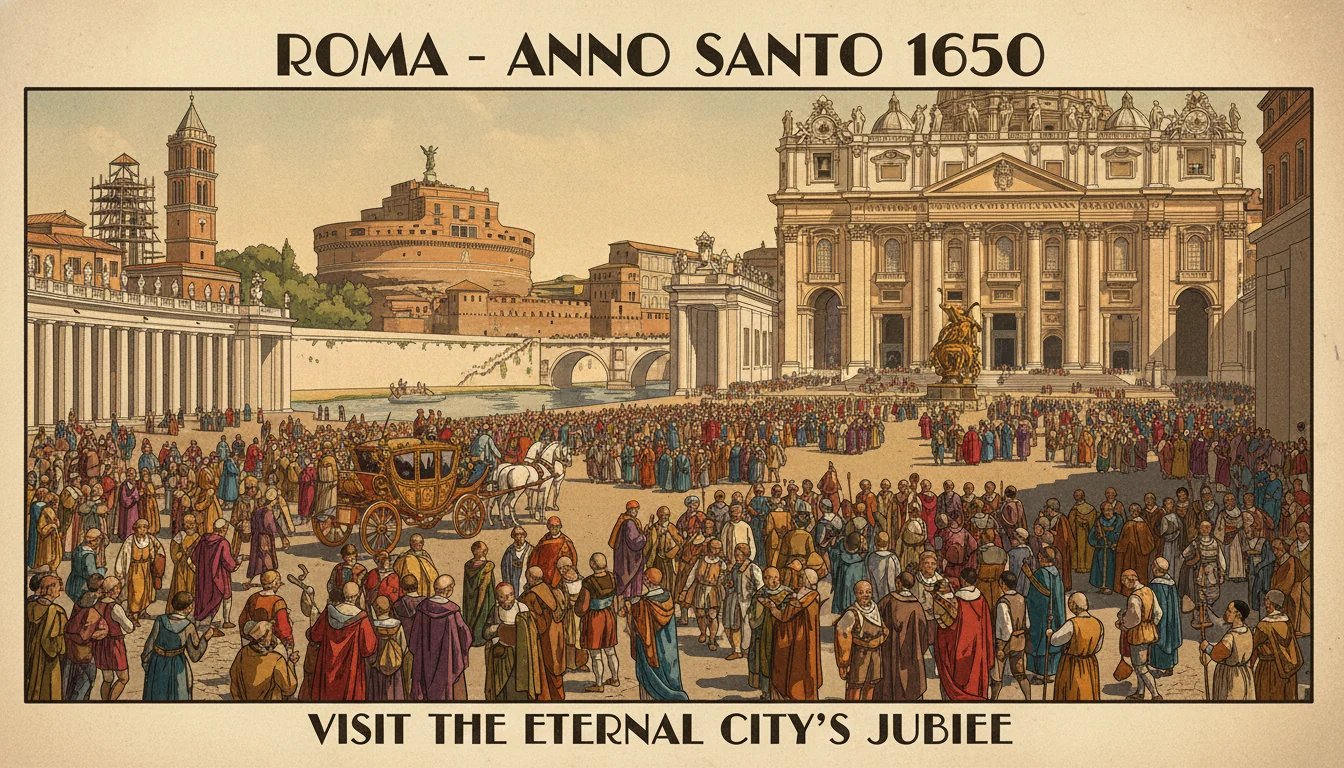
If the timing seems right for a visit to baroque Rome 1650, consider that this is a Holy Year. Pope Innocent X has declared the fiftieth year of the century an Anno Santo, and the city has been filling with pilgrims since January. They are walking, riding, sailing, and arriving by mule from every corner of Catholic Europe, and the city is operating at something close to capacity. The streets around the four pilgrimage basilicas - St. Peter's, San Giovanni in Laterano, Santa Maria Maggiore, and San Paolo fuori le Mura - are churned to mud by the volume of foot traffic.
This is not necessarily a bad time to visit. The energy of a Jubilee Year is real. The city has scrubbed itself presentable. The churches have opened their best relics. But it is busy, it is expensive for lodging, and some of the most instructive conversations about contemporary Roman life will be harder to have with locals who have been talking to pilgrims for months and are somewhat weary of foreigners.
Come in spring or autumn. Not summer.
The city you are entering
Rome in 1650 holds roughly 120,000 people inside ancient walls built for a million. The arithmetic is visible everywhere. The inhabited city clusters around the Vatican, the Tiber river bend, and the processional routes connecting the major churches. The rest of what is nominally Rome - the Esquiline Hill, the Celian, the Aventine - is fields, vineyards, monastery gardens, and ruins. You can walk from the Campo de' Fiori to a landscape of complete pastoral silence in fifteen minutes. Sheep graze between the arches of the ancient aqueducts.
The Tiber runs through the center of this city and the Tiber is a health problem. The marshes at its edges breed malaria. Locals call it the aria cattiva - the bad air - and they are correct in their instinct even if wrong about its mechanism. If you visit in July or August, you will learn what that means firsthand. The wealthy Romans who can afford to do so leave the city entirely in summer. Papal business slows to a minimum. The pilgrims who arrive in high summer often leave weaker than they arrived.
Arrive in April. The wildflowers are out on the Palatine Hill, the disease risk is manageable, and the light over the Forum in the early morning is extraordinary.
Who runs things
Pope Innocent X is the master of everything you will encounter. He is not a warmly loved figure - contemporaries found him vain, dominated by his sister-in-law Olimpia Maidalchini, and uncomfortably focused on enriching his family - but his papacy has been extraordinarily productive in terms of building and arts patronage. The Pamphilj palace and church on Piazza Navona are monuments to his dynastic ambition, and the Piazza Navona itself is being transformed into the most spectacular public space in the city.
Below the Pope, the government of Rome is an elaborate ecclesiastical hierarchy of cardinals, monsignors, and tribunals. The city is administered by the Governor of Rome (usually a cardinal) and policed by the shirri, a force of night watchmen and daytime constables who answer to the Papal Curia. If you attract their attention you will be dealt with efficiently and without appeal to any secular authority, because no secular authority exists here.
The Inquisition is present but less theatrical than in Spain. Its primary concern in Rome is with ideas, books, and heresy, not with the street manners of passing visitors. A Protestant traveler can move through the city without facing interrogation, provided he does not announce himself at inconvenient moments. This is a city that has been receiving foreign visitors for centuries and has developed a pragmatic approach to their heterodoxy.
Dress and cover
Your goal is to look like a prosperous pilgrim or a minor official in the service of a noble household. Both categories are present in large numbers and are treated with reasonable courtesy.
For men: a knee-length coat or cassock in dark wool, a linen shirt, stockings, leather shoes with buckles, and a broad-brimmed hat. The Baroque fashion for men in 1650 Rome still has some of the padded doublet silhouette but is beginning to shift toward a looser coat. If you are dressed approximately correctly, nobody will look twice.
For women: a long skirt, a fitted bodice, a white linen collar, and a veil or head covering when entering churches. Women moving through the city unescorted are unusual by the standards of the time and will draw comment. If you are travelling alone, attach yourself visibly to a group.
Do not wear bright or theatrical colours unless you want to be read as an entertainer or worse. Dark burgundy, ochre, grey, and deep blue are the default palette of respectable Roman dress in this period.
What to eat and drink
The pilgrims' Rome has no shortage of places to eat, though quality varies considerably. The osterie clustered around the major churches and pilgrimage routes serve wine, bread, pasta, and boiled or roasted meat. The pasta will be familiar - Rome has been eating pasta for two centuries by 1650 and some of the same shapes you know are already present. Cacio e pepe, in something close to its modern form, is a staple. Artichokes, fried in olive oil, are a local speciality of the Jewish quarter on the Tiber island.
The wine is good and cheap. The water is safer than in many European cities, thanks to three functioning ancient aqueducts - the Acqua Vergine (which still feeds the fountains in the Campo Marzio), the Acqua Felice, and the Acqua Paola - that bring spring water from the hills. At the public fountains scattered through the city, water flows continuously. Drink from those. Do not drink from the Tiber.
Meat is expensive outside feast days. Fish on Fridays is observed with some seriousness in a city where the Pope is technically watching.
The artists and what they are making
Gian Lorenzo Bernini is 52 years old in 1650 and at the height of his powers. His commission for the Fountain of the Four Rivers at Piazza Navona is almost complete - it will be unveiled in 1651 and represents the most extravagant piece of public sculpture since antiquity. In St. Peter's, his bronze baldachin, completed 1633, already dominates the crossing of the basilica in a way that makes every previous altar arrangement in Christendom look like preliminary sketches.
At Santa Maria della Vittoria, just north of the Quirinal Hill, his Cornaro Chapel with the Ecstasy of Saint Teresa is under construction. When it opens it will look like a theatrical performance translated into marble and gilded light. If you can get access to the site, the process of watching Bernini's workshop proceed is worth an afternoon.
Francesco Borromini is Bernini's great rival and the other architect who is physically reshaping the city. His church of San Carlo alle Quattro Fontane, on the Quirinal, has its interior complete - the extraordinary oval dome, the honeycomb lantern, the white plaster that seems to generate its own light. The two men detest each other, and their patrons take sides with something close to partisan intensity. Every building project in Rome is also, at some level, a maneuver in this ongoing competition.
What to avoid
The roads into Rome are more dangerous than the city itself. Bandits - brigands who prey on pilgrims and merchants - operate the mountain passes and the stretches of highway far from town. Travel in groups, during daylight, and do not advertise what you are carrying.
Inside the city, the most dangerous places after dark are the alleys and lanes beyond the pilgrimage routes, particularly near the river. The shirri control them poorly at night. Disputes resolved by knife rather than by court are common.
Summer is the great killer. The malaria season runs from July through September, and it does not spare visitors. Every year, pilgrims who arrive in August at the four basilicas leave their devotions behind them in the churchyard. If your visit is brief, avoid the warmest months absolutely.
The Jubilee Year brings special pardons for sins, which in practice brings to Rome a subset of people seeking absolution for rather serious matters. The city in 1650 has an edge of moral complexity that the official pilgrimage literature does not advertise.
What makes it worth going
St. Peter's Basilica in 1650 is already the most ambitious building in the Christian world. The interior, with Bernini's baldachin catching light from Michelangelo's dome above it, is a genuine spectacle. The ruins of ancient Rome - the Forum, the Colosseum, the Palatine Hill strewn with wildflowers and broken imperial marble - are still dramatic enough to astonish even visitors who have read everything written about them.
The city moves slowly, by the standards of what European capitals will eventually become. Business is conducted by petition and personal connection. Everything of consequence happens through the ecclesiastical hierarchy. Decisions take weeks. But in that slowness there is time to look, and what there is to look at in Rome in 1650 is, even by the standards of everything that came before and after, remarkable.
Bernini is working. Borromini is working. The Pope is building Piazza Navona into the showpiece he will never quite admit he built for his own family. The pilgrims are walking the seven hills in their thousands. And somewhere in the Vatican archives, a letter from Galileo, dead for eight years, sits unanswered.
Come in spring. Leave before summer.
For more on the period's artistic culture in Italy, see the guide to Renaissance Florence in 1490 and the companion piece on Ottoman Istanbul in 1555.
Quick Answers
Common questions about this topic
Who was the pope in Rome in 1650?
Pope Innocent X, born Giovanni Battista Pamphilj, reigned from 1644 to 1655. He was the sixth member of his family to become pope and used the papacy with enthusiasm to enrich and aggrandize his family, particularly through major building projects around Piazza Navona. 1650 was a Holy Year - an Anno Santo - which he declared, and the city was flooded with pilgrims from across Catholic Europe.
What was Rome like in 1650?
Rome in 1650 was a city of about 120,000 people inside ancient walls that had once held a million. Much of the area inside the walls was fields, vineyards, and ancient ruins. The inhabited city clustered around the Vatican, the Tiber bend, and the main pilgrimage routes. It was simultaneously one of Europe's most artistically ambitious cities and a place of extraordinary poverty, seasonal disease, and very effective ecclesiastical policing.
Was it safe to visit Rome in 1650?
Safer than the roads getting there - brigands were a serious risk on most routes into the city. Within Rome, violence was common in certain quarters and after dark, but the city had a functional police presence (the shirri) and the Inquisition kept a watchful eye on behavior it considered heretical. The greatest medical risk was malaria from the Tiber marshes, which killed visitors and locals alike during the summer months.
What major artworks could you see in Rome in 1650?
Bernini's bronze baldachin in St. Peter's Basilica (completed 1633) was already one of the most spectacular things in the city. His Ecstasy of Saint Teresa at Santa Maria della Vittoria was under construction. The Fountain of the Four Rivers at Piazza Navona was approaching completion, unveiled in 1651. Borromini's church of San Carlo alle Quattro Fontane had just been finished. The entire city was, in effect, a building site for the most ambitious art program in the world.

Need Advice from Someone Who Lived There?
Get firsthand accounts from people who actually lived through these moments in history.
Create your free account →No card required. Talk to anyone in history with 8 free credits a day. Some features require a paid plan.
Join the HistorIQly Club
Get smarter about the past.
Weekly stories, deep dives, and exclusive content straight to your inbox.