A Time Traveler's Guide to the Zulu Kingdom, 1820
Zulu Kingdom 1820 survival guide: what to wear, eat, and understand about Shaka's amabutho regiments, the iklwa, and the mfecane upheaval.
Read Wikipedia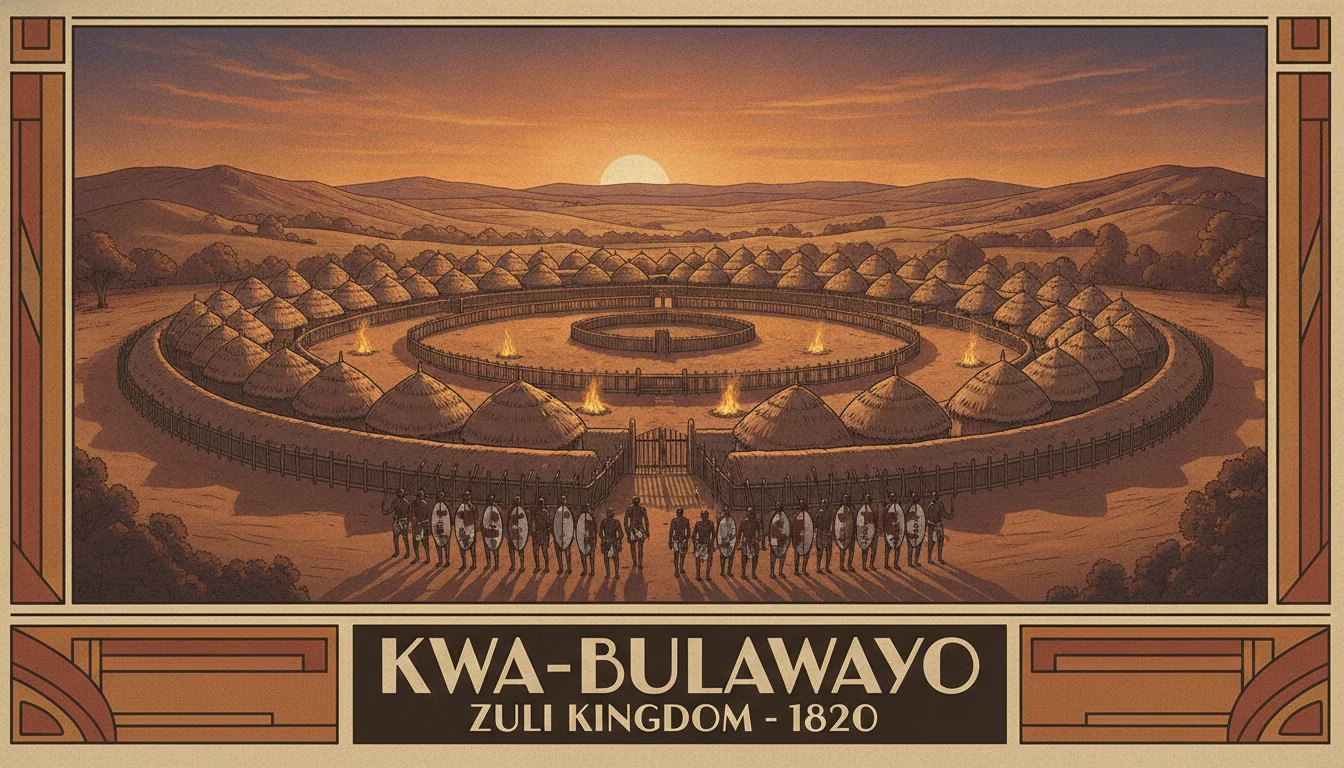
Set your dial for the Zulu Kingdom around 1820, in the hill country of what is now KwaZulu-Natal, South Africa. This is one of the most consequential military and social experiments happening anywhere on Earth that decade. A young leader named Shaka kaSenzangakhona has taken a small chiefdom and, in barely a handful of years, turned it into the dominant power of the region, using tactics and discipline that are rewriting the rules of warfare in southern Africa.
It is also a tense, fast-moving, occasionally brutal place to be a visitor. Regional instability is displacing communities for hundreds of miles in every direction. So before you click your watch into 1820, here is your practical guide to surviving, blending in, and understanding what you are looking at.
First, know what kind of place you're entering
The kingdom Shaka rules in 1820 did not exist in this form a decade earlier. He inherited leadership of the Zulu, then a modest chiefdom, around 1816, and rapidly absorbed or subdued neighboring groups through conquest, diplomacy, and reorganized military service. By 1820 his authority extends over a substantial and growing territory.
This is not a city in the European sense. Power is organized around royal homesteads, large circular settlements of thatched beehive-shaped huts enclosing a central cattle pen, since cattle are both the primary form of wealth and central to daily life. Shaka's own great homestead, generally identified as kwaBulawayo, houses thousands of people, including the regiments themselves.
Your safest approach is to arrive as a traveler from a distant chiefdom or, if you can pass for one, as one of the small number of British traders beginning to filter in from the Cape Colony and Port Natal around this period. A foreign visitor is not unheard of, but you will be watched closely and expected to show deference to the king.
Dress like you belong
Clothing here is not about covering the body so much as displaying status, age, and marital position, and it looks nothing like what a modern visitor packs. For most people, everyday dress is simple:
- a small apron or skin covering at the waist, different in style for men and women
- cowhide or other animal-skin garments, softened and worked by hand
- little to nothing on the upper body for most of the population, in a climate that makes this practical
- beadwork, worn as necklaces, bands, and belts, with colors and patterns signaling age-group, status, and marriage availability
Married women and senior men wear more elaborate versions of these garments, and specific ornaments, including certain headdresses made from feathers or fur, are restricted to particular ranks or achievements. Do not improvise anything resembling a formal headdress. Getting this wrong reads as mockery or a false claim to status, neither of which ends well.
Leave modern fabric, synthetic dye, and anything shiny at home. A visitor in bright synthetic colors becomes an object of fascination, the opposite of what you want.
Food and daily life
The diet centers on cattle, grain, and vegetables grown around the homesteads. Cattle are wealth as much as food, so beef is eaten but not carelessly slaughtered. Expect:
- sour milk, a curdled, thickened staple stored and fermented in gourds
- porridge made from sorghum or millet
- beans, pumpkins, and other cultivated vegetables
- beer brewed from sorghum, drunk communally and central to hospitality
- meat on festive or ceremonial occasions, since everyday slaughter of cattle is limited
Guests are generally offered food and drink as a matter of hospitality, and refusing outright can read as an insult. Eat what you're given, in modest portions, and follow the lead of those around you for where to sit and how to receive a bowl.
Social customs and hierarchy
Zulu society in 1820 is organized around homestead, lineage, and age. Status runs from the king down through chiefs and homestead heads to ordinary men and women, and separately through an age-based system that structures public life for young people who pass through life stages together with their peers.
A few rules of etiquette matter enormously:
- approach any homestead through the correct entrance and wait to be acknowledged
- never turn your back on someone of significantly higher status, including the king
- show visible deference to elders and to anyone identified as a chief or induna (a title used for officials close to the king)
- do not touch cattle in someone else's homestead without invitation
- speak when spoken to at the royal homestead, and do not volunteer opinions on succession or the king's health
Shaka's own authority is close to absolute, and his temperament is, by every surviving account, mercurial and capable of sudden violence. Executions for perceived disrespect or bad luck are a real feature of his reign. This is the single most important survival fact in this guide: minimize your visibility, and never contradict the king or anyone speaking in his name.
The military reforms, and why they matter
What makes 1820 worth visiting is the military revolution underway. Shaka has restructured how war is fought and how young men serve the state, and the results are reshaping the whole region.
The amabutho system. Young men (and, for some regiments, young women) are organized into age-based regiments, called amabutho, that live together, train together, and serve the king rather than dispersing home after initiation. This gives Shaka a standing, drilled fighting force loyal to the crown instead of scattered local levies loyal to individual chiefs. Regiments are housed at dedicated barracks-homesteads and identifiable by shield color.
The iklwa. Older Nguni warfare relied heavily on long throwing spears, hurled from a distance and often used up before close combat began. Shaka is closely associated with popularizing a shorter, broad-bladed stabbing spear, generally referred to as the iklwa, used at close range in the hand rather than thrown away. Paired with a large cowhide shield used to hook away an opponent's shield and expose his side, this favors disciplined close-quarters fighting and demands far more nerve from every warrior in the line.
The buffalo-horns formation. Regiments are drilled to fight in a formation often described as the buffalo horns: a strong central "chest" that engages the enemy head-on, two flanking "horns" that race around the sides to encircle them, and a reserve "loins" held back until needed. Executed well, it turns a battle into an envelopment rather than a straight clash.
Training is intense and discipline severe. Warriors are drilled hard, expected to move fast, and failure or cowardice in battle can carry lethal consequences. Do not volunteer to spar with anyone. Watch drills from a distance if you are permitted to watch at all.
Dangers you should take seriously
Two dangers matter here. The first is proximity to Shaka's court itself. His reputation for sudden, severe punishment of those who displease him is well attested across surviving accounts, including from the European traders who dealt with him directly. Keep a low profile, avoid the inner homestead unless escorted, and never compete for attention or status.
The second is the broader regional upheaval historians call the mfecane. Across a wide swath of southern Africa in this period, warfare, drought pressures, competition for grazing land, and the rise of powerful new states, including the Zulu kingdom itself, are displacing communities and triggering chain reactions of conflict well beyond Shaka's direct control. Historians debate how much of this upheaval to attribute to Zulu expansion specifically versus other regional pressures, and that debate is still active. What matters for your visit: territory outside the kingdom's immediate control is considerably less predictable than its well-organized core.
Must-see aspects of the kingdom
A regimental review. If you can watch amabutho regiments drilled from a respectful distance, take the chance. The scale and discipline of thousands of trained warriors moving as a unit is the clearest window into why this kingdom is expanding so fast.
A royal homestead. The scale of a homestead like kwaBulawayo, with its enormous central cattle enclosure and rings of huts housing thousands, demonstrates centralized organization built with no stone, no wheel, and no writing system, entirely from timber, thatch, and packed earth.
Cattle culture up close. Spend time, from a distance, watching how cattle are handled and valued. Understanding cattle as the currency of status, marriage, and diplomacy explains more about the society's logic than almost anything else you will observe.
Beadwork and ornament. The color and pattern language of beadwork carries real information about age, status, and availability. If a local offers to explain it to you, it is worth every minute.
What not to do under any circumstances
Do not:
- offer unsolicited opinions about the king, his health, or the succession
- touch or comment casually on anyone's cattle
- attempt to reproduce elaborate feathered headdresses or other restricted ornaments
- approach regimental barracks or drills without an escort
- travel alone through contested territory outside the kingdom's stable core
- mention any event after 1820, especially the kingdom's later wars or Shaka's own fate. Both are unwritten from where you stand, and speculating about either is exactly the kind of talk that gets visitors in trouble
Most importantly, do not treat any of this as a spectacle. You are watching a society reinventing its own military and political structure at extraordinary speed, with real consequences for the people living through it.
The experience you should not miss
If you have one moment in the Zulu Kingdom of 1820, make it dusk at a royal homestead, watching cattle brought in from grazing to the central enclosure while cooking fires are lit around the huts. Somewhere nearby, a regiment recently returned from campaign is resting between drills. The scale of organization on display, built by a society that has restructured itself within a single decade, is the real reason this destination belongs on any time-travel itinerary.
Keep your head down, mind your cattle etiquette, and do not ask about tomorrow. The Zulu Kingdom in 1820 owes you no explanation, but it is one of the most remarkable places on Earth to watch history accelerate in real time.
For another gold-rich West African power at a similar peak of confidence, see our guide to the Ashanti Empire in 1800.
Quick Answers
Common questions about this topic
Is it safe to visit the Zulu Kingdom in 1820?
Not entirely, but no more dangerous than most 1820s destinations. The real risk is Shaka's court, where breaches of etiquette or bad luck can be fatal, and the wider region, which is in serious upheaval. Stick to the outskirts of homesteads and you will likely be fine.
What is the iklwa and why does it matter?
The iklwa is the short stabbing spear associated with Shaka's military reforms, used at close range instead of being thrown. Paired with a large cowhide shield, it turned Zulu regiments into a close-combat force rather than a skirmishing one.
What is the mfecane?
The mfecane is the term historians use for a period of widespread upheaval, warfare, and displacement across a broad region of southern Africa in the early 1800s. Its causes are debated among historians, and Zulu expansion under Shaka is one factor among several, not the sole explanation.
What should I wear to blend in?
Very little by modern standards. Most everyday dress consists of animal-skin garments and beadwork rather than woven cloth, and status is shown through ornament, not tailoring. Do not attempt elaborate feathered headdresses, which are reserved for specific ranks and occasions.

Need Advice from Someone Who Lived There?
Get firsthand accounts from people who actually lived through these moments in history.
Create your free account →No card required. Some figures and features require a paid plan.
Join the HistorIQly Club
Get smarter about the past.
Weekly stories, deep dives, and exclusive content straight to your inbox.