A Time Traveler's Guide to the Kingdom of Kongo, 1600
In 1600, the Kingdom of Kongo is a Christian African monarchy with a literate court and trade routes across two continents, standing at the edge of geopolitical crisis.
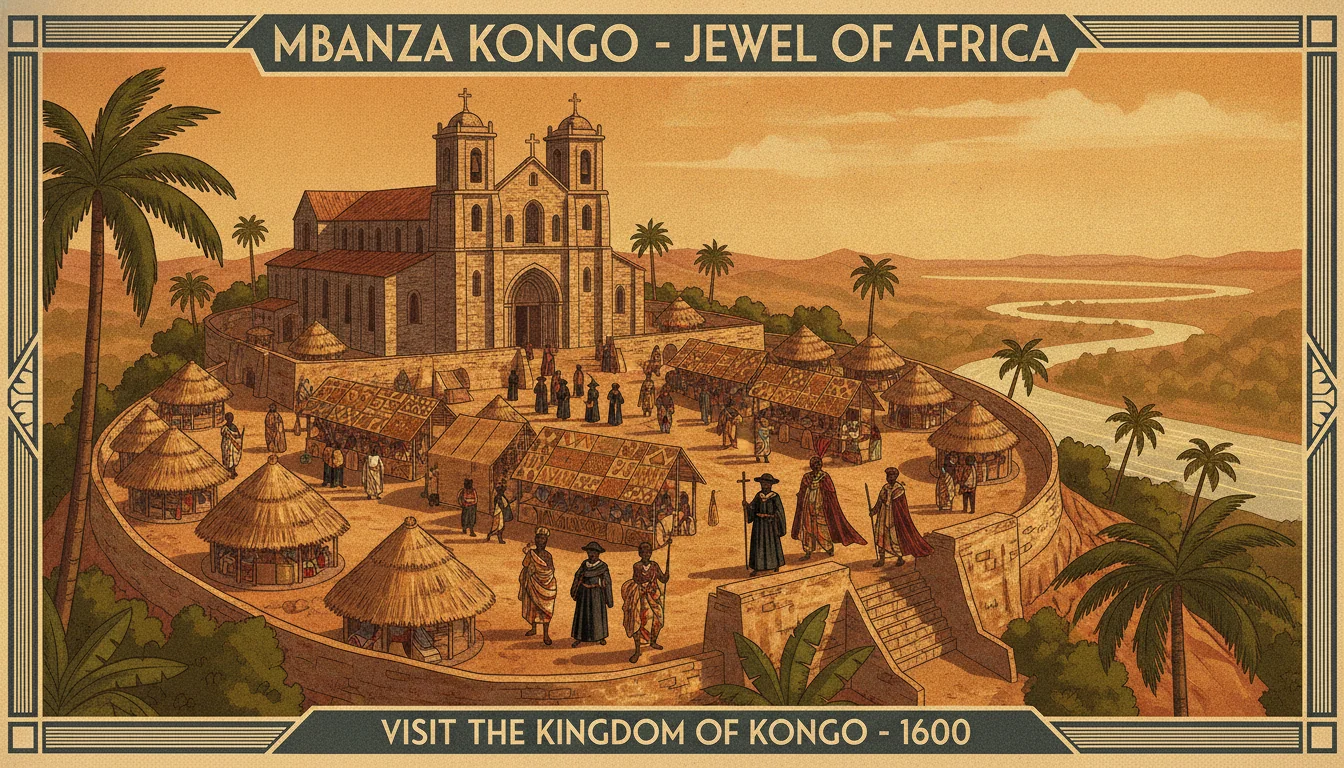
There is no easy city to step into in Central Africa in 1600 if you want a busy capital, a literate administration, and a diplomatic culture sophisticated enough to correspond with European monarchs in Portuguese and Latin. But Mbanza Kongo offers all three, on a high plateau in the northwest of what is now Angola, governed by a Christian king who has sent ambassadors to Lisbon and received Jesuits in return.
By 1600, the Kingdom of Kongo has been a Christian monarchy for over a century. The court maintains Catholic clergy. Parts of the elite can read and write. The reigning Manikongo, Alvaro II, has corresponded with Rome. If you arrive expecting a village, you will need a moment to recalibrate.
This is not the Africa of the European popular imagination. This is a sophisticated state with trade routes running to both coasts, a functioning tax system, a professional army, and an aristocracy navigating the most dangerous geopolitical development of the era: the Atlantic slave trade, which passes through their territory and through their hands simultaneously.
What kind of place you are entering
The Kingdom of Kongo is a hereditary monarchy with elective features - the Manikongo is drawn from the ruling Lukeni lineage, but the succession is managed by a council of nobles and does not follow strict primogeniture. Succession disputes have caused instability before and will again. In 1600, Alvaro II has been on the throne since 1587 and commands enough authority to present as a stable ruler, but the provinces on the eastern and northern periphery are more loosely controlled than the core.
The capital, Mbanza Kongo, may hold as many as 100,000 people - one of the largest cities in sub-Saharan Africa. It sits on a plateau at an altitude that makes the climate tolerable: cooler than the coastal lowlands, less humid than the forest zones further east. The city is organized into quarters associated with different clans, trades, and origins. The royal palace complex stands at the highest point. A stone cathedral occupies prominent ground nearby. A slave market operates in a designated section of the trading area.
These three things coexist in the same city. This is the essential fact about Mbanza Kongo in 1600: Christian, literate, politically sophisticated, and a transit node for the largest forced-migration event in human history to that point.
Language and communication
The language of the kingdom is KiKongo, a Bantu language with a tonal structure that requires considerable time to learn well. You will not acquire it in a day or a week.
Within the Kongolese aristocracy and the clerical establishment, Portuguese is usable. A century of missionary presence has established it as the language of correspondence with Lisbon, of the Church's services, and of commerce with Portuguese traders on the coast. The word for several everyday objects in 1600 KiKongo already carries Portuguese roots. If you speak Portuguese, you can navigate the upper tier of Kongolese society without a translator, particularly in formal contexts.
Do not assume, however, that Portuguese fluency will help you among ordinary people, farmers, market traders, or the enslaved persons who constitute a significant fraction of the capital's population. For those interactions you will need a KiKongo speaker or a multilingual intermediary. Such people exist, particularly among traders who work both the interior routes and the coastal contact zone, and are worth finding.
What to wear
Kongolese dress is made primarily from raffia cloth - woven from the fiber of the raffia palm in a range of weights and qualities. High-quality raffia can be worked fine enough to resemble velvet. Elite men wear elaborate wrapped garments; the Manikongo and senior nobility incorporate Portuguese-gifted cloth and elements of European cut into their wardrobe, particularly for formal occasions. Common people wear simpler raffia wraps covering the lower body.
If you arrive in modern clothing you will attract immediate and sustained attention. Your best option is to present yourself as a Portuguese trader or lay cleric, a category the Kongolese court has been dealing with for a century and understands. This requires at minimum a European-style doublet or plain outer garment acquired before arrival. You will look unusual to Kongolese eyes regardless of what you wear, but you will be a known category of stranger rather than an inexplicable one.
If you plan to travel into the city's market zones or the quarters away from the palace, dress plainly. Conspicuous wealth invites attention of all kinds.
Getting around the city
The streets of Mbanza Kongo are not paved. The city is organized around footpaths between family compounds, each compound typically walled and containing multiple structures and a garden. The overall arrangement is unmistakably urban - there is a logical geography to it, a sense of districts and neighborhoods - but it does not resemble a European city in layout.
The royal quarter is the most architecturally formal, with stone and brick structures reflecting a century of Portuguese-influenced construction. The cathedral is stone. Most of the rest of the city is built in local materials: packed earth, wood, thatch, and combinations of each.
Water comes from springs and from wells. Food arrives from the surrounding agricultural plateau at regular intervals. The smell of a large city in 1600 is what you would expect across cultures and centuries: smoke, animals, open drainage, food preparation, cloth-dyeing workshops, and the particular smell of a market operating in tropical heat.
The most useful tool for navigation is a connection to one of the noble families or to one of the missionary establishments. The Jesuits and Franciscans who staff the cathedral school have been mapping and moving through Mbanza Kongo for generations and are generally willing to assist a European visitor. Their hospitality comes with theological conversation, but it is practical as well as spiritual.
The political situation
Alvaro II has managed a stable reign so far by carefully balancing the internal demands of the Kongolese nobility against the external pressure of Portuguese commercial interests. The two are not always aligned. Portuguese traders want access to interior markets and enslaved people. Kongolese nobles want Portuguese goods, particularly copper, cloth, and prestige items. The court manages this exchange while trying to prevent Portuguese presence from becoming Portuguese control.
To the south, the Portuguese colony of Angola, formally established in 1575, is consolidating and beginning to exert pressure on Kongolese influence in the southern provinces. This is a slow-motion geopolitical problem in 1600. It will become an acute military one within a generation.
The slave trade runs through all of this. Kongolese rulers sell to Portuguese traders, primarily war captives and people from peripheral territories. The trade enriches the court and destabilizes the kingdom simultaneously - wars generate captives but also deplete populations, create grievances, and build enemies on the borders. The contradiction was visible to thoughtful observers even in 1600; the economic incentive was strong enough to override the observation.
What is worth seeing
The cathedral is the most remarkable structure in the city. Built in stone, maintained by Portuguese missionaries, it contains art that blends Kongolese aesthetic sensibility with Catholic iconography in ways that are unlike anything produced in Europe or in Africa independently. Kongolese Christianity by 1600 is not a thin colonial overlay. It is a century-old synthesis in which ancestral traditions, political theology, and Catholic practice have been woven into something genuinely new. The visual culture of that synthesis is worth the visit.
The market is worth a full day. Trade goods arriving through the Kongolese network come from hundreds of miles in every direction: copper from the inland mining zones, ivory from the eastern forest regions, raffia cloth in grades from common to luxury, salt from the coast, and the range of European trade goods that Portuguese ships carry north and south along the Atlantic. It is one of the most cosmopolitan commercial environments in Central Africa and gives a clear picture of how extensively connected the kingdom actually is.
Your safety
A foreigner who presents credibly as a Portuguese trader or representative is reasonably safe in Mbanza Kongo in 1600. The Kongolese court has managed European visitors for over a century, established protocols for receiving them, and has reason to maintain the relationship rather than disrupt it.
The risk is misidentification. A foreigner who cannot establish their identity and status in Portuguese or through a recognized intermediary is potentially categorizable as a captive. Substantial numbers of enslaved people move through this city. Be clear about who you are, whose company you travel with, and what your purpose is before you need to establish it under pressure. Arriving with a Portuguese trading contact or a missionary letter of introduction is strongly recommended. Arriving without any documentation, in clothes nobody recognizes, in a language nobody speaks, is a situation you do not want to have to explain.
The plateau climate is manageable by tropical standards, but you should expect heat, insects, and the standard range of infectious diseases that any densely settled African city of this period carries. Malaria is present in the lower-elevation zones around the city. The plateau itself offers some protection, but not immunity.
Go in the dry season. Go with a contact. Go ready to be surprised by how sophisticated a state the Kingdom of Kongo actually was. For other non-European capitals that confound the popular imagination of the era, the guides to visiting Ottoman Istanbul in 1555 and visiting Safavid Isfahan in 1680 cover two other cities that were, by almost any measure, more cosmopolitan than most of contemporary Europe.
Quick Answers
Common questions about this topic
What was the Kingdom of Kongo in 1600?
The Kingdom of Kongo was one of the largest and most powerful states in Central Africa, centered at Mbanza Kongo on a high plateau in what is now northwestern Angola. At its height it encompassed portions of modern Angola, the Democratic Republic of Congo, and Republic of Congo, with a population of several million people and a capital city of perhaps 100,000.
When did the Kingdom of Kongo become Christian?
King Lukeni lua Nimi (baptized Joao I) converted to Christianity in 1491 after contact with Portuguese missionaries. His son Afonso I became one of the most devout royal converts in African history, corresponding with the King of Portugal and the Pope in Latin. By 1600, Christianity was deeply embedded in Kongolese aristocratic culture, though popular practice blended Catholic and ancestral traditions.
What was the relationship between Kongo and Portugal in 1600?
Complex and increasingly unequal. Kongolese kings maintained Catholic clergy, traded with Portuguese merchants, and corresponded with Lisbon as sovereign equals in formal terms. But Portuguese-controlled trading networks were the primary channel for the Atlantic slave trade, and Kongolese rulers themselves participated in it - selling war captives and condemned people to Portuguese traders on the coast in exchange for cloth, copper, and prestige goods.
What happened to the Kingdom of Kongo after 1600?
The kingdom declined through the 17th century under pressure from internal succession disputes and Portuguese military encroachment from the south. The decisive blow came at the Battle of Mbwila in 1665, where Portuguese forces and their Angolan allies defeated and killed the reigning Manikongo, fracturing central authority for a generation. A formal Kongo state persisted in reduced form until the early 20th century.

Need Advice from Someone Who Lived There?
Get firsthand accounts from people who actually lived through these moments in history.
Ask Them YourselfJoin the HistorIQly Club
Get smarter about the past.
Weekly stories, deep dives, and exclusive content straight to your inbox.