Time Traveler's Guide to Knights of Malta, 1620
Your guide to the Knights of Malta in 1620 - where warrior-monks run a fortified harbor, raid Ottoman shipping, and operate the finest hospital in the Mediterranean.
Read Wikipedia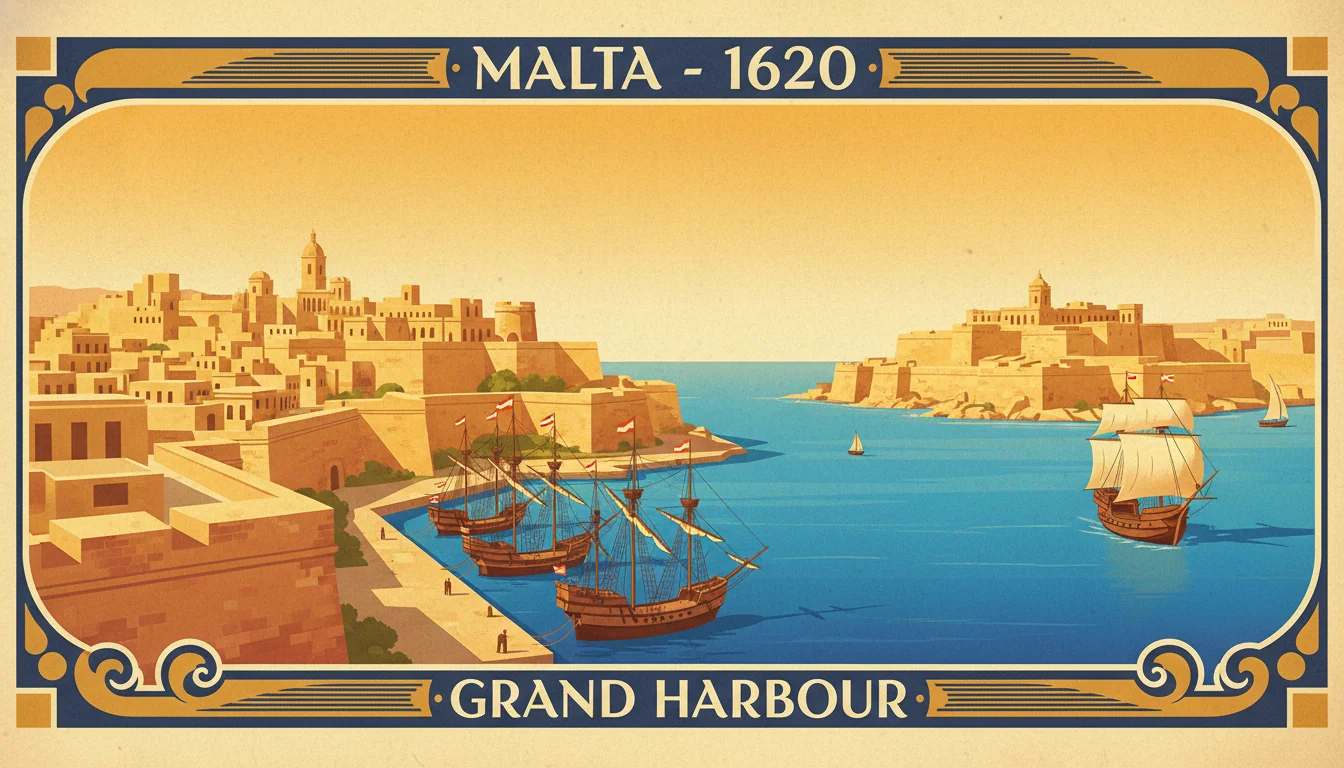
You arrive by sea, which is the only way to arrive. The harbor entrance is narrow enough that two galleys tied abreast would nearly block it, and that narrowness is the point. On either side of the entrance, fortifications rise straight from the limestone rock, bastions stacked on bastions, cannon embrasures staring down at the water from every angle. The whole arrangement was designed by engineers who had survived the Ottoman siege of 1565 and had fifty-five years since then to make sure it never happened again.
Welcome to Valletta, capital of the Sovereign Military Order of Saint John - today known as the Knights of Malta - in the summer of 1620. The sun is relentless. The limestone everything is built from throws the heat back at you. The smell from the harbor is complex and insistent.
Getting here and who you are
For practical purposes, you are traveling as a European merchant or a pilgrim in transit to the Holy Land, which passes through Malta with some frequency. The Order maintains control over who enters Valletta, and an unexplained foreigner without obvious purpose will attract the wrong kind of attention. A letter of introduction from a Catholic institution, or a plausible trading commission, smooths most interactions.
Your ship will anchor in the Grand Harbor, which is divided into several creeks separated by peninsulas and fortified headlands. The Customs House on the Valletta side will register your arrival. An official will want to know your name, your origin, and your business. Answer honestly, be Catholic in your visible conduct, and you will be waved through. Be Protestant and keep that information private.
The Order is not naively hospitable. Their intelligence network, built over centuries of operating between Christian and Muslim powers, is more developed than most principalities twice their size. Grand Master Alof de Wignacourt, now in his nineteenth year of leadership and approaching the end of a notably effective tenure, runs a state that knows what is happening in its own ports.
What you see
Valletta is a young city by 1620, only 54 years old, but it does not feel young. The Order poured enormous resources into building it quickly and well after the Great Siege made the old capital at Mdina seem too far inland and too exposed. The streets run in a grid, unusual for a Mediterranean city of this period, which means you can navigate without spending the morning lost in alleys. The grid also means the breeze from the harbor moves through the streets in summer, which matters more than it sounds.
The main street, Strada San Giorgio, runs from the city gate straight to the Auberge de Castille at the far end. Along it you pass the auberges of the various national langues, the eight national divisions of the Order, each with its own building and its own officers. The knights of France, Provence, Spain, Portugal, Italy, Germany, England (nominally, though England left the Catholic order after the Reformation and the langue is technically vacant), and Auvergne each maintain their own community within the larger whole. The architecture is self-consciously grand in the way that institutions with uncertain tenure tend to be: we are permanent, the buildings announce, even if the situation outside our walls says otherwise.
The Cathedral of St. John, consecrated in 1577, is still being decorated. By 1620 it already contains Caravaggio's enormous canvas depicting the beheading of the saint, completed during the painter's stay in Malta in 1608 and 1609. Caravaggio arrived under a false name, was admitted as a knight (briefly, and irregularly), painted some of the most extraordinary work of his career, committed an assault on a fellow knight, was imprisoned, escaped in dramatic fashion, and fled. His painting remains. It is the largest Caravaggio in existence and worth the visit in any era.
The hospital of the Order, the Sacra Infermeria, is located just below the city walls near the harbor. By common consent of visitors from across Europe, it is the finest medical facility in the known world in this period. The wards are enormous: the main hall is nearly 160 meters long, lit by high windows, scrubbed daily. Patients are fed from silver plates, a rule the Order maintains as a matter of dignity for the sick. The physicians include some of the most learned doctors in Europe, attracted by the Order's reputation and its resources. If you fall ill in Malta, you are in the best possible place for the times.
The real business of the harbor
The Order of St. John is a religious institution and a hospital and a military power, but in 1620 it sustains all three functions largely through maritime raiding. The corso, the authorized privateering against Muslim shipping, is the Order's primary revenue source. Galleys and sailing vessels depart regularly for patrols in the eastern Mediterranean, returning with prizes: cargo, vessels, enslaved persons.
This requires a word of clarification. If you are visiting from a Muslim-majority country or traveling on a ship from the Ottoman sphere, Malta is not a safe port of call. The slave market on Malta is active and busy. The Order takes Muslim prisoners from the corso and uses them as galley rowers or sells them in the market. The irony that the Order also maintains the finest hospital in the Mediterranean and enslaves people from the same trade routes is something they appear to have processed comfortably.
Conversely, Barbary corsairs based in North Africa run their own raids on Maltese and European shipping. The exchange is roughly reciprocal and equally brutal. If your ship is taken at sea in these waters, your nationality and religion determine whether you are ransomed, enslaved, or killed.
On land, the Grand Harbor is one of the busiest ports in the Mediterranean. Merchant vessels from Venice, Genoa, Sicily, Naples, and Spain call regularly. Grain comes in from Sicily to the west and from Egypt on captured vessels. Silk and spices change hands on the quays below Valletta. The Order levies port duties and takes a cut of prize sales.
How to eat and where to sleep
There are taverns near the harbor and inns along the main streets suited to traveling merchants and mariners. The food is based on what grows on the islands: rabbit, caught in the limestone countryside in large numbers, cooked in a wine sauce that is better than you expect. Ftira, a ring-shaped bread baked in stone ovens, is sold from street stalls in the morning. Fish is plentiful, octopus is dried on lines in every fishing village you pass. Local wine is made from grapes grown in the interior, somewhat rough, improved by the heat if you have reasonable expectations. Imported wines from Italy are available at better establishments for those with money.
Tobacco has recently arrived in Malta and you will smell it in taverns and on the quays. Some knights smoke it. The practice is new enough that it still attracts comment.
The danger you may not anticipate
The most overlooked hazard in 1620 Malta is not the Barbary corsairs or the summer heat. It is the social dynamics of the Order itself. The knights are mostly young men from European noble families, armed, bound by vows of celibacy and obedience that they observe with varying fidelity, cooped up on a small island with an institutional culture that resolves disputes through violence and accepts dueling as a normal fact of life.
Street altercations between knights, and between knights and civilians, are common. The Order has rules against them and enforces them inconsistently. Caravaggio's imprisonment was for striking a fellow knight in the face. The correct response to witnessing such an altercation is to find a side street immediately. You are not a knight. The person who started the fight has friends.
The hierarchy is complex and mostly invisible to outsiders. Seniority within the Order, membership in a particular langue, and personal relationships with senior officials can all determine whether an incident involving a visitor is treated as a minor inconvenience or a serious matter. Be polite, be unobtrusive, and avoid any confrontation with anyone wearing a black habit with a white eight-pointed cross.
Before you leave
If you have the means, take a small boat to Gozo, the sister island to the northwest. It is quieter than Malta, its citadel is smaller and older, and the views over the channel between the two islands on a clear morning give you some sense of why the Knights, surrounded by enemies on all sides, chose this particular limestone archipelago as the place they would hold.
They held it until Napoleon took it in 1798, at which point the Order surrendered after two days of negotiation, which is either practical or anticlimactic depending on your perspective. By 1620 that day is still 178 years away. The Great Siege is recent memory. The fortifications are the newest and best in the Mediterranean. The harbor is full of ships.
It is a remarkable place to be.
For other stops on the early modern Mediterranean time-travel circuit, see Visiting Ottoman Istanbul, 1555 and Renaissance Florence, 1490.
Quick Answers
Common questions about this topic
Who were the Knights of Malta in 1620?
The Knights of Malta were the Order of St. John of Jerusalem, a Catholic military and hospitaller order that held the island of Malta as a sovereign territory from 1530. By 1620 they had been there 90 years, had survived the Great Siege of 1565, and were one of the most powerful naval forces in the central Mediterranean.
Was Malta safe to visit in 1620?
For a European Christian traveler with appropriate documents and the right language skills, Malta was relatively safe on land. The island's fortifications were among the strongest in the world. At sea, however, the waters around Malta were actively contested between the Order's corsairs and their Ottoman and Barbary counterparts.
What language was spoken in Malta in 1620?
Maltese, a Semitic language written in a Latin-derived form, was spoken by the local population. Italian was the working language of the Order and the most useful lingua franca for visitors. Many knights spoke French, Spanish, or Portuguese depending on their national tongue and their langue, the national division of the Order.
What was Valletta like in 1620?
Valletta in 1620 was roughly 54 years old, built from nothing after the Great Siege. It was a planned Renaissance city of straight streets, baroque churches under construction, and massive limestone fortifications. The harbor it overlooked was the busiest in the central Mediterranean, and the Order's fleet was tied up at the quays below the city walls.

Need Advice from Someone Who Lived There?
Get firsthand accounts from people who actually lived through these moments in history.
Create your free account →No card required. Talk to anyone in history with 8 free credits a day. Some features require a paid plan.
Join the HistorIQly Club
Get smarter about the past.
Weekly stories, deep dives, and exclusive content straight to your inbox.