Time Traveler's Guide to Reformation Wittenberg, 1517
It's Reformation Wittenberg 1517, and a theology professor is about to nail complaints to a church door - your guide to the town that cracked Christendom.
Read Wikipedia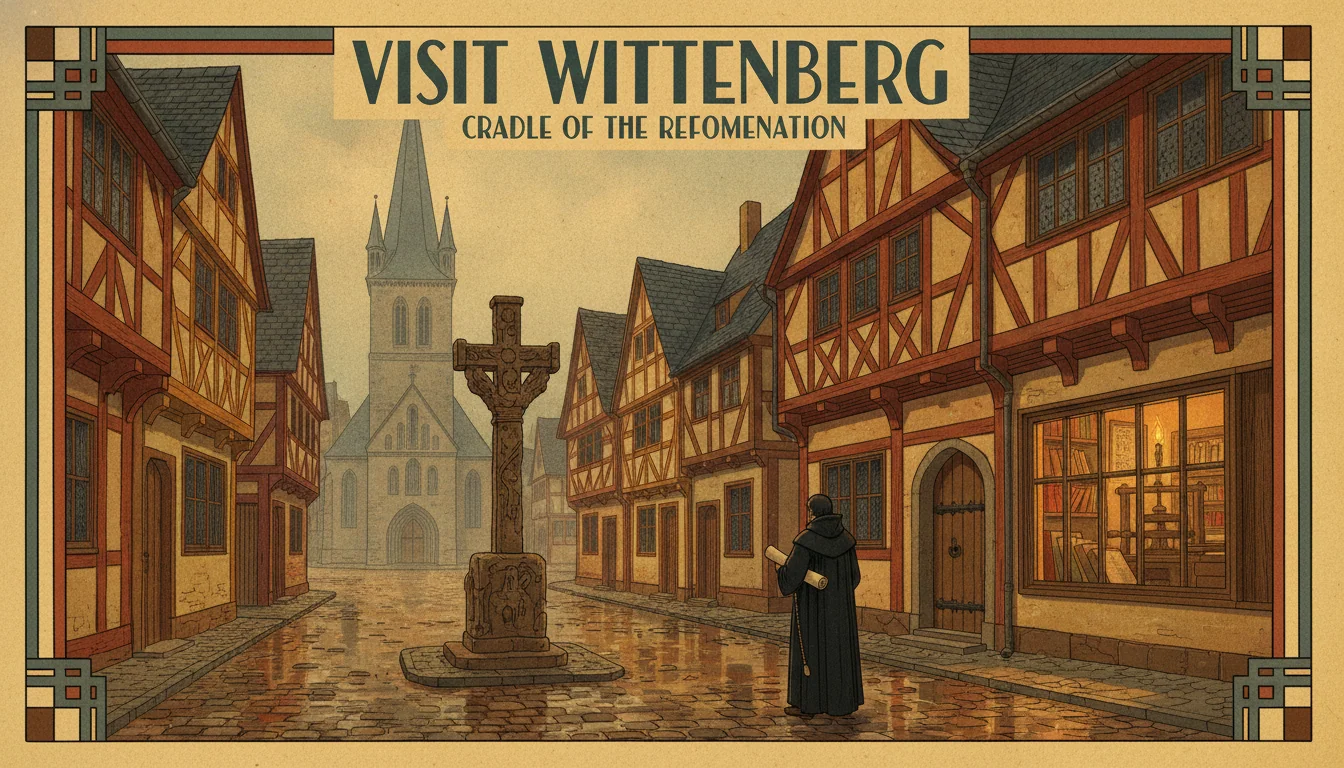
Welcome to Reformation Wittenberg 1517: population roughly 2,500 souls, a market, two churches, a university that is only fifteen years old, and a theology professor who is about to write a list of complaints that will shatter European Christianity for centuries. Pack lightly. The locals are preoccupied.
Wittenberg in 1517 sits on a low ridge above a bend in the Elbe River in Electoral Saxony - a flat, grey-skied corner of central Germany that Friedrich III, the Elector, has been quietly developing into something more than a provincial backwater. The streets are unpaved, the buildings mostly timber-framed, and the market square on a Monday morning smells of fish, livestock, and wood smoke. The Castle Church at the western end of town and the Town Church of St. Mary at the centre between them represent the entire physical ambition of the place. Neither is Cologne Cathedral. Together they are the most important buildings in early 16th-century Christianity, a fact that nobody here yet knows.
Getting in
You arrive through one of the town gates, most likely the western gate if you have come from Wittenberg's main road connections. There is a customs post. Have a reason for your presence - scholar, merchant, pilgrim - and stick to it. The town is academically active enough that a visiting scholar raises no eyebrows. The University of Wittenberg, founded by Friedrich the Wise in 1502 and formally known as the Leucorea, draws students from across Electoral Saxony and beyond.
The Elector Friedrich is the key political fact of your visit. He protects the university with something approaching passion, he has assembled one of the largest relic collections in Europe at the Castle Church (over 17,000 pieces, the church's guide will tell you with pride), and he is quietly skeptical of church overreach into his territory. When the indulgence controversy erupts, he will not allow the papal agent Johann Tetzel to operate within his lands. Whether this is theological conviction or political calculation is a question his contemporaries also cannot answer.
What to wear
The easiest mistake is arriving in black, which in 1517 marks you unmistakably as clergy or a wealthy merchant in formal dress when you want to pass unnoticed. Plain wool in earth tones - brown, grey, muted red - is what most people in a town this size wear. Men wear hose and a doublet, women a kirtle with a linen shift beneath. Your shoes will determine how much of the street filth reaches your legs.
A linen shirt under everything is non-negotiable from a social standpoint. It will need washing more often than your outer garments. Bring spare linen or plan to acquire it at the Monday market, where cloth is sold alongside grain, fish, and agricultural tools.
If you are presenting yourself as a scholar - the cover story most easily sustained near the university - acquire a black academic robe. This will be both less conspicuous and more useful than anything contemporary you might have brought.
Food and drink
Wittenberg's primary inn sits on or near the Marktplatz and will provide you with rye bread, salt fish, pickled vegetables, and beer as a matter of course. The beer is important. The water drawn from the town wells is bacterially interesting in ways that are uniformly bad. The local brewery produces a dark, heavy ale that most townspeople drink from morning onward. Acquire the habit.
The market on Monday mornings offers dried and smoked meats, root vegetables through the autumn, fresh fish from the Elbe, and bread. The autumn of 1517 has been a reasonable harvest year; you will not find extraordinary scarcity, though prices are higher near the university because the students, however poor, represent a captive market.
Do not expect fresh produce of any variety that is not currently in season. No lemons. No pepper unless you are dining with someone wealthy. Salt is everywhere and expensive. Sugar, if you need it, comes from a merchant specializing in Levantine goods.
The Castle Church and the notice board
The Schlosskirche, the Castle Church at the end of the Schlossstrasse, is both a relic-viewing destination and an academic notice board. The north door is where the university posts its disputation notices - formal invitations to scholarly debate on contested theological questions. On or around October 31, 1517, a document will appear on this door.
The man who puts it there is Martin Luther, thirty-three years old, professor of biblical theology at the university since 1512, an Augustinian friar, and a man in a state of sustained theological agitation. He has just written ninety-five propositions challenging the theology and practice of indulgences. He may post them himself; he may send them to the Archbishop of Mainz and rely on someone else to put them up; the precise mechanics have been disputed since the event. What is not disputed is that by December 1517, thanks to the printing press, copies of those propositions will be circulating across the German lands in a speed that neither Luther nor anyone else anticipated.
If you are present in October, the document on the church door looks entirely routine. A disputation notice in Latin. The kind of thing that appears and is taken down without much discussion. You will not know you are watching the opening act of the Reformation unless you already know what to look for.
The print shop
Lucas Cranach the Elder, court painter to the Elector and arguably the most important visual artist in the German lands east of the Rhine, has a print shop and pharmacy in Wittenberg. Cranach is forty-five in 1517, established, wealthy, and well-connected. His workshop produces portraits, religious panels, and printed broadsheets.
It is the broadsheet operation that matters for what is about to happen. Within weeks of Luther's theses circulating in manuscript, Cranach's press and others in the German-speaking world will reproduce them in print at a scale that makes the controversy impossible to suppress. You can visit the shop openly - it functions partly as a commercial pharmacy - and observe a working 16th-century print operation, which is itself a recent technological revolution built on the origins of the printing press, Gutenberg having operated his own press in Mainz fewer than seventy years earlier.
What to avoid
Religion is not a safe conversational topic in any direction. The local population is Catholic in the way that everybody in Electoral Saxony is Catholic in 1517: by default, by upbringing, by the absence of any alternative. But there are currents of dissatisfaction with Rome, with indulgence sellers, with the financial demands of the Church, that run through the merchant class and the university alike. You do not know yet which of the people you meet will become reformers, which will remain Catholic, and which will be burned for their views within a decade.
Avoid expressing opinions. Ask questions about crops, about university lectures, about local gossip. Plague is a genuine hazard in any German town in this period - not actively present in Wittenberg in late 1517, but a contingency to be taken seriously. If word reaches the town of an outbreak in nearby territories, the university will suspend lectures and people will leave. Have a departure route.
The Elbe provides your fastest exit: river transport moves goods and people along the Saxon corridor regularly, and a boat downriver to a larger city is the most reliable way to leave quickly if necessary.
The town after October
The month of October 1517 passes quietly by its own standards. Luther's document goes up. Some people read it. A few scholars argue about it. The print shops begin their work. By Christmas, the Archbishop of Mainz will have forwarded copies to Rome. By spring 1518, a papal investigation will have been opened. Within three years, Luther will be excommunicated and the town of Wittenberg will be the centre of the most consequential theological controversy in European history.
For now it is still a small town on a flat Saxon river, smelling of smoke and rye, with its Monday market and its brewery and its fifteen-year-old university and its thirty-three-year-old theology professor who cannot yet sleep at night - a far cry from the wealth and spectacle of Renaissance Florence further south, but about to matter far more.
The beer is adequate. The bread is heavy. The notice board outside the Castle Church, on an October morning, holds the document that will divide Western Christianity for the next five centuries and counting.
Do not mention this to anyone.
Quick Answers
Common questions about this topic
What was Wittenberg like in 1517?
Wittenberg was a small electoral Saxon town of roughly 2,000 to 3,000 residents, sitting on the south bank of the Elbe River. It had a university founded in 1502, a market square, a brewhouse, and two notable churches. It was unremarkable by German standards - a minor administrative and academic centre that happened to be about to become the most consequential address in European religious history.
Did Martin Luther really nail the 95 Theses to the door?
Probably not in the dramatic single-hammer stroke of tradition. The story of a public nailing derives primarily from a 1546 account by Philipp Melanchthon, who was not present. Luther himself described posting the theses and sending them to church authorities. The Castle Church door was a standard academic notice board for university disputes, and Luther was almost certainly posting them in that spirit, not staging a public protest.
Why did Luther object to indulgences?
Indulgences were papal certificates sold to reduce time in purgatory, either for the buyer or for a deceased relative. Luther's objection was theological: he argued that forgiveness of sin came from God's grace through faith, not from purchased certificates. The specific catalyst was the indulgence campaign run near Saxony by Johann Tetzel to fund the construction of St. Peter's Basilica in Rome.
What language did people speak in Wittenberg in 1517?
Early New High German, the transitional form between Middle High German and the modern language. Luther's later translation of the Bible into this dialect was enormously influential in standardizing written German. In 1517, educated residents also communicated in Latin, which was the language of the university, the Church, and all formal administration.

Need Advice from Someone Who Lived There?
Get firsthand accounts from people who actually lived through these moments in history.
Create your free account →No card required. Some figures and features require a paid plan.
Join the HistorIQly Club
Get smarter about the past.
Weekly stories, deep dives, and exclusive content straight to your inbox.