The West Mesa Bone Collector: Albuquerque's Unsolved Mass Grave
In 2009, a dog walker discovered bones on Albuquerque's West Mesa. The West Mesa Bone Collector case uncovered 11 victims and remains unsolved today.
Read Wikipedia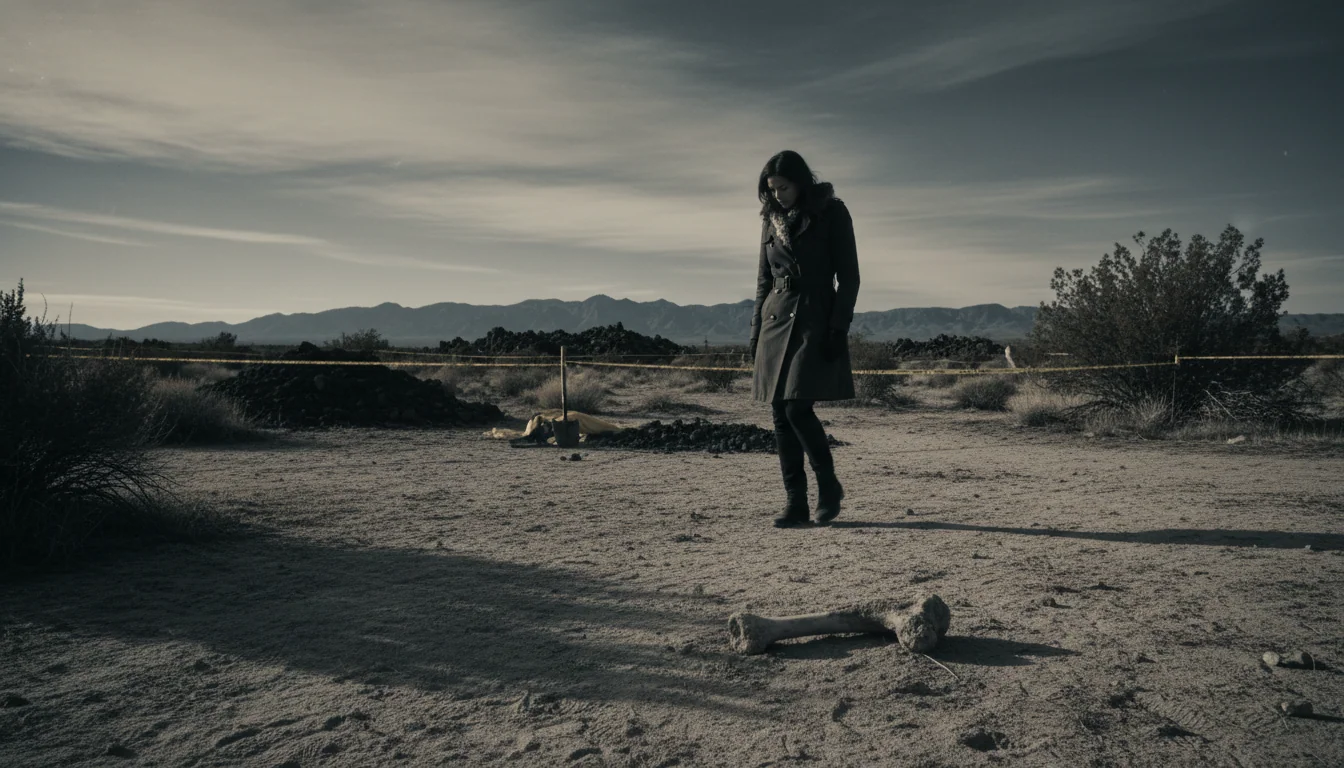
On the morning of February 2, 2009, a woman walking her dog across the scrubland west of Albuquerque found a human leg bone sticking out of the dry earth. The site was roughly seven miles southwest of downtown, a stretch of undeveloped high desert called the West Mesa - volcanic rock, juniper scrub, and the kind of silence that belongs to land nobody has yet built on. Police were called. The excavation that followed turned that silence into one of the largest forensic crime scenes in New Mexico history.
By the time investigators finished working the site, they had recovered the skeletal remains of eleven women and one fetal set of remains, found at multiple scattered locations across roughly a square mile of desert. The women had been deposited there over a period of several years. No one has ever been charged with their murders.
A site with a double life
The West Mesa in the early 2000s meant different things to different people. City planners saw undeveloped land in the path of Albuquerque's westward suburban sprawl. People familiar with the street economies along Central Avenue - the old Route 66 corridor running through the city's poorer neighborhoods - saw something else: a place that was dark at night, unreachable by casual observers, and useful to someone who needed privacy and time.
The victims were predominantly young Hispanic women, most last seen between 2001 and 2005. Ages ranged from the mid-teens to the early thirties. Many were connected to sex work or to the informal drug economy along Central Avenue and in the South Valley neighborhoods immediately east of the mesa. They had disappeared from communities close to the land that would hold their remains for years.
Most of their disappearances had been reported to police. Most of those reports went nowhere.
The failure that preceded the bones
Understanding the West Mesa case means understanding what happened before the discovery. When the bones were found in 2009, families came forward immediately with accounts of filing missing persons reports years earlier, waiting, calling back, and being told to wait again. In several cases women had been gone four or five years before the excavation confirmed they were dead.
This pattern - the diminished institutional response to missing women from marginalized communities - has been documented at scale across American policing. Critics describe it as the hierarchy of victims: a largely invisible calculus in which the urgency attached to a disappearance correlates with the victim's perceived social standing. Women involved in street economies, women with criminal records, women without stable housing, receive systematically slower attention when they disappear.
The West Mesa case is one of the clearest American examples of how that calculus enables prolonged violence. By the time the first bone was found in 2009, the killer had apparently stopped using the site several years earlier. The desert had erased whatever forensic footprint was there - tire tracks, footprints, biological trace material - that a contemporaneous investigation might have captured and used. The crime scene had aged past recovery before anyone knew it was a crime scene at all.
The investigation
Albuquerque police, the FBI, and the New Mexico Office of the Medical Investigator excavated the site through 2009, using cadaver dogs, ground-penetrating radar, and systematic grid searches. Forensic anthropologists worked through months of careful recovery to identify the remains.
Nine of the eleven victims were eventually identified using dental records, DNA comparison with family members, and bone analysis. Two remained nameless for years. A later identification using advances in forensic DNA technology reduced that number. But as of the most recent public update, at least one woman found on the West Mesa was still unidentified - a fact that captures in miniature what the whole case represents: lives so thoroughly outside official view that even their deaths could not fully register.
The investigation produced persons of interest. It did not produce charges.
Lorenzo Montoya
The name most frequently associated with the West Mesa murders is Lorenzo Montoya, and his story is frustrating precisely because it ended before any legal reckoning could occur.
In December 2006, a 14-year-old girl named Jamie Garcia disappeared from the Westside area of Albuquerque. Her body was found hidden in the crawl space beneath the home of a local laborer named Lorenzo Montoya. Before Montoya could be arrested and tried, he was shot and killed by Garcia's father.
When the West Mesa remains surfaced two years later, investigators examined Montoya closely as a central person of interest. The geography overlapped with his known movements. The victim profile - young Hispanic women from the street economy on Albuquerque's west side - matched precisely. The disposal method, using isolated scrubland at the city's edge, was consistent with how the West Mesa killer had operated.
DNA comparisons between material found at Montoya's property and evidence from the West Mesa site were conducted. Investigators have never publicly confirmed a definitive forensic link. The official case remains open with no named suspect.
This ambiguity is real, not merely procedural. Montoya is dead and cannot be questioned, tried, or compelled to answer. Whether he was the sole killer, one of several people involved, or a convenient convergence of matching circumstantial details has never been established with the evidentiary weight a criminal case requires. The families of the West Mesa victims deserve more than a probable answer assembled from overlap.
Attempts to move the case forward
The FBI has maintained the West Mesa murders as an active cold case, and periodic reviews have assessed new forensic tools as they developed. The advent of forensic genealogy - matching DNA from crime scene evidence against public genealogical databases to identify biological relatives of an unknown suspect - received considerable attention in connection with West Mesa after the technique helped close multiple long-unsolved American homicide cases starting in the late 2010s.
No public announcement of a genealogical DNA hit has been made in connection with the West Mesa case as of 2026.
Victim advocates, investigative journalists, and the families of the identified women have worked consistently to keep the case in public view and to push for additional identifications and investigative action. The case has been incorporated into broader advocacy around missing and murdered Hispanic and Indigenous women, a category of violence that federal and state agencies have increasingly acknowledged is both significantly undercounted and systematically underinvestigated.
The two-decade gap between the killings and any resolution also poses a practical challenge. Witnesses have aged, died, or moved. Persons of interest who were accessible in 2009 are harder to locate in 2026. Memories that could once have been cross-checked against physical evidence have faded past the point of reliable testimony.
The shape of the case
The West Mesa Bone Collector case fits a pattern that appears repeatedly in American criminal history: multi-victim cases concentrated among communities where the protections that serve other populations are thinner and slower to arrive. The Gilgo Beach victims on Long Island, the Green River victims in Washington State, the Chillicothe missing women in Ohio - in each, vulnerable women disappeared over years, their reports filed and shelved, while the investigation that might have intervened earlier never came.
That structural observation is not separate from the crime. It is woven into it. A killer who selects victims from informal economies is, in practice, selecting from the population least likely to trigger sustained official attention. Whether the West Mesa killer understood this in those terms or simply learned it from years of access to the site, the practical result was the same: years of impunity on a patch of desert west of a city that was not looking.
For the women whose bones lay there through years of Albuquerque winters and summers, the accounting is not finished. The case stays open. The technology advances. The families wait for something more than a probable answer.
Seventeen years after the first bone was found, no one has been made to answer for what happened on the West Mesa.
For a comparable pattern of institutional failure along a different American highway, see our investigation into the Texas Killing Fields on I-45.
Quick Answers
Common questions about this topic
How were the West Mesa victims discovered?
On February 2, 2009, a woman walking her dog on undeveloped desert land on Albuquerque's southwestern edge found a human leg bone in the ground. Police excavations over the following months uncovered the skeletal remains of eleven women and one fetal set of remains scattered across roughly one square mile of the West Mesa.
Who is suspected in the West Mesa murders?
No one has been charged. Lorenzo Montoya, an Albuquerque laborer killed in 2006 before he could be prosecuted for a separate murder, is the most commonly named person of interest. His victim profile, geography, and method overlapped with the West Mesa case, but investigators have never publicly confirmed a definitive forensic link.
Were all the West Mesa victims identified?
Nine of eleven victims were identified through dental records, DNA comparison with families, and forensic analysis. Two remained unidentified for years, and a subsequent identification using advances in DNA forensics reduced that number. As of the most recent public update, at least one victim remained unknown - a woman whose identity was as thoroughly erased as her life.
Why were the disappearances not investigated sooner?
Most victims were women connected to sex work or substance abuse, communities that historically receive slower official responses to missing persons reports. Families described filing reports with Albuquerque police and hearing little back for years. Critics argued the systemic failure to pursue these reports allowed the killer to operate undetected for years.

Want to Interrogate the Suspects?
Chat with historical figures and uncover the truth behind history's greatest mysteries.
Create your free account →No card required. Talk to anyone in history with 8 free credits a day. Some features require a paid plan.
Join the HistorIQly Club
Get smarter about the past.
Weekly stories, deep dives, and exclusive content straight to your inbox.