What If the Library of Alexandria Never Burned?
The Library of Alexandria never burned in one night. Its slow, centuries-long death raises a sharper question: how much would surviving have changed?
Read Wikipedia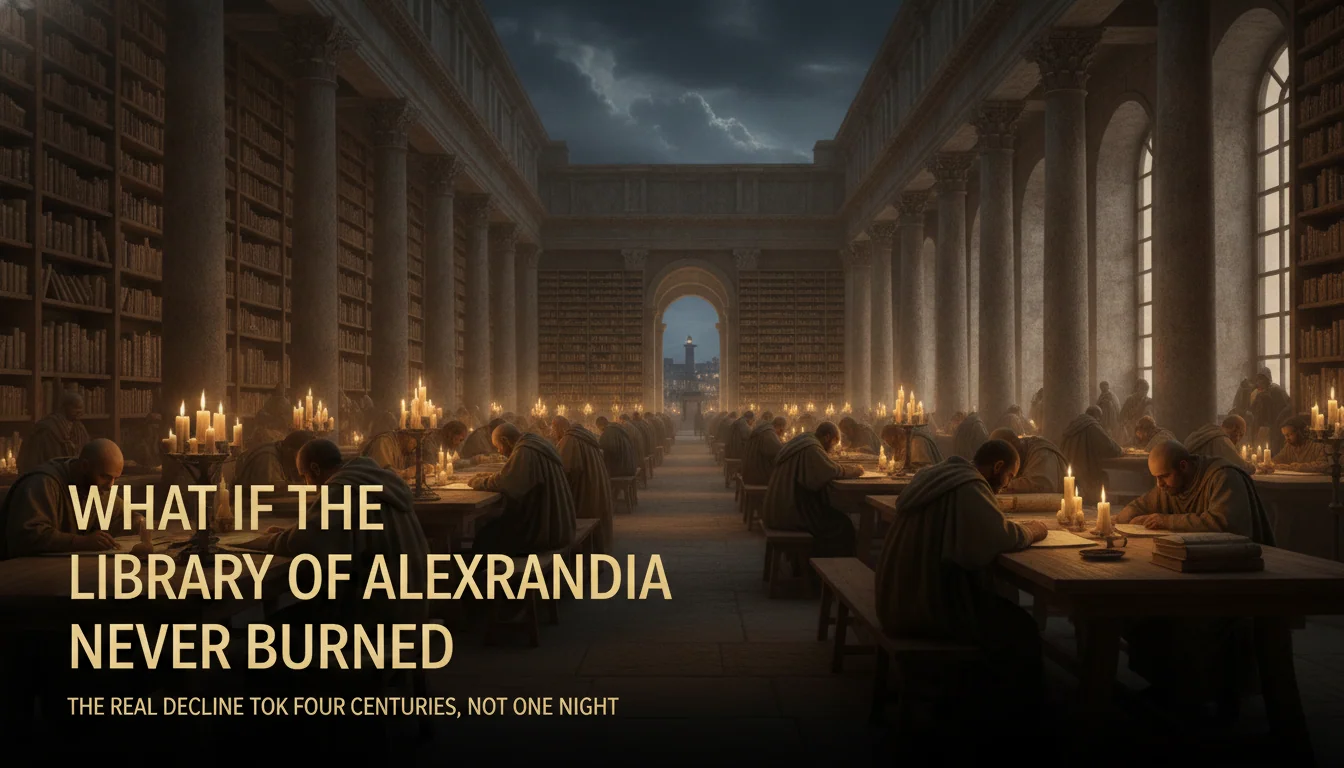
Ask most people how the Library of Alexandria was destroyed and you get the same movie in miniature: Julius Caesar's soldiers, a stray torch, an entire civilization's accumulated wisdom going up in one apocalyptic night. It is a great story, with a villain, a single moment, and a body count measured in scrolls instead of people. It is also, according to most of what survives in the ancient record, not really what happened.
The truer story is slower: an institution that rose spectacularly, then bled out over roughly four centuries through neglect, war, funding cuts, and religious upheaval, with no single fire responsible for its end. That makes the popular counterfactual, "what if it had never burned," a slightly different question than it first appears. There was no one match to un-strike. So the more honest version of the thought experiment is this: what if the institution behind the library, the royal patronage and the scholarly community that fed it, had simply never been allowed to decline at all?
What actually happened
The library was founded in Alexandria in the early third century BC, under the first Ptolemaic kings who ruled Egypt after Alexander the Great's death, the same dynasty that would end three centuries later with Cleopatra. It grew out of and alongside the Mouseion, a research institute dedicated to the Muses that functioned something like a state-funded university, housing scholars on royal salary rather than students paying fees. Ancient writers describe an aggressive acquisition policy: ships docking in Alexandria's harbor reportedly had their scrolls confiscated for copying, with copies (not always the originals) returned to the owners. Ancient sources cite scroll counts running from the tens of thousands into the hundreds of thousands, figures modern historians treat with real skepticism, since no surviving inventory backs up any of them.
What the library produced is not in dispute. Euclid organized geometry into the textbook form still recognizable today. Eratosthenes, a librarian himself, calculated the circumference of the Earth using little more than shadows, wells, and geometry, and got remarkably close to the real figure. Herophilus and Erasistratus performed some of the earliest systematic human dissections on record, mapping anatomy that would not be revisited with comparable rigor for well over a thousand years. Callimachus compiled the Pinakes, an ambitious catalog of Greek literature that functioned as a foundational bibliography for the ancient world, even though it too has not survived.
Then came the long decline, in stages rather than a single blow. In 48 BC, during a military crisis in Alexandria, Julius Caesar set fire to ships in the harbor to deny them to his opponents, and ancient writers, including Plutarch, report the fire spread to buildings on shore, possibly including warehouses storing scrolls awaiting export. Whether this touched the main library collection or a secondary stockpile is genuinely disputed, and the ancient accounts themselves disagree on the scale of the loss. Over the following three centuries, the Mouseion's fortunes tracked the empire's: funding tightened, political turmoil in the city repeatedly spilled into violence, and fighting during a Roman emperor's reconquest of the city in the 270s AD damaged the palace quarter where the library had stood. By 391 AD, when a Christian mob destroyed the Serapeum, a temple complex housing a subsidiary library collection, following an imperial edict against pagan worship, the main Mouseion library had likely already ceased to function as the institution it once was. A much later story, that a Muslim caliph ordered the city's books burned to heat public baths after the conquest of Alexandria in 641 AD, surfaces only in accounts written centuries afterward and is treated by most modern historians as legend, not least because there is little evidence a great library still existed there to burn.
The point of divergence
So the counterfactual worth asking is not "what if Caesar's fire never happened," since that fire, even at its worst, was probably not the decisive blow. The more useful hinge is institutional: what if the Ptolemaic and then Roman authorities in Egypt had kept funding the Mouseion at something like its founding-era level, kept it insulated from the recurring civil violence in Alexandria, and kept it staffed with working scholars straight through the third, fourth, and fifth centuries AD, rather than letting royal patronage lapse as Rome's own priorities shifted?
That is a plausible change, not a fantastical one. Royal and imperial patronage of scholarship was a recurring choice in the ancient world, not a law of nature. Other cities, including Pergamon and later Constantinople, sustained major libraries for centuries under sustained institutional backing. Alexandria's Mouseion had every ingredient to do the same: an endowed staff, a river of incoming scrolls through its harbor, and, for a long stretch, no serious military threat to the city itself. What it lacked, especially after Egypt became a Roman province in 30 BC, was a ruling power for whom funding Greek scholarship in Alexandria specifically stayed a political priority through every crisis. Change that variable and the institution plausibly survives its disasters the way Constantinople's libraries survived theirs for centuries, treating the Caesar-era fire as a repairable setback rather than a milestone in a longer death.
The consequence chain
Granting that divergence, what follows is speculation, tied to things we can actually document about how ancient knowledge traveled and how much of it is missing today.
A continuously functioning Alexandrian scholarly community would plausibly have kept recopying its holdings onto fresh papyrus and, eventually, onto the more durable parchment codex format that began replacing scrolls in late antiquity. That recopying cycle is what determined survival for ancient texts generally. Works transcribed into the new format across the third to sixth centuries AD tend to survive; works that were not, simply because no one thought them worth a scribe's time, are gone regardless of any fire. A wealthier, ongoing institution would plausibly have recopied a wider slice of its collection: more of the plays of the Athenian tragedians beyond the handful that survive, more of Sappho's poetry beyond a few fragments, and a fuller run of the Hellenistic mathematical and astronomical works now known only through fragments or later summaries.
It is also reasonable to think a surviving Alexandrian tradition would have fed more directly into the translation movement centered in Baghdad from roughly the eighth century AD onward, when scholars there rendered Greek philosophy, medicine, and mathematics into Arabic, often via intermediate Syriac translations. That movement already drew on whatever Greek material had survived by then, scattered across Byzantine, Syriac Christian, and Persian hands. A still-functioning Alexandria, on the same Mediterranean trade routes, plausibly gives those translators cleaner, wider source material, rather than the patchy, multiply-copied versions that actually reached them.
Where the speculation runs out
Here is where the popular version of this thought experiment overreaches, and where the real constraints bite hard.
Alexandria's library was never the sole repository of ancient learning, however much legend makes it sound that way. Pergamon, Antioch, Athens, Rome, and eventually Constantinople all held major collections, and the mechanism that destroyed the largest single haul of ancient Greek and Byzantine manuscripts we know of was not anything that happened in Egypt. It was the sack of Constantinople in 1204, during the Fourth Crusade, two and a half centuries before the city fell for good, when Western crusaders looted and burned a city that had spent nearly a millennium accumulating precisely the kind of material Alexandria is imagined to have preserved. A surviving Alexandria does not undo that later catastrophe, and there is no clean reason to think its scholars would have kept irreplaceable duplicates that Constantinople itself lacked.
Papyrus is also fragile. It survives centuries only with active, repeated recopying, a labor cost that never goes away no matter how secure an institution feels in any given decade. A library "surviving" for a thousand additional years means an unbroken chain of scribes, funding, and institutional will across empires, religious transformations, and changes of language, all of which would have to hold. That is harder to sustain than a single dramatic fire is to avoid, and most ancient institutions, however well resourced, did not manage it.
Finally, and this is the part the "lost golden age" version of the myth skips past: having more ancient texts is not the same as having earlier science. Aristarchus of Samos proposed a heliocentric model of the solar system in the third century BC, and it went nowhere for the better part of two thousand years, not for lack of a preserved manuscript, but because the astronomical instruments, the mathematics, and the cultural appetite to overturn an intuitively satisfying Earth-centered picture were not yet in place. A scientific revolution needs more than surviving books. It needs printing to make ideas cheap to spread, instruments precise enough to generate new data rather than reinterpret old texts, and institutions built to reward experimentation over commentary. None of that follows automatically from an Egyptian library staying open.
What plausibly changes, then, is narrower and more honest than the popular myth: a richer surviving canon of Hellenistic literature and science, some real gains for later scholars working from better texts, and a fuller record of what the ancient world actually knew. What almost certainly does not change is the broad shape of technological and scientific history, which depended on far more than any one library's fate.
Worth restating plainly: this is an informed thought experiment built on documented institutions and known transmission bottlenecks, not a claim about what did happen. The record shows an institution that faded over centuries rather than one that burned in a night, and that slower, messier truth turns out to be more interesting than the myth it replaced.
Quick Answers
Common questions about this topic
What actually happened to the Library of Alexandria?
There was no single catastrophic fire that destroyed it all in one night. The library and its research institute, the Mouseion, declined over several centuries through a series of separate setbacks: a fire during Julius Caesar's campaign in Alexandria in 48 BC that reportedly burned warehouses near the harbor, gradual funding cuts and political instability under later Roman rule, fighting in the city in the 270s AD, and the destruction of a related temple library, the Serapeum, by a Christian mob in 391 AD. By the time of later stories about the library's end, the institution had likely been a shadow of its former self for generations.
Did Julius Caesar really burn the library down?
He set fire to ships in Alexandria's harbor in 48 BC during a military crisis, and ancient writers say the fire spread to nearby buildings, possibly including storehouses holding scrolls meant for export. Most modern historians doubt this fire destroyed the main library collection outright. It was one damaging episode in a much longer decline, not the single dramatic ending later legend made it out to be.
What knowledge was actually lost?
We genuinely do not know the full contents of the library's collection, since no catalog survives intact. What is well documented is that a great deal of Greek literature, philosophy, and science known to exist in antiquity, including most of the plays of the great Athenian tragedians and most of the poetry of Sappho, does not survive today in any form, lost gradually across many centuries and many locations, not in one Alexandrian bonfire.
Would history have been very different if the library had survived intact?
Probably not as dramatically as the popular version of this counterfactual imagines. Alexandria was never the only repository of ancient learning, papyrus scrolls decayed and needed constant recopying regardless of any single institution's fate, and a scientific revolution requires instruments, methods, and economic conditions that texts alone do not supply. A surviving library would plausibly have preserved more specific works, not rewritten the shape of technological history.

Debate the Timeline
Chat with historical figures about how differently it could have gone.
Create your free account →No card required. Some figures and features require a paid plan.
Join the HistorIQly Club
Get smarter about the past.
Weekly stories, deep dives, and exclusive content straight to your inbox.