What If Hitler Had Died in World War I?
Hitler was wounded at the Somme and gassed near Ypres. A rigorous counterfactual on the war that nearly killed him before he became history's monster.
Read Wikipedia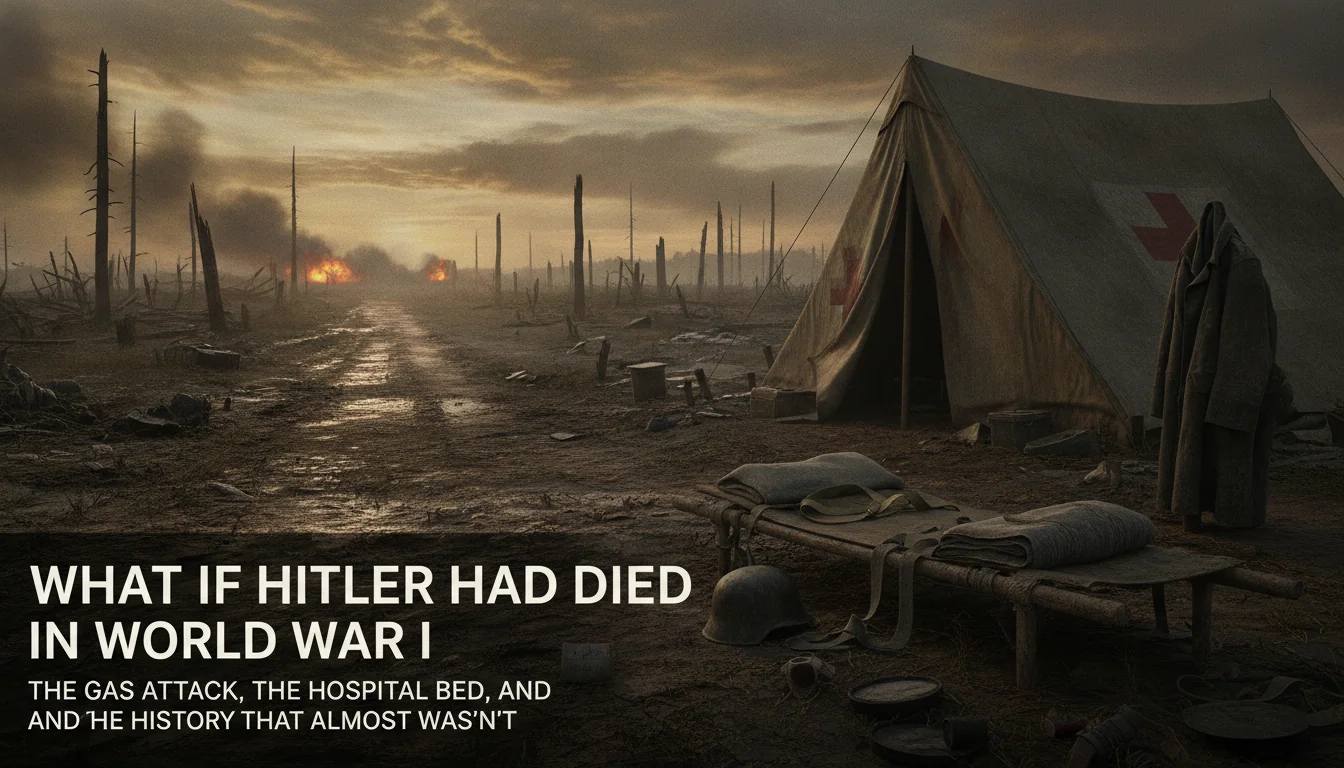
Adolf Hitler should have died at least twice before he ever gave a speech that mattered. A British shell fragment tore into his thigh outside Bapaume in the autumn of 1916. Two years later, a cloud of mustard gas rolled over his position near Ypres and left him temporarily blind. Both times he recovered. Both times he went back to a war that was busy killing the men around him by the tens of thousands. History does not usually let its worst chapters hinge on whether one lance corporal's trench happened to be twenty meters to the left. This one plausibly did.
What actually happened
Hitler volunteered for the Bavarian Army in August 1914, not long after Germany went to war, and was assigned to the 16th Bavarian Reserve Infantry Regiment, nicknamed the List Regiment after its first commander. He served for most of the war as a regimental messenger, a Meldegänger, carrying orders between headquarters and the front line. Some historians have argued this role, based somewhat further back from the trenches than a rifleman's, put him at less constant risk than frontline infantry duty. Others point out that runners still crossed open, shelled ground on a regular basis and that Hitler's own unit was cut to pieces multiple times over the course of the war. Both things were true. The job was safer on average and still routinely lethal.
He was, by the account of the men who served with him, a diligent and somewhat odd soldier, uninterested in home leave, devoted to the war in a way that struck some comrades as strange. He earned the Iron Cross Second Class in 1914 and, in 1918, the Iron Cross First Class, an unusual decoration for someone of his rank. The officer who recommended him for it, Hugo Gutmann, was Jewish, a fact that later Nazi propaganda worked hard to obscure.
The two near-misses that matter for this counterfactual came about two years apart. In October 1916, during the Battle of the Somme, a shell fragment wounded him in the leg, an injury whose severity later became the subject of historical debate. He was evacuated to a military hospital near Berlin and did not return to his regiment until early 1917, missing several of the war's worst months. Then, in October 1918, weeks before the war ended, he was caught in a British gas attack near Ypres. He suffered temporary blindness, likely from a combination of the mustard gas's effects on his eyes and, some historians suspect, a psychological component layered on top of it. He was sent to a military hospital at Pasewalk in Pomerania, and it was there, still recovering, that he learned Germany had asked for an armistice and that the Kaiser had abdicated. He described this moment in Mein Kampf as the point at which he decided to become a politician, framing Germany's defeat as a betrayal he intended to avenge.
Neither wound was freakish. Millions of soldiers on both sides were wounded, gassed, or killed in circumstances barely distinguishable from Hitler's. What makes his case worth pausing on is not that his survival was improbable in the way, say, surviving a firing squad would be. It is that a modest, entirely plausible variation in either incident, a slightly closer shell fragment, a slightly higher gas concentration, an infection that didn't clear, would have ended an otherwise unremarkable Austrian corporal's life in a war that had already claimed millions of unremarkable lives. Nothing about the world in November 1918 would have registered his death as significant.
The point of divergence
Take the more dramatic of the two near-misses. Say the gas exposure near Ypres in October 1918 is somewhat worse, enough to cause fatal respiratory damage or an infection that a wartime hospital, already overwhelmed in the war's final weeks, cannot treat in time. This is not a stretch. Mustard gas was far more likely to maim, blind, or disable than to kill outright, but a real minority of exposures did prove fatal, especially when respiratory damage turned into pneumonia an overstretched wartime hospital couldn't treat, and severity varied enormously with concentration, wind, and how quickly a soldier got his mask on. Hitler dies at Pasewalk, or shortly after being evacuated there, in the last weeks of the war he had volunteered so eagerly to fight.
It is worth being honest about how small this change is. It requires no altered battle, no different order, no butterfly sweeping across the whole war. It only requires the gas cloud to have been a little denser, or Hitler's mask to have gone on a few seconds slower, both entirely within the range of what happened to thousands of other soldiers caught in gas attacks that same autumn.
The consequence chain
Follow the chain that plausibly unspools from there, staying close to what we know about Munich's political fringe after November 1918.
Without Hitler, there is no veteran drifting back to Munich in 1919, assigned by the army's intelligence branch to monitor a small nationalist splinter group called the German Workers' Party, and discovering he has a talent for public speaking that surprises even him. That specific chain of events, an army handler noticing an unusually persuasive informant and encouraging him to join the party he was sent to watch, requires Hitler specifically. Someone else would have joined that party, or a similar one, or not; the party's early growth in 1919 and 1920 leaned heavily on Hitler's ability to hold a beer-hall crowd, a skill contemporaries and later historians alike have described as genuinely rare among the era's other fringe agitators.
It is plausible, then, that the German Workers' Party remains a minor Munich curiosity rather than becoming the National Socialist movement, or that a comparable party rises but under different leadership, with a different tone, a different relationship to violence, and a different set of scapegoats emphasized or de-emphasized. The Beer Hall Putsch of 1923, built around Hitler's specific alliance with Erich Ludendorff and his particular reading of Mussolini's march on Rome the year before, likely does not happen in the same form, because it was substantially Hitler's initiative.
Further out, the chain gets thinner. The Nazi Party's later seizure of power depended on Hitler's specific tactical choices, his relationship with German president Paul von Hindenburg in 1933, his elimination of internal rivals in 1934, and a personal ideological obsession with a war against the Soviet Union and the extermination of European Jews, an obsession that was distinctly his own rather than a generic feature of German nationalism. Remove him and it is reasonable to think Germany still produces an authoritarian, revanchist, antisemitic nationalist movement in response to the same economic collapse and national humiliation. It is much less certain that movement produces a war of the same scale, or a genocide organized with the same industrial method and the same fixation. Different leaders make different choices even from similar starting material.
The limits
Here is where the speculation has to stop pretending it knows more than it does. The Treaty of Versailles' reparations, the hyperinflation of the early 1920s, the Great Depression's devastation of German employment, and a European antisemitism that long predated Hitler, all of that stays exactly the same regardless of one corporal's fate in a Belgian gas attack. Germany's fragile Weimar democracy was structurally vulnerable to an authoritarian takeover from the moment it was founded, undermined by resentments no single death could erase. It is not plausible that a Hitler-free Germany simply muddles along as a stable democracy; the underlying pressures were too severe and too widely shared across the political spectrum.
What is genuinely uncertain is the shape any successor movement takes, whether it finds a leader with Hitler's specific combination of oratorical skill, ideological fixation, and willingness to act on it, and whether the Second World War, if it happens at all, unfolds anywhere near the scale it did. We cannot know whether a different far-right leader pursues war with the Soviet Union with the same fervor, or whether the machinery of the Holocaust, so bound up with Hitler's own decades-long obsession, gets built by someone else in anything like the same form.
The reminder
None of this is a claim about what would have happened. It is an informed thought experiment built on a real and well-documented near-miss, treated with the same caution any historian would bring to a single soldier's survival in a war that killed roughly nine million of them. Hitler's death near Ypres in October 1918 was entirely plausible and did not happen. What follows from imagining that it did is a chain of reasonable inferences about political mechanics in Munich, not a prophecy about the twentieth century. The one thing that seems safe to say is the least comforting one: the forces that made Nazism possible would have remained in place, waiting for whoever walked through the door that Hitler, in our history, happened to walk through first.
Quick Answers
Common questions about this topic
Did Hitler actually almost die in World War I?
Yes, more than once. He was wounded by shrapnel at the Battle of the Somme in October 1916 and was hospitalized for several months, not returning to his regiment until early 1917. In October 1918 he was exposed to a mustard gas attack near Ypres and was temporarily blinded, spending the final weeks of the war recovering in a military hospital at Pasewalk.
What happened to Hitler at Pasewalk hospital?
While recovering from the gas attack and partial blindness, Hitler learned of Germany's request for an armistice and the Kaiser's abdication in November 1918. He later wrote in Mein Kampf that this moment, hearing of Germany's defeat while blind in a hospital bed, was when he decided to go into politics.
Would the Holocaust never have happened if Hitler had died in World War I?
This is genuinely unknowable, and historians are cautious about it. The conditions that produced Nazism, the Treaty of Versailles' resentments, hyperinflation, the Great Depression, and an already-radicalized far right, would still have existed without Hitler. Some other figure might have led a similar movement, but the specific ideology, tactics, and outcome Hitler produced were shaped by him personally, so a different leader would very plausibly have produced a different history rather than an absent one.
Did Hitler receive any medals in World War I?
Yes. He received the Iron Cross Second Class in 1914 and, unusually for someone of his rank, the Iron Cross First Class in 1918. The officer who recommended him for the higher award, Hugo Gutmann, was Jewish.

Debate the Timeline
Chat with historical figures about how differently it could have gone.
Create your free account →No card required. Some figures and features require a paid plan.
Join the HistorIQly Club
Get smarter about the past.
Weekly stories, deep dives, and exclusive content straight to your inbox.