The Alto Knights vs. History: How Accurate Is the Mob Biopic?
The Alto Knights accuracy check: De Niro's 2025 mob drama follows the real 1957 war between Vito Genovese and Frank Costello. How much holds up?
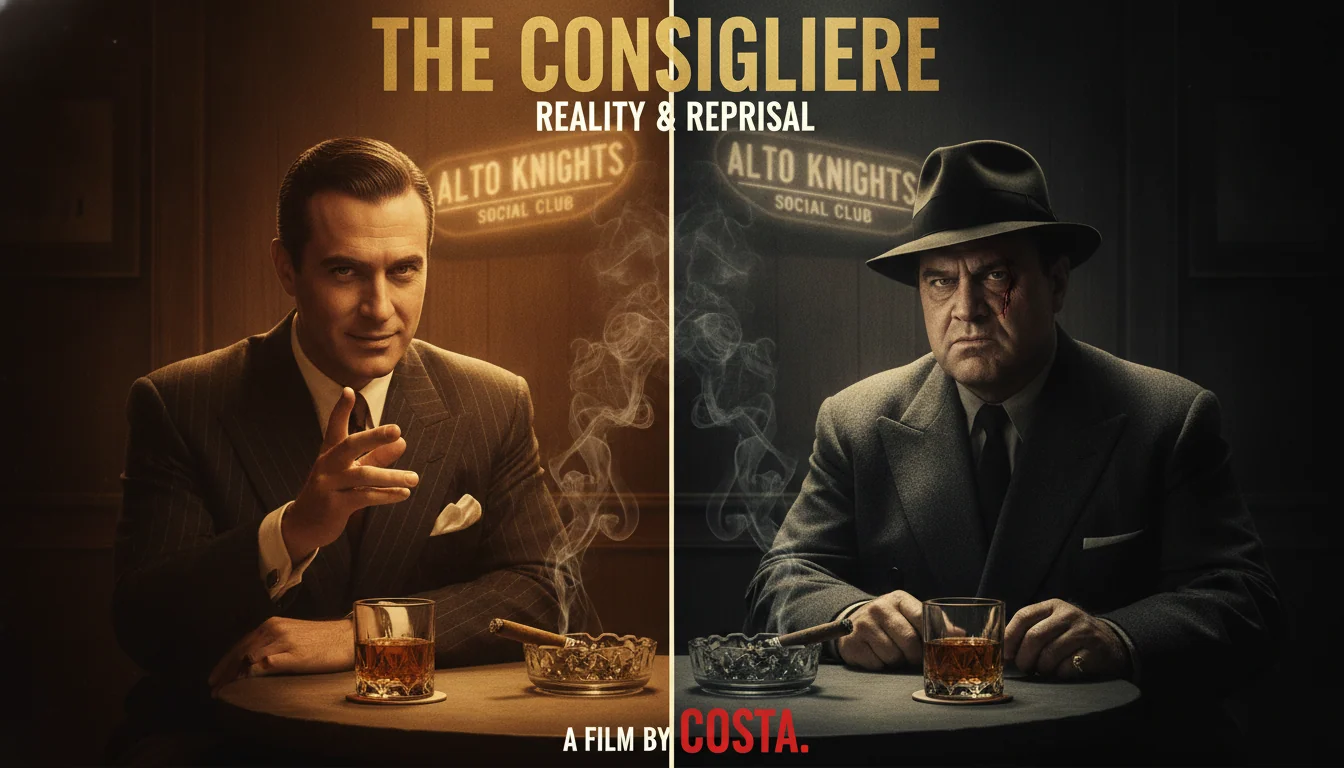
When Barry Levinson's mob drama opened in early 2025, the publicity hook was Robert De Niro playing two rival bosses using prosthetics and split-screen technique - Frank Costello and Vito Genovese, the two men who defined the New York underworld's most turbulent year. It was a reasonable hook. The gimmick raised an obvious question: does the film respect the genuinely remarkable true story underneath it, or does the casting conceit become the story?
The answer, as with most mob films that draw on the postwar New York families, is that the history is richer than the dramatization, and the drama is more faithful to the record than the gimmick suggests.
Who these men actually were
Frank Costello was born Francesco Castiglia in Calabria, Italy, in 1891 and brought to New York as a child. By the 1940s he had become what the press called the Prime Minister of the Underworld - not because he commanded through violence, which he generally preferred to avoid, but because he understood political machinery and institutional bribery at a level no other mob figure of his era matched. He had judges, politicians, and officials in his orbit, not as occasional assets but as long-term managed relationships. He was comfortable at the Copacabana and at Tammany Hall fundraisers. He was the organization's version of a diplomat.
Vito Genovese was his temperamental opposite. Born in Naples in 1897, he arrived in New York in 1913 and rose through the Luciano family, the organization that would eventually bear his own name. Where Costello worked through money and connection, Genovese worked through intimidation and patience. He had fled to Italy in 1937 after being charged with murder, spent the war years in Mussolini's Italy, and returned to the United States in 1945 after the murder charge collapsed when the key witness died in custody. His ambition had not collapsed with it.
By the mid-1950s the Genovese family was nominally led by Costello, with Genovese as underboss. This was not a stable arrangement.
What Hollywood got right
The assassination attempt on Costello
On the evening of May 2, 1957, Frank Costello walked into the lobby of his apartment building at 115 Central Park West and was shot in the head. The bullet skimmed his skull without penetrating. He was taken to Roosevelt Hospital, where police arrived expecting a dying man who might cooperate. Costello was not dying, and he was not going to cooperate. He said he had not seen the shooter clearly. He suggested it was probably a robbery attempt.
The shooter was Vincent Gigante, a large former boxer who would later command the Genovese family himself for decades, famously feigning mental illness while running the organization from a Greenwich Village social club. Gigante was charged but acquitted because Costello, following the code he had operated by his entire career, declined to identify him. The film's treatment of this episode tracks the documented record: the shooting, the survival, the wall of silence.
Costello's withdrawal and Genovese's takeover
Following the shooting, Costello did what a rational man with a grazed skull and enemies capable of sending assassins to his lobby would do. He stepped aside. He formally withdrew as boss. Genovese took over. The transition involved no public warfare. It was accomplished through the retirement of a man who understood the arithmetic of continued conflict.
This is historically accurate. The mob succession of 1957 was not a dramatic firefight. It was a sequence of implicit threats, a failed murder attempt, and a man deciding that the position was no longer worth defending at the cost of his life. Films that preserve this muted resolution are being faithful to what happened.
The murder of Albert Anastasia and the Apalachin summit
In October 1957, Genovese arranged the murder of Albert Anastasia, who ran his own crew and whose ambitions represented a continuing threat to Genovese's consolidation. Anastasia was shot in the barber's chair of the Park Sheraton Hotel on October 25, 1957 - an event so cinematic that no subsequent mob drama about this era has been able to omit it.
Six weeks later, Genovese convened what was intended as a national summit of organized crime figures at the Apalachin, New York estate of Joseph Barbara. More than sixty senior figures gathered from across the country. New York State Police sergeant Edgar Croswell, who had been watching Barbara's property for unrelated reasons, set up a roadblock on Route 17 when he noticed the unusual density of out-of-state luxury cars on the property. What followed produced some of the most undignified scenes in American organized crime history: men in good suits running through upstate New York woods in November, throwing weapons into the undergrowth, abandoning Lincoln Continentals on the grass.
More than fifty men were identified or detained. The Apalachin meeting became the first publicly accepted proof that a national organized crime network existed. J. Edgar Hoover, who had spent decades insisting that the American Mafia was a myth, found his position untenable almost overnight.
What Hollywood gets wrong, or compresses
Genovese's actual fall
The most ironic chapter of the story follows the period the film covers. In 1959, just two years after taking power, Genovese was convicted of narcotics conspiracy and sentenced to fifteen years. The evidence against him came substantially from a low-level drug dealer named Nelson Cantellops, and organized crime historians have argued convincingly that Cantellops was positioned and incentivized through a back-channel operation involving Costello and Meyer Lansky - the men Genovese had just displaced.
In short: Genovese orchestrated the takeover, and the people he deposed orchestrated his conviction. He died in the federal penitentiary at Springfield, Missouri, in 1969. Costello died in 1973 of a heart attack, in his apartment, outside a prison. The reversal is too neat to feel like fiction, which is probably why films set in 1957 tend to close before it arrives.
The dual-casting question
De Niro playing both roles is a bold formal device, and it communicates something real about how these men were perceived: as mirror images of the same world, reaching from opposite directions. In practice, Costello and Genovese were physically different men, and contemporaries did not confuse them. The device is a director's conceit, not a historical claim. Whether it illuminates or distracts from the story depends on individual tolerance for theatrical stylization in an otherwise realistic frame. The history does not require it, and the history is strong enough to stand without it.
What the film cannot quite capture
The texture of the real 1957 is harder to dramatize than its events. The New York underworld at that moment was in genuine institutional crisis: the Kefauver Committee hearings of 1950 to 1951 had exposed the structure of organized crime to a national television audience for the first time, law enforcement was increasingly coordinated across jurisdictions, and the men running the families were navigating a level of scrutiny their predecessors had not faced. Genovese's summit at Apalachin was not just a power display - it was an attempt to solve specific business problems created by this increased exposure. The raid destroyed the meeting and its intended solutions simultaneously.
This context, the specific pressure the families were under and the specific management problem the Apalachin meeting was meant to address, is the kind of detail that requires historical explanation to land. It tends to get compressed in dramatization.
Historical Accuracy Score: 7/10
The Alto Knights is built on documented history. The Costello shooting, the Anastasia murder, the Apalachin raid, and the power transfer from Costello to Genovese are all real. The fundamental dynamic - two men running the same organization with incompatible visions of how power should be exercised - is faithful to the record. Organized crime films frequently compress similar timelines: the Goodfellas vs History breakdown and the Casino (1995) vs History analysis show how often the documented facts prove at least as cinematic as the dramatization.
What the film underserves is the aftermath. The Genovese conviction and its probable orchestration is the most satisfying chapter of the story: the man who took power by arranging a shooting in a lobby is eventually destroyed by the men he deposed, through a narcotics informant and a federal courtroom. That ending requires no embellishment. The history embellishes itself. Films that close before it arrive are leaving the best part on the cutting room floor.
What the film gets most right: the 1957 events themselves, rendered with sufficient attention to the mixture of calculation and catastrophic overreach that characterized the real year.
What it gets most wrong: the endgame, and the degree to which the man who looks like a winner in November 1957 is the man running out of runway by 1959.
Quick Answers
Common questions about this topic
Is The Alto Knights based on a true story?
Yes. The Alto Knights is based on the real 1957 power struggle between Vito Genovese and Frank Costello, two senior figures in what became the Genovese crime family. Key events including the attempt on Costello's life, the murder of Albert Anastasia, and the Apalachin summit are drawn from documented history.
Did Vito Genovese really try to kill Frank Costello?
Yes. On May 2, 1957, a gunman later identified as Vincent 'The Chin' Gigante shot Costello in the lobby of his apartment building at 115 Central Park West. The bullet grazed Costello's head. He survived, refused to identify the shooter to police, and subsequently stepped down as boss of the family - which Genovese then took over.
What was the Apalachin meeting?
On November 14, 1957, roughly sixty senior figures from organized crime across the United States gathered at the Apalachin, New York estate of Joseph Barbara. New York State Police set up a roadblock after noticing the unusual concentration of out-of-state luxury vehicles. More than fifty men were detained or identified fleeing through the woods. It was the first widely accepted documented proof that a national organized crime network existed.
What happened to Vito Genovese after he took power?
Genovese was convicted of narcotics conspiracy in 1959 and sentenced to fifteen years in federal prison. Organized crime historians, including Selwyn Raab, have argued the case against him was arranged partly through the efforts of Frank Costello and Meyer Lansky, who used a drug informant to set him up. Genovese died in federal prison in 1969.

Debate the Accuracy with the Real Figures
Ask the real people what Hollywood got wrong about their lives.
Chat with HistoryJoin the HistorIQly Club
Get smarter about the past.
Weekly stories, deep dives, and exclusive content straight to your inbox.