How Was the Great Pyramid Built? The Ramps, Labor, and Engineering Behind Giza
How was the Great Pyramid built? Paid Egyptian crews quarried, floated, and dragged 2.3 million blocks up ramps to raise it in about two decades.
Read Wikipedia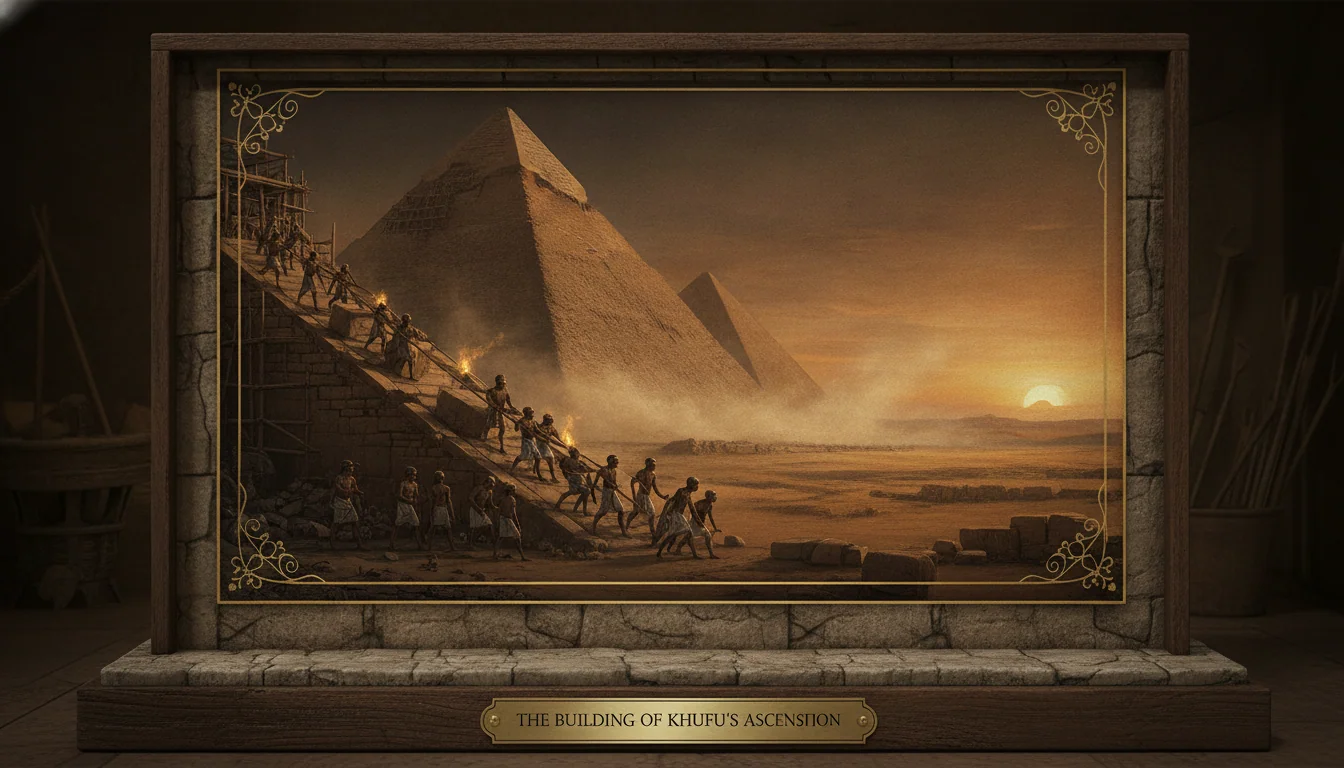
Start with the number that should stop anyone from reaching for aliens: roughly 2.3 million blocks, averaging around two and a half tons apiece, set with a precision that keeps the base level to within a few centimeters across more than 750 feet of side length. The Great Pyramid at Giza, raised for the pharaoh Khufu in the middle centuries of the third millennium BC, has no wheel-driven cranes, no iron tools, and no draft-animal winches behind it. What it has instead is one of the best-documented feats of organized human labor in the ancient world, and a set of engineering solutions clever enough that we are still arguing over the details.
The impossible object
When European travelers and early Egyptologists began measuring the pyramid seriously in the 19th century, what stunned them was not size alone. Plenty of ancient structures are big. What stunned them was the precision. The base is nearly a perfect square, the four sides are aligned to the cardinal points with an error of a small fraction of a degree, and the whole structure was originally sheathed in polished white Tura limestone casing so fine that the joints between blocks were reportedly thinner than a knife blade. Flinders Petrie's meticulous 1880s survey confirmed a level of accuracy that would challenge a modern crew with laser levels, let alone one working with copper chisels and rope.
The scale of the logistics is what really needs explaining. Getting a single two and a half ton block from quarry to final position, hundreds or thousands of times a week for years, required a functioning supply chain: quarrying teams, boat crews, road and ramp builders, haulers, setters, toolmakers, and enough bakers and brewers to keep everyone fed. The pyramid is as much a monument to Old Kingdom Egypt's administrative capacity as it is to its stonework. The same question of raw force versus clever technique dogs other ancient megaliths, from the still-unsettled debate over how the enormous Baalbek trilithon blocks were quarried and moved to the long-running puzzle of Stonehenge's bluestones, but nowhere else does the sheer scale of the logistics reach Giza's numbers.
How was the Great Pyramid built? Quarries, boats, and wet sand
The core of the pyramid is local limestone, quarried a short distance away on the Giza plateau itself, which kept the bulk of the hauling short. The fine white casing stone that gave the finished pyramid its famous gleam came from quarries at Tura, across the Nile, and had to be ferried over by boat. The hardest job of all was moving granite from Aswan, more than 500 miles to the south, used for the King's Chamber and the massive roofing beams above it, some of which are estimated to weigh in the tens of tons each. Those blocks traveled the length of Egypt on barges during the Nile flood season, when high water let boats come close to the construction site.
We know some of this from more than inference. In 2013, papyri were found at a Red Sea harbor site at Wadi al-Jarf, kept by a mid-level official whose logbook describes his crew hauling limestone from Tura to Giza by boat, tracking the days spent loading, sailing, and returning. It is the oldest inscribed papyrus archive found in Egypt, and it turns the supply chain from scholarly reconstruction into eyewitness account. Researchers reported in 2024 that a since-vanished branch of the Nile once ran much closer to the pyramid fields than the modern river does, shortening the final overland haul considerably.
Once on site, blocks moved on wooden sledges, dragged by gangs of men over prepared surfaces. Tomb paintings from the Middle Kingdom show workers pouring water in front of a sledge hauling a heavy statue, and a 2014 study by Dutch physicists confirmed why: wetting sand ahead of a sledge can cut the pulling force required by close to half by making the grains clump instead of piling into a mound of resistance. It is a small trick, but multiplied across thousands of hauls it likely saved enormous amounts of labor.
Getting blocks up to height is the part that still generates the most argument. A single ramp running straight from the ground to the peak would, at a slope haulers could actually climb, have needed to be over a mile long and would have used more material than the pyramid itself, which most Egyptologists find implausible. The leading alternatives are a ramp that wrapped around the exterior in a zigzag or spiral as the structure rose, or an internal spiral ramp built into the body of the pyramid and later hidden by the casing stones. Each theory explains some physical evidence, such as ramp remnants found at other pyramid sites and irregularities in the pyramid's corners, but no single one explains all of it. The likely answer is a combination, external ramps for the lower courses and something more compact higher up, where a mile-long ramp becomes physically absurd.
Leveling the site was done with water. Egyptian surveyors are believed to have cut shallow trenches and filled them with water to establish a perfectly flat reference plane, since water finds its own level with no instrument needed beyond the eye. Alignment to true north likely used observations of circumpolar stars, tracked across the night sky to bisect the angle between their rising and setting points, a technique that requires patience and careful record-keeping rather than any technology unavailable to Bronze Age astronomers.
Hemiunu's project
Tradition credits the pyramid's design to Hemiunu, a vizier and probable relative of Khufu, whose own statue and tomb were found at Giza close to the pyramid he is believed to have overseen. Whether Hemiunu was the sole architect or the senior administrator managing a team of specialists, the project reflects a state that could plan multi-decade infrastructure and coordinate quarrying, transport, and construction with the seasons of the Nile. The pyramid was as much a bureaucratic achievement as an architectural one.
The workers, not slaves
Herodotus, writing centuries later from secondhand priestly accounts, described gangs of 100,000 slaves forced to labor under threat of the whip. That image stuck for two thousand years. Excavations beginning in the 1990s, led by archaeologists Mark Lehner and Zahi Hawass, uncovered a purpose-built settlement just south of the pyramids with bakeries, breweries, fish-processing facilities, and barracks-style housing for thousands of workers. Nearby, a workers' cemetery held skeletons showing healed fractures and evidence of medical care, with burials given genuine dignity rather than the mass disposal expected for expendable slave labor. Graffiti left by crews inside the pyramid's internal relieving chambers, names like the "Friends of Khufu" gang, suggest organized teams with pride in the project rather than coerced misery.
Current estimates put the workforce at any given time around 20,000 to 30,000 people, far below Herodotus's figure: a smaller core of permanent skilled masons and toolmakers, plus larger rotating crews of laborers, likely farmers conscripted during the months when Nile floodwaters made their fields unworkable anyway. They were paid in food, housing, and probably social standing, a rotational labor obligation rather than chattel slavery.
How the technique was lost
The Great Pyramid was not the start of a tradition that kept improving. It was closer to a ceiling that Egyptian pyramid building never matched again. Within a few generations, later Old Kingdom pyramids at sites like Abusir and Saqqara shrank dramatically in size and used cheaper rubble cores faced with a thin shell of good stone, and many of those later pyramids have collapsed into rubble mounds today because the core construction was so much weaker. The administrative machine capable of mobilizing tens of thousands of workers for a single tomb strained the state and did not survive the fragmentation that followed the Old Kingdom's collapse.
By the New Kingdom, pharaohs abandoned monumental pyramids altogether in favor of hidden rock-cut tombs in the Valley of the Kings, partly because pyramids had proven to be enormous, unmissable advertisements to tomb robbers. The specific organizational knowledge behind Giza, the logistics chains, the seasonal labor rotations, the ramp systems, was never written down as a technical manual and simply faded as priorities changed. Centuries later, the pyramid's own fabric was stripped further: an earthquake in 1303 loosened much of the polished casing stone, and medieval builders hauled it away to help construct Cairo, which is why the pyramid we see today is duller and rougher than the gleaming monument Khufu's subjects would have seen.
What we still cannot answer
Modern engineers and Egyptologists have replicated individual techniques convincingly: the wet-sand friction trick works, water-trench leveling works, and small-scale ramp and sledge experiments have moved multi-ton blocks with historically plausible crew sizes. What nobody has done is prove definitively which ramp configuration the builders actually used, since candidate designs leave overlapping and ambiguous traces in the archaeology. The interior of the pyramid still holds open questions too. In 2017, a team using cosmic-ray muon imaging detected a previously unknown void above the Grand Gallery, reportedly at least 30 meters long, whose purpose remains unexplained. Decades earlier, a small robot sent up one of the narrow internal shafts running from the Queen's Chamber found a stone slab fitted with copper handles, and a later robot that drilled through it found another blocking stone behind it. Nobody knows what, if anything, lies beyond.
None of that ambiguity supports mystical explanations. It reflects a genuinely hard engineering and logistics problem, solved by people whose names we mostly do not know, using tools we can hold in a museum case. The gap between "we understand roughly how this was done" and "we can point to the exact ramp" is normal for four-thousand-year-old construction sites. It is also, honestly, part of the appeal: a monument built entirely by human hands that is still capable of keeping modern engineers arguing.
Quick Answers
Common questions about this topic
How did ancient Egyptians actually build the Great Pyramid without modern machinery?
Crews quarried local limestone on site, floated finer casing stone across the Nile from Tura, and hauled granite from Aswan over 500 miles away. Blocks were dragged on wooden sledges over ramps, and workers wetted the sand ahead of the sledges to cut friction dramatically. Scholars still debate whether the ramp system was a single straight ramp, a switchback around the exterior, or an internal spiral, and it may have combined more than one method.
Were the pyramids built by slaves?
No. Excavations of a purpose-built workers' settlement at Giza in the 1990s found bakeries, breweries, medical care for healed fractures, and a nearby cemetery with proper burials, none of which fit a slave-labor system. The workforce appears to have been a mix of skilled permanent crews and rotating laborers, likely conscripted farmers, working in exchange for housing, food, and status rather than under the whip Herodotus later described.
How long did it take to build the Great Pyramid?
Most estimates put construction at around two decades, roughly matching the length of Khufu's reign in the mid 2500s BC. That timeline requires setting a large block in place every few minutes across the working day for years on end, which is part of why the logistics behind the project are as impressive as the pyramid itself.
Can modern engineers explain every part of how it was built?
Not completely. Experimental archaeology has confirmed several individual techniques, such as the friction-reducing wet sand trick and water-trench leveling, but no single ramp theory accounts for all the physical evidence, and some internal features, including a large void detected above the Grand Gallery and blocked shafts inside the structure, still have no agreed explanation.

Meet the Ancient Engineers
Chat with the inventors who built the impossible centuries early.
Create your free account →No card required. Some figures and features require a paid plan.
Join the HistorIQly Club
Get smarter about the past.
Weekly stories, deep dives, and exclusive content straight to your inbox.