Stonehenge Bluestones: The Impossible 150-Mile Journey from Wales
How did Neolithic Britain haul Stonehenge's bluestones 150 miles from Wales to the site with no wheels or metal? The quarries, the science, the debate.
Read Wikipedia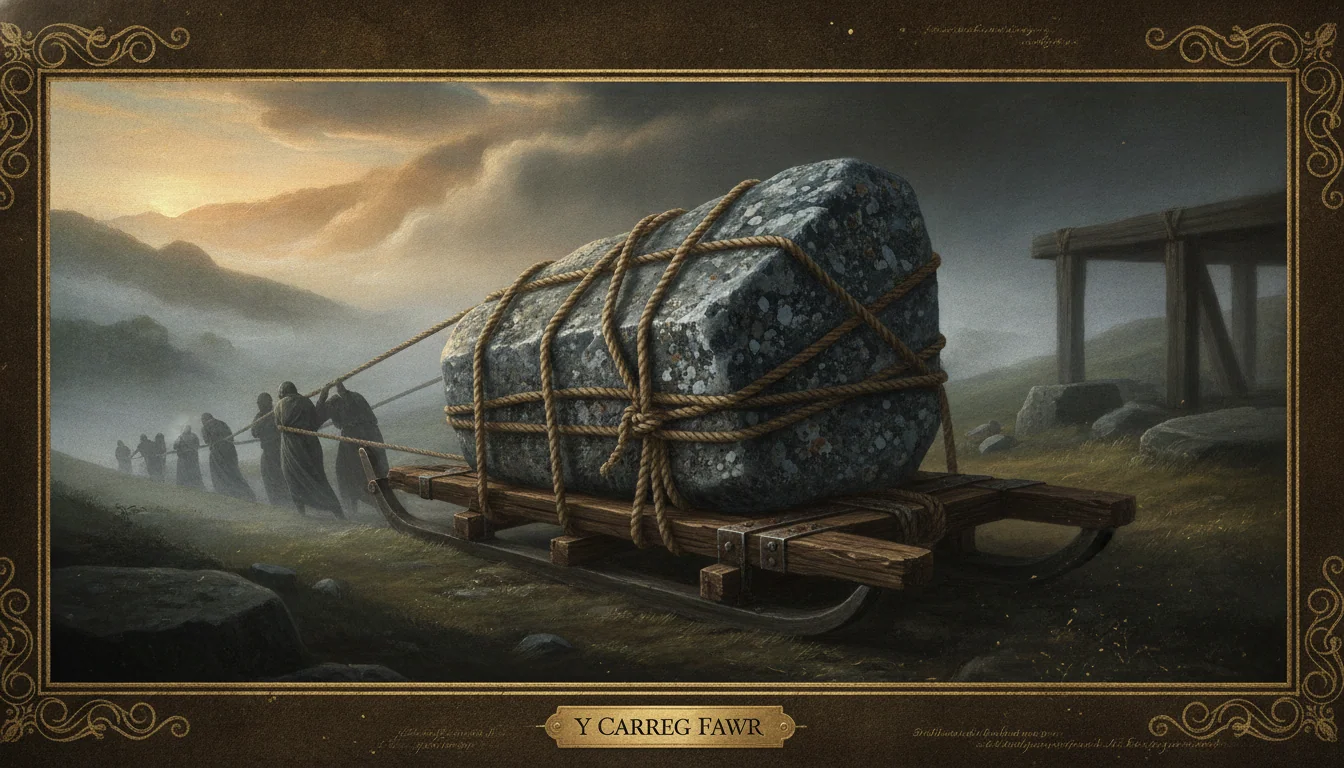
Every year, millions of visitors walk the roped path around Stonehenge and photograph the giant sarsens, the sandstone pillars that give the monument its famous silhouette. Fewer people look closely at the smaller stones standing among them: mottled blue-grey pillars, most no taller than a person. Those unglamorous stones are Stonehenge's bluestones, and they are the real puzzle. The sarsens came from a quarry a manageable twenty miles up the road. The bluestones came from Wales, roughly 140 to 150 miles away, hauled across rivers, hills, and quite possibly open water by people who had no wheel, no metal tool, and no writing system to record how they pulled it off.
That the job got done at all, more than four thousand years before diesel cranes existed, is one of the quietly astonishing feats of prehistoric Europe, alongside puzzles like the quarrying and hauling behind the Great Pyramid's construction in Egypt or the raising of the enormous worked blocks at Baalbek's trilithon in Lebanon. It is also one of the most searched: type "how were the Stonehenge stones moved" into any search engine and you will find decades of theories, a small library of experiments, and a scientific debate that keeps getting fresh jolts from new studies.
The impossible object
Stonehenge is really two monuments wearing one name. The taller sarsens, some over twenty feet tall and weighing up to 25 tons, were quarried at West Woods on the Marlborough Downs, a manageable twenty miles from Salisbury Plain. Nobody argues seriously about how those arrived; twenty miles of gently rolling ground is well within the range of Neolithic haulage.
The bluestones are the real mystery. They are smaller, generally two to five tons apiece, and there were originally as many as eighty of them, though fewer than half survive standing today. In 1923, the geologist Herbert Henry Thomas examined the spotted dolerite among the bluestones and matched its mineral signature to outcrops in the Preseli Hills of Pembrokeshire, in southwest Wales. That put the true source not twenty miles away but somewhere around 140 to 150 miles distant, across the Bristol Channel or the length of Wales and southern England, depending on the route taken.
For decades, some geologists preferred a tidier explanation: that Ice Age glaciers had dragged the stones most of the way, dumping them near Salisbury Plain long before anyone decided to build a monument there. It was a comforting theory, because it did not require Neolithic farmers to move multi-ton stones across a country with no roads, no wheels, and no draft harness. On the best current evidence, it also turned out to be wrong.
How it actually worked
At Carn Goedog and Craig Rhos-y-felin, two Preseli outcrops now confirmed by excavation as Stonehenge's bluestone quarries, archaeologists led by Mike Parker Pearson found direct evidence of Neolithic quarrying dated to roughly 3400 to 3200 BC, centuries before the stones were finally erected on Salisbury Plain. The technique exploited the rock itself. Both outcrops are naturally jointed dolerite and rhyolite, standing in vertical pillars separated by existing cracks. Rather than fighting solid rock with fire and water, the Neolithic quarry workers drove wooden and stone wedges into those joints and used timber levers, propped on stacked stone and turf platforms, to walk each pillar free before lowering it onto a waiting bed of logs.
From there the job became haulage, and this is the part experimental archaeologists have actually tested. The likeliest reconstruction uses a wooden sledge riding on a track of log rollers, dragged by teams pulling on plant-fiber rope, with extra hands carrying spent rollers from the back of the sledge to the front as it advances. One well-known trial hauling a four-ton stone this way needed about sixty people and covered barely a mile and a half on a good day; a smaller two-ton bluestone probably needed only twenty or so haulers. Even at optimistic rates, a single stone's overland journey across the hills of Wales could have eaten up the better part of a year. Residue analysis on a sarsen at the site has even suggested animal fat may have greased the sledge runners, a small but telling domestic detail.
Because a fully overland route out of the Preseli Hills crosses genuinely rough terrain, many archaeologists suspect the builders used water for at least part of the trip: floating stones down local rivers to the coast, then along the Bristol Channel and up the Bristol Avon and the Wiltshire Avon toward Salisbury Plain, on rafts or lashed log boats. No boat or raft from the period survives to confirm this, so the river-and-sea route remains the leading theory rather than a proven fact. What almost every reconstruction agrees on is that the labor was organized, patient, and entirely human: no wheel, no animal harnessed to the load, no metal tool anywhere in the process.
Who built it, and why
The people who quarried and hauled these stones were Neolithic farmers, working centuries before Britain had metal, the wheel, or writing. They left no explanation of their motives, so archaeologists reconstruct intent from the stones themselves. The bluestones are not simply the closest hard rock to Wiltshire; several outcrops of comparable stone sit far closer to Salisbury Plain than Wales does. Whoever chose Preseli stone chose it deliberately, which suggests the place of origin mattered as much as the rock's physical qualities, perhaps because the Preseli Hills already held religious or ancestral meaning for communities on both sides of the Bristol Channel.
A striking, still-debated theory adds a twist. In 2021, Parker Pearson's team argued that a dismantled stone circle at Waun Mawn, in the Preseli Hills, matched the diameter of Stonehenge's earliest enclosure and shared its solstice alignment, and proposed that some bluestones had already stood as a stone circle in Wales before being dismantled and rebuilt on Salisbury Plain. Later geological survey work has challenged a direct link between Waun Mawn's empty stoneholes and the confirmed quarries, so the "recycled monument" idea remains a genuine, unresolved argument rather than settled history. What is not in dispute is the scale of cooperation required. Moving even one modest bluestone took dozens of workers and months of labor, with food and logistics to support them the whole way. Moving as many as eighty of them was a project that could only have bound scattered farming communities into something like a shared undertaking.
How the knowledge was lost
Nothing about Neolithic megalith-hauling was written down, because nobody in Neolithic Britain wrote anything down. The engineering lived entirely in practice: passed from an experienced quarry worker or haulage foreman to an apprentice, refined a little with each stone, never fixed in a text that could outlive the people who held it. Ancient DNA evidence suggests that within a few centuries of Stonehenge's main building phases, the population of Britain changed substantially, with newcomers associated with the Bell Beaker culture arriving from the European continent. Whatever direct chain of memory connected the quarry workers of 3200 BC to their descendants did not survive that transition intact.
By the time literate societies took an interest, the real story was already gone, and legend rushed in to fill the gap. Geoffrey of Monmouth, writing in the 12th century, claimed the wizard Merlin used magic to transport the stones of the "Giants' Dance" from Ireland to Salisbury Plain, tearing down a monument giants had supposedly carried there from Africa. That story held the field, more or less unchallenged, for the better part of eight centuries. The mechanism was not stolen or suppressed by rivals. It simply had nowhere to be recorded once the last person who remembered doing the work had died, and a good legend is a durable substitute for an answer nobody has anymore.
Rediscovery, and what we still cannot prove
The mystery has been solved in layers, over a century, and each layer has made the achievement look more impressive rather than less. Thomas's 1923 mineral match started the modern hunt. Excavations at Carn Goedog and Craig Rhos-y-felin in the 2010s, led by Parker Pearson's team, uncovered the actual quarry faces, complete with stone and wooden wedges and the platforms used to lever pillars free, and dated the quarrying itself to around 3400 to 3200 BC. Then, in 2024, a geochemical study added a genuinely startling twist: the six-ton Altar Stone at the monument's center, long assumed to be Welsh like the other bluestones, was instead traced to sandstone formations in northeast Scotland, more than 750 kilometers away, very likely moved at least part of the way by sea. It stands as one of the longest confirmed stone hauls of its era anywhere in the world, and it means Neolithic Britain's regional networks stretched further, and were organized more tightly, than anyone assumed even a decade ago.
The glacial-transport theory, meanwhile, kept losing ground as repeated sediment studies near Salisbury Plain turned up no trace that ice had ever reached the site, closing off the last serious alternative to deliberate human transport.
What nobody has done is reproduce the whole journey. Modern trials have hauled single stones a few miles under controlled conditions with a few dozen volunteers; nobody has dragged a multi-ton pillar 150 miles across Wales and southern England, or floated one down a river and across the Bristol Channel, to see how long it truly took or how many hands it truly required. The balance between overland and water transport is still a best guess, the exact route is still argued over, and the mechanics of moving the Altar Stone across open water from Scotland are, at present, a near-total blank. The stones themselves remain the only proof that the journey was ever possible at all.
Quick Answers
Common questions about this topic
How did Neolithic Britain move stones weighing several tons across 150 miles?
The leading reconstruction uses timber sledges dragged over log rollers by rope teams, with at least part of the route likely covered by river and coastal transport rather than one continuous overland haul. Experimental trials show a two-ton stone could move with roughly twenty haulers, though the full 150-mile journey has never been fully reproduced.
Where exactly did the Stonehenge bluestones come from?
Most were quarried in the Preseli Hills of Pembrokeshire, southwest Wales, at outcrops including Carn Goedog and Craig Rhos-y-felin, identified through geochemical matching of the stone's mineral signature. The Altar Stone at the monument's center came from much farther away; a 2024 study traced it to sandstone in northeast Scotland.
Was Stonehenge originally a stone circle in Wales?
A 2021 study proposed that a dismantled circle at Waun Mawn in the Preseli Hills may have been an earlier version of Stonehenge, later taken down and rebuilt in Wiltshire, based on matching dimensions and a shared solstice alignment. Later geological work has challenged the direct link, so the idea remains a debated hypothesis rather than settled fact.
Could modern engineers replicate the bluestones' journey today?
Short-distance experiments have confirmed that human teams with sledges, log rollers, and rope can haul multi-ton stones without wheels or draft animals. Nobody has recreated the full 150-mile route from Wales, though, or explained exactly how the six-ton Altar Stone crossed open water from Scotland, so parts of the journey remain unreplicated.

Meet the Ancient Engineers
Chat with the inventors who built the impossible centuries early.
Create your free account →No card required. Some figures and features require a paid plan.
Join the HistorIQly Club
Get smarter about the past.
Weekly stories, deep dives, and exclusive content straight to your inbox.