Arsenal: The Roman Ballista - Artillery That Built an Empire
The Roman ballista: six centuries of torsion bolt-throwers that gave Rome precision siege firepower unmatched in the ancient world.
Read Wikipedia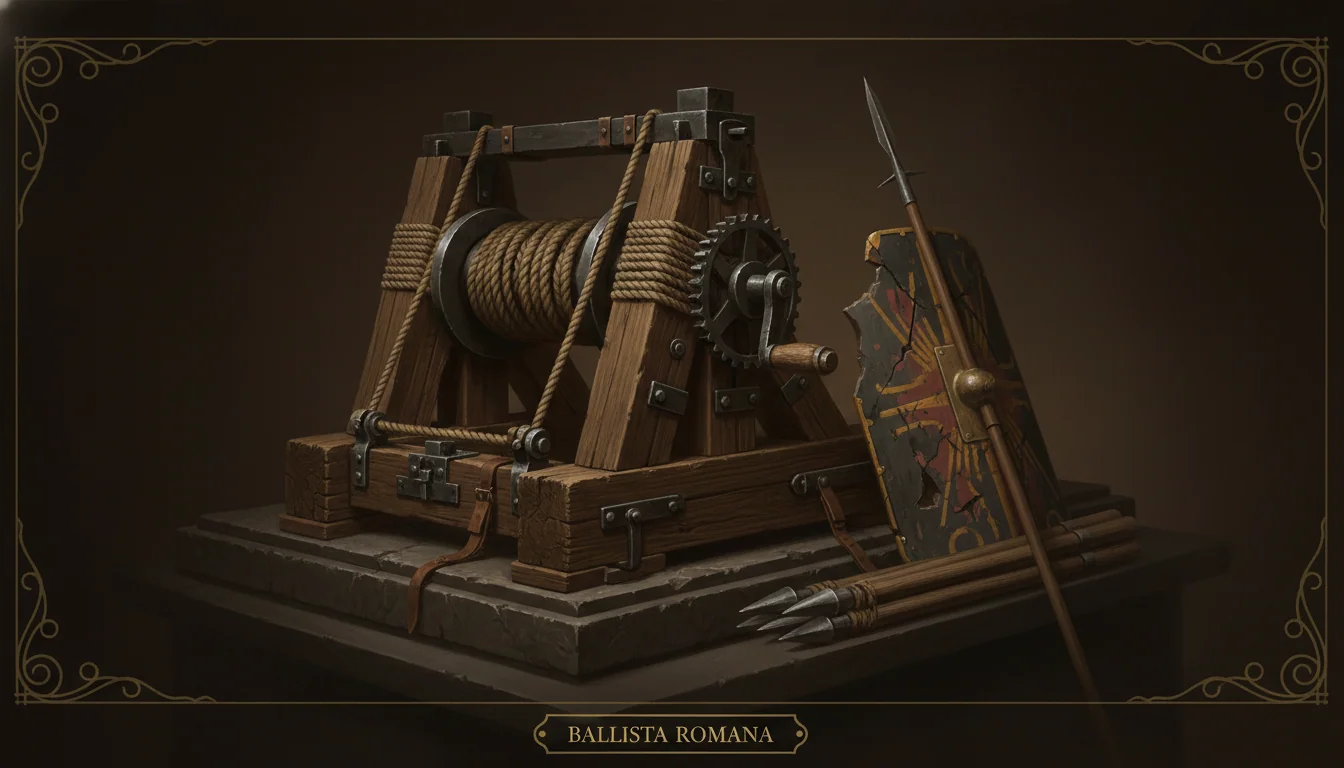
Long before the trebuchet became the defining image of medieval siege warfare, Rome operated a precision artillery system that put modern heavy weapons in perspective. The Roman ballista was, at its core, a very large crossbow powered by twisted organic fibers, capable of launching a heavy bolt with enough velocity to punch through a shield, kill the man behind it, and still have energy left to wound the man behind him. Deployed in quantity - and Rome deployed them in quantity - ballistae turned fortress walls into killing grounds for the defenders as much as for the attackers.
The weapon's story begins in Greece, evolves through Macedon, and reaches its peak in the hands of the Roman legions. It is a story about materials science and engineering as much as about warfare, because the ballista's power was ultimately constrained by the organic materials inside it.
The Greek beginning
The direct ancestor of the ballista was the gastraphetes, a device developed in the Greek world around the early 4th century BCE, possibly in Syracuse. The name means "belly bow" - it was a large crossbow spanned by bracing the trough against the belly and pushing the bow down while the feet were planted against the ground. It was cumbersome and slow to reload, but it could generate more draw weight than any human arm could manage with a conventional bow.
From this came the critical insight: the mechanical advantage that made a crossbow more powerful than a hand bow could be taken much further if the energy storage system was improved. The answer, developed by Greek military engineers in the early 4th century BCE, was torsion - twisted bundles of sinew, horsehair, or tendon held in a rigid wooden frame, storing enormous potential energy when twisted and releasing it explosively when the mechanism fired.
Philip II of Macedon was one of the first rulers to build a systematic siege artillery program around torsion weapons - the same Macedonian military tradition that produced the sarissa pike used so devastatingly by his son Alexander. His son Alexander the Great deployed sophisticated ballistae in his campaigns: at the Siege of Tyre in 332 BCE, Alexander's artillery fired from ships as well as from prepared land positions, making the island city's famous walls vulnerable for the first time. The torsion bolt-thrower had become a weapon of war rather than an experimental device.
How the ballista worked
A fully assembled Roman ballista consisted of two vertical torsion springs mounted in a heavy wooden or iron-reinforced frame, each spring a tightly twisted bundle of sinew or horsehair held in a cylindrical housing. Two wooden arms were inserted through these spring bundles, one arm per spring. A bowstring connected the two arms. When the string was winched back using a ratchet mechanism, both arms were forced forward against the resistance of the twisted springs, storing tremendous energy. A bolt - an iron-tipped wooden shaft roughly 60 to 90 centimeters long - was placed in the firing groove. When the trigger was released, the springs drove the arms back to their resting position and the bolt was launched with enormous velocity.
The key engineering challenge was the sinew. Animal sinew (gut, tendon, and sometimes dried human hair in extreme circumstances) was far superior to rope or leather for torsion springs because of its high tensile strength and elasticity. But sinew was expensive, difficult to maintain, and degraded in humid conditions. The Roman military maintained dedicated supply chains for sinew acquisition and had specialists, the fabri, responsible for the artillery.
The Roman scorpio was the smaller, field-portable variant. A one- or two-man weapon, it could be carried on campaign and set up quickly. The carroballista was a scorpio mounted on a two-wheeled cart or pack-mule frame for even greater mobility. Trajan's Column, completed in 113 CE and depicting the Dacian Wars of 101-106 CE, shows carroballistas deployed in the field alongside infantry - the earliest visual evidence of mobile field artillery in European military history.
The weapon at work
What made the ballista militarily transformative was not just its power but its precision. Contemporary accounts describe ballistae being used to target individual officers on fortress walls, to suppress archers on parapets while assault parties moved forward, and to clear sections of wall in preparation for battering ram operations. This is anti-personnel work, not just the demolition that modern audiences associate with siege weapons.
Caesar's campaign against the Gallic coalition at Alesia in 52 BCE provides the most complex example of Roman artillery deployment in a field setting. Caesar's army built a double circumvallation - an inner wall containing Vercingetorix's force and an outer wall facing the Gallic relief army - around the hilltop fortress. Ballistae and scorpiones were positioned at intervals along both walls, creating overlapping fields of fire that could suppress attacks from either direction. When the relief army launched its main assault, the Roman artillery helped break attack after attack without requiring the defenders to expose themselves to direct combat.
The Siege of Jerusalem in 70 CE, recorded in detail by the Jewish historian Josephus, gives the most vivid account of Roman artillery in full deployment. Josephus describes heavy stone-throwers launching projectiles of a talent's weight (approximately 26 kilograms) at extreme range. The defenders, he writes, learned to watch for the flash of the white stones in flight and would shout a warning when they saw one coming, giving defenders perhaps a second to throw themselves flat. The bolt-shooters targeting the walls and parapets operated at closer range and were apparently terrifying enough that their sound alone could scatter defenders.
Artillery as imperial infrastructure
The Roman legionary order of battle included dedicated artillery allotments. According to Vegetius, writing in the late 4th or early 5th century CE, the standard was ten onagers and fifty-five carroballistas per legion, plus smaller scorpiones at the century level. These numbers reflect a systematic approach to artillery that no other ancient military matched at scale.
Crucially, maintaining this arsenal required specialized knowledge. The fabri - engineers and craftsmen serving within the legions - were responsible for building, repairing, and operating the artillery. This was not a role that could be improvised. The torsion springs required skilled hands to tune correctly; a spring twisted too tightly could break; one too loosely twisted produced insufficient power. The bolts needed to be precisely dimensioned to fit the launch groove. The winching mechanisms required maintenance. Ballista warfare was a technical profession, and Rome was the only ancient state that institutionalized it at scale.
This institutional knowledge was ultimately the weapon's greatest vulnerability.
Decline and successor
As the Western Roman Empire contracted in the 5th century CE, the technical infrastructure that maintained torsion artillery began to erode. The fabri tradition depended on schools of military engineering embedded in functioning legions, and as the legion system fragmented, the specialized knowledge went with it. The Eastern Roman Empire, centered at Constantinople, retained artillery expertise for centuries longer.
In western medieval Europe, the trebuchet eventually displaced the ballista tradition. The trebuchet used a heavy counterweight dropping through gravity to fling a projectile - a simpler mechanism requiring no expensive sinew springs, no precise tuning, and no specialized engineering knowledge to operate at a basic level. A trebuchet could be built by competent carpenters with readily available materials. A ballista could not.
The crossbow, derived from the same gastraphetes tradition that gave birth to the ballista, survived as a small-arms weapon through the medieval period, eventually reaching a mechanical sophistication in the 14th and 15th centuries that rivaled the longbow in penetrating power.
The ballista's word in modern English
The weapon left one unexpected legacy. The Latin verb ballistare, to throw, and the related noun gave medieval scholars their word for the study of projectile motion. Ballistics - the science of how projectiles travel through the air - is named directly after Rome's bolt-thrower. Every modern artillery calculation, every rifle trajectory study, every missile flight path analysis uses a branch of physics named for a wooden box of twisted sinew sitting in a military camp at the edge of the empire.
For a weapon that relied entirely on organic materials and disappeared with the civilization that made it, the ballista's reach into the modern technical vocabulary is quietly remarkable.
Quick Answers
Common questions about this topic
What is a ballista?
A ballista is a torsion-powered bolt-throwing artillery weapon used by the Greeks and Romans. It works by twisting bundles of sinew or horsehair under extreme tension, storing energy that is released when the twisted bundles snap back. The result is a heavy projectile launched at high velocity - accurate enough to target individuals at several hundred meters.
What is the difference between a ballista and a catapult?
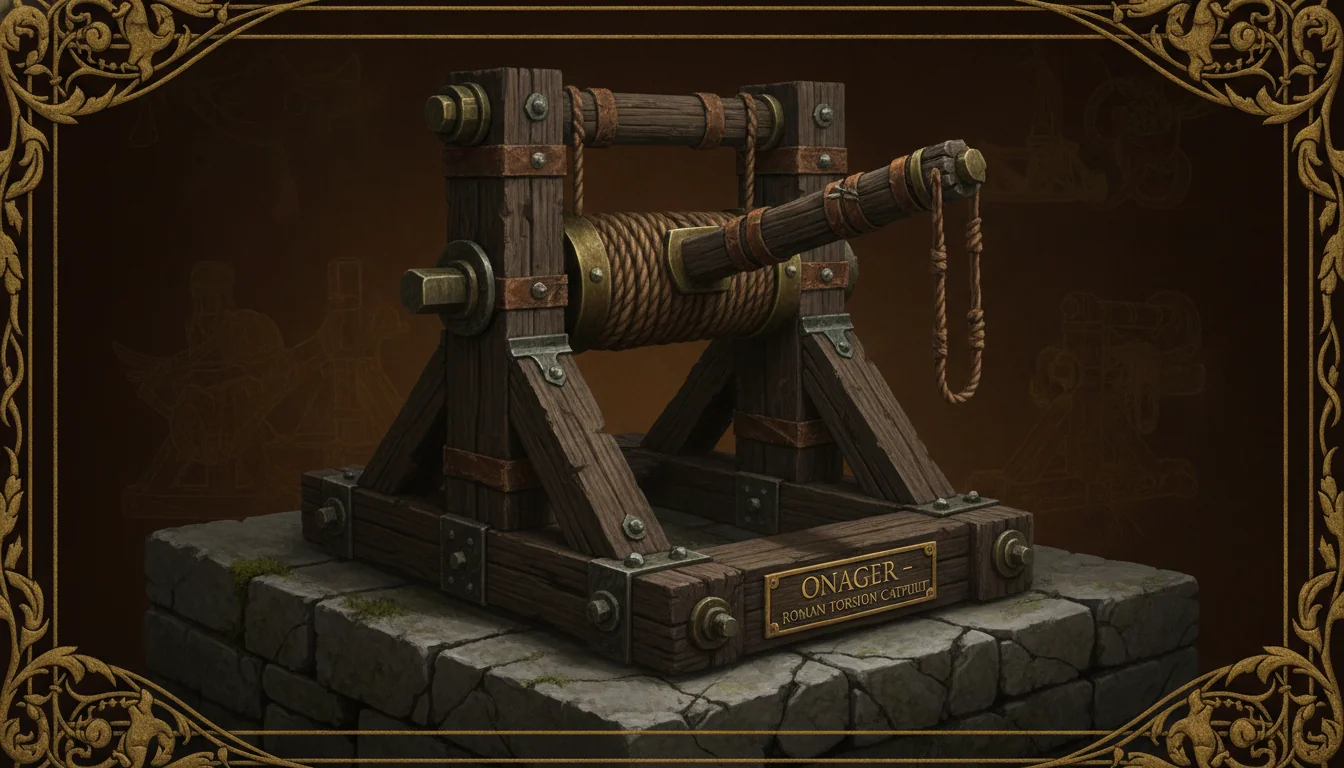
In modern popular usage, catapult is a general term for any large ancient throwing machine, while ballista specifically refers to the torsion bolt-thrower. The Romans themselves used 'catapulta' for bolt-shooters and 'ballista' for stone-throwers, though the terminology varied by period. The scorpio was the smaller, more portable Roman bolt-thrower; the onager was the Roman stone-thrower with a single throwing arm.
What was the scorpio or scorpion?
The scorpio (also called scorpion) was the smaller, field-portable version of the Roman bolt-thrower. A one- or two-man weapon, it could be carried on campaign and deployed quickly. The carroballista was a scorpio mounted on a cart or mule frame for even greater mobility, shown prominently on Trajan's Column. Smaller and more precise than the full ballista, the scorpio was used for anti-personnel work in both sieges and field battles.
How accurate was the Roman ballista?
The large ballista was accurate enough at 300-400 meters to target a section of parapet rather than just a wall face. Josephus, describing the Roman siege of Jerusalem in 70 CE, records that defenders learned to watch for the flash of the ballista mechanism because the white limestone bolts were visible in flight - giving perhaps a second's warning to take cover.

Talk to the People Who Wielded These Weapons
Chat with the soldiers, smiths, and commanders whose lives were shaped by the weapons of their age.
Create your free account →No card required. Talk to anyone in history with 8 free credits a day. Some features require a paid plan.
Join the HistorIQly Club
Get smarter about the past.
Weekly stories, deep dives, and exclusive content straight to your inbox.