Arsenal: The Roman Onager
The Roman onager was a single-arm torsion catapult that flung stones and fire at city walls - the wild donkey of Roman siege warfare, and what it could actually do.
Read Wikipedia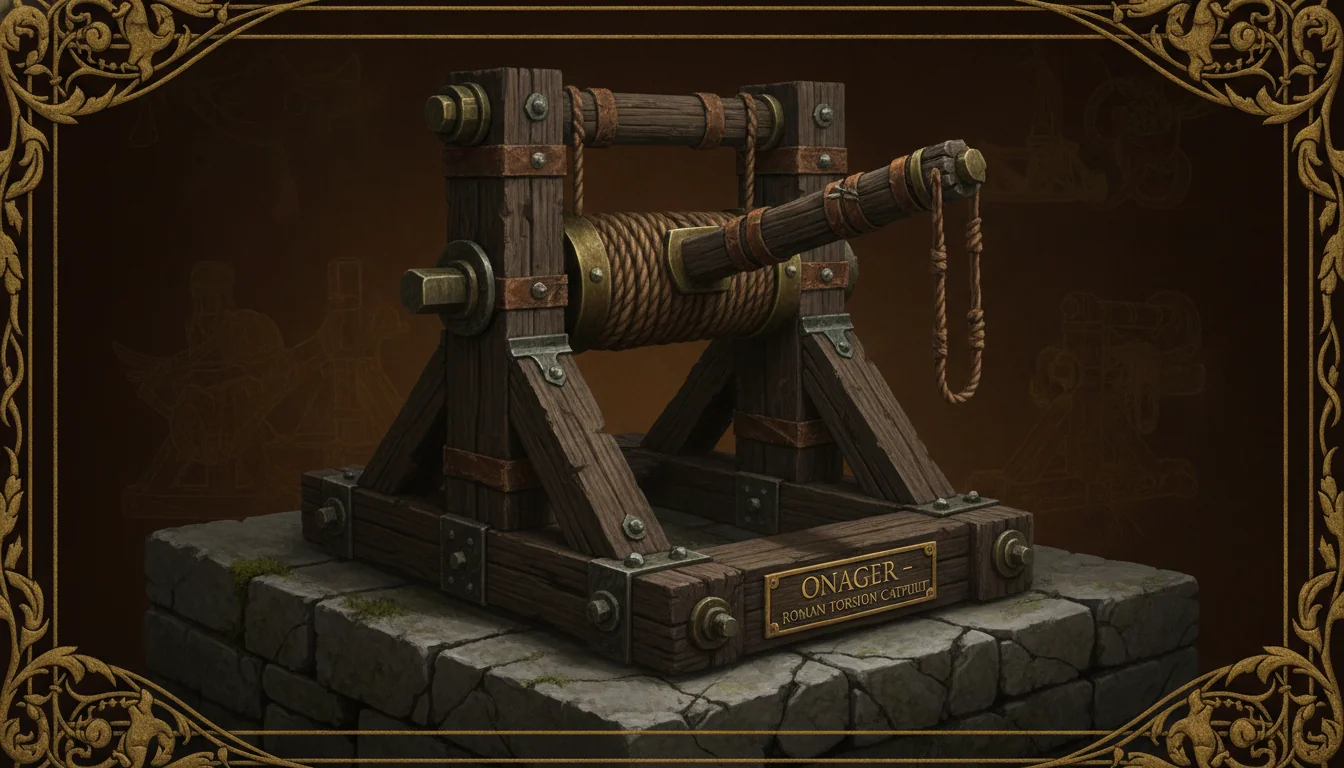
The Romans named it for a wild donkey. This was not affectionate. The onager - the feral ass of central Asia - was known throughout the ancient world for its rear kick, an explosive, violent motion that could shatter bone and send a grown man into the air. When Roman engineers wanted to describe a machine that thrashed and bucked and flung heavy objects with bruising force, the comparison was obvious. The name stuck for centuries.
The Roman onager was the workhorse of Roman siege artillery, the weapon that lobbed stones against gates, walls, and defenders who thought distance made them safe. It was not the most powerful machine in the Roman toolkit, nor the most accurate. But it was rugged, transportable, and effective enough to appear in nearly every major Roman siege from the 3rd century AD onward.
What it was and how it worked
The onager was a single-arm torsion catapult - crucially different from the ballista, which used two arms and functioned more like a giant crossbow. The onager had one vertical arm set into a thick bundle of twisted rope, sinew, or hair. That bundle, under extreme tension from being wound tight, functioned as a spring. When the arm was pulled down against the tension and locked in place, the device was ready. When the lock was released, the arm swung upward in a violent arc and struck a padded stop beam at the top of the frame, transferring the kinetic energy to whatever sat in the sling or cup at the arm's end.
The projectile could be a rounded stone, a clay pot of burning oil or naphtha, a bag of burning material, or - in the grimmest applications documented by ancient sources - the severed heads of enemies, which Roman and later medieval commanders sometimes launched into besieged cities for psychological effect. The standard military use was stone or incendiary.
The frame was heavy timber, designed to be lashed to a bed of planks or a rock surface to absorb the recoil. The kick was substantial and real. Roman engineering manuals noted that the onager's lurch on firing could overturn a poorly mounted machine, and that crews who positioned it on soft ground needed to anchor it before operation. The comparison to the donkey was earned.
Construction and the torsion principle
The heart of the onager's mechanism was the torsion bundle, called the modiolus by Roman writers. Craftsmen twisted the sinew or rope to extreme tightness, then inserted the vertical arm through the bundle at the center. The arm was held against the stored energy of the twisted fibers until the trigger mechanism released it.
Maintaining the torsion bundles was one of the more demanding logistical aspects of owning siege artillery in the ancient world. Sinew and hair absorbed moisture and lost tension in wet conditions; they dried and cracked in hot, dry climates. Roman and later Byzantine manuals specified that artillery should be kept under cover when not in use, that the bundles should be loosened after extended storage, and that the quality of the fiber - horse hair, ox sinew, human hair in extreme cases - directly determined the machine's performance.
The arm itself was typically ash or elm, chosen for flexibility and resistance to fracture under the repeated shock of the stop beam. The stop beam pad was wool or leather, designed to cushion the impact and protect the arm. Even so, arms broke. Field repair manuals existed, and legionary engineering units traveling with siege trains carried replacement components.
The sling at the end of the arm extended the effective radius of the swing, multiplying the speed at which the projectile was released. The sling's length was calibrated to the desired trajectory: a longer sling flattened the arc and increased range; a shorter sling produced a steeper angle useful for lobbing projectiles over walls rather than at them.
What the onager replaced and what it competed with
The dominant Roman stone-thrower before the onager was the ballista - a two-armed device that fired bolts or rounded stones at high velocity on a flat trajectory. The ballista was accurate, powerful at close range, and capable of penetrating shields and light armor at distances where the onager would be less effective. Roman legions used both.
The onager's advantage was tactical versatility. Because it lobbed projectiles in a high arc, it could throw over intervening obstacles - earthworks, walls, bodies of troops - that the flat-shooting ballista could not clear. It was also simpler to build than the ballista, with fewer precision-fitted parts and a more forgiving mechanism. A skilled carpenter could construct a functional onager from local timber in the field; the ballista required more precise components.
The tradeoff was accuracy. The ballista could target individual men on a wall at medium range. The onager was better understood as an area weapon: concentrate fire on a gate, a tower base, or a section of parapet, and sufficient stones would do the work even with imprecise aim. Roman siege doctrine appears to have used both weapons in complementary roles, with ballistae providing suppressing fire against defenders on walls and onagers battering structural targets.
At the sieges
The first detailed references to the onager by name come from the 4th century AD, notably in Ammianus Marcellinus's history of the Roman campaigns against the Sassanid Persian Empire. His account of the siege of Amida in 359 AD describes Roman use of both ballistae and onagers in the defense of the city, including an incident in which an onager arm struck and killed two brothers who were operating it when it snapped.
Earlier Roman siege works, including those of Julius Caesar at Alesia in 52 BC and the siege of Masada in 73 AD, employed torsion artillery, though whether these were strict onagers or related machines is debated. The mechanics were understood well before the name became standard. Caesar's siege works at Alesia - the double ring of circumvallation and contravallation he constructed around the hilltop fortress while also defending against an external Gallic relief army - incorporated artillery platforms as part of an engineering project that remains one of the most studied in military history.
The siege of Dura-Europos on the Euphrates, excavated in the 20th century, produced extraordinary physical evidence of ancient siege warfare: Roman and Sassanid tunnels, collapsed masonry, the remains of defenders in a mine shaft, and evidence of artillery fire on the fortifications. The combination of tunnel mining and artillery bombardment, both aimed at collapsing the walls from different vectors, was standard late Roman practice against stone fortifications.
The projectiles and what they did
Against earth or timber palisades, even medium-sized stones were devastating. Wooden gatehouses, palisade walls, timber towers, and roofed defensive galleries could be broken apart by sustained bombardment, and the debris created secondary hazards for defenders trying to make repairs.
Against stone masonry, the onager was more useful as a terror weapon and a gate-breaker than as a wall-demolisher. Ramming and mining remained more efficient for breaching heavy stone construction, but artillery kept defenders off the walls while rams and sappers worked. Stones landing among defenders in an open space on the wall walk caused casualties that degraded the garrison's ability to resist.
Incendiary projectiles, pots of burning oil or naptha with a lit wick, added fire to the equation at sieges where defenders had wooden structures to protect. The psychological effect of burning projectiles arriving from a distance was real and documented: sources describe garrisons that panicked under incendiary bombardment even when the structural damage was limited.
Decline and the trebuchet
Torsion artillery was labor-intensive, maintenance-heavy, and sensitive to conditions in ways that made it difficult to sustain in extended campaigns far from supply lines. The counterweight trebuchet, which emerged in the 12th century in the medieval West, solved several of these problems at once. It used gravity as its power source, required no torsion bundle, worked consistently regardless of humidity, and could be scaled up to throw vastly heavier projectiles than any torsion machine could manage.
The trebuchet's range and power exceeded the onager's substantially at the larger end of the scale. Medieval engineers built machines capable of hurling stones of 100 kg or more at ranges well beyond what torsion artillery could achieve. The onager, and torsion artillery generally, did not vanish overnight - Byzantine forces used torsion machines well into the medieval period - but the technology was eventually superseded by gravity, which has the advantage of never wearing out.
What the name preserved
The word onager has a longer cultural life than the machine. The Romans' vivid naming habit, connecting a siege engine to a kicking donkey, ensured that the image survived in literature and historical memory long after the device itself became obsolete. Medieval writers describing ancient siege warfare used the term consistently. It appears in chronicles, technical manuals, and military histories across several centuries.
The actual machine - the heavy timber frame, the twisted sinew bundle, the padded stop beam, the violent backward lurch - has been reconstructed by experimental archaeologists and tested at working scale. Those experiments confirm what Roman engineers knew: the onager is powerful, unreliable in aim, punishing to operate, and perfectly named.
For the weapons that Roman artillerymen worked alongside, see our profiles of the Roman gladius and the Macedonian sarissa.
Quick Answers
Common questions about this topic
What was the Roman onager?
The onager was a single-arm torsion catapult used by Roman armies from roughly the 3rd century AD onward. It hurled stones or incendiary projectiles using a vertical arm powered by twisted ropes or sinew bundles under extreme tension. When released, the arm swung upward, hitting a padded stop beam, and flung the projectile in a high arc toward the target.
Why was it called an onager?
Roman sources explain that the machine's violent recoil and kick when fired resembled the kick of an onager, the wild donkey of central Asia. The animal was known for a spectacularly powerful rear kick - and the catapult's tendency to lurch backward on firing made the comparison apt.
How far could a Roman onager throw?
Estimates vary with the machine's size. A medium onager could hurl a stone of 5 to 10 kg a distance of around 300 to 400 meters. Heavier machines could throw larger stones but at shorter range. Accuracy decreased sharply with distance; the onager was most effective at walls within 150 to 200 meters.
What replaced the onager?
The counterweight trebuchet, developed in the 12th century, ultimately superseded torsion artillery in siege warfare. The trebuchet used gravity rather than twisted fiber, was more powerful, more consistent, and required less maintenance. However, torsion catapults of various kinds remained in use alongside early trebuchets for several centuries.

Talk to the People Who Wielded These Weapons
Chat with the soldiers, smiths, and commanders whose lives were shaped by the weapons of their age.
Create your free account →No card required. Some figures and features require a paid plan.
Join the HistorIQly Club
Get smarter about the past.
Weekly stories, deep dives, and exclusive content straight to your inbox.