Arsenal: The Roman Scutum Shield
The Roman scutum was the foundation of legionary doctrine - the curved shield that let soldiers fight as one body and build an empire over six centuries.
Read Wikipedia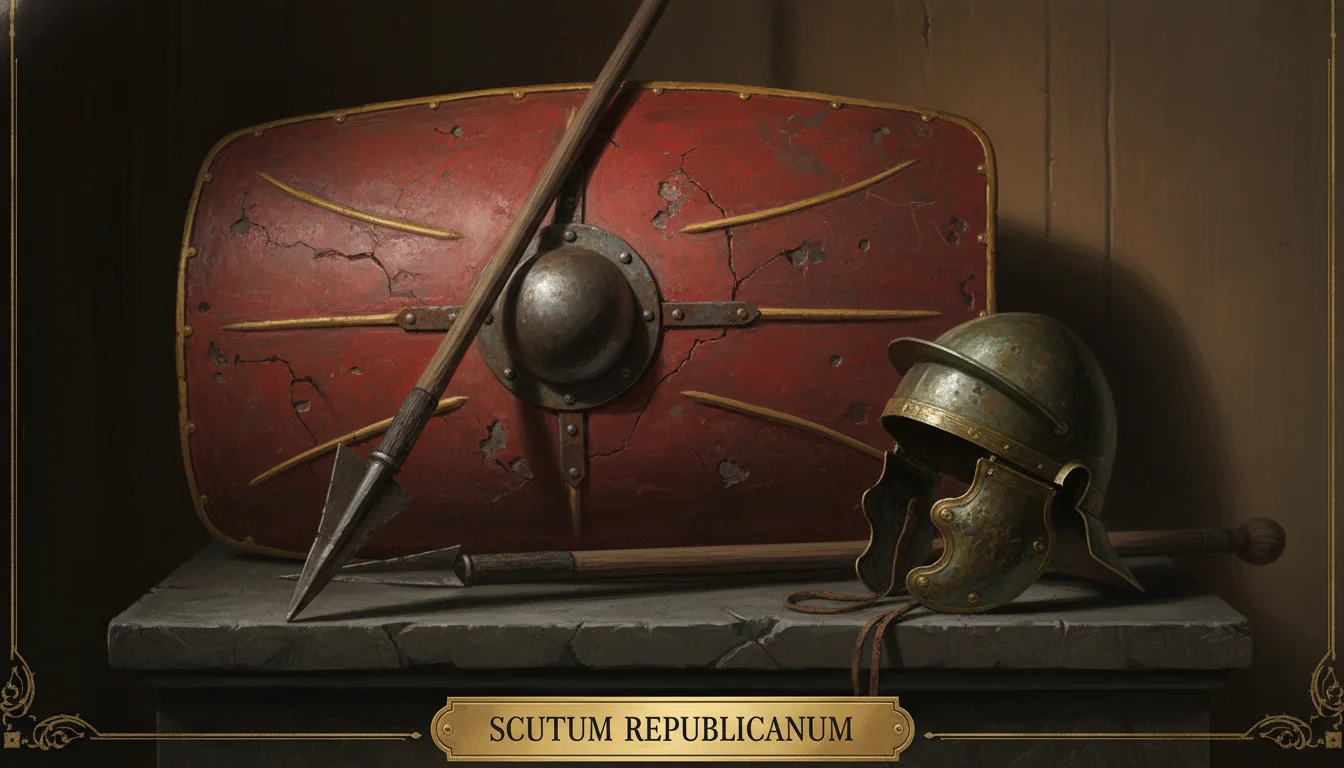
The gladius gets the poetry. The pilum gets the engineering admiration. The scutum gets taken for granted - treated as merely the thing a legionary hid behind while the proper weapons did the work. This is wrong. The scutum was not simply protective equipment. It was the engine of the Roman tactical system, the foundation on which everything the legions did in close combat was built. Without it, the gladius was a short sword being swung by an individual man. With it, the gladius became the killing instrument of the most effective military system the ancient world produced.
Understanding the scutum means understanding what the Roman army actually was: not a collection of individual warriors competing in heroic single combat, but a disciplined, industrial system of violence. The scutum was the component that made the system work.
What the scutum was
The standard legionary scutum of the late Republic and early Empire was a large curved rectangular shield, roughly 80 centimeters wide and somewhere between 100 and 130 centimeters tall, with a pronounced cylindrical curve along its horizontal axis. The curve was not decorative - it was structural. The concave inner surface let the shield wrap around the user's body, protecting not just the chest and left arm but the lower legs as well. Held correctly, with the left arm behind the grip bar and the body braced, the scutum covered the legionary from chin to shin.
Construction was sophisticated. The wooden core was built from multiple thin strips of wood glued together in alternating grain directions - what modern engineers would recognize as laminated plywood, probably two or three layers thick. This cross-ply construction resisted the kind of splitting that a single plank would suffer under a direct missile impact. The wood was then covered in canvas and leather, glued and stitched under tension. A central iron or bronze boss, the umbo, protruded from the outer face. An iron or bronze rim reinforced the edges against sword blows.
The result was a shield that could absorb a pilum impact without shattering, deflect glancing sword cuts, and sustain repeated abuse across a campaign season. Surviving examples - most notably specimens from the eastern frontier and the remarkable painted example recovered from Dura-Europos in Syria - suggest the total weight was between 6 and 10 kilograms, though estimates vary based on the age and manufacture of specific pieces. That is considerable weight to carry at the run, and Roman legionaries were expected to do exactly that.
The umbo was not merely decorative. In close combat it was a weapon. A sharp punch forward drove the boss into an opponent's face, chest, or weapon arm with the full body weight of the man behind it. Roman training manuals describe the technique explicitly, and the physical damage patterns on some excavated shields confirm it was practiced.
Origins and evolution
The oval scutum predates the rectangular form. Italic and Celtic warriors were using large oval body shields long before Roman armies standardized the rectangular variant. The rectangular shape became dominant in Roman service during the period of the manipular legion - roughly the 4th to 3rd century BC - when Roman tactical doctrine moved away from the Greek-derived phalanx model toward the more flexible three-line system that would define the Republic's armies for the next three centuries.
Precisely when the rectangular form was adopted is not clear from the surviving sources. What is clear is that by the time Rome was fighting the Samnites and the Hellenistic kingdoms in the 3rd century BC, the rectangular curved scutum was the legionary's standard shield and the tactical doctrine built around it was already mature. The basic formula - large, curved, rectangular, with umbo - held for six centuries despite variations in detail across regions and eras.
The tactical system
The scutum did not function alone. It was the central piece of a three-part weapons system designed around a specific tactical sequence that Roman writers described with evident professional satisfaction.
The sequence began at medium range with the pilum, the heavy javelin that Roman legionaries carried in the assault. The pilum was an engineering marvel of a specific kind: its iron shank was designed to punch through a shield and bend on impact, making it impossible to pull out cleanly or throw back. A well-executed pilum volley, released at close range, disrupted the enemy formation at precisely the moment the legionaries needed to close the gap - shields dragged down by embedded weapons, arms yanked forward, men stumbling out of formation.
Into that disruption, the legionaries advanced behind their scuta. The shield covered the left side and front; the gladius worked from the right in short, lethal thrusts through gaps in the enemy line. The man who tried to swing a long slashing sword at this combination found no room and no angle. The scutum absorbed the arm's movement before the blow could develop. Vegetius, summarizing earlier training doctrine, made the case explicitly: a cut rarely kills outright because bones and muscle protect the vital areas; a thrust two inches deep into the chest or stomach is almost always fatal.
In formation, the shields of adjacent men overlapped. The man to your left covered part of your right flank; your scutum covered part of his. The formation became geometrically stronger than any of its components. Against the long slashing swords favored by Gallic and Germanic opponents, the combination of overlap, short gladius, and disciplined advance produced lopsided casualty ratios. The barbarian raised his arm to swing; the legionary stepped into the gap and drove the gladius into the exposed armpit or chest. Polybius, describing the wars in the Po valley, noted that Gallic iron swords bent on the first blow and had to be straightened underfoot, while Roman blades kept their edge and their point.
The testudo
The scutum made the testudo possible, and the testudo was one of the most tactically distinctive formations in ancient warfare. The name is Latin for tortoise, and the shape justifies it: soldiers on the outer files held their scuta vertically facing outward and forward, while men in the interior raised their shields horizontally above their heads. The resulting shell of overlapping coverage could deflect arrows, sling stones, and thrown javelins from defenders on walls.
Ancient sources confirm the testudo was a practical battlefield device, not just a literary flourish. Plutarch describes its use during Antony's Parthian campaign. Cassius Dio records it used in Britain. Trajan's Column, carved in the early 2nd century CE, depicts the formation in sculptural detail. Roman commanders used it to advance siege equipment against defended walls and to allow engineering work - filling ditches, positioning battering rams, emplacing ladders - to proceed under fire.
The testudo demanded discipline, physical strength, and the right equipment. It only works with shields large enough and rigid enough to actually interlock with their neighbors. A lighter or smaller shield produces gaps. The scutum's specific dimensions and construction were prerequisites, which is why the testudo appears in the historical record alongside the scutum and fades when shield types change.
Key campaigns
The scutum in its element was the close-order infantry engagement on open or moderately clear ground. Caesar's Gallic Wars provided those conditions repeatedly across a decade, and the legions' performance against Gallic and Germanic opponents with longer weapons demonstrated the doctrine's ruthless efficiency. At Alesia in 52 BC - the siege of the hill fort where Vercingetorix had gathered the Gauls - Caesar's legions simultaneously held a besieged enemy inside their circumvallation and fought off a massive relief force outside. Both tasks required precisely the close-order, shield-based fighting the scutum was built for.
The sieges of Jerusalem in 70 CE and Masada in 73-74 CE produced documented accounts of testudo formations advancing under intense missile fire. Josephus describes Roman formations maintaining their shape under a continuous rain of projectiles while advancing to the walls.
Where the scutum struggled was terrain that denied formation advantages. The disaster in the Teutoburg Forest in 9 CE - three legions destroyed by Arminius in forested, broken ground - was fundamentally a terrain problem. Shields that protected men in close formation offered far less advantage to men fighting individually through trees.
The decline
By the 3rd century CE, the Roman military environment was changing in ways that made the scutum's specific advantages less decisive. The most pressing threats came from cavalry-heavy opponents on open ground - Sassanid Persian cataphracts on the eastern frontier, mobile Germanic horsemen on the Rhine and Danube. Engagements on open steppe or wide river plains against cavalry required mobility and individual reach that the tight legionary formation, optimized for close infantry fighting, could not provide.
Oval and round shield forms began replacing the rectangular scutum in legionary service. The spatha, a longer sword originally used by Roman auxiliary cavalry, replaced the gladius by similar logic - greater reach on horseback, better suited to the looser formations becoming standard in an army that was increasingly cavalry-centered. By the time of Diocletian's military reforms in the late 3rd century, the army that emerged looked substantially different from the manipular legion that had built the empire.
What remained
The scutum outlasted the tactical world that produced it. Its visual identity - painted with the eagle, the thunderbolt, and the unit's distinctive colors - became the defining symbol of the Roman legionary in art across centuries, depicted on arches, columns, and funerary monuments long after the shield itself had changed. The Dura-Europos shield, with its deep red face and Jupiter's eagle, is the most complete survivor, but the type appears in Roman sculpture from Britain to Mesopotamia.
The tactical insight it embodied - that a disciplined line of overlapping shields creates combat capability greater than the sum of its parts - was not forgotten. It reappears in shield-wall discussions from the Viking age onward. The Romans did not invent the principle. They standardized it, drilled it into professional soldiers for six centuries, and built the largest empire the ancient world had ever seen with it as their primary infantry tool. The gladius gets the poetry. The scutum won the wars. For the other key weapons in the legionary's kit, see the histories of the Roman gladius and the Roman pilum.
Quick Answers
Common questions about this topic
What was the Roman scutum made of?
The scutum was constructed from multiple thin strips of wood glued together in alternating layers - essentially ancient plywood - then covered in canvas and leather, with an iron or bronze central boss called the umbo. Evidence from surviving examples suggests it weighed between 6 and 10 kilograms. The wooden core gave it the structural rigidity to absorb pilum impacts without shattering.
What was the testudo formation?
The testudo, Latin for tortoise, was a formation in which Roman soldiers interlocked their shields to create a near-continuous surface of overlapping cover. Men on the outer files held their scuta vertically facing outward; men in the interior raised their shields horizontally above their heads. The resulting shell could deflect arrows, javelins, and stones from defenders on walls during siege assaults.
How long was the scutum used by Roman legions?
The large curved rectangular scutum was the standard legionary shield from roughly the 3rd-4th century BC through the 3rd century CE - a span of roughly six hundred years. The transition away from it was gradual, driven by changes in the Roman army's tactical priorities as cavalry-heavy opponents replaced close-order infantry as the main threat.
What replaced the scutum?
The scutum was gradually replaced by oval and round shields as the Roman army shifted from close-order infantry battles to more mobile engagements on open frontiers. By the late empire, late Roman infantry carried oval shields better suited to the looser formations that had become standard on the Rhine and Danube. The transition paralleled the replacement of the gladius by the longer spatha.

Talk to the People Who Wielded These Weapons
Chat with the soldiers, smiths, and commanders whose lives were shaped by the weapons of their age.
Create your free account →No card required. Talk to anyone in history with 8 free credits a day. Some features require a paid plan.
Join the HistorIQly Club
Get smarter about the past.
Weekly stories, deep dives, and exclusive content straight to your inbox.