Arsenal: The Bayonet - How a Plug of Steel Retired the Pike and Lasted Four Centuries
Bayonet history in one article: how a plug of steel ended the pike, survived four centuries of infantry warfare from Vauban to the Falklands, and still ships in the modern patrol kit.
Read Wikipedia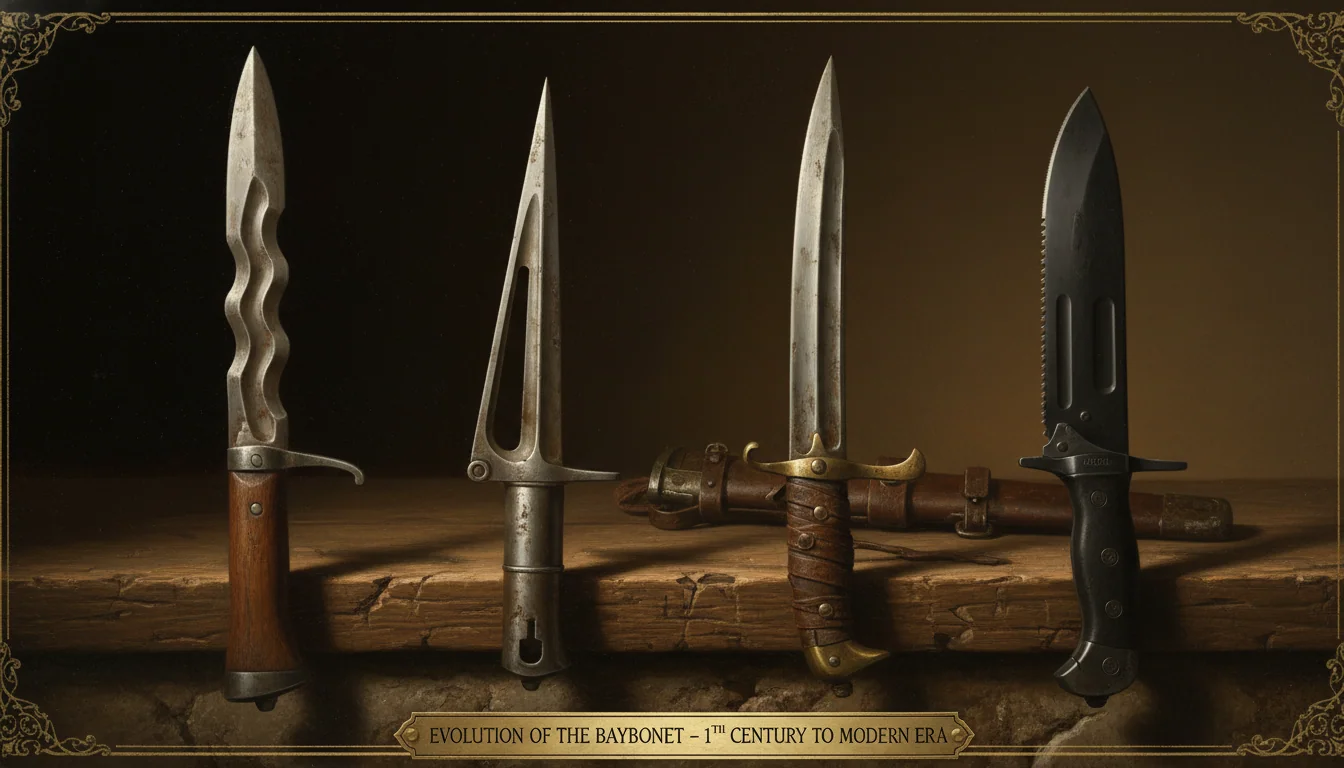
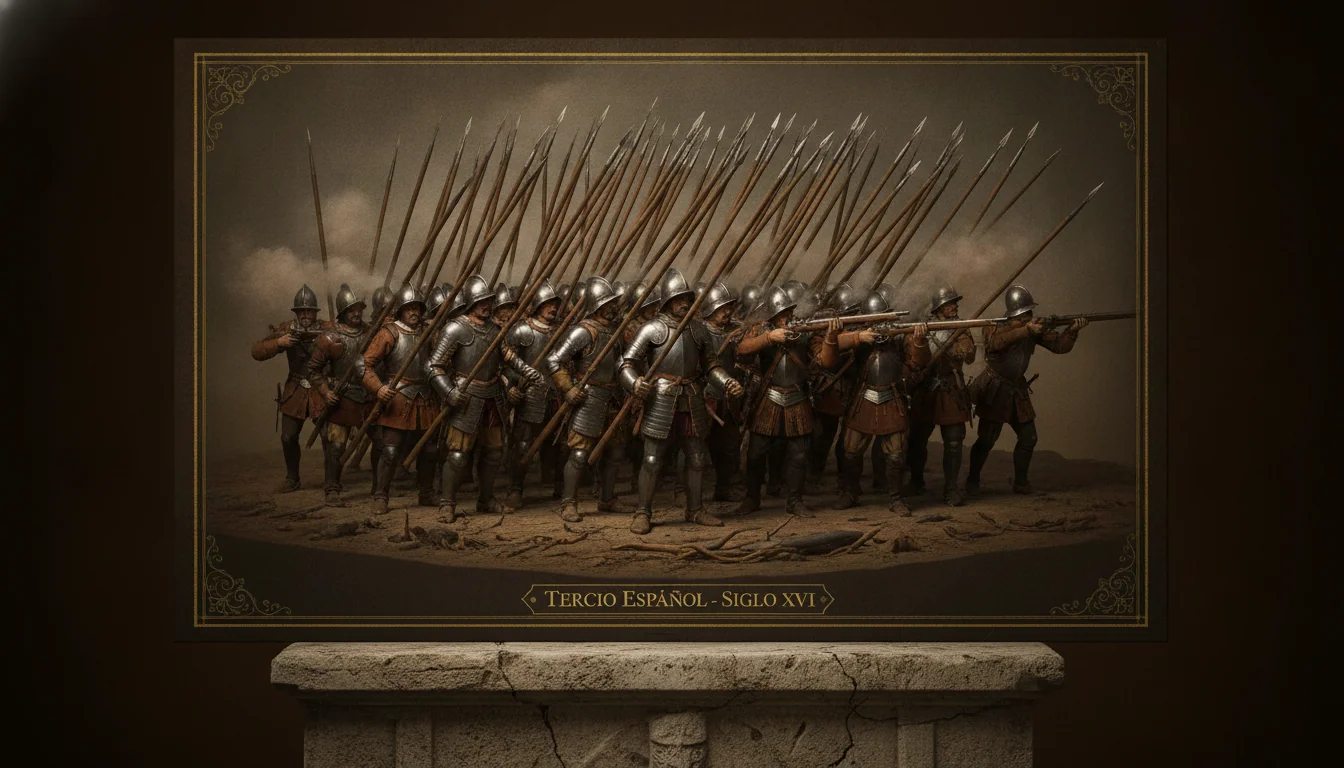
For most of military history, infantry armies ran on two separate specialties that did not like to share a formation. The musketeers shot things. The pikemen kept cavalry and charging infantry from killing the musketeers while they reloaded. This arrangement worked, after a fashion, but it required twice the manpower, twice the logistics, and a careful choreography of unit positioning that fell apart the moment a battle moved faster than the officers could direct.
The bayonet made that whole structure redundant. A soldier with a musket and a fitted blade could shoot at range and defend himself at arm's length. The pike became unnecessary. One weapon, one soldier, one mission. It sounds simple because it is, and because simple solutions to complex problems tend to end careers and end armies once they work.
The plug bayonet and its obvious flaw
The earliest bayonets, appearing in French military use by the 1640s, were plug designs: a tapered handle pushed directly into the muzzle of the musket. The idea was sound in theory - a soldier could fix steel when cavalry approached and use his musket as a spear. The problem was equally simple. Once the plug bayonet was fitted, the musket was a spear and nothing else. The muzzle was blocked. You could not fire.
This was not a fatal flaw in all circumstances. If you had time to judge when cavalry was coming, you could reload first, fire a volley, then jam in the plug. But battle does not always offer that courtesy, and the trade-off between firepower and protection created tactical dilemmas that commanders handled with varying success.
The demonstration of what went wrong came on July 27, 1689, at the Battle of Killiecrankie in Scotland. A Jacobite force of Highland Scots, fighting for the exiled James II, charged the government troops of William III's army with claymores and broadswords. The government infantry fixed their plug bayonets, losing their ability to fire. The Highlanders, who had fired their own single volley and charged immediately, were on the government line before it could respond effectively. The government force was broken. Killiecrankie was a Highland tactical triumph - and the plug bayonet's death warrant.
Vauban's socket and the end of the pike
The solution had already been developed. The socket bayonet, perfected in France by the military engineer Sebastien Le Prestre de Vauban and adopted by the French army in 1689, fit around the outside of the musket barrel rather than blocking it. An L-shaped slot in the socket slipped over a lug on the barrel and locked in place with a quarter-turn. The musket could be fired with the bayonet fixed. The infantryman now did both jobs.
The tactical implications were immediate and sweeping. The pike, which had been the anchor of European infantry formations since the Swiss Confederation revolutionized warfare in the 14th century, lost its rationale in a decade. A formation of musketeers with socket bayonets could receive a cavalry charge without needing pikemen in their ranks. The pikemen themselves, relieved of their role, could be rearmed with muskets, doubling the firepower of the formation at no increase in manpower.
By the War of Spanish Succession, which began in 1701, most major European armies had completed the transition. The last English pikemen were officially disbanded around 1705. The pike-and-shot formation that had defined European land warfare for more than two centuries was gone. The age of the musketeer-rifleman, who carried his own close-combat defense in his hand, had begun.
The socket bayonet's design logic
The blade of the socket bayonet settled, in many armies, on a triangular cross-section - three flat faces meeting at a sharp point, with no cutting edge. This seems counterintuitive until you consider what it was actually meant to do.
A triangular puncture wound is harder for surrounding tissue to close than a flat slash. The three channels created by the three faces resist the contraction of muscle around the wound. The blade is also structurally strong - much harder to snap than a thin flat blade when the musket is being used as a pike. And the triangular bayonet was easier and cheaper to produce at scale, which mattered when armies were issuing hundreds of thousands of them.
The French objected to the triangular bayonet on humanitarian grounds during the Geneva Conventions of the 19th century, arguing that it created unnecessarily severe wounds. British military lawyers countered that the purpose of a weapon was to incapacitate an enemy, and that severity of wound was a design feature rather than a flaw. The debate produced no resolution. Triangular bayonets continued to be used.
Napoleonic warfare and the bayonet's psychological role
By the Napoleonic period, the bayonet's actual combat function was already less significant than its psychological one. Studies of casualty records from 18th and 19th century battles consistently show that bayonets caused a small minority of wounds - perhaps 5 percent or less, depending on the engagement. The great killers were musket balls, artillery, and in later periods rifle fire.
But bayonet charges were not primarily about producing bayonet wounds. They were about producing rout. A line of infantry advancing with fixed bayonets, at close range, in disciplined formation, produced in defenders the same effect that a charging cavalry line produced: a choice between standing and dying, or running and surviving. Most human beings make the rational choice. The charge that meets an unsteady line breaks it; the charge that meets a steady line is repulsed. Bayonets were the instrument of the question, not always of the answer.
The British square - infantry forming a close-order rectangle with fixed bayonets on all four faces - became the most reliable defense against cavalry. Horses are unwilling to run onto a hedge of steel. At Waterloo in 1815, British squares stood against repeated charges by French cavalry under conditions that should, on paper, have broken them. They didn't, in part because horses are smarter than cavalry tactics sometimes assumed.
The American Civil War and the limits of the charge
The introduction of the rifled musket by the time of the American Civil War changed the equation without anyone fully adjusting their doctrine in time. A rifled weapon was accurate at 300-400 yards rather than the 50-80 yards of a smoothbore musket. The practical effect was that a defending force could fire four or five aimed shots at a charging force before it closed the gap to bayonet range. The resulting casualty rates on attackers attempting set-piece charges were catastrophic.
The famous charges at Gettysburg, Petersburg, and elsewhere were examples of infantry attempting Napoleon-era tactics against rifle-era firepower. Most bayonet charges in the Civil War ended before the men reached the defenders, or with the defenders retreating before contact. Bayonet wounds accounted for less than 1 percent of casualties in most analyses of the conflict.
Commanders at the time knew this. Orders to fix bayonets and charge persisted anyway, partly from tactical habit, partly because there was no clear alternative, and partly because the bayonet charge remained a powerful tool for breaking demoralized or surprised defenders even when it failed against prepared ones.
The First World War and the trench tool
The trenches of the Western Front created a specific bayonet problem. Rifle-length socket bayonets, designed for open-field use, were awkward in the narrow confines of a communication trench or dugout. Several armies responded with shorter patterns - the British Pattern 1907 "sword bayonet" was eventually shortened, and various spike bayonets were developed for compactness.
The actual fighting in trenches used bayonets less than almost any other weapon. Grenades, trench clubs, entrenching tool handles sharpened to points, and revolvers were the primary close-quarters tools once soldiers were actually inside an enemy trench. Bayonets fixed and ready mattered more for the approach across no man's land, where the threat of mounted cavalry or organized infantry counterattack was at least theoretically plausible.
Training in bayonet fighting - the thrust, the parry, the butt-stroke - continued throughout the war and beyond, not primarily because bayonet fighting was common, but because the drills built physical aggression and combat confidence in new soldiers. A man trained to stick a bayonet into a sack of straw and twist felt differently about closing with the enemy than a man who had only fired at paper targets.
Post-1945 and the knife bayonet
The post-World War II period saw the bayonet complete its transformation from fighting weapon to utility tool. As rifles shortened (from the Garand to the M14 to the M16), the proportions of the long socket-mounted blade became increasingly awkward. The knife bayonet emerged as the standard: a utility blade of 6-8 inches, fitted with a crossguard that doubled as a wire-cutting tool when used in conjunction with the scabbard, and designed to function as a field knife when not mounted.
The US M7 bayonet, introduced for the M16 rifle, was followed by the M9, which added a more versatile blade shape and improved wire-cutter function. The British L3A1 and its successors followed similar logic. The weapon remains in service across virtually every major army, still trains drilled, still issued on operations, still occasionally used in circumstances where it was not expected to be needed.
Actual bayonet charges since 1945 are rare but not absent. British forces have fixed bayonets and charged in the Falklands, in Iraq, and in Afghanistan. Argentine, Argentinian, Iraqi, and Taliban forces have found, at various points in the last four decades, that the bayonet charge is not as obsolete as the distance-dominant nature of modern warfare might suggest.
The weapon that Vauban perfected to solve the problem of the plug bayonet in 1689, that ended the three-century reign of the pike, that stabilized the European infantry formation until the machine gun changed the calculation again, is still in the kit. It has not solved a tactical problem in the way it once did. But it has not gone anywhere either.
For the weapons it replaced and the ones it fought alongside, see our deep dives on the Roman Gladius and the Viking Ulfberht Sword.
Quick Answers
Common questions about this topic
Where does the word bayonet come from?
The etymology is disputed. The most common account traces the name to Bayonne, a city in southwestern France near the Spanish border, where blades were produced in the 17th century. A competing theory derives it from a Basque or Old French word for a type of short blade. By the mid-17th century, 'bayonette' appears in French military documents referring to a blade fitted to a firearm.
What was wrong with the plug bayonet?
The plug bayonet was jammed directly into the muzzle of the musket, preventing the weapon from being fired once it was fixed. This meant an infantryman had to choose, at a decisive moment, between firepower and close-combat protection. The Battle of Killiecrankie in 1689 illustrated the problem when Highland troops with broadswords swept over government infantry who had fixed their plug bayonets and could not fire.
When did the bayonet replace the pike?
The transition happened rapidly between roughly 1689 and 1710. The socket bayonet, which fit around the musket barrel rather than blocking the muzzle, allowed a single infantryman to both fire and receive a charge. By the War of Spanish Succession (1701-1714), most major European armies had retired the pike and replaced the pike-and-shot formation with the musket-and-bayonet combination.
Are bayonets still used in modern armies?
Yes, though primarily as utility knives rather than as weapons. Bayonet charges in the traditional sense became extremely rare after World War II, though they have occurred in limited engagements since. Modern bayonets like the US M9 are designed as multi-purpose cutting tools that can mount on the barrel in an emergency. Most armies still train bayonet fighting, partly for its value in building aggression and close-combat confidence.

Talk to the People Who Wielded These Weapons
Chat with the soldiers, smiths, and commanders whose lives were shaped by the weapons of their age.
Create your free account →No card required. Talk to anyone in history with 8 free credits a day. Some features require a paid plan.
Join the HistorIQly Club
Get smarter about the past.
Weekly stories, deep dives, and exclusive content straight to your inbox.