The Zweihander: History of the Giant Two-Handed Sword
Zweihander sword history in brief: the Landsknecht's answer to the pike wall, a blade nearly as tall as its wielder, wielded by double-pay mercenaries.
Read Wikipedia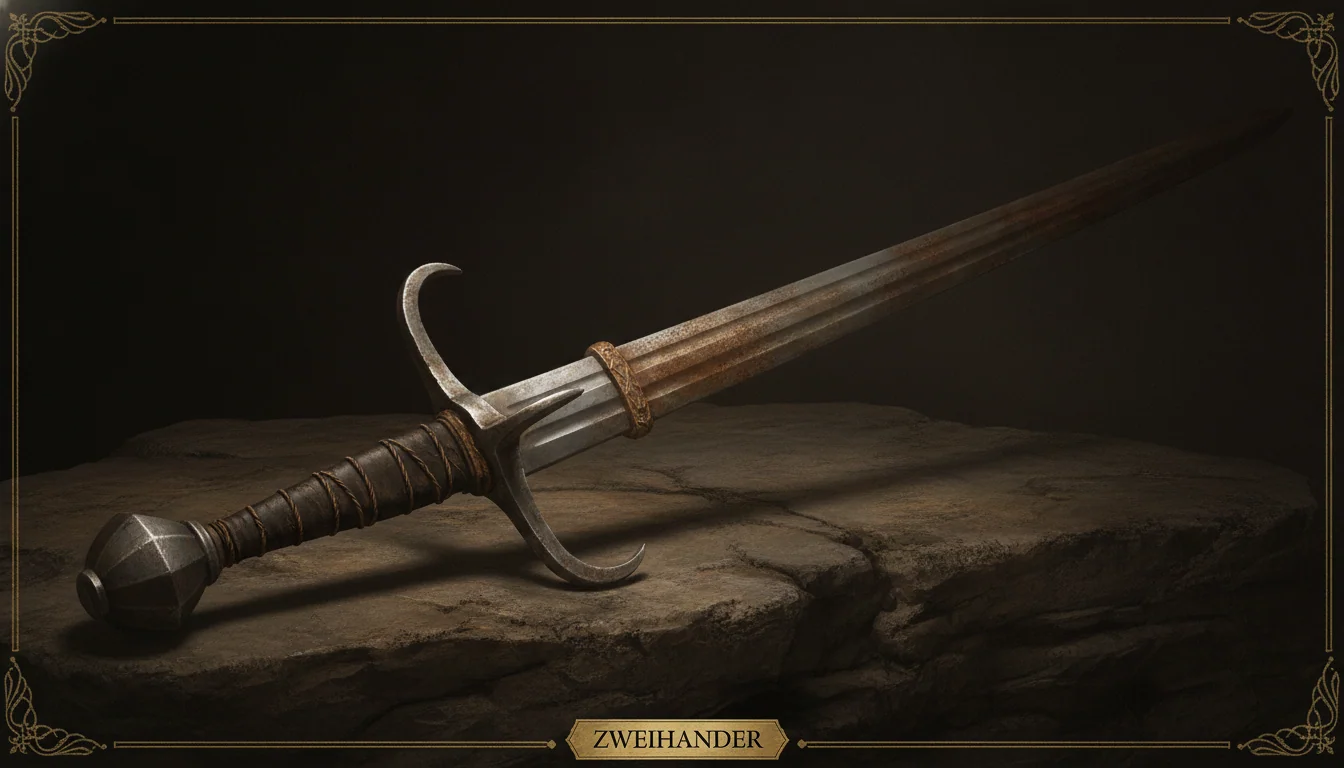
A pike was six meters long and expensive and took years of drill to use well. The simplest answer to a wall of pikes was a man with a sword long enough to knock them aside - and the willingness to walk directly into them to do it.
That man was the Doppelsoldner. His weapon was the Zweihander. And the combination, for roughly a century and a half of European warfare, was one of the more genuinely terrifying things that could appear across a battlefield at close range.
Quick answer: A Zweihander was a large two-handed sword, usually about 55-73 inches long and 5-8 pounds, associated with Landsknecht Doppelsoldner in 15th- and 16th-century pike warfare. Firearms and standardized pike-and-shot tactics made its battlefield role obsolete by around 1600.
What it was and what it wasn't
The Zweihander - German for "two-hander," also known as the Bidenhander, the Doppelhander, the Montante in Iberian armies, the Spadone in Italian, and the Epee a deux mains in French - is not a greatsword in the cinematic sense. Films and video games have trained audiences to imagine a two-handed sword as a cleaver for cutting through armor, and the Zweihander was not that.
It was a precision instrument for a specific tactical problem, built to solve it within the chaotic physics of a 16th-century infantry engagement.
A war-grade Zweihander typically measured between 55 and 73 inches overall, with a blade of 42 to 56 inches. It weighed between 5 and 8 pounds - less than most people expect given its size, because the point of balance sat near the ricasso (the unsharpened section of the blade just above the cross-guard) rather than at the tip. A skilled user could change the direction of a swing mid-motion, which is not possible with a heavier unbalanced weapon of the same length.
The cross-guard was large and swept forward, sometimes doubled, sometimes fitted with additional side rings. Between the cross-guard and the blade's sharpened section sat the ricasso, typically 8 to 14 inches long. The ricasso's existence was not decorative. It allowed the fighter to "half-sword" - to grip the blade itself with the secondary hand for close-quarters leverage when the sword's full length became a liability rather than an asset. A fighter half-swording with a Zweihander was essentially wielding a short-shaft polearm with a very sharp end.
Above the cross-guard, sometimes projecting horizontally from the ricasso, were the Parierhaken - "parrying hooks" or "flukes." These were short blunt projections whose purpose was to catch incoming weapons during close-quarters grappling. Combined with the long grip, the forward-swept guard, and the parrying hooks, the Zweihander gave a trained soldier a remarkable range of defensive options for something that long.
The Doppelsoldner
The Zweihander did not belong to knights or to the nobility. It belonged to Landsknecht infantry - German mercenary soldiers who formed the shock-infantry backbone of European armies through much of the 15th and 16th centuries. Landsknecht were professionals, not feudal levies. They contracted for campaigns, negotiated their pay collectively, elected their own company commanders, and maintained an internal culture of theatrical self-presentation. Their clothing was deliberately outrageous - slashed sleeves, parti-colored hose, feathered hats - partly because mercenary fame was a marketing tool and partly because Landsknecht culture valued display.
Within the Landsknecht formations, the Doppelsoldner ("double-pay soldier") occupied the most dangerous position. The standard Landsknecht formed in a deep pike-square, its front rank the deadliest place to stand. The Doppelsoldner volunteered for that front rank and received double the standard wage in exchange. Some carried pikes like their comrades. The ones who carried the Zweihander occupied the tip of the formation, the point where two opposing pike squares made contact.
Their job was to advance into the hedgehog of enemy pikes ahead of the main formation, use sweeping strokes to knock pike shafts to the side, and create breaks in the enemy line through which the following ranks could push. A pike presented vertically or angled slightly toward a diagonal was physically vulnerable to a hard horizontal sweep from a Zweihander. Not every stroke cut through the shaft - they often didn't - but shafts knocked aside were shafts not pointing at the advancing infantry.
A Doppelsoldner could also shorten a pike by cutting off its head. A pike minus its metal point is still a long and unwieldy stick, but it is less immediately lethal. At the moment two pike squares collided, the Doppelsoldner's role shifted to the chaotic hand-to-hand struggle that followed - a situation where a long sword still gave range advantage over the short swords and daggers of men who had dropped their pikes to grapple.
This was not a long career. The casualty rate for front-rank fighters in pike-square engagements was the highest in any 16th-century infantry force.
The wars that defined it
The Zweihander reached its peak use during the Italian Wars - the series of French, Spanish, Swiss, and Habsburger conflicts that convulsed the Italian peninsula from 1494 to 1559. These were the wars that gave European military doctrine most of its early-modern vocabulary: pike-and-shot tactics, combined-arms thinking, the dominance of Swiss and German professional infantry over feudal cavalry charges.
At the Battle of Bicocca in April 1522, Swiss pikemen who had refused to wait for artillery support advanced against an entrenched Landsknecht and Spanish position. The Swiss were cut down in front of the earthworks in one of the worst single-afternoon defeats in Swiss military history. The Doppelsoldner at the front of the Landsknecht line helped hold that position against an assault that should, by numbers alone, have overwhelmed it.
The Battle of Pavia in February 1525 - the decisive engagement of the Italian Wars that produced the capture of the French king Francis I - featured some of the largest concentrations of Landsknecht in European history. French pike formations, Spanish arquebusiers, and German two-handers all met on the same field, and the resulting combat validated the combined-arms doctrine that would define European infantry tactics for the next century.
The Swiss also fielded weapons in the Zweihander class during this period. The Scottish Highlands produced the claidheamh-mor - the great sword - in a similar role: a long two-handed weapon used in the chaotic close-quarters fighting that followed a charge, where the length gave a warrior an advantage over opponents armed with shorter blades.
Pier Gerlofs Donia and the legend of the giant sword
Any account of the Zweihander eventually arrives at Pier Gerlofs Donia, the Frisian rebel leader of the early 16th century known as Grutte Pier (Great Pier). He was a large man - contemporary accounts describe him as physically imposing - who led an insurgency against the Duchy of Gelre in the years around 1515. He became a folk hero in Frisia partly through documented military success and partly through his subsequent mythologization.
The museum at Leeuwarden in the Netherlands displays a sword said to have been Pier's. It measures approximately 213 centimeters (roughly 7 feet) and weighs just over 6.6 kilograms (nearly 15 pounds). This would make it exceptional even by Zweihander standards - heavier than any war-use sword and long enough to be effectively unwieldy in a real formation.
The likely explanation is that the sword was a trophy object rather than a weapon, made to celebrate Pier's legend after his death, in the tradition of commemorative arms that were always too large or too ornate to fight with. The story of a warrior who required a seven-foot sword appealed to Frisian cultural memory. The sword the museum holds reflects that appeal.
War Zweihanders were long. They were not that long.
The decline
The last chapter of Zweihander sword history is a quiet one. The weapon's tactical niche began to close in the second half of the 16th century. The combination that ended it was firearms and standardization.
As the arquebus improved in reliability and rate of fire through the 1540s and 1550s, and as the musket arrived in the 1560s, the proportion of firearms to pikes in a typical infantry unit steadily increased. The role of the Doppelsoldner was to disrupt pike walls at the moment of collision. As those collisions became less central - as firearms did more of the killing before infantry made contact - the front-rank pike-breaker had less to break.
The standardization of pike-and-shot tactics under Spanish and Dutch military reformers produced formations in which infantry mixed pikemen and musketeers in ratios that reduced the importance of the pure pike clash. By the 1590s, military manuals were describing the Zweihander as a secondary or ceremonial weapon rather than a primary one.
The Swiss Guard of the Vatican has carried Zweihanders and similar pole-weapons in ceremonial roles since at least the late 16th century, which is why images of the current guard include long two-handed swords alongside halberds. This is the weapon's afterlife: a symbol of martial seriousness drained of its actual combat function, carried by men in striped trousers whose job is mostly to look formidable in a court setting.
In that role, at least, the Zweihander has proved essentially immortal.
For the formation the Zweihander was built to confront, see Arsenal: The Pike. For the heavy impact weapon that complemented it in Swiss and Burgundian warfare, see Arsenal: The Halberd.
Quick Answers
Common questions about this topic
What is a Zweihander?
A Zweihander (German: two-hander) is an oversized two-handed sword developed primarily in the 15th and 16th centuries for use in close-quarters infantry combat. Typically 55 to 73 inches overall, it was wielded by specialized mercenary infantry called Doppelsoldner who received double pay for serving in the most dangerous position on the battlefield - the front rank against enemy pike formations.
How heavy was a Zweihander?
Functional war-use Zweihanders weighed between approximately 5 and 8 pounds (2.2 to 3.6 kilograms). Despite their imposing length, they were balanced weapons, not clubs. Many surviving ceremonial examples are heavier and longer because they were made for parade display rather than combat.
What were Zweihanders used for?
Their primary battlefield role was breaking enemy pike formations. Doppelsoldner would advance against a pike hedge and use sweeping strokes to bat aside pike shafts, shortening the effective reach of the enemy line and opening gaps for the rest of their unit to exploit. In the chaotic hand-to-hand melee that followed a pike clash, the Zweihander's length gave an advantage over shorter swords.
When did the Zweihander disappear from use?
The Zweihander was effectively obsolete as a primary weapon of war by the late 16th century. The widespread adoption of firearms and the standardization of pike-and-shot tactics reduced the need for a specialized pike-breaker. By around 1600 the weapon survived mainly in ceremonial form - Swiss Guards and similar palace troops carried them as symbols of authority. The Swiss Guards at the Vatican still carry them today in their parade role.

Talk to the People Who Wielded These Weapons
Chat with the soldiers, smiths, and commanders whose lives were shaped by the weapons of their age.
Create your free account →No card required. Some figures and features require a paid plan.
Join the HistorIQly Club
Get smarter about the past.
Weekly stories, deep dives, and exclusive content straight to your inbox.