Arsenal: Tank History
A complete tank history: from the Mark I's first trench crossing in 1916 to composite-armored main battle tanks, the weapon rebuilt itself four times over a single century.
Read Wikipedia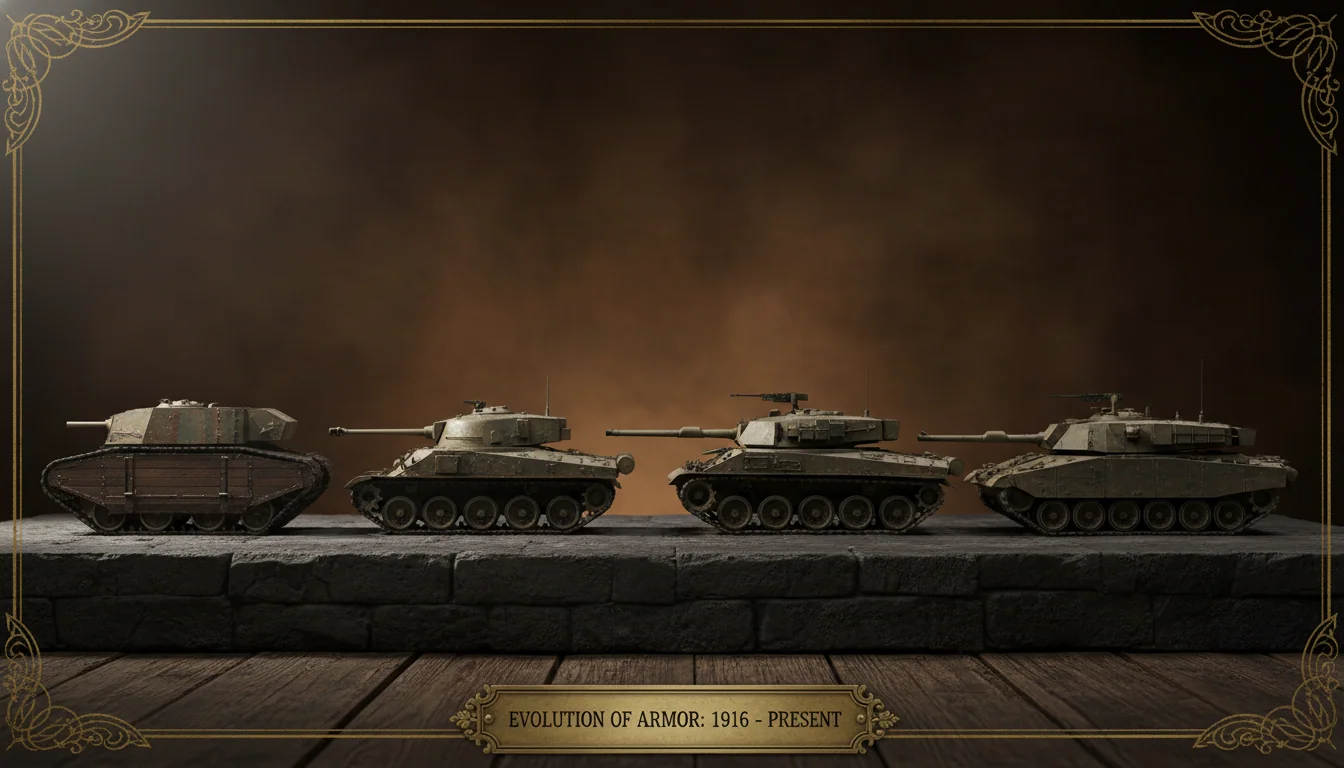
On September 15, 1916, on a stretch of churned French farmland near the village of Flers, a British mechanical rhomboid crossed the German trenches and changed the history of warfare. The Mark I tank was slow, mechanically unreliable, unventilated, and lethal to its own crew in extended action - temperatures inside reached roughly 50 degrees Celsius, exhaust fumes regularly incapacitated the men it was meant to protect, and four separate crew members were needed just to coordinate the steering. Of the 49 available for the battle, fewer than a third reached their objectives under their own power.
None of this mattered to the future. The principle had been demonstrated: a machine could cross ground that bullets could not stop. Over the following century, every subsequent generation of military engineers would attempt to perfect that principle, and tank history records four complete rebuilds of the weapon over that century.
The original problem
The tank was invented to solve a specific tactical crisis. By the end of 1914, the Western Front had solidified into a system of trenches, barbed wire, and machine-gun positions that made infantry assault catastrophically expensive. The British War Office and the Admiralty, which had a stronger culture of mechanical innovation, began parallel programs to develop an armored vehicle capable of crossing wire and neutralizing machine-gun emplacements.
The Mark I's distinctive rhomboid profile, with tracks running around the entire hull rather than just beneath it, was not aesthetic. It was engineered to bridge a twelve-foot trench and climb a sixty-degree parapet. The sponsons mounted on the sides carried either 6-pounder guns in the "male" variant or Vickers machine guns in the "female." The crew of eight worked in near-total noise and heat, coordinating a cumbersome gear system that required four men to drive.
Even in this primitive form, the psychological effect on German infantry was significant. Men who had successfully defended their positions against everything thrown at them fled from machines that appeared to absorb bullets and keep moving. The tactical effect of the Mark I on September 15 was limited. The lesson was visible.
The turret revolution: Renault FT
The design breakthrough that would define tank architecture for the following century came not from Britain but from France. The Renault FT, entering service in 1917, introduced the configuration every subsequent tank would follow: a rotating turret mounted on top of the hull, containing a single gun, with the engine at the rear and the crew compartment in the middle. The concept seems obvious in retrospect. In 1917 it was a genuine innovation that the British and German tank programs had not achieved.
The FT was small and light, barely six tonnes, and could be produced in quantity. By the armistice in 1918, France had built more than 3,700 of them. They served with American, Italian, and Belgian forces. Captured and licensed variants were still fighting in wars from China to Spain more than a decade later.
Between the wars, tank doctrine fragmented. Britain's Royal Tank Corps experimented with independent armored formations. The Soviet Union developed a massive armored force built around Christie-suspension designs. Germany, officially prohibited from building tanks under the Versailles Treaty, trained covertly in the Soviet Union and then developed the Panzer program with startling speed after 1933. Most armies, however, defaulted to a conservative doctrine: tanks were infantry support weapons, not independent operational instruments.
The WWII revolution: armor, mobility, and mass
The German campaigns of 1939 to 1941 validated the minority view. Concentrated armor, operating alongside air support and motorized infantry, could penetrate defensive lines deeply enough to collapse the logistics and communications of the defending force before it could reorganize. The fall of France in six weeks and the destruction of Soviet armies in the summer of 1941 demonstrated what fast, concentrated armor could do when doctrine and training matched the technology.
The Germans made a critical mistake afterward. They assumed their early technical advantage would persist. It did not.
The Soviet T-34, deployed in significant numbers from 1941, combined capabilities no German tank of the period matched: sloped armor that deflected shells rather than absorbing them flat, a 76mm gun sufficient to engage most German armor, wide tracks that crossed the mud and snow that immobilized narrower German vehicles, and a diesel engine that did not catch fire when struck. The T-34 was not the most powerful or best-armored tank of the war. It was the most balanced design at the moment it was needed, and Soviet industry produced it in quantities that eventually overwhelmed German manufacturing.
Germany's response grew progressively heavier. The Tiger I, arriving in 1942, carried an 88mm gun and armor that made it essentially immune to most Allied anti-tank weapons at normal combat ranges. The Panther, designed as a direct response to the T-34, introduced sloped armor and a high-velocity 75mm gun. The Tiger II in 1944 could defeat nearly any Allied tank at any practical engagement distance. These were formidable vehicles. They were also expensive to produce and mechanically unreliable in ways that the American Sherman was not.
The M4 Sherman was, in almost every technical category, inferior to the later German designs. It was also available by the thousands, field-maintainable by mechanics with a fraction of the training German technicians required, and deliverable to allied armies across two oceans. Logistics and production volume defeated engineering sophistication at the scale the war required.
The Cold War: the main battle tank concept
The postwar era produced a conceptual clarification. The wartime division between heavy, medium, and light tanks was replaced by the Main Battle Tank, designed to fill all roles. The British Centurion, introduced in 1945, is generally considered the first practical MBT: heavily armored enough to fight enemy armor, mobile enough to support infantry, armed well enough to be useful across scenarios.
The Cold War standoff in central Europe drove constant refinement across two blocs. The Soviet T-54 and T-55 became the most-produced tanks in history, eventually numbering around 100,000 units across the Warsaw Pact. The T-62 added a 115mm smooth-bore gun. The T-64, T-72, and T-80 added composite armor, autoloaders, and progressively improved fire control.
NATO's answer was a series of increasingly capable western designs. The German Leopard 1 and its successor the Leopard 2 emphasized mobility and firepower. The British Chieftain and Challenger prioritized armor protection. The American M60 lineage led to the M1 Abrams, entering service in 1980 with composite armor derived from British Chobham research, a 105mm gun later upgraded to a 120mm smooth-bore, and a gas turbine engine that gave it exceptional power-to-weight performance.
The Gulf War of 1991 produced the most one-sided tank battles in the weapon's history. American Abrams engaged and destroyed hundreds of Iraqi T-72s, most at ranges beyond which the T-72's fire control system could effectively return fire. The disparity was partly technological and partly a result of the training gap between American crews and the Iraqi army that fielded them.
The present threat
The tank has survived earlier predictions of its obsolescence. Anti-tank guided missiles, introduced in the late 1950s, were supposed to make it unviable. They did not, partly because crews adapted, partly because active protection systems gradually caught up with the threat, and partly because armies reorganized to support armor with infantry and air defense.
The current threat environment is more complex. Top-attack missiles that strike the thinly armored roof rather than the heavily protected front, first-person-view kamikaze drones costing a few hundred dollars, and long-range loitering munitions have all demonstrated real vulnerabilities when tanks operate without sufficient support. The war in Ukraine from 2022 onward made these vulnerabilities visible in sustained combat footage in a way that forced every major military to reconsider how tanks should be employed.
The answer emerging from those reconsiderations is not to abandon the type but to integrate it more tightly into combined-arms formations with dedicated air defense, electronic warfare support, infantry escort, and active protection systems. The Israeli Trophy system, now fitted to American Abrams tanks, intercepts incoming projectiles before impact. Larger composite armor packages, electro-optical jammers, and AI-assisted crew systems are in development or in service.
The unbroken line
The rhomboid that lurched across a French field in September 1916 would be unrecognizable to the crew of an M1 Abrams or Leopard 2. The underlying requirement that produced it - a machine that can cross defended ground, survive direct fire, and keep attacking - has not changed. The answer to that requirement has been rebuilt from scratch at least four times since: from rhomboid to rotating turret, from armor-piercing shot to shaped charge, from steel plate to composite ceramic, from mechanical fire control to thermal imaging and laser rangefinding.
Each rebuild followed the same pattern: a new threat exposed the limits of the previous design, an engineer somewhere responded, the threat adapted, and the cycle continued. The fifth rebuild is underway now. It involves drones, active countermeasures, and the question of whether a crewed vehicle moving at forty kilometers per hour will remain viable against weapons that move at several hundred.
The crew of the Mark I would not have phrased the question that way. But they would have recognized the problem. Their machine was also being shot at by things it could not stop. They kept moving anyway.
For more Arsenal deep-dives into weapons that defined their eras, see our articles on the M1 Garand and the M16 rifle.
Quick Answers
Common questions about this topic
What was the first tank used in battle?
The British Mark I was the first tank to see combat, deployed at the Battle of Flers-Courcelette on September 15, 1916, during the Battle of the Somme. Of the 49 available for the operation, 32 reached the starting line and about 21 made it into action - a troubling ratio that foreshadowed the mechanical reliability problems that would plague early tank designs for years.
Which WWII tank was the most important?
The Soviet T-34 is widely considered the most significant single tank design of the Second World War. Its combination of sloped armor, wide tracks capable of crossing ground that stopped German vehicles, a powerful main gun, and production numbers that overwhelmed German manufacturing capacity fundamentally shaped the Eastern Front.
What is a main battle tank?
A main battle tank (MBT) is a heavily armored, heavily armed tracked vehicle designed to operate across all battlefield roles: fighting enemy armor, supporting infantry, and exploiting breakthroughs. The concept emerged after WWII as a replacement for the earlier division between heavy tanks and lighter medium tanks. The British Centurion, introduced in 1945, is often cited as the first practical MBT.
What threatens the tank in modern warfare?
Two developments have made tanks significantly more vulnerable: precision-guided top-attack missiles that strike the thinly armored roof, and small first-person-view kamikaze drones costing a few hundred dollars. Both were demonstrated extensively in Ukraine from 2022 onward. Major militaries continue developing the tank type, now with active protection systems designed to intercept incoming projectiles before impact.

Talk to the People Who Wielded These Weapons
Chat with the soldiers, smiths, and commanders whose lives were shaped by the weapons of their age.
Create your free account →No card required. Some figures and features require a paid plan.
Join the HistorIQly Club
Get smarter about the past.
Weekly stories, deep dives, and exclusive content straight to your inbox.