Arsenal: The Dacian Falx - The Weapon That Made Rome Redesign Its Helmet
The Dacian falx forced Rome to redesign its standard helmet and create the manica arm guard - a distinction almost no ancient weapon can claim against the Roman legions.
A weapon earns its place in history when it does something unexpected. The Dacian falx earned its footnote by doing something very specific: it hit Roman soldiers in places their armor was not built to protect, with such consistent effectiveness that Rome - one of the most sophisticated military supply organizations in the ancient world - redesigned its standard-issue equipment in response.
That is a distinction almost no other weapon in the ancient world can claim. The Romans had been fighting since the 4th century BC. They had faced Gallic slashing swords, Macedonian pikes, Punic war elephants, Parthian horse archers, and Germanic axes. They adapted. They improved. But they rarely changed their fundamental equipment at the legionary level as a direct response to a single weapon being used by a single enemy. The Dacian falx forced them to.
The Dacians and their world
The Dacians were a Thracian-related people living in and around the Carpathian Mountains of what is now Romania, with adjacent territory extending into modern Moldova, Bulgaria, and Hungary. They were not a unified state for most of their history - the region was governed by competing tribal kingdoms that periodically coalesced under exceptional leaders.
By the late 1st century AD, under the rule of Decebal, the Dacians had become the most coherent military force north of the Danube, which served as Rome's northeastern frontier. Decebal had reorganized his army, fortified his capital at Sarmizegetusa Regia in the Carpathian foothills, and built a network of stone fortifications that represented a serious investment in defensible terrain. The Dacians were not a poorly armed tribal confederation facing professional soldiers for the first time. They were a militarily sophisticated kingdom that had been watching Rome build its Danubian infrastructure for decades and drawing conclusions.
In 85 AD, they raided across the Danube and killed the Roman governor of Moesia. Emperor Domitian responded with campaigns that ran from 85 to 89 AD. The result was inconclusive enough that Rome agreed to a peace that included annual tribute payments to Decebal - an outcome that contemporaries and subsequent Romans alike recognized as humiliating. When Trajan became emperor in 98 AD, correcting this situation was near the top of his agenda.
The weapon in both forms
The Dacian falx appeared in two configurations that served different tactical purposes.
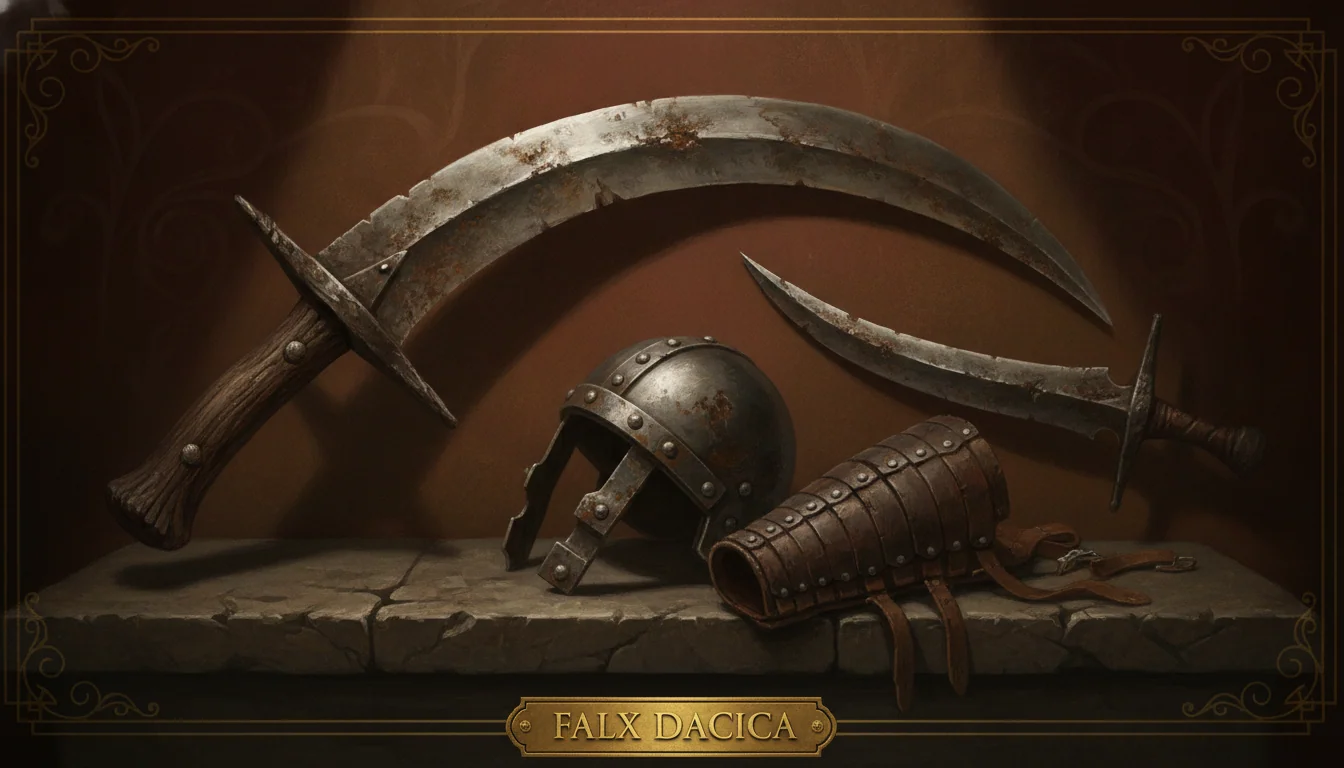
The shorter version, sometimes called the sica, was a one-handed curved blade used as a personal sidearm in close combat. Its concave edge and curved shape gave it a different attack geometry than a straight sword - it could be used to hook around a shield edge or slice in angles that a straight blade could not achieve at the same wrist position. For the warrior carrying one, it functioned roughly as a gladius equivalent, filling the role of a sidearm in hand-to-hand fighting.
The longer version is the one that caused Roman armourers problems. This was a two-handed weapon: an iron blade typically between 60 and 90 centimeters in length, sharpened on the inner (concave) edge, mounted on a wooden pole. The two-handed grip and the long curved blade allowed the user to swing the weapon in a high arc, bringing it down from above or from the side at angles that a shield oriented to the front could not intercept.
The critical geometry was overhead. A Roman legionary's rectangular scutum protected the front of the body from roughly shoulder to knee. It was highly effective against horizontal thrusts and cuts, and against missiles aimed at the torso. Against a strike that originated high and descended from above the shield - hooking over the rim and driving toward the neck, shoulder, or top of the helmet - the scutum offered almost nothing. The falx's curve was the mechanism that allowed a Dacian warrior to generate that angle while standing at what appeared to be normal engagement distance.
The trade-off was exposure. A two-handed grip meant no shield of the warrior's own. Falx users were vulnerable to missile fire and to the initial advance of a shielded opponent. In a disciplined Roman line formation, a warrior without a shield had a short life expectancy. The falx worked best when the Dacians could disrupt formation integrity - in rough terrain, in ambushes, in the kind of fighting in which an organized Roman advance could be broken into individual engagements.
Trajan's Column as forensic record
Trajan's Column in Rome stands 30 meters tall and is carved with a continuous spiral narrative of the Dacian campaigns. It was completed around 113 AD, within years of the events it depicts, and was produced under imperial patronage by sculptors with access to participants and perhaps official records. It is not simply propaganda - it is too specific about equipment details, too interested in accurate representation of both sides, to be pure invention.
The column shows Dacian warriors wielding the falx in both configurations. The two-handed version is depicted in action against Roman formations, held at the overhead angle that gives it its characteristic silhouette. Roman legionaries appear in their standard equipment - lorica segmentata plate armor, rectangular scutum, Gallic-type or Coolus-type helmets.
What the column does not show, but what the archaeological record does, is Rome's response. Legionary helmets from the early 2nd century AD begin showing a structural change absent in earlier examples: reinforcing cross-bars running from the front brim to the back of the bowl and across the crown. These additions can only be explained as protection against downward strikes - there is no other attack geometry against which they add meaningful protection that was not already present in the earlier helmet design. The Dacian campaigns are the most plausible and widely accepted explanation for their appearance in this period.
The manica - a segmented metal and leather arm guard covering the sword arm from wrist to upper arm - also appears in Roman equipment in approximately this period. The sword arm is the limb not covered by the scutum, and it is precisely the limb most exposed to an over-shield downward cut. Before the Dacian Wars, standard legionary equipment included no protection for the sword arm. After them, the manica is documented in both artistic and archaeological sources. The weapon that forced its invention was the falx.
The campaigns
The First Dacian War opened in 101 AD with Trajan crossing the Danube on two parallel pontoon bridges built simultaneously - an engineering statement as much as a tactical one, intended to communicate that Rome was bringing resources beyond anything Decebal had previously faced. The campaign was hard-fought. Dacian forces fought in terrain that favored defense, and the falx-armed warriors engaged Roman formations in close-quarters fighting throughout the Carpathian approaches. The equipment changes Rome had prepared were tested against the weapon that had prompted them.
Trajan won the first campaign and forced a peace, installing Roman garrisons in Dacian territory. Decebal violated the peace within two years - executing the Roman garrisons, rearming, and beginning to fortify again. The Second Dacian War launched in 105 AD was prosecuted with more finality. Apollodorus of Damascus designed a permanent stone bridge across the Danube at Drobeta, solving the supply-line problem that had limited Domitian and constrained even Trajan's first campaign. Sarmizegetusa Regia fell after a siege. Decebal, facing capture, died by his own hand. Dacia became a Roman province.
What the falx left behind
The conquest of Dacia effectively ended the falx as a weapon of historical consequence. The population that had developed it was absorbed into the Roman provincial system. Dacian cultural and military traditions dissolved within a generation or two as colonists arrived, Latin spread, and the Dacian language and religion receded.
What the falx left behind was Roman engineering. The reinforced helmet design persisted in the Roman equipment record for decades, adapted for conflicts in other theaters where overhead strikes were a threat. The manica spread through legionary use more broadly than the Dacian Wars alone would require. The tactical problem that the falx posed had produced solutions that turned out to have value beyond the specific adversary.
In the accounting of weapons history, the Dacian falx is a minor weapon in terms of scale - used by one people in two sets of campaigns - that had an effect on military technology disproportionate to its geographic spread. It is remembered not for what it was, but for what it made Rome become.
For a Roman soldier standing in a Carpathian pass in 101 AD, the falx was a genuine tactical problem that required a genuine engineering response. The response worked well enough that historians a century later used it to date Roman equipment, because the helmet cross-brace is that clear a marker of the specific adversary that forced it. Few weapons in history have left such a specific structural signature in the equipment of the people they were used against. For the Roman weapons on the other side of these engagements, the Roman pilum and the Roman gladius are the two pieces of equipment that legionaries carried into the Dacian campaigns alongside the improved helmets.
Quick Answers
Common questions about this topic
What was the Dacian falx?
The Dacian falx was a curved iron blade weapon used by the Dacians of the Carpathian region. It appeared in two forms: a shorter one-handed version called the sica, and a longer two-handed version that required both hands to wield. The two-handed falx could deliver overhead or hooking strikes that came down over the top of a Roman legionary's shield.
Why did the falx force Rome to change its armor?
The falx's curved blade and overhead striking angle allowed it to hook over or around the rim of the rectangular Roman scutum shield and strike the top of the helmet or the shoulder. Roman legionaries responded during Trajan's Dacian Wars by adding cross-bracing reinforcements to their helmets and adopting the manica, a segmented arm guard for the sword arm, both of which appear in the archaeological record for the first time in this period.
When were the Dacian Wars?
Rome fought two main sets of Dacian Wars. Emperor Domitian fought Dacian incursions in 85-89 AD, ending in an inconclusive peace that required Rome to pay tribute. Trajan then launched two campaigns: the First Dacian War of 101-102 AD and the Second Dacian War of 105-106 AD, which ended with the conquest and annexation of Dacia as a Roman province.
What happened to the Dacians after the wars?
After the Second Dacian War, Dacia became a Roman province called Dacia Traiana. Trajan resettled large numbers of colonists there from across the empire. The province was extensively Romanized, the Dacian language gradually disappeared, and modern Romanian is a Romance language descended from the Latin spoken by the colonists - one of the more striking long-term consequences of Trajan's campaigns.

Talk to the People Who Wielded These Weapons
Chat with the soldiers, smiths, and commanders whose lives were shaped by the weapons of their age.
Talk to a WarriorJoin the HistorIQly Club
Get smarter about the past.
Weekly stories, deep dives, and exclusive content straight to your inbox.