Arsenal: The Greek Aspis - The Shield That Made the Phalanx
The Greek aspis was not just a shield. It was a civic institution, a formation weapon, and the reason a few thousand citizen-soldiers could hold off a Persian army.
Read Wikipedia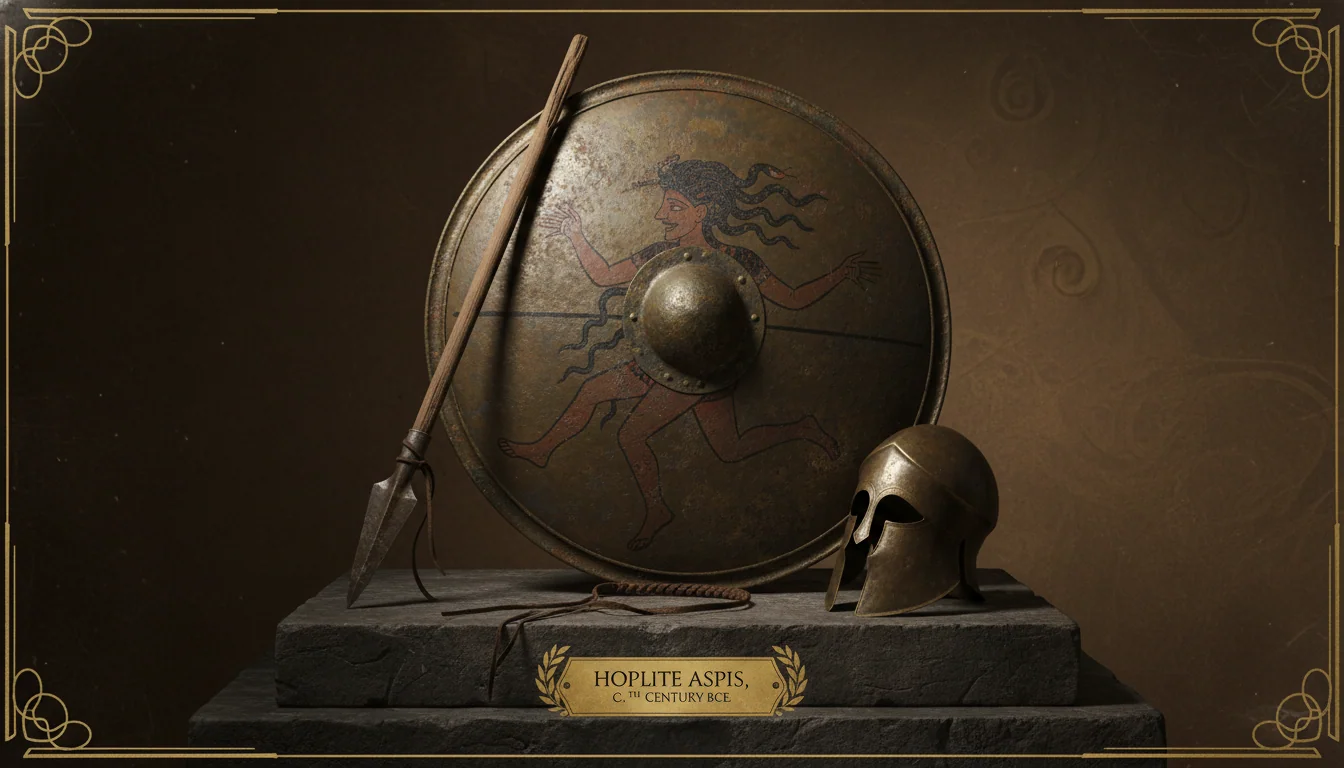
In the summer of 490 BCE, roughly ten thousand Athenian and Plataean soldiers stood on the plain of Marathon and watched a Persian army of substantially larger numbers begin its advance. What happened next would be attributed to Athenian courage, Miltiades' tactical genius, and the gods. All of that may be true. But there is a more concrete reason the battle went the way it did, and it weighs about eight kilograms and is made of wood and bronze.
The aspis - the large round shield of the Greek hoplite - was not just a piece of defensive equipment. It was the enabling technology of an entire system of warfare, a system that made disciplined citizen-soldiers the dominant land force of the classical Greek world for nearly three centuries.
The problem it solved
Every army in the ancient world used shields. The Persian infantry at Marathon carried the gerrhon, a large wicker-and-leather shield suitable for absorbing arrows and deflecting lighter missiles. Egyptian soldiers used rawhide shields. Assyrian infantry carried wooden shields with metal reinforcement. What made the aspis different was not its material - wood and bronze were widely available - but its grip system.
Before the aspis emerged in the Greek world around 700-680 BCE, warriors carrying large shields typically gripped them at a central horizontal bar or used one or two straps. This worked well enough for static defense, but it required significant muscular effort over time, and it limited the shield's size because all the weight went through the hand and wrist.
The aspis solved this with what historians call the double-grip system. Through the center of the shield ran a bronze armband called the porpax, wide enough for the forearm to pass through up to approximately the elbow. A leather or cord grip called the antilabe ran across the interior near the rim, caught by the hand. Together they distributed the shield's weight across the entire forearm rather than concentrating it in the hand, allowing the warrior to carry a much larger, heavier shield for much longer without fatigue.
The practical consequence was enormous. A shield roughly 80 to 90 centimeters across, covering the wearer from shoulder to knee, could now be used one-handed by a disciplined infantryman in close formation. The right hand was free for a thrusting spear.
The shield as a formation weapon
An aspis carried correctly does not only protect the person holding it. The key tactical insight of hoplite warfare was that the large left-edge overhang of the shield extended past the carrier's own left side, providing partial cover to the man standing immediately to his left. In the phalanx formation, each hoplite thus depended on the shield of the man to his right for protection of his own exposed right flank.
This mutual dependence transformed the aspis from personal armor into a collective weapon. A soldier who broke and ran left the man to his left without cover. The formation only functioned if everyone held. The social and military logic became inseparable: to abandon your shield was to betray your neighbor, and by extension your city.
The famous Spartan saying - "come back with your shield or on it" - captures the stakes precisely. Warriors who fled battles typically dropped their heavy shields to run faster. Carrying your dead comrade's body off the field on his own shield was the gesture that proved you had held. The aspis was the most visible marker of whether a man had done his civic and military duty.
This dynamic also produced a documented tactical problem. Because each man sought shelter under his right-hand neighbor's shield, phalanxes tended to drift to the right as the formation advanced, every man unconsciously edging toward the covered side. The historian Thucydides specifically noted this leftward drift problem at the Battle of Mantinea in 418 BCE, where both Argive and Spartan phalanxes shifted right during the advance. A skilled general factored this drift into his deployment.
Construction and cost
The aspis was expensive to make and expensive to own. The core was carved from close-grained hardwood, typically a single piece of seasoned timber shaped into a shallow bowl with a pronounced offset rim. The exterior face was covered in a thin sheet of hammered bronze, held in place with small bronze tacks and an outer rim of heavier bronze that doubled as an impact edge. Some shields also carried an interior leather lining that helped absorb blows and reduced cracking. The porpax armband was riveted in place through the wooden core.
Total weight ran between six and nine kilograms, with the bronze facing and rim accounting for most of it. A fine shield might also carry painted decoration on the bronze face - blazons of animals, geometric patterns, or mythological scenes that served as unit identifiers. Sparta's lambda (the Greek letter representing Lakedaimon) was one of the more famous examples of city-specific decoration, though many shields bore family or personal devices.
The cost of a complete hoplite panoply - aspis, bronze breastplate or quilted linen corselet, bronze or leather helmet, bronze greaves, and the long thrusting spear called the doru - was substantial enough to exclude the poor. Ancient sources suggest it represented several months of ordinary wages. This placed full hoplite service within the reach of the zeugitai, the middling Athenian farmers who could afford a pair of oxen. Below that class, citizens served in lighter roles. Above it, the wealthy served on horseback.
The aspis thus defined a military and civic tier. In Athens, the expansion of hoplite service through the 6th and 5th centuries BCE tracked directly with the expansion of democratic participation. The men who owned shields and stood in the phalanx had a credible claim on political voice.
In battle
The phalanx's tactical sequence was straightforward in theory and brutal in practice. The formation advanced at a jog in the final stages of approach - running further risked breaking the line - with shields overlapping and spears held overhand at shoulder height or underhand for the lower body. At contact, the front ranks engaged in close thrusting with spears while the rear ranks pushed forward.
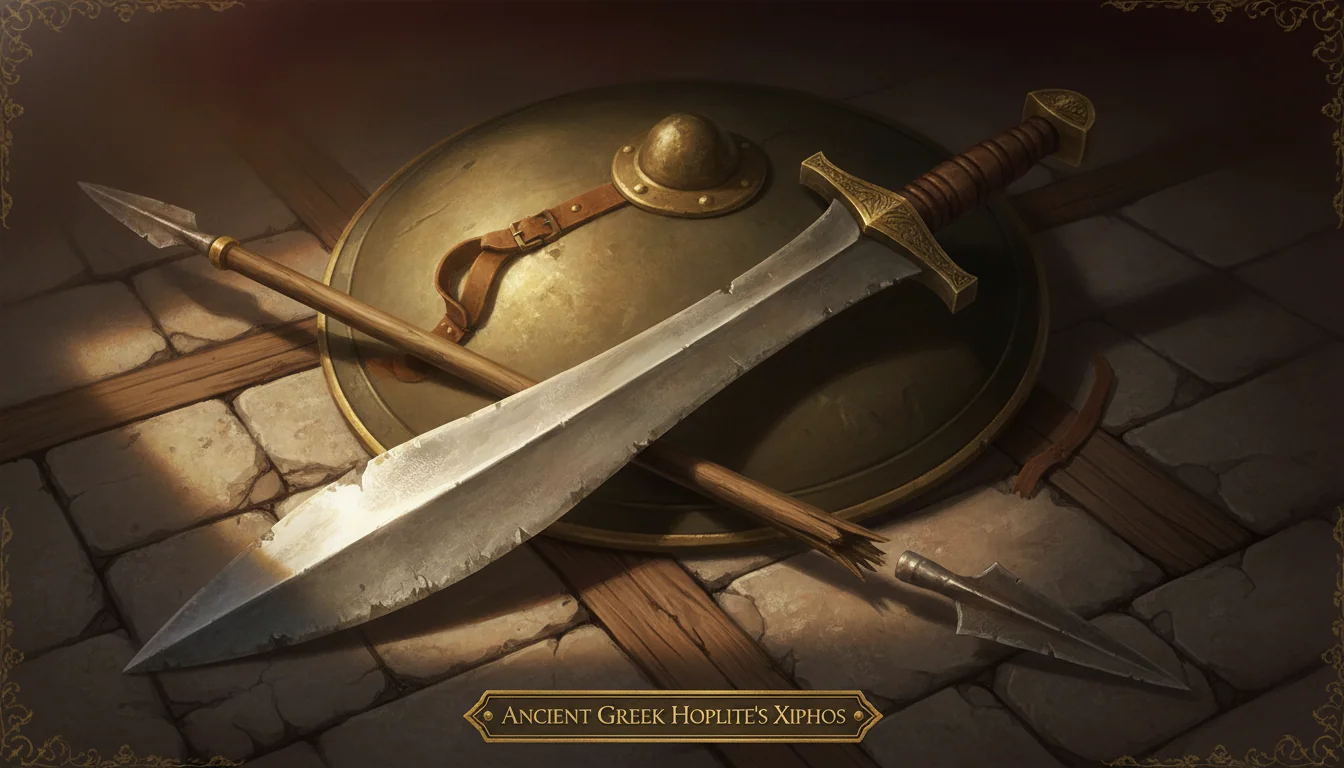
When spears broke or the fighting became too close for spear work, hoplites drew the short sword - typically a xiphos or kopis - and fought at blade length. The premium remained on staying in contact with the shield of the man to the right and maintaining the wall.
The othismos, the great push that sometimes decided phalanx engagements, remains debated by modern scholars. Whether it was a literal shoving match of shield against shield involving the entire formation, or a more metaphorical term for the general press of the fight, is uncertain. What is clear is that physical endurance, cohesion, and weight of numbers mattered enormously once the lines locked.
Against the Persian army at Marathon, the aspis formation proved decisive. Persian infantry equipped with wicker shields could not withstand the physical shock of the advancing bronze wall. The Athenians ran the final distance to close the range against Persian archers, hit the Persian line at speed, and drove through it. The battle's result depended more on formation than on individual heroism.
The end of the aspis era
For roughly three centuries, from the late 7th through the late 4th century BCE, the aspis was the foundation of Greek land warfare. Its decline came not from any weakness in the design but from a fundamental change in tactical theory.
Philip II of Macedon developed the sarissa phalanx in the mid-4th century BCE. The sarissa, a pike between five and seven meters long, gave the Macedonian formation devastating reach advantage over any opponent. But the sarissa required both hands to control, which meant the carrier could not hold an aspis of the classical type. Macedonian infantry used a smaller shield strapped directly to the forearm - the pelte - while their hands operated the pike.
The sarissa formation could outrange and outpush a traditional hoplite phalanx before close contact could be established. By the time of Alexander's campaigns in the 330s BCE, the tactical world that had been built around the aspis was over.
The shield itself survived in modified forms throughout the Hellenistic and Roman periods. But the specific combination of aspis, doru, and phalanx formation that had defined Greek warfare from Marathon to Mantinea disappeared with the world that produced it.
What lasted was the principle: that shared defense, not individual valor, is what holds a line. The aspis was eight kilograms of wood and bronze. What it carried was the weight of the city. For a comparison with Rome's answer to the same design problem, see the Roman scutum.
Quick Answers
Common questions about this topic
What was the Greek aspis?
The aspis (also called hoplon, from which the word hoplite derives) was the large circular shield used by Greek citizen-soldiers from roughly 700 BCE onward. It was approximately 80-90 cm in diameter, made of wood faced with bronze, and weighed between six and nine kilograms. Its defining feature was a double-grip system - a central bronze armband (porpax) through which the forearm passed, and a hand grip at the rim (antilabe) - that allowed the shield to be carried one-handed while bearing its considerable weight.
Why was the aspis so important for the phalanx?
The aspis made the phalanx possible. Its large size covered a hoplite from shoulder to knee, but crucially the shield's left edge extended past the carrier's own left side, providing cover to the man standing on his left. Each hoplite depended on his right-hand neighbor's shield for protection of his own exposed right side. This mutual dependence created the tight, disciplined formation that could only function as a unit - and that made raw courage a collective rather than individual asset.
How much did a full hoplite panoply cost?
A complete set of hoplite equipment - aspis, bronze breastplate, helmet, greaves, and spear - cost roughly the equivalent of several months of wages for an ordinary laborer. Only the middle class of Greek citizens, the zeugitai (farmers who could afford an ox team), could reliably equip themselves. This tied civic and military participation together: the men who could afford to fight were the men who had the most stake in the city.
What replaced the aspis?
The Macedonian army under Philip II and Alexander the Great superseded the traditional aspis-based phalanx with the sarissa formation. The sarissa was a pike up to seven meters long that required two hands to control, so sarissa infantry used a smaller round shield strapped to the forearm rather than the large aspis. The tactical superiority of depth and reach over the classical phalanx's push meant the sarissa system rendered the old formation largely obsolete by the mid-4th century BCE.

Talk to the People Who Wielded These Weapons
Chat with the soldiers, smiths, and commanders whose lives were shaped by the weapons of their age.
Create your free account →No card required. Talk to anyone in history with 8 free credits a day. Some features require a paid plan.
Join the HistorIQly Club
Get smarter about the past.
Weekly stories, deep dives, and exclusive content straight to your inbox.