Arsenal: The Roman Pilum
The Roman pilum was not a javelin - it was an engineering solution designed to ruin the enemy's shield and strip his defense in the seconds before the gladius came out.
Read Wikipedia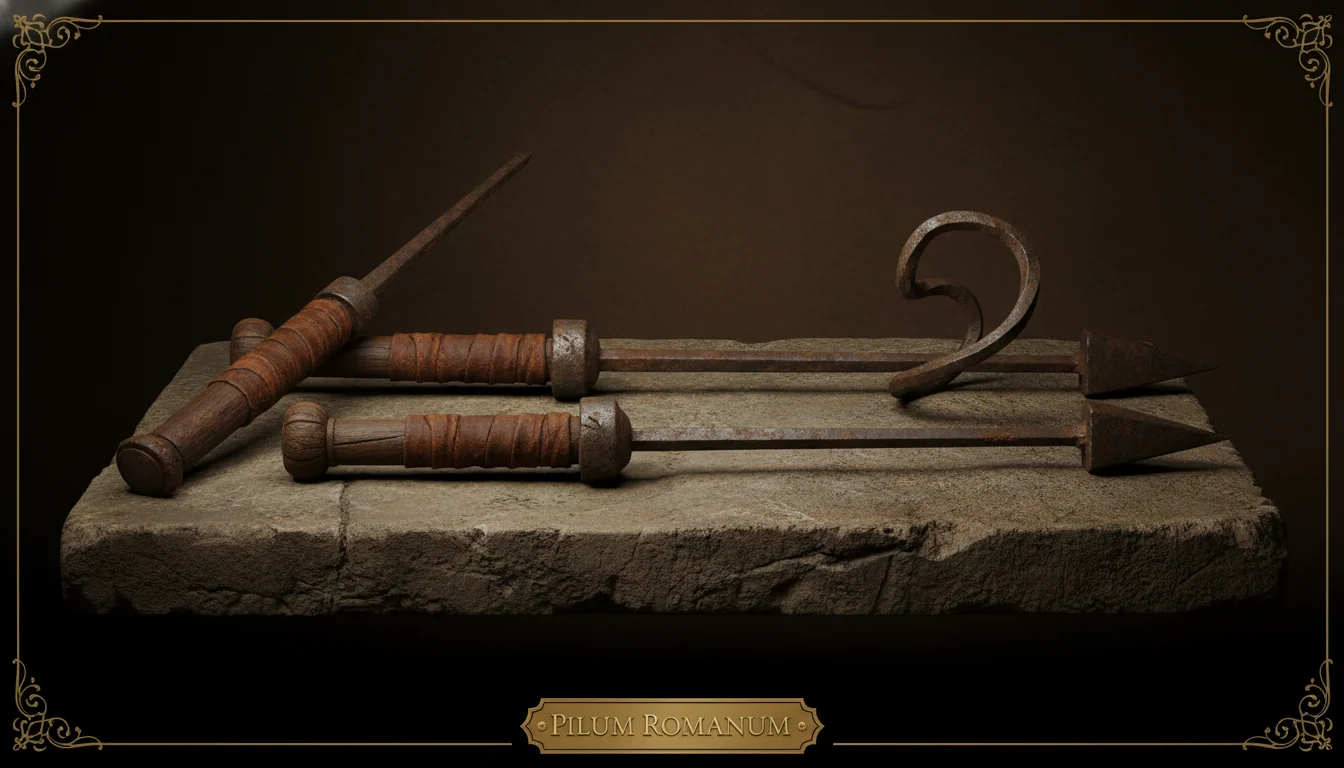
The Roman soldier who charged a Gallic shieldwall in 57 BC was not trying to hit anyone with his pilum. He was trying to ruin the enemy's shield.
That distinction separates the pilum from almost every other throwing weapon in ancient warfare. Most javelins were designed to wound or kill. The pilum was designed to disable the most common piece of defensive equipment on the ancient battlefield, stripping the man behind it of his primary protection in the moments before hand-to-hand combat began. The lethality came second. The engineering logic came first.
The design
A standard pilum consisted of two main parts joined at a collar. The lower portion was a wooden shaft roughly 120 to 150 centimeters long, shaped to fit comfortably in a throwing grip. Emerging from the top of this shaft was a long, thin iron shank - typically 60 to 90 centimeters - ending in a small pyramidal or barbed point.
The total weapon ran to roughly 200 centimeters in length and weighed somewhere between 2 and 4 kilograms depending on the variant. Two broad types existed: a heavier version with a weighted lead ball or iron collar at the junction of shaft and shank, which added forward mass and improved penetration at the cost of throwing distance, and a lighter version for greater range.
The critical element was always the shank. It was deliberately made long and thin - far thinner relative to its length than a structurally efficient spear would require. This was not a manufacturing limitation. It was the whole point.
How the bending worked
Drive a 3-kilogram object with a thin iron rod protruding from the front into a wooden shield at close range, and the rod bends. The force of impact distributes along the length of the shank faster than the narrow iron can transmit it, and the metal buckles at its weakest point - usually just above the wooden shaft, sometimes in the middle of the shank.
If the pilum penetrated the shield and bent inside it, the enemy now carried a shield with a heavy angled iron rod embedded in it. The weight and leverage made the shield nearly impossible to hold in proper defensive position. The soldier had three options: drop the shield and fight unprotected, try to drag out the bent pilum (impossible quickly under combat conditions), or hack off the wooden shaft with his sword, which took time he did not have.
If the pilum glanced off armor or struck the ground, it bent there and lay useless. It could not be picked up and thrown back. It could not be re-straightened in the seconds available. The legionary had turned his weapon into something the enemy could not use and had already drawn his gladius by the time the pilum hit the ground.
Plutarch records that the general Gaius Marius modified the pilum's construction before his campaigns in the late 2nd century BC, replacing one of the iron rivets connecting the shank to the wooden shaft with a wooden pin. This ensured that even if the metal shank did not bend - if it struck at an angle that distributed force too evenly - the shaft would separate from the shank at that pin, achieving the same result by a different mechanism. Whether Marius's modification was as clean as Plutarch describes or reflects a longer evolution of design is debated, but the principle he describes is real.
The volley before the swords
Every ancient account of Roman legionary combat places the pilum at the same tactical moment: the last seconds of the approach, just before the two lines made contact.
Polybius, writing in the 2nd century BC, described the Roman practice of throwing the javelin and immediately drawing the sword to receive the enemy's charge. The sequence was precise - volley, draw, close - because the pilum was only effective at short range. Throwing it at fifty meters accomplished little; throwing it at ten meters turned it into a miniature battering ram against whatever it struck.
Julius Caesar's Gallic Wars provides the most detailed surviving accounts of pila in actual use. At the Battle of the Nervii in 57 BC, Caesar describes his soldiers throwing their pila and then fighting with their swords - the habitual sequence - but notes that the Nervii's formation pressed so close so quickly that there was barely time for the throw. At the siege of Alesia in 52 BC, Caesar ordered pila thrown from the ramparts of his circumvallation down onto the Gallic relief army attacking from outside.
One of the most revealing accounts comes from Pharsalus in 48 BC, where Caesar faced Pompey's army. Caesar notes that he ordered his more experienced troops not to throw their pila at the approaching Pompeian cavalry but to use them as thrusting weapons, aimed at the faces of the horsemen. He calculated that Pompey's cavalry, drawn largely from the upper classes with little taste for facial injury, would flinch from having a sharp iron rod thrust at them and break formation. The tactic worked. The cavalry routed. Pompey's exposed flank collapsed.
The flexibility of use - throw it from a distance, hold it as a short thrusting spear at close quarters, hurl it from fortifications - made the pilum more versatile than its single famous application suggests.
Against the phalanx
The pilum's most structurally important test came against the Macedonian phalanx, the dominant military formation of the Hellenistic world. The sarissa phalanx was a forest of 5 to 6-meter pikes held at a 45-degree angle, presenting an effectively impenetrable wall of points to any frontal attack. In the battles of the Second Macedonian War and the Roman-Seleucid War, Roman legions managed to defeat sarissa phalanxes repeatedly, a result that puzzled contemporaries and has been analyzed by historians ever since.
Part of the answer is tactical flexibility: the manipular Roman formation could negotiate broken terrain that disrupted the phalanx's alignment. But part of the answer is the pilum. A volley of heavy javelins thrown into the packed ranks of a phalanx, where shields were held at the soldiers' sides rather than in front of their faces, could create gaps in the formation. At the Battle of Pydna in 168 BC, where the Roman consul Lucius Aemilius Paullus destroyed the last Macedonian royal army, the decisive moment came when the phalanx's alignment broke on uneven ground and legionaries poured into the gaps with their swords. The pilum volley that preceded that moment is not recorded in granular detail, but the tactical sequence - disrupt, enter, cut - is consistent with every other Roman engagement of the period.
Technical evolution
The pilum underwent modest modifications over its roughly six centuries of continuous service. The weighted-ball variant became more common in the late Republic and early Empire, as armies standardized equipment. The barbed point, designed to prevent withdrawal from a wound as well as from a shield, appears in archaeological finds from the Imperial period. Roman forts along the Rhine and Danube have yielded large quantities of pila in varying states of preservation, allowing historians to reconstruct the range of designs in service simultaneously.
One curious find from Oberaden in Germany suggests that some pila were manufactured with a pre-weakened shank - an intentional reduction of the iron cross-section at a specific point designed to ensure the bend happened in the most tactically useful location. Whether this represents standard production practice or a local innovation is unclear from the evidence, but the idea that Roman military engineers consciously engineered the failure point into the weapon's design is consistent with everything else known about the pilum's logic.
The decline
The pilum's disappearance tracks the dissolution of the classic legionary system. Through the 3rd century AD, as the Roman army expanded its reliance on allied troops - Goths, Huns, Sarmatians, and others - fighting in their own styles with their own weapons, the specific pilum tradition gradually diluted. The lancea, a lighter javelin usable from horseback as well as on foot, increasingly replaced it in the drill manuals and on the battlefield.
By the 5th century, the pilum as a distinct weapon type had effectively ended. The armies that fought the last battles of the Western Empire carried lances, axes, and swords of various regional traditions. The engineering insight - that a weapon's primary job was not to kill but to disable the enemy's shield in the critical moment before the sword came out - did not transfer cleanly to any successor system.
The Roman legionary who crouched behind his scutum and let the javelin volley rip at ten meters was using a weapon specifically designed by someone, at some point in the 3rd or 2nd century BC, who had thought carefully about what actually happens in the last seconds before two infantry lines collide. The answer was not more killing from a distance. The answer was engineering a moment of maximum confusion, delivered at minimum range, so that the sword could do the rest.
For the weapon that finished the job after the pilum, see our profile of the Roman Gladius. For an earlier ranged weapon that operated on similar shock principles, see the War Chariot.
Quick Answers
Common questions about this topic
What was the Roman pilum?
The pilum was the standard heavy throwing javelin of the Roman legionary, used from roughly the 3rd century BC through the late Empire. It consisted of a wooden shaft topped by a long, thin iron shank ending in a small pyramidal or barbed head. The distinctive feature was that the iron shank was designed to bend on impact - whether it pierced a shield or not - preventing reuse and making an enemy's shield too heavy or awkward to manage.
Why did the pilum bend when it hit?
The thin iron shank was long enough and narrow enough that the force of impact against a solid object - a shield, armor, or the ground - would buckle it. The ancient historian Plutarch records that the general Marius modified the pilum before 100 BC to make it more reliably disposable, replacing one of the iron rivets joining shank to shaft with a wooden pin that would break on impact. Either the bending shank or the breaking joint ensured the weapon could not be thrown back.
How was the pilum used in battle?
The pilum was a shock weapon delivered at very close range - typically 5 to 20 meters - just before the legionary closed with his gladius for hand-to-hand combat. Caesar's Gallic Wars describes pila thrown at such close range that they sometimes pinned shields together, forcing Gauls to cut their shield straps. The volley was not meant to kill at distance; it was meant to disrupt the enemy's defensive posture at the moment of impact.
When did the pilum disappear?
The heavy pilum declined through the 3rd and 4th centuries AD as the Roman army increasingly relied on allied troops (foederati) carrying their own weapon traditions. By the 5th century it had been largely replaced by the lancea, a lighter throwing spear used both mounted and on foot. The pilum's specific engineering logic - bending on impact to deny reuse - did not survive its era.

Talk to the People Who Wielded These Weapons
Chat with the soldiers, smiths, and commanders whose lives were shaped by the weapons of their age.
Create your free account →No card required. Some figures and features require a paid plan.
Join the HistorIQly Club
Get smarter about the past.
Weekly stories, deep dives, and exclusive content straight to your inbox.