Arsenal: The Gatling Gun
Gatling gun history from Civil War to colonial Africa: Richard Gatling's multi-barrel weapon was the first reliable rapid-fire gun and changed warfare permanently.
Read Wikipedia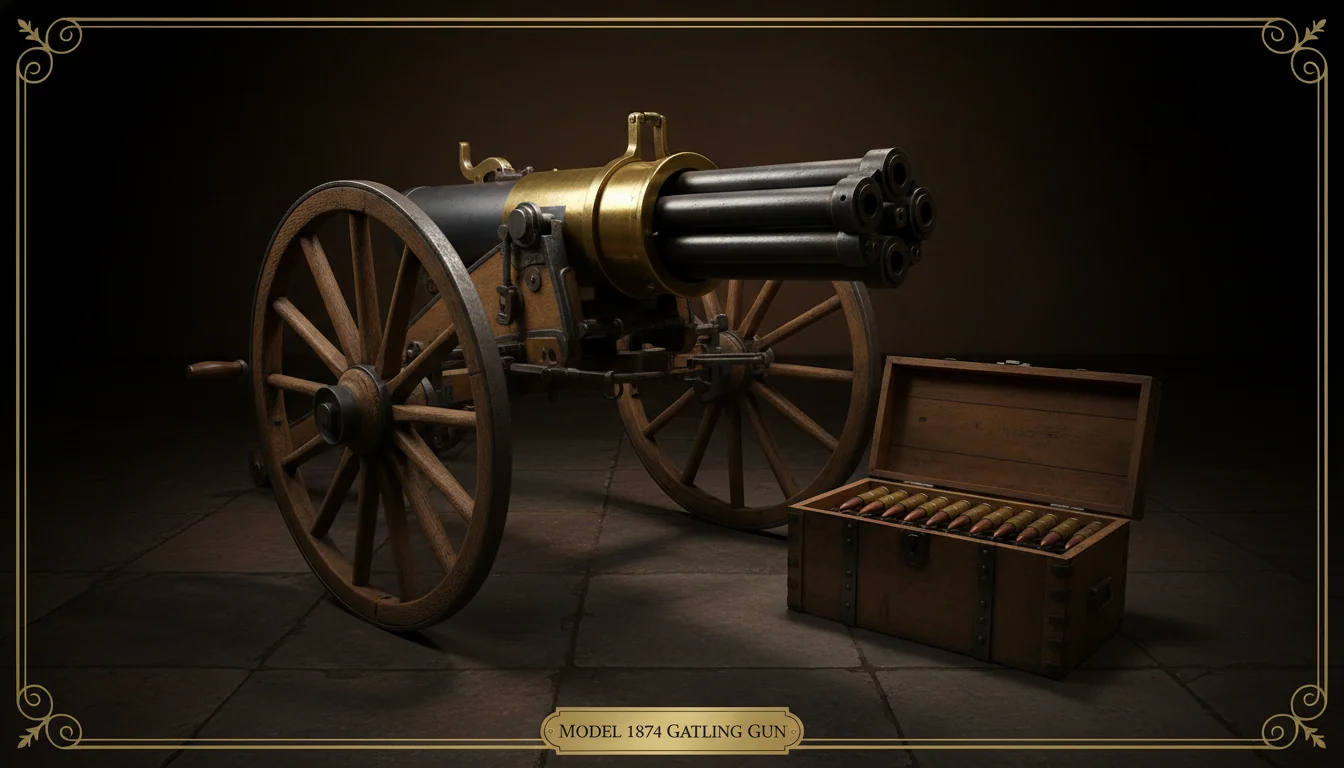
Gatling gun history begins with an inventor who believed his weapon would reduce war rather than intensify it. Richard Jordan Gatling submitted his patent application in 1862, and there was something almost pious in the language he used to describe what he had built. He told correspondents that he hoped the weapon would demonstrate that a small, well-armed force could do the work of a regiment, making mass conscription unnecessary and thus reducing the scale of war. He had watched two years of the bloodiest conflict in American history unfold around him. The reasoning was sincere. The conclusion was wrong in every direction.
The Gatling gun did not make wars smaller. It made the firepower of the winning side catastrophically larger, and it did so reliably enough that every major military in the world wanted one within twenty years.
The design problem it solved
Before the Gatling, rapid infantry fire meant having more soldiers. The percussion-cap muzzleloader used by most Civil War infantry could fire two to three aimed rounds per minute with a trained soldier. Breech-loading designs improved on that somewhat, but any single-barrel weapon faced a fundamental constraint: continuous firing produced heat, and heat caused reliability failures. The barrel warped. The breech mechanism jammed. Sustained fire was limited not by the shooter's speed but by the weapon's ability to tolerate it.
Gatling's insight was to distribute the problem. His original 1862 design used six barrels arranged around a central axis, all fed from a gravity hopper above the breech. A hand crank at the rear rotated the barrel assembly; as each barrel cycled through the firing position at the bottom of the rotation, it loaded from the hopper, fired, and ejected the spent case. The barrels rotated away from the firing position between shots, giving each one time to cool. No single barrel was ever worked hard enough to fail.
The mechanical elegance was genuine. At a time when single-shot rifles required manual reloading after every round, a trained crew on a 1862-model Gatling could deliver 200 aimed rounds per minute. This was not theoretical. Demonstrations for army officials, done in controlled conditions, produced those numbers consistently.
The 1860s and 1870s: refinements
The original design used paper cartridge ammunition that was already becoming obsolete by the mid-1860s. Gatling moved quickly to adapt. The Model 1865 used steel and brass components with metallic cartridges in place of the earlier paper rounds, substantially improving both reliability and rate of fire. Subsequent models through the 1870s chambered the weapon for the US Army's standard .45-70 Government cartridge, simplifying logistics for units already carrying that round.
Later versions were available in four-barrel, six-barrel, and ten-barrel configurations. The ten-barrel models, rotating faster and firing in tighter bursts, could approach 400 rounds per minute with premium ammunition and a well-drilled crew. The tradeoff was weight: the weapon required a wheeled field carriage and a horse-drawn limber for the ammunition chest, and moving it cross-country was a logistical commitment that not every commander was prepared to make.
The mechanical heart of the design - the rotating barrel cluster with the central feed and the hand crank - remained essentially unchanged from the 1862 patent through the end of the weapon's military service life. Later patents addressed feed mechanisms, cartridge extraction, and barrel materials, but the core concept that Gatling put on paper in 1862 is the one that worked.
Civil War: promising and peripheral
The Union Army's adoption of the Gatling was tentative and arrived too late to shape the war's outcome. Gatling was a North Carolinian by birth, and the Lincoln administration's initial caution about his loyalties delayed formal procurement. A number of senior officers also argued that the weapon was expensive, temperamental, and unnecessary given the Union's numerical advantages in manpower.
General Benjamin Butler, impatient with institutional caution, purchased twelve guns at his own expense in 1864 and deployed them during the siege of Petersburg. The effect on Confederate positions exposed to concentrated Gatling fire was immediately apparent to observers. But Butler's initiative remained exceptional rather than typical, and the war ended before the Army moved toward large-scale procurement.
The Gatling's Civil War use was thus real but peripheral. Its reputation was made in what came after.
Colonial warfare and the mathematics of empire
The 1870s and 1880s produced the Gatling gun's most consequential deployments, and none of them involved American soil. European powers conducting colonial expansion across Africa and Asia discovered that the weapon's rate of fire solved a specific tactical problem: how to hold off numerically superior opponents who could close ground at a sprint and were not deterred by moderate casualties.
British forces used Gatlings in the Anglo-Zulu War of 1879. At the Battle of Ulundi in July that year, Gatlings mounted at the corners of a British infantry square swept Zulu attack formations that had enough momentum and discipline to reach the perimeter's outer edge. Combined with the Martini-Henry rifle volleys from the square's interior, the fire was overwhelming. The Zulus at Ulundi were not poorly led or poorly motivated. They were attacking into a volume of fire that no pre-industrial army had encountered before and that their tactics had no answer to.
British gunboats on West African rivers mounted Gatlings for operations hundreds of miles inland, where the combination of a shallow-draft hull and a gun that could saturate a riverbank made small vessels capable of decisive engagements against forces that would have overwhelmed an equivalent number of ground troops.
The pattern held across different theaters and different armies. When the US Army deployed Gatlings on the Great Plains through the 1870s, the logistical weight of the carriage limited its use to supply-line operations. At the Battle of the Little Bighorn in 1876, Custer's column left its three Gatlings with the supply train because the carriages would have slowed the approach march. The decision did not cause the defeat at the Little Bighorn, but the absence was noted in the subsequent Army review of the engagement.
The Maxim gun ends it
In 1884, Hiram Maxim demonstrated his self-powered automatic weapon to British military observers. The Maxim gun used the recoil energy from each fired round to cycle the bolt, strip the next cartridge from the ammunition belt, and recock the firing mechanism. It required no external power source, no hand crank, and no crew member dedicated to maintaining a rhythm. One person could fire it; two could operate it efficiently.
The Maxim was water-cooled, which solved the heat problem far more elegantly than the rotating-barrel system. A water jacket around the barrel barrel absorbed heat continuously during sustained fire, allowing the weapon to fire until the ammunition ran out rather than until the mechanism failed. It delivered 400 to 600 rounds per minute reliably, and unlike the Gatling, that rate could be maintained without a crew counting their crank strokes.
The comparison was not close. A Gatling required more men to operate, more mechanical intervention to keep running, and a drive mechanism that could fatigue a crew during extended use. The Maxim required almost none of those things.
By the mid-1890s, most major armies were phasing out their Gatlings in favor of the Maxim and its derivatives. The British adopted the Maxim as standard in 1891. The US Army followed through the 1890s. The hand-cranked weapon that had seemed revolutionary in 1862 was obsolete in three decades.
What it left behind
The Gatling gun sits at a specific inflection point in military history: the transition from volley fire to automatic suppression. Before it, generating high rates of fire meant having more soldiers. After it, the rate of fire was a property of the machine rather than the number of people behind it. Every machine gun and automatic weapon since follows from this insight, even those that achieved it by different mechanical means.
Its direct mechanical descendant entered service in the mid-20th century, when engineers working on aircraft armament rediscovered the rotating-barrel principle and married it to electric drive motors. A single barrel could not fire fast enough for jet-age aerial combat; multiple barrels, each firing once per rotation, could. The M61 Vulcan, developed in the late 1940s and still in service on American fighter aircraft, uses six rotating barrels driven by an external electric motor and fires at rates exceeding 6,000 rounds per minute. The barrels still rotate to distribute heat. The ammunition still feeds through a central mechanism. The weapon that bears Gatling's name in popular reference still carries his core idea into the air.
He was wrong about the war-reducing part. He was absolutely right about the barrels.
For other weapons that defined their era, see the M1 Garand, the rifle that Patton called the greatest battle implement ever devised, and the crossbow, which democratized killing power centuries before Gatling tried the same trick with rotating barrels.
Quick Answers
Common questions about this topic
Who invented the Gatling gun?
The Gatling gun was invented by Richard Gatling, an American inventor and physician from North Carolina. He filed for a patent in 1862 and received it in November of that year. He claimed the weapon was designed partly to reduce casualties by allowing a small force to generate the firepower of a large one, theoretically making mass conscription unnecessary.
Was the Gatling gun used in the American Civil War?
Yes, in limited quantities. The Union Army purchased a number of Gatling guns in 1864 and used them during the siege of Petersburg. Adoption was slow, partly due to skepticism about mechanical reliability and partly due to wariness about Gatling's Southern origins, though his commitment to the Union cause was not in serious doubt.
What replaced the Gatling gun?
The Gatling gun was superseded in the late 1880s and 1890s by self-powered automatic weapons, most notably the Maxim gun, invented by Hiram Maxim in 1884. The Maxim used recoil energy from firing to cycle the action automatically, requiring no hand crank, and delivered comparable or superior rates of fire with a smaller crew. Most major armies had replaced their Gatlings by the mid-1890s.
Did the Gatling gun design survive into the modern era?
Yes. The rotating multi-barrel principle was revived in the mid-20th century with electrically driven versions, most notably the 20mm M61 Vulcan cannon used on American military aircraft from the 1950s onward. Modern rotary cannon variants fire at rates exceeding 6,000 rounds per minute. The barrels still rotate to distribute heat - the same fundamental idea Gatling patented in 1862.

Talk to the People Who Wielded These Weapons
Chat with the soldiers, smiths, and commanders whose lives were shaped by the weapons of their age.
Create your free account →No card required. Some figures and features require a paid plan.
Join the HistorIQly Club
Get smarter about the past.
Weekly stories, deep dives, and exclusive content straight to your inbox.