Arsenal: The Lee-Enfield Rifle - The Fastest Bolt-Action in Military History
The Lee-Enfield rifle history spans over a century: its rear-locking bolt and 10-round magazine made British forces the fastest bolt-action infantry of both world wars.
There is a specific claim that turns up in nearly every piece written about the Lee-Enfield, and it is worth getting right at the start. The standard SMLE-equipped British soldier could fire fifteen aimed rounds per minute as a practical sustained rate. The figures sometimes cited in popular histories - thirty rounds per minute or higher - are records set by exceptional riflemen in deliberate training exercises under ideal conditions, not combat norms. The practical rate is the correct comparison with enemy rifles, and on that measure the Lee-Enfield still wins. The German Gewehr 98 that faced it across No Man's Land held five rounds in a fixed internal magazine and had a bolt that required a longer, less ergonomic stroke to cycle. The difference, multiplied across thousands of men in sustained firefights, mattered.
The "Mad Minute" was the British Army's informal name for a one-minute rapid-fire exercise in which a soldier fired as many aimed rounds as possible at a target 300 yards distant. It was a training benchmark, not a battle drill. Understanding why those numbers were possible requires understanding the Lee-Enfield's actual architecture - which is itself the product of a long argument between competing ideas about what a military rifle should do.
Origins: James Paris Lee and the Enfield barrel
The Lee-Enfield is a hybrid weapon, and its name reflects that plainly. The "Lee" refers to James Paris Lee, a Scottish-born inventor who emigrated to the United States and whose rear-locking bolt design was adopted by the British Army in the 1880s. The "Enfield" refers to the Royal Small Arms Factory at Enfield Lock in Middlesex, the facility that contributed the rifled barrel design and eventually gave the weapon its production home.
Lee's bolt was the innovation that made everything else possible. Conventional bolt-action mechanisms of the period locked at the front of the receiver, placing the bolt handle far forward and requiring a longer stroke to cycle. Lee moved the locking lugs to the rear of the bolt, near the handle. This made the bolt feel marginally less rigid under high pressure - a theoretical disadvantage the British Army debated at considerable length - but it made the cycling motion far faster. A trained shooter barely needed to break his cheek weld against the stock to work it.
The first rifle combining Lee's action with an Enfield barrel was the Lee-Metford, adopted in 1888. When cordite replaced black powder as the standard propellant in the 1890s and began eroding the Metford's shallow rifling, the barrel was replaced with one produced at Enfield to different specifications. The Lee-Enfield family was formally established in 1895.
The Short Magazine Lee-Enfield
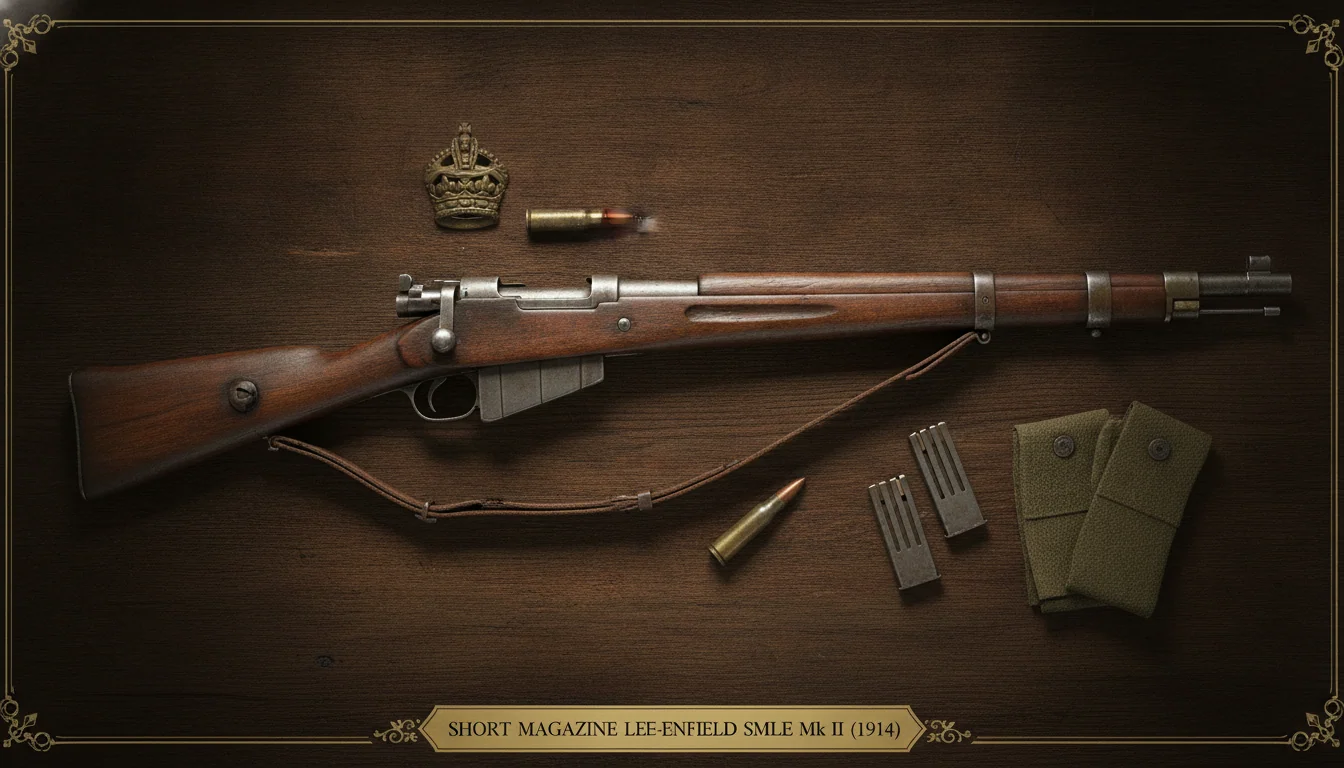
The critical development came in the early 1900s, when the British Army began trialing a shortened version of the rifle that could be standardized across infantry and cavalry without maintaining two separate weapons in the supply chain. The Short Magazine Lee-Enfield, designated SMLE Mk I, was adopted in 1904 and refined into the Mk III by 1907.
The SMLE - pronounced "Smelly" by those who carried it - was shorter than its predecessor but retained the full 10-round detachable box magazine. That magazine was the rifle's second major advantage over German and most other European alternatives. The Gewehr 98 loaded from 5-round stripper clips and had a fixed internal magazine. The SMLE could be topped up with individual rounds, charged from 5-round clips, or in theory have the magazine swapped for a fresh one - an option rarely used in practice but available. British soldiers typically loaded from clips, but the architecture of the system was fundamentally more generous than anything across the line.
The Mk III was the rifle that went to war in 1914, that held the line at Mons and Le Cateau, that was dug into the trenches of the Somme and Passchendaele. The British Expeditionary Force's opening battles produced the first widely reported demonstration of the SMLE's practical fire rate: German commanders at Mons initially believed they were engaging machine guns before their own officers confirmed they were hearing rapid bolt-action rifle fire from well-trained infantry.
First World War production
Production pressure from 1914 onward generated simplified variants with fewer machined components, and a substantial portion of SMLE output shifted to factories in British India, Australia, and Canada. The numbers manufactured during 1914 to 1918 exceeded what the Enfield factory alone could have produced in that period, and the rifle's design - simple enough for distributed manufacturing, robust enough to function in mud, frost, and fouled conditions - proved suited to industrial-scale war.
The SMLE Mk III saw refinement into the Mk III* during the war, primarily through the elimination of features deemed unnecessary under production pressure, including the long-range volley-fire sights that had been designed for a style of warfare the trenches had rendered obsolete.
Between the wars and the No.4
Between the wars, British Army trials and testing facilities began work on a modernized rifle better suited to production by precision machine tools and simpler to manufacture at scale. The result was the No.4 Mk I, adopted in 1941. The No.4 retained Lee's bolt action and the .303 British cartridge but introduced a heavier barrel, an aperture rear sight replacing the SMLE's open V-notch, and simplified manufacturing tolerances throughout.
The No.4 was arguably more accurate than the SMLE at longer ranges, because the aperture rear sight aligned the shooter's eye more precisely. It was also heavier, which soldiers who had trained on the earlier pattern found unwelcome. The sighting system was better; the balance was different.
The No.4 was the standard British and Commonwealth rifle through most of the Second World War. It fought at El Alamein, on the Normandy beaches, at Kohima and Imphal on the Indian frontier. A lighter derivative, the No.5 Mk I, was developed for jungle operations and saw service in Burma and Malaya, though its shortened barrel produced a significant muzzle blast and recoil that soldiers found unpleasant enough to give it an unflattering nickname.
Why the action worked
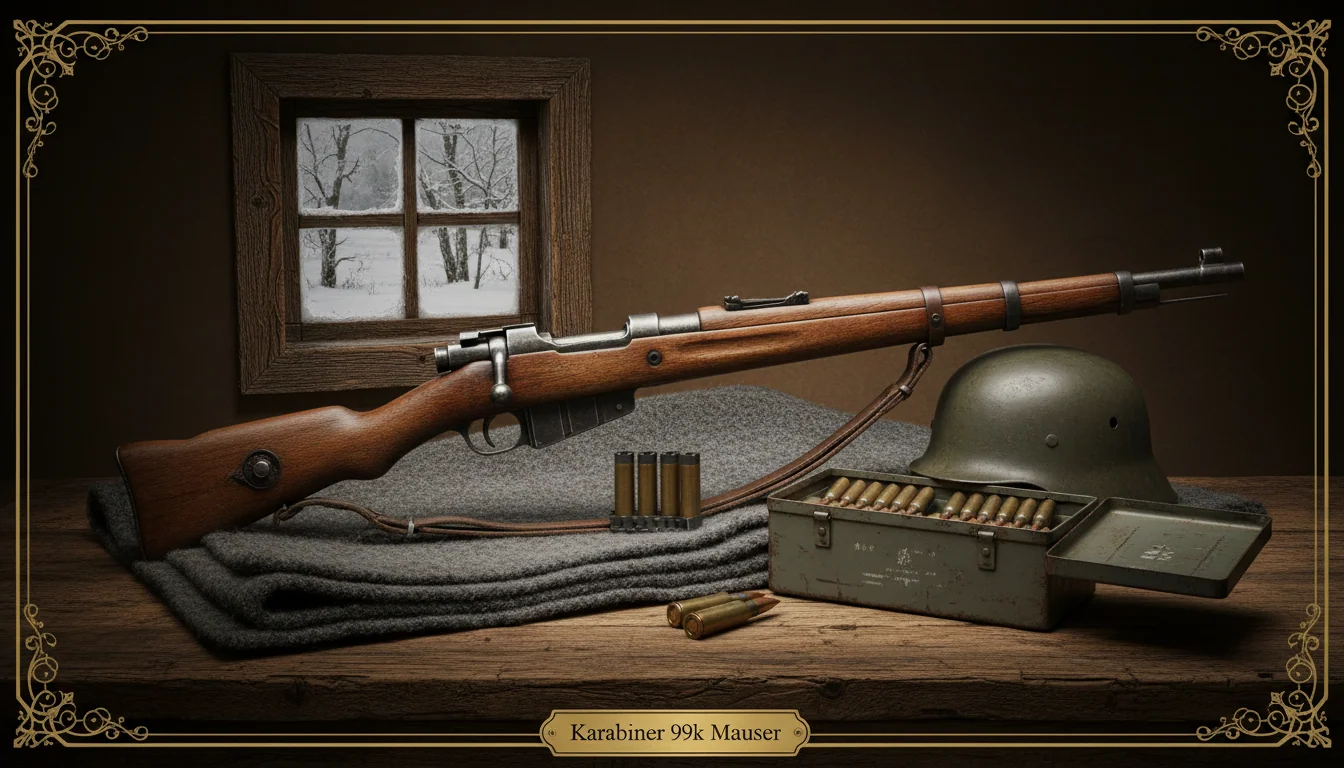
The Lee-Enfield's longevity has a mechanical explanation beyond the rear-locking bolt. The action was deliberately designed with some flexibility in headspace and chamber tolerances - dimensions that critics called sloppiness and that operators in dirty conditions called reliability. A Mauser 98 was more precisely fitted and inherently more accurate in a controlled setting, but it was also more susceptible to jamming when fine tolerances were filled with mud, sand, or propellant fouling. The Lee-Enfield cycled reliably when other rifles hesitated. The same design priority - reliability under adverse conditions over bench-rest precision - drove later generations of infantry weapon design, including the AK-47, which applied a similar philosophy to a self-loading mechanism.
The firing pin design also contributed. The two-piece striker Lee incorporated produced a shorter lock time - the interval between trigger release and primer strike - which reduced the chance of a light strike on a marginally seated round. These were not accidents. They reflected a design philosophy that prioritized sustained combat function over bench-rest accuracy, and that philosophy proved correct across multiple decades of conflict.
The end of first-line service
By the 1950s, the Lee-Enfield's era as a front-line British weapon was ending. The L1A1 SLR, a version of the Belgian FN FAL chambered in 7.62x51mm NATO, replaced it in British Army issue during the late 1950s. The .303 British cartridge was standardized out of NATO ammunition logistics, and the semi-automatic action of the L1A1 suited the changed tactical doctrine of the Cold War era.
But the Lee-Enfield did not disappear. The Indian Army's Ishapore factory manufactured the rifle in various patterns well into the later decades of the 20th century, and photographs from Indian Reserve Police units well into recent decades show Ishapore-produced Lee-Enfields on the shoulder. Afghan fighters have carried Lee-Enfields that were issued to their grandfathers' generation, because the rifle is simple enough to maintain without specialized tools and chambered in a cartridge still produced commercially worldwide.
Total production across all countries, all variants, and all decades of manufacture exceeded 17 million. No single bolt-action military rifle has been manufactured in larger numbers. Those numbers reflect not just British and Commonwealth military demand but the rifle's reputation in every market it entered: reliable under abuse, accurate at practical ranges, and faster to work than anything else in its class.
The bolt-action debate
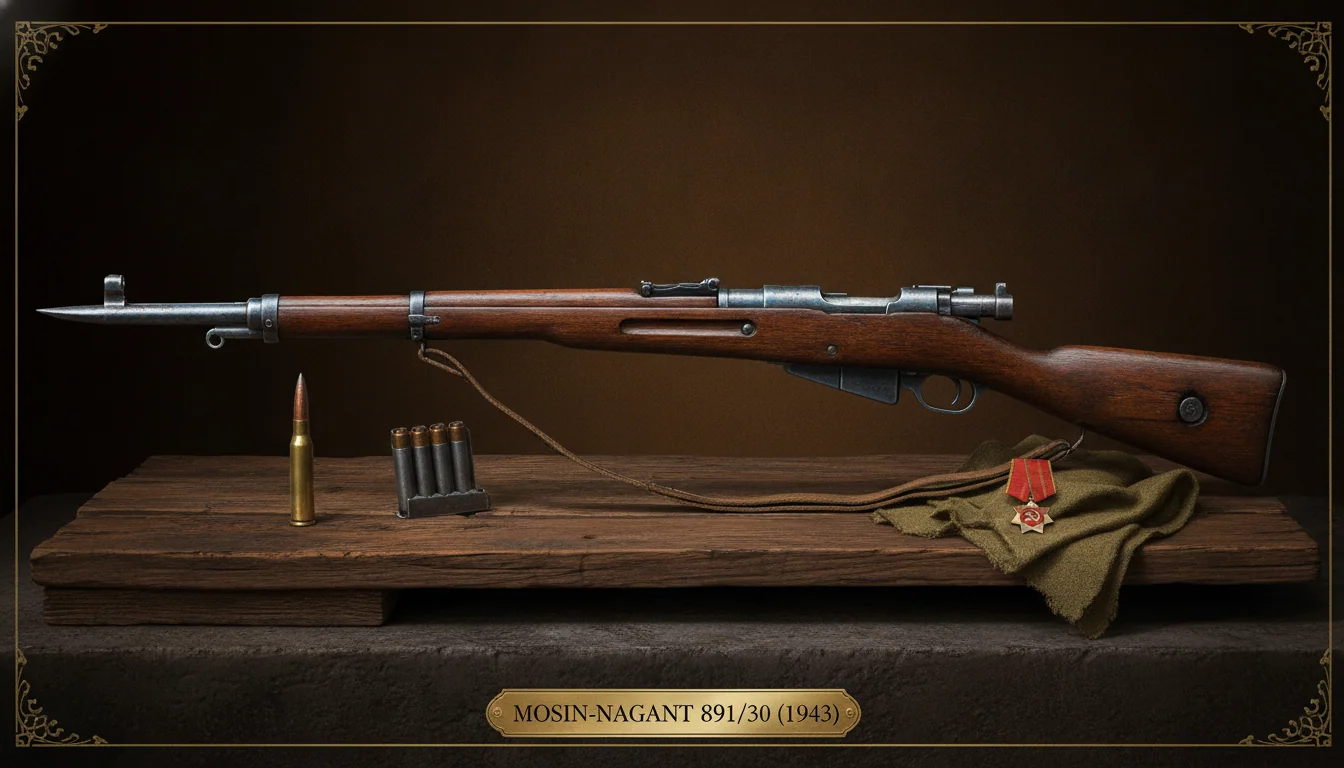
The competition for the title of definitive bolt-action military rifle has historically centered on the SMLE, the Mauser 98, the Springfield M1903, and the Mosin-Nagant. Each reflects a different set of priorities. The Mauser optimizes for mechanical precision and strength under extreme pressure. The Springfield emphasizes long-range accuracy. The Mosin prioritizes manufacturing simplicity at the cost of ergonomics. The Lee-Enfield prioritizes practical rate of fire and reliability under adverse conditions.
There is no objective winner across all criteria. But the Lee-Enfield's combination of a smooth fast action, a generous magazine, and a cartridge capable of reliable performance at battle ranges made it the rifle most British and Commonwealth soldiers would choose to carry if given the option - and over more than a century of continuous production, nearly all of them eventually did. The M1 Garand, which American forces carried through the same conflicts, chose a different answer to the speed problem: eliminating the bolt cycle altogether through semi-automatic operation.
The distinction between the fifteen aimed rounds per minute a trained British soldier could produce and the ten a German soldier could produce with a Gewehr 98 sounds small. In a sustained firefight lasting minutes, it is not small at all. That gap is what the Lee-Enfield was designed to create, and it did.
Quick Answers
Common questions about this topic
Why was the Lee-Enfield considered the fastest bolt-action rifle?
The Lee-Enfield's bolt handle was positioned at the rear of the action rather than the front, which meant a shooter barely needed to break his firing position to cycle it. Combined with a generous trigger guard, a smooth action, and a 10-round magazine - double that of the Gewehr 98 - trained British soldiers could fire 15 aimed rounds per minute under standard conditions.
How many Lee-Enfields were made?
Total production across all variants and all manufacturers exceeded 17 million rifles, spread over more than a century of continuous manufacture. The Short Magazine Lee-Enfield Mk III, introduced in 1907, was the most numerous single variant and the one most associated with the First World War.
What caliber did the Lee-Enfield fire?
The standard Lee-Enfield chambered the .303 British cartridge, a rimmed bottlenecked rifle round introduced in 1888. The .303 British remained the British and Commonwealth standard rifle and machine-gun cartridge through both world wars, finally being replaced by 7.62x51mm NATO in British service during the 1950s.
Was the Lee-Enfield still in use after World War Two?
Yes. The Lee-Enfield saw combat in Korea, Malaya, Kenya, and numerous other conflicts through the 1950s and beyond. The Indian Army's Ishapore factory produced the rifle in various patterns well into the late decades of the 20th century, and militias in Afghanistan were still carrying Lee-Enfields decades after most NATO armies had retired it.

Talk to the People Who Wielded These Weapons
Chat with the soldiers, smiths, and commanders whose lives were shaped by the weapons of their age.
Talk to a WarriorJoin the HistorIQly Club
Get smarter about the past.
Weekly stories, deep dives, and exclusive content straight to your inbox.