Arsenal: The Mosin-Nagant Rifle
The Mosin-Nagant rifle served the Russian Empire, the Soviet Union, Finland, and dozens of armies through two world wars. Roughly 37 million were built.
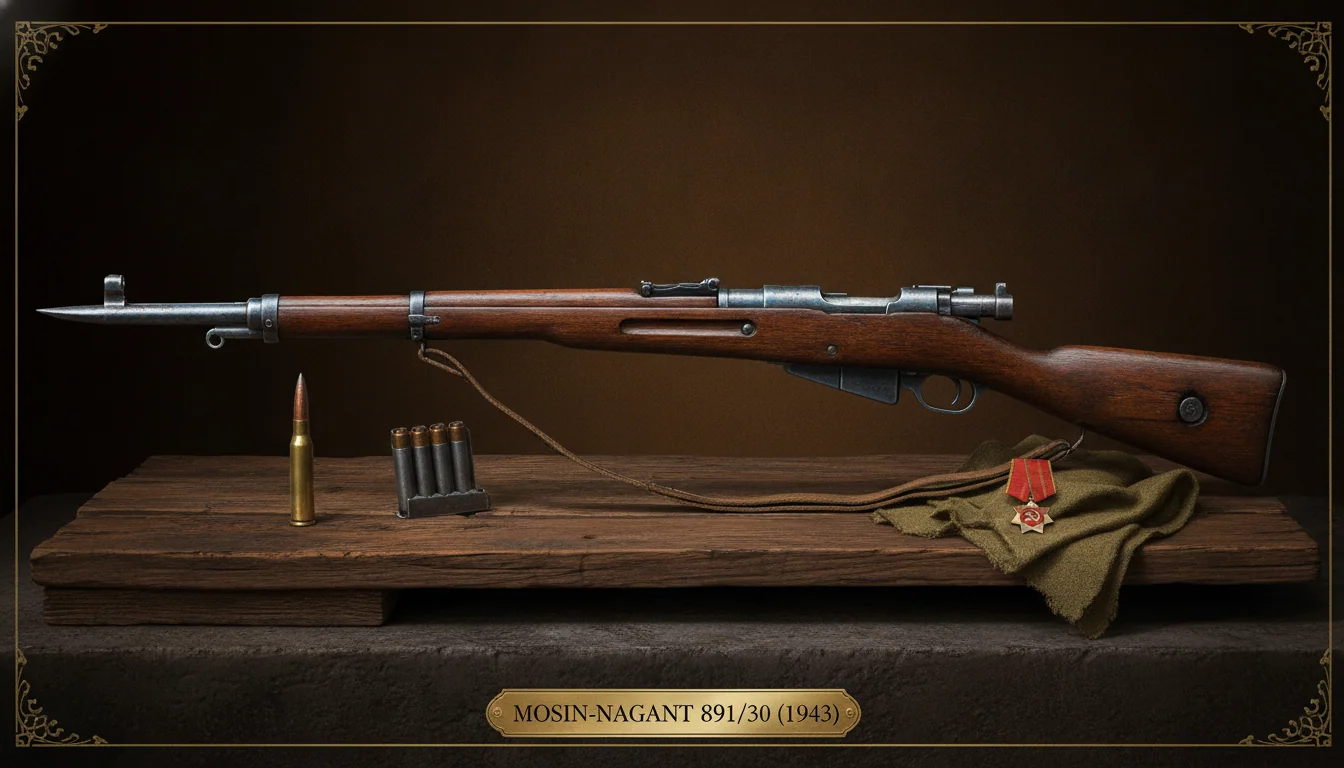
In the winter of 1942, in the ruins of Stalingrad, Soviet snipers were holding positions with a rifle that had been designed to fight Napoleon's grandchildren in 1891. The Mosin-Nagant was already over fifty years old before the most destructive war in history even started. It outlasted the tsar who ordered it, the empire that fielded it, and the ideology that industrialized its production beyond all historical precedent. Somewhere in the world today, it is still being fired.
Few weapons have traveled as far in every sense.
The design competition of 1889
The Russian Imperial Army entered the 1880s with a firearms problem familiar to every major power of the era. Breech-loading metallic cartridge rifles had rendered all previous weapons obsolete within a single decade, and the pace of improvement made any choice feel temporary from the moment of adoption.
The commission tasked with finding a replacement for the aging Berdan rifles opened a competition in 1889. The two finalists were designs submitted by Captain Sergei Mosin, a Russian Army officer with an existing patent on a bolt mechanism, and Leon Nagant, a Belgian designer from Liege whose family firm also produced revolvers for the Russian military.
Both designs were tested exhaustively. Mosin's bolt action was judged superior. Nagant's interrupter and feed mechanism worked better with the new rimmed cartridge the commission had simultaneously adopted. The compromise weapon took the best of both: Mosin's bolt, Nagant's feed system. Adopted in 1891 and named after both men, it fired a new cartridge designated 7.62x54mmR - a rimmed bottleneck round sending roughly a 9.6-gram bullet at around 615 meters per second. The caliber designation "3-line" referenced an old Russian measuring unit: one line equaled 2.54 millimeters.
Mosin received a prize of 30,000 rubles. Nagant received a smaller prize for his feed mechanism contribution. Neither became wealthy from the arrangement.
The design
The M91 was a long rifle: 1,306 millimeters overall with the standard infantry bayonet in place, and the bayonet was considered part of the standard fighting configuration. Russian doctrine through the Second World War expected soldiers to advance and fight with the bayonet fixed. The resulting weapon was awkward in confined spaces, and soldiers frequently removed the bayonet informally despite regulations against it.
The magazine held five rounds loaded through the top of the action with a stripper clip in a single downward push. The bolt was a simple two-lug design that cocked on opening - reliable in mud and cold but somewhat slower to cycle than a Mauser-style cock-on-closing system. It worked, which was the relevant criterion.
The trigger, in most production examples, was notoriously heavy and imprecise. Soviet armorers and Finnish gunsmiths both spent significant effort trying to improve it. The standard production trigger was functional under the assumption that a soldier firing at targets within 300 meters in the confusion of infantry combat did not particularly require a clean break.
WWI and the supply crisis
Russia went to war in 1914 with approximately 4.6 million Mosin-Nagants in the military inventory. That sounds substantial until you account for an army mobilizing to over 12 million men and taking catastrophic losses against the Germans and Austro-Hungarians on the Eastern Front. The Tula and Izhevsk arsenals could not begin to meet the demand.
Russia placed contracts with Westinghouse and Remington in the United States for over 3 million rifles. These American-built Mosins were of excellent quality. The revolution that collapsed the tsarist government in 1917 also collapsed the contracts; a portion were diverted to other Allied powers and some eventually reached American National Guard armories. The experience of producing Russian-specification rifles at American factories was part of what prepared Remington and Westinghouse for later wartime production demands.
The supply crisis was never truly solved. Russian soldiers in WWI sometimes shared weapons - one man carried the rifle, another carried its ammunition, and they exchanged when the first was killed. This was documented by correspondents and post-war military historians. It was not unusual.
Finland and the superior variants
When Finland declared independence in 1917 and fought its way through a civil war and subsequent border conflicts, it inherited large quantities of Russian military materiel including hundreds of thousands of Mosin-Nagant rifles. The Finnish Army found the weapon fundamentally sound and improved it systematically over the following two decades.
Finnish armorers rebarreled captured M91s, improved trigger assemblies, fitted better stocks, and eventually produced distinctly Finnish variants - the M28, the M28-30, and the M39 - that are generally considered the finest production versions of the basic design. Finnish Mosins are consistently more accurate than their Russian counterparts: better barrels, improved sight geometry, triggers that actually break cleanly.
The Winter War of 1939 to 1940, in which Finland resisted Soviet invasion against enormous numerical odds for more than three months, was fought substantially with these Finnish-modified rifles. Simo Hayha, the Finnish sniper with the highest confirmed kill count in recorded military history, used an iron-sighted M28-30 in temperatures that fell to minus 40 Celsius. He preferred iron sights over a scope because a scope required him to raise his head higher above cover, reducing his concealment. He was wounded in March 1940, near the war's end, by a Soviet counter-sniper's explosive bullet. He survived and lived to 96.
Stalingrad and the sniper program
The M91/30 - the 1930 modernization that shortened and standardized the barrel, improved the rear sight, and tightened production tolerances - was the standard Soviet infantry rifle from the 1930s through most of the Second World War. The sniper variant added a PU or PE optical sight and a turned-down bolt handle to clear the scope body.
The Soviet Army's sniper program, built around this weapon, produced the combatants who brought the Mosin-Nagant into global popular memory - largely through the 2001 film Enemy at the Gates and the real history it dramatized with varying accuracy.
Vasily Zaitsev, credited with between 225 and 242 confirmed kills at Stalingrad depending on the source, became the public face of the Soviet sniper program after the writer Vassily Grossman profiled him during the battle. The film depicts a famous duel between Zaitsev and a supposed German super-sniper named Major Konig. No German records confirm the existence of this specific opponent; the duel is almost certainly fictionalized. Zaitsev's combat record and his scoped M91/30 are historical.
Lyudmila Pavlichenko, with 309 confirmed kills the most effective female sniper ever documented, used the same rifle. She toured North America in 1942, meeting Eleanor Roosevelt and Eleanor Roosevelt's husband, drawing significant press coverage of the Soviet war effort at a moment when Western publics knew little about the Eastern Front's scale.
After the war
The Mosin-Nagant did not retire when Germany surrendered. Soviet stockpiles were enormous, and allies and proxy forces received them throughout the Cold War. Chinese and North Korean armies used Mosins in Korea. North Vietnamese and Viet Cong fighters used captured and supplied examples. Egyptian and Syrian armies fielded them in the early Arab-Israeli wars.
Soviet factories transitioned to the SKS carbine and then the AK-47 platform in the 1950s, but the Mosin's service life extended as long as the stockpile lasted and the conflicts requiring basic infantry weapons continued. As of the early 21st century, Mosin-Nagants continue to appear in African and Middle Eastern conflicts where Soviet-era arsenals have been opened or captured.
Why it lasted
The Mosin-Nagant's longevity reflects what a bolt-action military rifle actually needs to be in the conditions where it is used. It is not elegant. The trigger is mediocre. The sight radius is shorter than ideal. The fixed bayonet regulation is eccentric. The stripper clip feed is slower than a Mauser-type loading system.
None of those limitations prevented it from functioning. It worked in the mud of the Pripyat Marshes. It worked at Stalingrad when lubricants were freezing. It worked in Finnish forests severe enough to crack vehicle axles. The cartridge it fired in 1891 remained in production for the Dragunov sniper rifle over a century later.
Thirty-seven million Mosin-Nagants is not a number that reflects refinement. It reflects the specific requirements of industrialized warfare: a weapon that can be produced faster than it is destroyed, operated by soldiers with minimal training, and maintained under conditions that would appall a peacetime armorer.
By all those measures, the rifle that two designers argued over in St. Petersburg in 1889 performed better than either of them had any right to expect. It is still performing, in the hands of people who were not born when the Soviet Union that mass-produced it ceased to exist.
Quick Answers
Common questions about this topic
Who designed the Mosin-Nagant?
The rifle blended two competing designs. Captain Sergei Mosin of the Russian Army contributed the bolt and basic action; Leon Nagant, a Belgian designer from Liege, contributed the feed interrupter mechanism. The Russian commission that adopted it in 1891 named it after both men. Soviet nomenclature later referred to it simply as the Model 1891 or the 3-Line Rifle.
What caliber does the Mosin-Nagant fire?
The Mosin-Nagant fires the 7.62x54mmR cartridge, a rimmed bottleneck round adopted alongside the rifle in 1891. It remains in production today, used in the PKM machine gun and the SVD Dragunov sniper rifle. It is one of the longest-serving military cartridges in history.
Was the Mosin-Nagant used by snipers in WWII?
Extensively. The Soviet sniper program built around the scoped M91/30 variant produced some of the most effective snipers of the entire war. Vasily Zaitsev, credited with over 200 confirmed kills at Stalingrad, used a scoped M91/30. Lyudmila Pavlichenko, the most successful female sniper in recorded history with 309 confirmed kills, used the same platform. The 2001 film Enemy at the Gates depicts Zaitsev's Stalingrad campaign.
How many Mosin-Nagants were manufactured?
Estimates vary by source, but roughly 37 million Mosin-Nagants were produced across all variants and all manufacturers, making it one of the most produced bolt-action rifles in history. Production ran in Russia, the Soviet Union, the United States (under WWI contracts), France, Finland, China, and several other countries.

Talk to the People Who Wielded These Weapons
Chat with the soldiers, smiths, and commanders whose lives were shaped by the weapons of their age.
Talk to a WarriorJoin the HistorIQly Club
Get smarter about the past.
Weekly stories, deep dives, and exclusive content straight to your inbox.