Sling Weapon History: From David's Stones to Balearic Mercenaries
The complete sling weapon history: from shepherd's field to the Punic Wars, how the ancient world's most underestimated ranged weapon outlasted every rival for three thousand years.
Read Wikipedia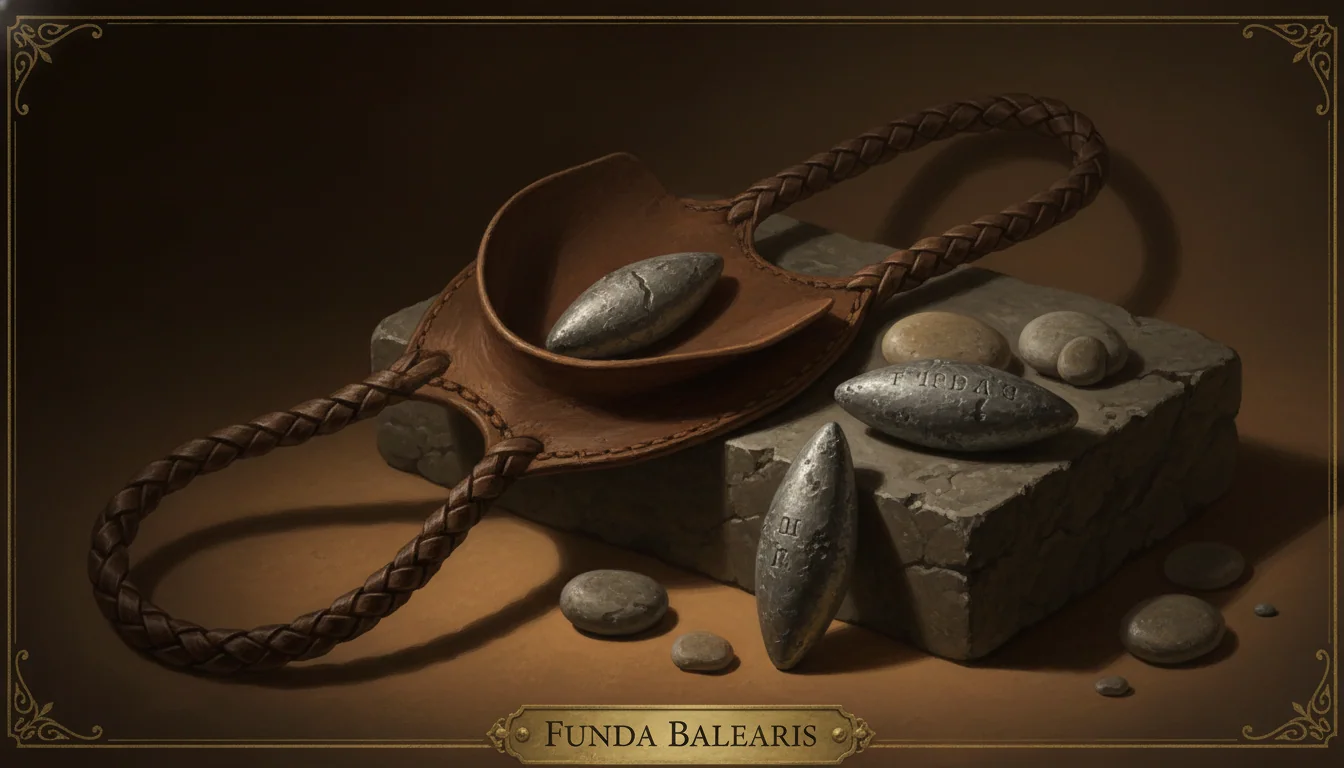
Before the bow, before the spear, before any weapon that required forging or fletching, there was the sling. A strip of leather or braided cord, a pocket at the center, and a stone from the nearest riverbed. Children learned it. Armies made careers of it. This is the core of sling weapon history: for several thousand years, across every continent where people made war, it was one of the most effective projectile weapons a person could carry.
The sling never gets the credit it deserves. It does not appear in the armories of fantasy kingdoms. Museums display it in cases labeled "primitive." The bows get the dramatic recreations, the archers get the popular history books, and the slingers stand outside the narrative arguing that they could, in fact, outrange a longbow with a good lead bullet and favorable ground.
They had a point.
What it is and how it works
A war sling is not complicated. Two cords of equal length, leather or sinew or braided plant fiber, meet at a central pocket wide enough to cradle a stone or a cast lead bullet. The slinger holds both cords, loads the pocket, swings in a vertical or horizontal arc to build momentum, and releases one cord at the appropriate point in the rotation. The projectile leaves the pocket at high velocity, carried by the physics of a rotating lever arm. A good slinger does the calculation automatically, the way a good pitcher throws without calculating arm angle.
The physics are more impressive than the description suggests. Modern testing with reproductions using lead bullets has produced muzzle velocities in the range of 90 to 100 kilometers per hour for untrained users and significantly higher for the experienced. Ancient sources describe lead glandes - the cast bullets shaped like acorns or almonds that were standard for professional slingers by the 5th century BC - as arriving with a sound like a hornet and embedding themselves in flesh in ways that arrows did not. The blunt profile of the bullet transferred kinetic energy differently: instead of a narrow penetrating wound, a glans produced a deep crushing impact capable of shattering bone through moderate protection.
The range figures that appear in ancient sources are probably optimistic in the enthusiastic classical tradition. Modern experimental archaeology suggests maximum effective range for a trained slinger with a lead glans in the region of 200 to 400 meters, with reliable aimed fire at shorter distances. That is comparable to the drawn-bow range of a Welsh longbowman and exceeds the effective range of most infantry bows of the ancient world.
Origins: as old as the first shepherd
The sling appears in the archaeological and textual record of virtually every complex society in the ancient world, and in many that were not complex at all. Slingstones, river cobbles chosen or shaped for weight and smoothness, accumulate at archaeological sites in the Near East and Mediterranean from at least the 7th millennium BC. Some of the earliest are clearly selected rather than naturally deposited. Someone was choosing them for a purpose.
The practical origins almost certainly predate complex warfare. Shepherds used slings to drive predators away from livestock, a use that requires no military sophistication and that survives in the Middle East and Andes into the modern period. A practiced shepherd with a sling can hit a moving dog-sized target at significant range after years of daily practice. The same skill, applied to a man-sized target wearing leather or linen, was a natural adaptation when the threat changed.
By the time literate civilizations begin describing battles, the sling is already ubiquitous. It appears in Egyptian reliefs, Mesopotamian texts, and the Iliad, where Homeric warriors sling at each other from outside arrow range with the same casualness that marks every other aspect of the poem's chaotic battle scenes.
David and Goliath
The most famous single engagement in sling history takes about twelve verses in the first Book of Samuel to describe, and its details, read carefully, are more militarily coherent than the story's cultural life suggests.
Goliath of Gath is described in the text as a heavily armored champion fighter, covered in bronze - helmet, coat of mail, greaves, javelin, shield. He challenges the Israelites to send a single man to face him, following the ancient convention of champion combat meant to spare armies the cost of full battle. Saul's army has no suitable champion willing to face Goliath in close combat. He has been standing in the valley making this challenge for forty days.
David is not a soldier. He is a young man who has come to the Israelite camp to bring supplies to his older brothers. When he volunteers to fight Goliath, the text emphasizes that he has spent years defending livestock with a sling. Saul offers him armor. David declines it, because it is not his equipment. He goes down to the brook and selects five smooth stones.
The military logic is straightforward. Goliath, in heavy armor, cannot close with David before David fires. David's weapon is a pure ranged weapon whose operator can stand outside the range of Goliath's javelin and spear. The famous shot, a stone to the forehead in the one spot the helmet does not cover, is the outcome that the weapon and the tactical situation make predictable. It is not divine magic. It is a shepherd who knows his instrument deciding that the rules of champion combat favor the slinger over the armored giant every time, provided the slinger keeps his distance.
Whatever the historical basis of the account, the tactical reasoning embedded in the story is sound.
The Balearic Islanders
The most celebrated slingers in the ancient world were not Greek, not Roman, not Carthaginian. They came from the Balearic Islands - modern Majorca, Minorca, and Formentera - in the western Mediterranean. Ancient writers from Diodorus Siculus to Strabo describe the Balearic islanders as training their children in the sling before they could properly eat solid food: mothers reportedly set food on an elevated ledge and refused to give it to the child until they could knock it down with a stone.
This origin story is almost certainly exaggerated, but the underlying point - that Balearic slingers began their training in infancy - appears credible. The islands were poor in agricultural land but rich in this single exportable skill, and the men of the Balearics worked as mercenary slingers throughout the ancient Mediterranean world.
Carthage used them extensively. In the three Punic Wars against Rome, Balearic slingers served on the flanks of Carthaginian armies as light infantry, peppering advancing enemies with lead glandes from outside spear range before Carthaginian cavalry and heavy infantry closed the engagement. Hannibal took Balearic units across the Alps in 218 BC and used them at the Trebia, at Lake Trasimene, and at Cannae. The slingers at Cannae in 216 BC operated on the wings of an army that destroyed roughly 70,000 Roman soldiers, the single worst day in Roman military history.
Ancient sources describe the Balearic slinger carrying three slings of different sizes: one for long range, one for medium range, one for close engagement. This system of variable range adjustment, built into the equipment rather than the projectile, is a sophisticated military adaptation that took armies centuries to develop for firearms.
The glans and the Roman adoption
Cast lead sling bullets - glandes - represent a significant technological refinement over river stones. A shaped projectile with controlled weight and aerodynamic profile performs more consistently than a random pebble, in the same way that a machined cartridge performs more consistently than a handmade one. Glandes from the 4th century BC onward appear at battle sites and siege contexts across the Mediterranean, often inscribed with identifying phrases: unit names, commander names, and occasional taunts directed at the enemy. A few bear the image of a thunderbolt. Some are inscribed in Greek or Latin with phrases meaning "take this" or, more crudely, with explicit anatomical insults.
Rome, after conquering the Balearic Islands in 123 BC under Quintus Caecilius Metellus (who received the honorific "Balearicus" for the campaign), incorporated Balearic slingers directly into the Roman army as auxiliary troops. Roman armies thereafter carried organic slinger capacity. Julius Caesar's campaigns in Gaul include references to his use of Balearic auxiliaries, and the legions that fought in the siege of Jerusalem in 70 AD included slinger units.
The Rhodians, inhabitants of the island of Rhodes in the Aegean, were another famous source of mercenary slingers in the classical world. Alexander the Great used Rhodian slingers in his Persian campaigns. The combination of Balearic and Rhodian slingers gave Macedonian and later Roman armies ranged fire that operated beyond spear range on both flanks of a line formation.
What replaced it
The sling did not die dramatically. It faded across the late Roman and early medieval period for structural rather than technical reasons. As the imperial Roman army changed recruitment patterns and the Mediterranean world fragmented after the 5th century, the specialized mercenary populations that had supplied professional slingers became less accessible. The skill takes years to develop to military standard. An army that cannot recruit from a population where the training is already embedded in childhood has no practical path to fielding a slinger corps.
Crossbows and, eventually, firearms offered something the sling could not: a weapon that could be used effectively after weeks of training rather than years. A conscript army can learn to fire a crossbow. It cannot learn to sling competitively in a campaign season.
The sling did not lose a technological competition with the bow. It lost a labor competition with weapons that required less human capital to operate at minimum military standard.
The Balearic Islands stopped producing professional mercenary slingers as Roman demand collapsed. The technique survived in rural and pastoral contexts everywhere shepherds needed to deter wolves, and in some mountain communities it persisted as both a practical tool and a cultural artifact into the modern period.
The lead glandes in the museum case look small and unimpressive. At 200 meters, arriving faster than a surprised man can react, they were not.
For more on ancient ranged weapons and their tactical legacy, see our features on the war chariot and the Roman gladius.
Quick Answers
Common questions about this topic
How effective was the ancient sling as a weapon?
Highly effective at range and against unarmored or lightly armored opponents. Modern tests with lead bullets - glandes - suggest experienced slingers could reliably strike targets at 50 to 100 meters and reach maximum ranges of 300 meters or more. Ancient sources describe the wounds as crushing and penetrating, with lead bullets deforming on impact in ways arrows did not.
Who were the Balearic slingers?
The Balearic Islanders - from Majorca, Minorca, and Formentera in the western Mediterranean - were the most celebrated mercenary slingers of the ancient world. They served Carthaginian armies throughout the Punic Wars and were later absorbed as auxiliaries into Roman service. Ancient sources claim they trained from childhood, carrying three slings of different lengths for different ranges.
How did the sling compare to the bow?
The sling and bow were complementary rather than competing weapons. Bows had faster sustained rates of fire and more precise aim at moderate ranges. The sling could achieve comparable or greater range using lead bullets, and a stone from a sling had significant kinetic energy at the point of impact. Skilled slingers could outrange most archers and operated usefully in terrain where bowstrings could not be kept dry.
When did the sling stop being used in warfare?
The sling declined as a primary military weapon through the late medieval period as armor improved and firearms began to appear, though it never fully disappeared. Roman armies had stopped using dedicated slinger units by the late imperial period as recruitment patterns changed. Lead sling bullets continued to appear at siege sites through at least the 4th century AD.

Talk to the People Who Wielded These Weapons
Chat with the soldiers, smiths, and commanders whose lives were shaped by the weapons of their age.
Create your free account →No card required. Some figures and features require a paid plan.
Join the HistorIQly Club
Get smarter about the past.
Weekly stories, deep dives, and exclusive content straight to your inbox.