Arsenal: The Zulu Iklwa Stabbing Spear
The Zulu iklwa: Shaka's stabbing spear, paired with a massive cowhide shield, created a close-quarters system that shocked the British army at Isandlwana in 1879.
Read Wikipedia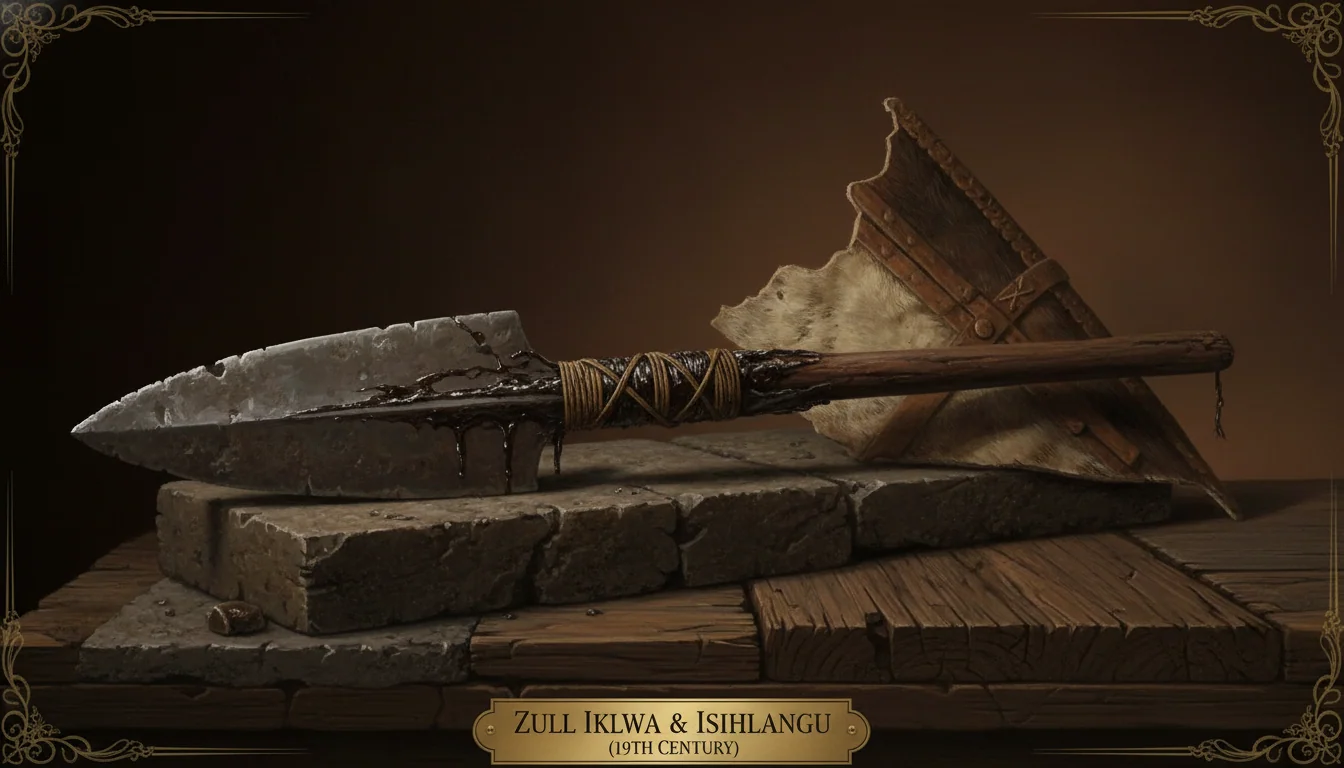
Before Shaka, the Zulu were one of dozens of clans occupying the coastal hills and grasslands of what is now KwaZulu-Natal, South Africa. Warfare between the Nguni-speaking clans of the region was, by most accounts, relatively ritualized: throwing spears exchanged at range, casualties absorbed, outcomes negotiated. It was conflict governed by convention more than by the logic of annihilation.
Shaka kaSenzangakhona changed that logic completely. In roughly a decade after seizing the Zulu kingship around 1816, he transformed a minor clan into the dominant power across a region the size of England, using a redesigned spear, a new style of shield, and a tactical system built around closing to killing range as fast as possible and not stopping until the fight was done.
The weapon at the center of this revolution was the iklwa.
The old way of war
The standard Nguni throwing spear before Shaka's reforms was a long-shafted weapon designed to be cast at an enemy from a distance. Warriors carried several of them and threw in volleys, much as European skirmishers used javelins or light missiles, with the fight degenerating into individual close-quarters struggle only after the throwing phase had thinned the opposing lines. This style of warfare required enough open ground for missiles to carry and enough social convention to stop the killing before it became total.
The conventional small shield used alongside these throwing spears was adequate for missile defense but not built for the aggressive close-quarters use that Shaka envisioned. The system as a whole favored caution and range over decisive engagement.
Shaka had no use for caution, and he had no interest in range.
The redesign
The iklwa, as Shaka standardized it, was a spear of a fundamentally different character. The shaft was shortened to roughly one meter, about a third the length of the traditional throwing weapon, eliminating any practical use as a projectile but reducing the leverage advantage an opponent could seize during a grapple. The blade was enlarged significantly: where traditional spear blades were narrow and light, the iklwa's blade was broad, typically around 45 centimeters long and 4 to 5 centimeters wide, with a pronounced midrib for stiffness and two cutting edges tapering to a sharp point.
The blade was socketed to the shaft and secured with sinew binding and tree resin, creating a joint strong enough to withstand the torque of a deep thrust without the blade twisting free. The total weight of the completed weapon was manageable - estimates based on surviving examples and reconstructions place it at roughly 600 to 800 grams - but the blade-heavy balance made it a different handling proposition from a throwing spear. It swung differently, pointed differently, and felt like a weapon that was going somewhere and intended to stay there.
The name is said to derive from the sound the broad blade made when withdrawn from a body - a wet, sucking pull that would become the weapon's signature at close range. Whether this etymology is strictly accurate or has been mythologized is difficult to establish, but the name itself is onomatopoeic, and the description is consistent with the wound profile such a blade would create.
The shield as partner
The iklwa was not designed to work alone. Shaka paired it with the isihlangu, a large cowhide shield that stood roughly 1.5 meters tall, covering a warrior from chin to ankle when held properly. The isihlangu was a fighting implement as much as a protection: stretched over a rigid frame and bound tightly to dry taut, it was stiff enough to push with and light enough to maneuver quickly.
The tactical combination worked as follows. As two warriors closed, the Zulu fighter used the left edge of his isihlangu to hook the right edge of the opponent's shield and drive it sharply to the right - a powerful lateral push that rotated the opponent's body leftward and exposed his left armpit and ribcage. The iklwa came forward in the same moment, driving into the exposed target under the arm or across the ribs. The thrust was short, direct, and aimed at the gap created by the shield maneuver.
Shaka reportedly drilled this sequence until it was automatic. He is said to have demanded that warriors train it repeatedly against each other with blunted weapons, developing the muscle memory needed to perform it under the stress of an actual engagement. The result was an attack sequence that a trained warrior could complete in under a second from a standing grapple.
The formation
The individual weapon was lethal. The formation around it was devastating.
Shaka organized his army into regiments called amabutho, each drawn from men of a specific age cohort who had grown up together and trained together, and who were forbidden to marry until the king gave permission - a system that bound warrior identity entirely to the regiment and to the king's service.
In battle, the amabutho deployed in the formation known as izimpondo zankhomo - the horns of the buffalo. A central mass, the chest, engaged the enemy frontally. Two fast-moving flanking forces, the horns, curved outward and around to encircle the enemy's flanks and close behind them. A reserve, the loins, was held back - reportedly seated with their backs to the fighting to prevent excitement from drawing them in prematurely.
The horns moved fast. Zulu warriors ran barefoot, their feet hardened from childhood on rough terrain, and Shaka had eliminated the sandals that slowed movement and wore out quickly. Long-range approach marches of 50 to 80 kilometers were accomplished in a single day. The speed of Zulu strategic movement repeatedly surprised opponents who expected an army to move at the pace of a European column.
When the horns closed, the iklwa system came into its own. Opponents surrounded on three sides and being pushed from the front had no room to throw weapons, no ability to disengage, and no direction to retreat. The kill zone was inside the chest's engagement range. That was exactly where the iklwa and the isihlangu worked.
Gqokli Hill, 1818
The tactical proving ground was the Battle of Gqokli Hill in 1818, two years into Shaka's reign. The Ndwandwe, a much larger confederation to the north under Zwide, sent a force of roughly 10,000 to 12,000 warriors against the Zulu. Shaka positioned his several thousand defenders on the hilltop, a position the Ndwandwe had to assault uphill with tired troops who had marched without adequate water. The izimpondo zankhomo formation engaged them on the slope, the horns cutting around the flanks as the chest held the center.
The Ndwandwe suffered catastrophic casualties and withdrew. Two years later at the Battle of Mhlatuze River, the Zulu destroyed the Ndwandwe completely. Zwide fled. The survivors were absorbed or scattered across a wide region in a population displacement that historians call the Mfecane, the crushing or scattering, which reshaped southern African demographics for a generation.
Isandlwana, 1879
The most famous engagement of the iklwa's career came more than fifty years after Shaka's death. On January 22, 1879, a Zulu force of approximately 20,000 warriors located and attacked a British column camped below the hill of Isandlwana in Natal. The column consisted of about 1,700 men, a mix of the 1st Battalion, 24th Regiment of Foot, colonial units, and Natal Native Contingent troops, along with artillery.
The izimpondo zankhomo formation deployed perfectly. The British commander, Lord Chelmsford, had divided his force and was absent from camp when the Zulu arrived. The camp had no defensive perimeter, having been positioned hastily. When the horns closed, the British line was outflanked on both sides and the center was overwhelmed.
A combination of factors contributed to the defeat - the missing commander, the lack of a defensive laager, and contested accounts of ammunition supply problems that may have limited British firepower at critical moments. But the fundamental tactical superiority of the encircling formation against an unprepared camp should not be understated. When the horns closed and the chest drove forward, the iklwa did exactly what it had been designed to do. Approximately 1,300 of the British and allied troops were killed.
It remains one of the most complete defeats ever suffered by the British army in the field.
Khambula and Ulundi: the limit
The iklwa's dominance was short-lived in the face of what came next. At Khambula in March 1879 and Ulundi in July 1879, British forces operating from prepared defensive positions used disciplined volley fire from Martini-Henry breech-loading rifles and Gatling guns to inflict catastrophic casualties on Zulu forces that could not approach close enough for the iklwa system to work. The horns formation required the warriors to cross several hundred meters of open ground under fire. At Ulundi, the British formed a hollow square, protected on all four sides, with cavalry and artillery available. The Zulu lost approximately 1,500 dead. British casualties were minimal.
The tactical world that had made the iklwa the most effective close-quarters weapon in southern Africa had evaporated in the same generation that produced it. Against muzzle-loading muskets fired by poorly trained opponents, closing to contact was survivable and devastating. Against well-aimed breech-loading fire from prepared positions, crossing open ground was simply fatal.
Legacy
The iklwa survived the Anglo-Zulu War as a ceremonial and cultural object and retains that significance in Zulu culture today. The weapons Shaka developed - the iklwa, the isihlangu, the izimpondo zankhomo formation - are among the most refined indigenous military systems ever assembled in sub-Saharan Africa, and the speed with which they transformed a minor clan into a regional empire remains one of the more striking examples of how tactical innovation can reshape political geography within a single generation.
The British defeat at Isandlwana sent a shock through the Victorian military establishment that produced significant reform discussions about tactical doctrine, colonial military logistics, and the dangers of underestimating opponents. The weapon that delivered that shock was an iron blade on a hardwood shaft, paired with a cowhide shield, wielded by men who had spent their lives training to use both with lethal speed at arm's length.
For other non-European weapons that shaped military history, see our profiles of the war elephant and the Spear of Longinus.
Quick Answers
Common questions about this topic
What was the iklwa?
The iklwa was a short stabbing spear developed under Shaka, king of the Zulu from around 1816, featuring a shortened hardwood shaft of roughly one meter and a broad, long iron blade. It replaced the traditional throwing spear as the primary Zulu weapon and was designed for use at close quarters in combination with a large cowhide shield.
Why did Shaka replace the traditional throwing spear?
Shaka believed that the traditional practice of throwing spears allowed enemies to dodge and then advance while Zulu warriors were disarmed. By shortening the shaft and enlarging the blade, he converted the spear from a projectile to a close-quarters stabbing weapon, forcing the fight inside the opponent's reach and capitalizing on the Zulu shield system's ability to expose the enemy's left side.
What happened at the Battle of Isandlwana?
On January 22, 1879, a Zulu force of approximately 20,000 warriors destroyed a British column of about 1,700 soldiers from the 1st Battalion, 24th Regiment of Foot and attached units at Isandlwana in Natal. It was one of the worst defeats ever inflicted on the British army. The Zulu encircling formation and the iklwa performed exactly as designed at close range.
Did the iklwa disappear after the Anglo-Zulu War?
The iklwa was functionally obsolete as a battlefield weapon after the Anglo-Zulu War of 1879, when Gatling guns and disciplined volley fire from modern breech-loading rifles ended the viability of massed close-quarters assault. The weapon survived as a ceremonial object and cultural symbol in Zulu culture, where it retains that significance today.

Talk to the People Who Wielded These Weapons
Chat with the soldiers, smiths, and commanders whose lives were shaped by the weapons of their age.
Create your free account →No card required. Some figures and features require a paid plan.
Join the HistorIQly Club
Get smarter about the past.
Weekly stories, deep dives, and exclusive content straight to your inbox.