The Arquebus: The Gun That Ended the Age of the Armored Knight
The matchlock arquebus turned a peasant with two weeks of training into a threat to any knight alive. How a smoking, clumsy gun rewired European warfare.
Read Wikipedia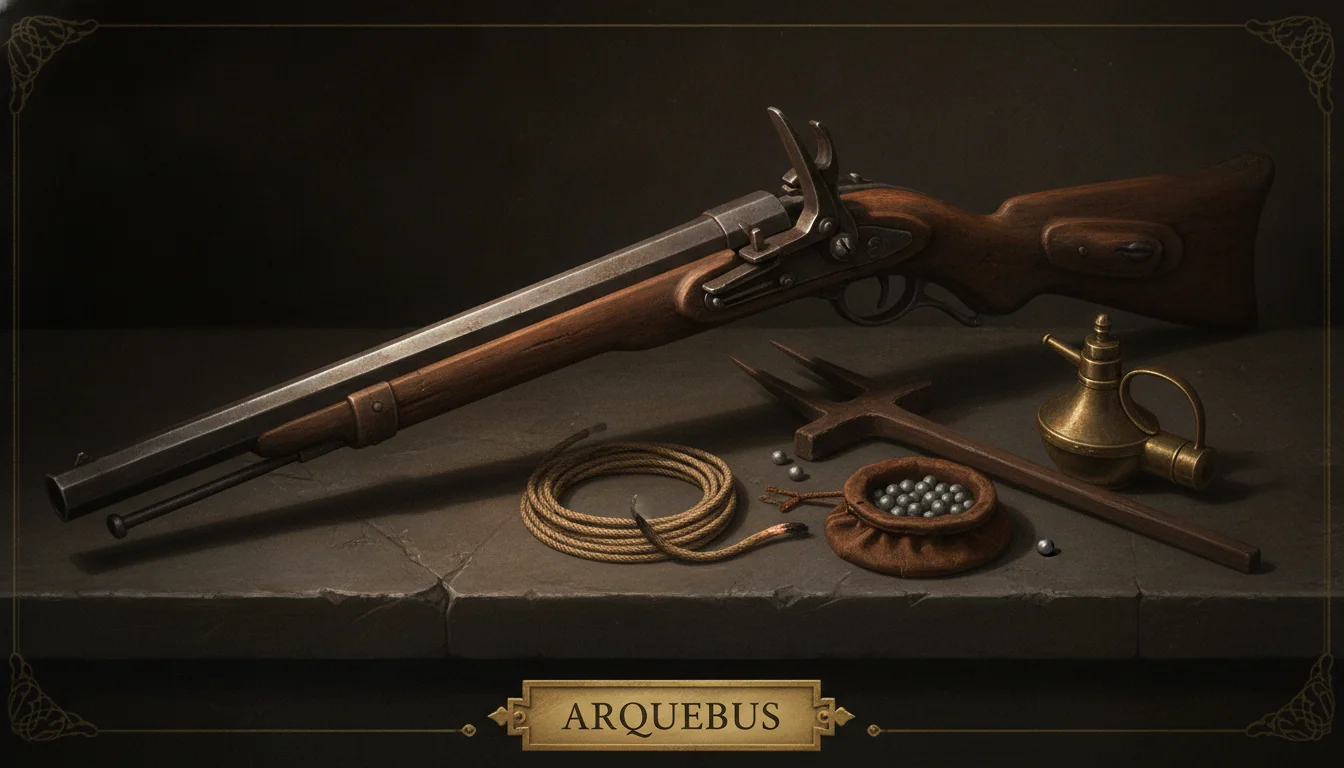
In 1525, on a cold February morning outside Pavia, a force of Spanish and Imperial soldiers carrying clumsy, smoke-belching guns broke the finest heavy cavalry in Europe. French knights, the descendants of a military class that had ruled European battlefields for a thousand years, rode into a killing field of gunfire and pikes and did not ride back out. The gun that did the damage was not especially accurate, not especially fast to load, and not especially elegant. It was the arquebus, and by the time its short reign ended, the armored knight was a museum piece.
From hand cannon to matchlock
The arquebus did not appear out of nowhere. Its ancestor was the hand cannon, a crude iron or bronze tube mounted on a wooden stock or pole, fired by touching a burning wick or hot iron directly to a small hole drilled in the barrel. Hand cannons had been in scattered use across Europe and China since at least the 14th century, and they were miserable weapons to operate. A soldier needed both hands to aim the tube and a third to apply the flame, which made accurate shooting nearly impossible and reloading painfully slow.
The innovation that turned the hand cannon into something resembling a modern firearm was the matchlock mechanism, which appears to have developed in Europe sometime in the mid-1400s, with some of the clearest evidence pointing to German and Central European armories. The matchlock replaced the free hand holding a burning taper with an S-shaped lever, called a serpentine, that clamped a length of slow-burning cord known as the match. Pulling a trigger swung the serpentine down, driving the glowing tip of the match into a small pan of priming powder, which flashed through a touch hole and ignited the main charge in the barrel. For the first time, a soldier could hold a firearm level, sight down the barrel with both hands, and fire it with a simple mechanical squeeze.
The weapon that resulted, generally called the arquebus (from a Germanic root meaning roughly "hook gun," a possible reference to a hook-shaped mount some early versions used to absorb recoil), was a smoothbore, muzzle-loaded gun typically firing a lead ball a little over half an inch across. It was light enough, in its typical form, to be aimed and fired by one soldier without a support, unlike the heavier muskets that followed it. None of that made it a good weapon in isolation. It was slow to load, inaccurate past close range, and useless if rain soaked the match or the priming powder. What it offered instead was something armies had never had before: a lethal weapon that a farmer's son could learn to use in weeks rather than years.
Cheap soldiers, expensive knights
That last point is the hinge on which the entire history of the arquebus turns. A knight represented a lifetime of investment: years of training from childhood, a warhorse bred and conditioned for war, and a suit of plate armor that could cost as much as a small farm. An arquebusier represented a few weeks of drill and the price of a gun that any competent smith could produce in volume. Armies that had spent centuries built around a small, expensive elite of mounted men-at-arms suddenly had access to infantry that could be raised, armed, and replaced far faster and cheaper.
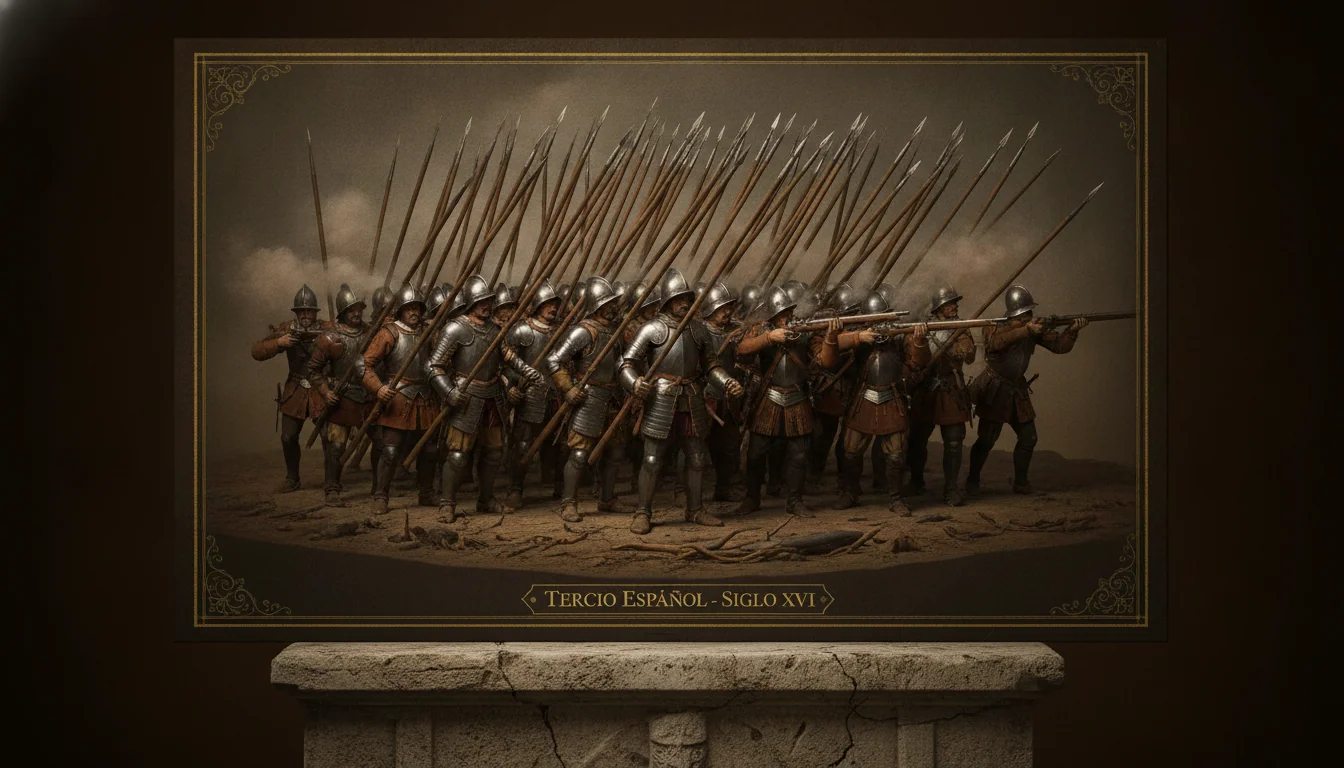
This is not to say the arquebus made war simple. Alone, arquebusiers were vulnerable to cavalry, since reloading a matchlock left a soldier defenseless for the better part of a minute. The solution that emerged, especially in Spanish service, was to pair arquebusiers with blocks of pikemen in combined formations. The Spanish tercio, formalized in the early 1500s, arranged pikemen in a dense core to receive and break cavalry charges, with sleeves and forward skirmish lines of arquebusiers to pour fire into the enemy as they approached. Similar pike-and-shot formations developed across Europe under different names, from the German Landsknecht formations to later Dutch and Swedish adaptations. The pike protected the gun; the gun made the pike formation lethal at range. Readers interested in the pike's half of that partnership can find more in our history of the pike and the tercio.
Pavia and the death of the charge
The Battle of Pavia, fought in February 1525 between the forces of the Holy Roman Emperor Charles V and the army of King Francis I of France, is the battle most historians point to as the moment the arquebus announced itself as a war-winning weapon. Spanish arquebusiers, operating from cover in the walled park of Mirabello outside Pavia, poured concentrated fire into the French gendarmes, the armored heavy cavalry that formed the elite of the French army. Francis I himself was unhorsed and captured. French losses were severe, with many historical accounts describing several thousand dead including a substantial portion of the French nobility present, though exact figures from 16th-century battles should be treated as approximate. The French king's captivity and the scale of the defeat sent a shock through European courts: a scratch force of commoners with guns had broken the pride of French chivalry.
Pavia was not a one-off. Through the 16th century, arquebus-armed infantry became a fixture of every major European army, from the Italian Wars through the Wars of Religion in France. Outside Europe, the technology spread with remarkable speed. Portuguese traders introduced matchlock firearms to Japan around 1543, where local smiths on the island of Tanegashima reverse-engineered and mass-produced them within a generation, a story covered in depth in our piece on the tanegashima. By 1575, at the Battle of Nagashino, Oda Nobunaga's forces are widely credited with using massed matchlock volleys, reportedly organized in rotating ranks to keep up continuous fire, to shatter the cavalry charges of the Takeda clan, though the precise tactical details of that battle have been debated and embellished by later chroniclers and should be read with some caution.
The craft and its limits
Making an arquebus reliable was a genuine technical achievement for its era, even if the finished weapon looks primitive today. Barrels were forged from iron staves wrapped and welded around a mandrel, then bored and polished by hand, a laborious process that determined how safely the gun could handle its powder charge. The serpentine mechanism required close tolerances to strike the pan consistently. Gunsmiths experimented constantly with barrel length, bore diameter, and stock shape, gradually improving range and reliability without ever escaping the matchlock's core weaknesses.
Those weaknesses were serious. The burning match had to be kept lit at all times during a battle, which meant soldiers marched into combat trailing smoldering cord, a hazard in itself when powder was being handled nearby. Wind or a rain shower could snuff the match or foul the priming powder outright. At night, the glow of hundreds of lit matches announced an army's position and rough strength to anyone watching from a distance. Loading remained a multi-step process, measuring powder, ramming a ball and wadding down the barrel, priming the pan, that a well-drilled soldier could complete in perhaps a minute, a glacial rate by any modern standard.
From matchlock to wheellock to flintlock
Gunsmiths spent the following two centuries trying to solve the matchlock's problems, and the story of the arquebus's descendants is really the story of the ignition mechanism. The wheellock, developed in German-speaking lands in the early 1500s, replaced the burning cord with a spring-driven steel wheel that spun against a piece of pyrite to throw sparks into the priming pan, much like a modern cigarette lighter. It solved the problem of the ever-burning match and let cavalry carry loaded pistols safely, but the mechanism was expensive and delicate, which kept it a weapon of wealthier troops and specialists rather than a replacement for the common infantry gun.
The flintlock, which matured over the 1600s, offered a simpler and cheaper answer: a spring-loaded cock holding a piece of flint struck a steel plate to throw sparks directly into the pan. It was sturdier than the wheellock, faster to reload than the matchlock, and far more weather-resistant than either. By the later 17th and into the 18th century, flintlock muskets, heavier, longer-ranged descendants of the old arquebus, had displaced the matchlock across nearly every European army, a transition explored further in our histories of the flintlock musket and its famous descendant, the Brown Bess.
The knight's last excuse
It would be an overstatement to say the arquebus alone killed the armored knight. Pike formations, the rising cost of maintaining heavy cavalry, changes in siege warfare and fortification, and simple economics all played a role in the decline of the mounted man-at-arms as the centerpiece of European armies. But the arquebus removed the last practical justification for that centerpiece. A suit of plate armor that had once made its wearer nearly untouchable on the battlefield could still be pierced, and even when it was not pierced outright, the knight beneath it was now just one more target in a killing field shared with pikemen, gunners, and cannon. War was no longer a contest decided by a narrow warrior aristocracy. It belonged, increasingly, to whichever state could arm, drill, and pay the largest disciplined body of common soldiers. The arquebus did not write that new rule by itself, but it was the weapon that made the rule impossible to ignore.
Quick Answers
Common questions about this topic
What is the difference between an arquebus and a musket?
The terms overlap, but generally the arquebus was the earlier, lighter matchlock firearm, manageable without a support, while the musket that emerged later in the 1500s was a heavier, longer-barreled gun with greater range and penetration that usually required a forked rest to fire. Over the 17th century the word musket gradually absorbed the arquebus into a single broad category of shoulder-fired infantry guns.
How did the arquebus defeat armored knights?
A single arquebus ball rarely outmatched the best plate armor at range, but arquebusiers fired in volleys from formation, and no armor protected a knight's horse or every angle of his body. Combined with pikes that stopped cavalry charges before they closed, arquebus volleys made the mounted, armored charge an unreliable gamble rather than a decisive weapon.
Was the arquebus accurate?
Not by later standards. A smoothbore matchlock ball tumbled unpredictably in flight, and effective range against an individual target was often under 100 meters. Its value came from volume of fire and psychological shock rather than marksmanship, which is why commanders massed arquebusiers in ranks instead of relying on individual skill.
Why did the matchlock eventually disappear?
The matchlock's burning cord was slow to prepare, useless in rain or wind, and gave away a soldier's position in the dark. The wheellock and later the flintlock replaced the cord with a spark-generating mechanism that was faster, more reliable, and safer around gunpowder, and by the later 1600s flintlock muskets had displaced matchlocks in most European armies.

Talk to the People Who Wielded These Weapons
Chat with the soldiers, smiths, and commanders whose lives were shaped by the weapons of their age.
Create your free account →No card required. Some figures and features require a paid plan.
Join the HistorIQly Club
Get smarter about the past.
Weekly stories, deep dives, and exclusive content straight to your inbox.