Better Man vs. History: How Accurate Is the Robbie Williams Biopic?
Better Man accuracy: how Robbie Williams' CGI chimp biopic handles the Take That fallout, his drug spiral, and the Angels comeback. A fact-check.
Read Wikipedia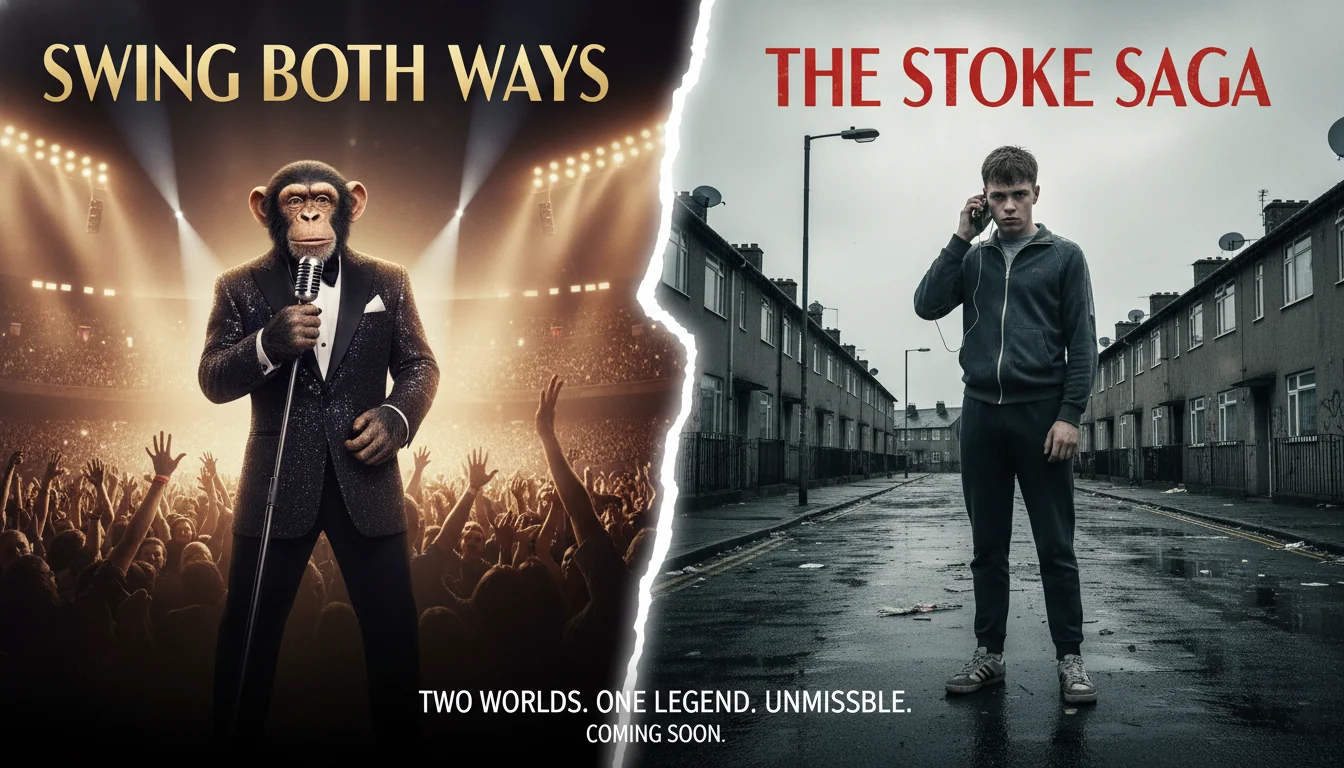
Michael Gracey's Better Man arrived in cinemas in late 2024 with one of the stranger conceits in biopic history: Robbie Williams, one of the best-selling solo artists in British pop history, rendered throughout the film as a motion-captured CGI chimpanzee. The conceit sounds gimmicky. The film, surprisingly, pulls it off, largely because Williams himself drove the creative decision and understands that self-deprecation has always been his most effective tool.
The result is a biopic that is more emotionally honest than most of its genre, which raises the obvious question: how accurate is it when measured against the documented record?
What Hollywood Got RIGHT
The Take That dynamic
Better Man depicts Williams joining Take That as a teenager from Stoke-on-Trent, feeling permanently out of place among more polished bandmates, and developing a particularly tense relationship with Gary Barlow, the group's primary songwriter and musical anchor.
The broad strokes are correct. Williams was born in Stoke-on-Trent in 1974 and joined Take That in 1990 after an audition. He was the youngest member and the one given the fewest lead vocal parts during the early years. Barlow was the group's songwriting center of gravity, and by the mid-1990s was publicly being positioned as the British equivalent of George Michael - a genuine songwriter-performer rather than a pop confection. The internal hierarchy this created was real, and Williams has described it consistently across years of interviews as a source of genuine psychological damage.
The specific scenes of Barlow dismissing Williams's contributions and looking at him with something close to contempt are dramatized, but both men have confirmed in separate public accounts that their relationship was genuinely cold and that Williams felt deeply undervalued. Barlow has, for his part, acknowledged in later years that he did not handle the situation with maturity.
The 1995 sacking
The film depicts Williams being fired from Take That in 1995 and the immediate collapse of his mental health that followed. He goes home to his mother, stops getting out of bed, and begins drinking and using drugs at destructive rates.
This tracks the documented record closely. Williams was effectively pushed out of Take That in July 1995 during a conversation that the other members have confirmed was as brutal as it sounds in retrospect. The band went on to enormous success without him - their final single before Barlow himself left, How Deep Is Your Love, reached number one in the UK. Williams, meanwhile, had no follow-up plan, no ready solo deal, and no obvious path forward.
The subsequent period of addiction and depression that the film depicts, including the weight gain, the withdrawal, and the near-total absence of professional activity in the first year post-sacking, is consistent with what Williams has said in interviews and in print. The extent of his consumption was, he has stated, life-threatening.
Angels as the comeback anchor
The film correctly identifies Angels, released in late 1997, as the record that transformed Williams from a failed pop experiment into a genuine solo artist. The song was written with Guy Chambers during a productive recording partnership that the film portrays accurately in outline. Angels became one of the best-selling UK singles of the 1990s, and its impact was real enough that Williams later performed it at both Knebworth and the Concert for Diana.
The film's suggestion that Angels was not an instant smash - that it climbed slowly through word of mouth and radio play rather than debuting at number one - is essentially accurate. The single peaked at number four in the UK chart but stayed in the top ten for weeks and eventually became a standard.
The Knebworth concerts
The film builds to the 2003 Knebworth shows, which it presents as the peak of Williams' commercial career and, emotionally, as both triumph and void. The historical fact: Williams played three nights at Knebworth in August 2003 to audiences of 125,000 per night. It was, at the time, one of the largest concert audiences in British pop history.
The film's emotional framing - that getting everything he wanted did not fill the gap left by everything that had damaged him - is consistent with what Williams has said publicly about that period. He entered rehab not long after the peak of his commercial success, not because the career was failing but because he was.
What Hollywood Got WRONG
The timeline of events is compressed
Better Man compresses the mid-1990s into a tighter sequence than the reality. Williams was fired in July 1995, but his recovery and early solo work stretched over two full years before Angels arrived in late 1997. The film moves through this period quickly, which is standard biopic practice but which somewhat understates how long the drift lasted and how close he came to never recording anything coherent.
The Port Vale element is underplayed
Williams is a passionate supporter of Port Vale F.C., his hometown club, to a degree that has been a consistent feature of his public identity for decades. He eventually became a co-owner of the club. The film gestures at his working-class Stoke identity but largely omits the football dimension, which is a meaningful gap for anyone who knows Williams primarily from his non-musical public life.
Nicole Appleton is handled carefully
Williams had a well-documented relationship with All Saints singer Nicole Appleton in the late 1990s, including a pregnancy that ended in a termination. The film references this period obliquely but does not name her or engage with the specific events, which is understandable given that Appleton is a living person who did not participate in the production. The result is a biographical gap in the emotional chronology.
The drug specifics are softened
Williams has been considerably more explicit in his own writing and interviews about exactly what he was consuming and at what volumes during the worst years than the film allows itself to be. Better Man conveys the severity without the specifics, which is a commercial and legal calculation that results in a slightly softened portrait of the addiction years.
The verdict
Better Man is an unusually honest piece of authorized biography. It does not flatter Williams into heroism. The monkey metaphor is not vanity - it is, if anything, anti-vanity, a deliberate choice to present himself as ridiculous. The Take That material is as uncomfortable as it should be. The addiction arc is not sanitized into a tidy redemption story. The film also resists the standard biopic move of ending on triumph - the emotional resolution is ambiguous, which is itself historically accurate.
Where it compresses or omits, the reasons are mostly practical rather than self-protective. Williams' career is long enough that a two-hour film must choose its moments. The compression of the mid-1990s and the absence of the Appleton chapter are the most historically significant gaps, but neither undermines the film's fundamental portrait of a man whose public confidence and private damage ran in parallel for decades.
Historical accuracy score: 7/10. Strong on the emotional architecture and the key events. Weaker on the timeline and the gaps around relationships with people who declined to participate. The chimpanzee conceit is, on reflection, the most faithful thing in it.
For other musical biopic fact-checks, see our analyses of Walk the Line and Bohemian Rhapsody, two films that face similar tensions between emotional truth and documented fact.
Quick Answers
Common questions about this topic
Is Better Man based on a true story?
Yes. Better Man is an authorized biopic of Robbie Williams, made with his full cooperation and narrated by him. The film covers his childhood in Stoke-on-Trent, his years with Take That, his solo career, his drug and alcohol dependency, and his marriage to Ayda Field. Williams approved the script and provided personal accounts that shaped the film's key scenes.
Why does Robbie Williams appear as a chimpanzee in Better Man?
Director Michael Gracey used a CGI chimpanzee as Williams' on-screen avatar throughout the film, a creative choice Williams endorsed. Williams has said in interviews that he chose the chimp metaphor to represent how he has always felt like an outsider performing for approval - an entertainer rather than an artist, a circus act rather than a peer.
Is the Gary Barlow feud portrayed accurately in Better Man?
The film depicts a strained and contemptuous relationship between Williams and Gary Barlow during the Take That years, which is broadly consistent with what both men have said publicly. The specific scenes of dismissal and humiliation are dramatized, but the core dynamic - Barlow as the serious musician who looked down on Williams as a lightweight - is confirmed by both parties.
Did Robbie Williams really nearly die from drug and alcohol abuse?
Yes. Williams has spoken extensively in interviews and in his memoir about the severity of his addiction during the late 1990s, when he was consuming large quantities of alcohol, cocaine, and prescription drugs daily. He entered rehab in the late 1990s and has credited the process with saving his life. Doctors reportedly warned him that continued use at the rate he was going would kill him within a short time.

Debate the Accuracy with the Real Figures
Ask the real people what Hollywood got wrong about their lives.
Create your free account →No card required. Talk to anyone in history with 8 free credits a day. Some features require a paid plan.
Join the HistorIQly Club
Get smarter about the past.
Weekly stories, deep dives, and exclusive content straight to your inbox.