The Bikeriders vs. History: How Accurate Is the Outlaws MC Saga?
The Bikeriders accuracy sets it apart from most biker films: Jeff Nichols' 2024 drama is grounded in Danny Lyon's real Chicago Outlaws MC photographs.
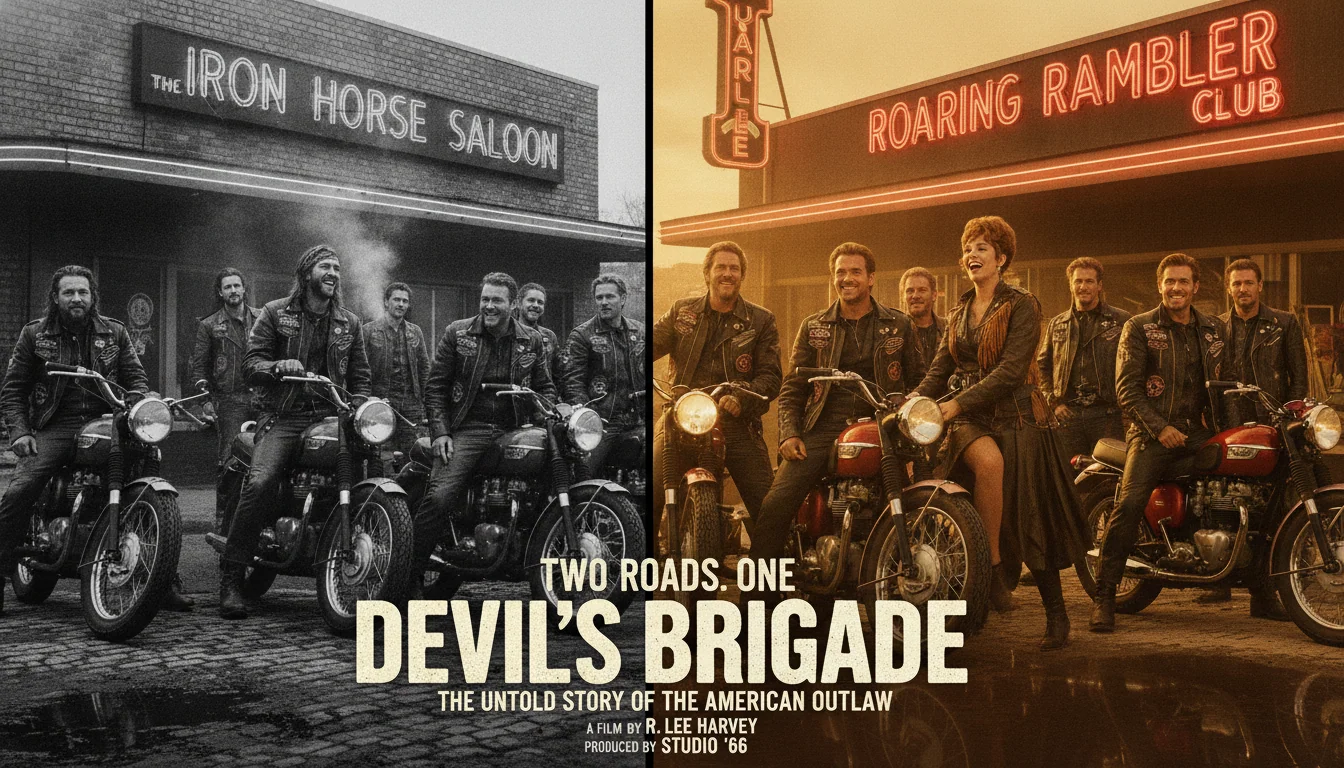
The Bikeriders opens with a woman in a Wisconsin diner being interviewed by a photographer she barely knows about the man she married and the world she stumbled into. The club in the film is called the Vandals. The real club was the Outlaws. That is the most significant thing Jeff Nichols changed in adapting Danny Lyon's 1968 photography book, and even that change is more legal protection than historical revision. Everything else - the culture, the women, the drift toward violence, the collapse of what the founders had intended - is drawn from a documentary record that Lyon assembled by living inside it.
For fidelity to the world it depicts, this is one of the most honest American biker films ever made.
What the film is actually based on
Danny Lyon, then a Yale-educated photographer who had already documented the civil rights movement riding with SNCC, spent roughly two years in the mid-1960s riding with the Chicago chapter of the Outlaws Motorcycle Club. He photographed them at bars, rallies, garages, and funerals. He conducted long recorded interviews with members and with the women in their orbit. In 1968 he published the result as The Bikeriders - a book of photographs and first-person oral testimony that became one of the defining documents of American working-class counterculture.
The book was raw and specific in the way only someone who was actually there could produce. Lyon never positioned himself as a detached observer: he was a participant who happened to carry a camera.
Jeff Nichols adapted the book by centering Kathy (Jodie Comer), the wife of Benny (Austin Butler), telling the story of her marriage and the club's history to a Lyon-figure interviewer (Mike Faist). The structure mirrors Lyon's actual method: gather testimony, assemble voices, let the contradictions stand. The specific characters are composites or invented. The world they inhabit is not.
What Hollywood Got RIGHT
The Outlaws' real origins
The real Outlaws Motorcycle Club was founded in 1935 at a roadhouse in McCook, Illinois - just outside Chicago. By the time Lyon rode with the Chicago chapter in the mid-1960s, the club was predominantly white working-class men who had come home from Korea or the Second World War and found that civilian life offered nothing that matched the road.
The film renders this accurately. Johnny (Tom Hardy), the club's patriarch, is a man who built something because motorcycles and the men around them meant something to him - not because of money, not because of crime, but because of a feeling the wider culture had never offered. This matches what Lyon's interviews document: the founding generation of outlaw bikers were not primarily criminals. They were men who wanted autonomy, speed, and a community that would not ask them to wear ties.
The generational fracture
This is the film's central drama and its most historically grounded element. By the late 1960s and into the 1970s, outlaw motorcycle clubs were attracting a different kind of recruit - men drawn not by road culture but by the club's reputation for violence, the available criminal income, and the protection the patch offered. The original members and the newcomers had almost nothing in common except the same leather vest.
Court records, law enforcement reports, and independent journalism from the 1970s all confirm that this split was real inside the Outlaws and across the other major outlaw clubs - the Hells Angels, Bandidos, and Pagans. The film dramatizes it through Benny, whose wildness and charisma the old guard loves but cannot contain, and through a rotating cast of newer members who represent the coming culture of casual, purpose-driven violence.
Kathy as documentary subject
The decision to center Kathy as narrator is the film's most significant structural invention - and it is grounded in Lyon's actual method. Lyon conducted extended recorded interviews with women in the club's orbit: wives, girlfriends, and hangers-on. Several of their accounts appear in the original book. Kathy is a composite of those women, and Jodie Comer's performance draws from their recorded voices: a mixture of clear-eyed practicality about the violence with genuine attachment to the community and its specific freedoms.
The period visual record
Nichols and his production team created a 1960s and 70s biker world that holds up against Lyon's photographs in almost every frame. The specific shapes of BSA and Triumph motorcycles, the colors of the leathers, the vinyl booths of the roadhouse bars, the muscle cars in the parking lots - all of it matches the photographic record Lyon left behind. Documentary photographers who have reviewed the film consistently note that the visual world is the most faithful recreation of Lyon's source material they have encountered on screen.
What Hollywood Got WRONG
The Vandals' scale is compressed
The real Outlaws MC of the 1970s was not a single tight-knit Chicago chapter handling individual acts of personal violence. By the mid-1970s, the Outlaws had expanded to dozens of chapters across the South and Midwest and were involved in organized criminal enterprises including drug distribution, protection rackets, and contract violence. The film presents a world of intimate, almost domestic violence inside a small community. The actual organization's violence was industrial and geographic in scale.
This compression is understandable - Lyon's book was about one chapter, and Nichols stayed close to that frame. But viewers should not mistake the film's intimate scope for a complete portrait of what the Outlaws actually became.
Benny has no specific historical counterpart
Austin Butler's Benny - the most beautifully written character in the film - does not correspond to any documented individual. He is a composite drawn from several young members who appear in Lyon's photographs and interviews: men who were electrifyingly alive on a motorcycle and constitutionally unable to survive for long in any structured environment. This is not a flaw. It is how dramatic adaptation of documentary material works. But Benny should be understood as a representative type, not a recovered biography.
The club war context is absent
One of the defining facts of American outlaw biker culture from the 1970s onward is the violent war between the Outlaws and the Hells Angels, which involved bombings, shootings, and murders on both sides and continued for decades. The film makes no reference to this conflict.
This reflects Lyon's own frame: his book was completed in 1968, before the war fully metastasized. The absence is not an error so much as a limit of the source material's era. But a viewer who walks away thinking the Outlaws' main problem in the 1970s was the gradual criminalization of their membership has missed the larger conflict that defined the period.
Historical Accuracy Score: 7.5/10
The Bikeriders is remarkable for how honestly it renders the texture of the world Danny Lyon documented. The period detail, the class dynamics, the women's experience, and the generational fracture between those who built the clubs and those who inherited them are all firmly grounded in the historical record.
What the film softens is scale: the real Outlaws' criminal expansion, their territorial war with the Hells Angels, and the way outlaw biker culture was transformed by the 1970s drug economy into something Lyon's 1968 book had no reason to anticipate.
What the film gets most right: the culture of the founding generation, the documentary texture of Lyon's original project, and the specific experience of the women who lived inside that world.
What it gets most wrong: the compression of the Outlaws' real scale and the absence of the inter-club warfare that made the 1970s so lethal for everyone involved.
If you want to understand what American outlaw biker culture looked like before it became a fully organized criminal enterprise, this is the closest any film has come to Lyon's record. The Vandals are the Outlaws in everything except their name.
The Bikeriders accuracy in rendering class dynamics and women's experience is comparable to what Goodfellas achieves for organized crime's inner circle, or what Public Enemies attempts for Depression-era gangsters - films that use real historical texture rather than studio mythology.
Quick Answers
Common questions about this topic
Is The Bikeriders based on a true story?
Yes. The Bikeriders (2024) is based on Danny Lyon's 1968 photography book of the same name, a documentary project Lyon completed after spending roughly two years riding with the Chicago chapter of the Outlaws Motorcycle Club. The film's fictional 'Vandals MC' stands in for the real Outlaws, and Jodie Comer's character Kathy is drawn from real interviews Lyon conducted with biker wives and girlfriends.
Is the Vandals MC a real club?
No. The Vandals MC in the film is a fictional composite representing the real Chicago Outlaws MC. The Outlaws Motorcycle Club was founded in McCook, Illinois in 1935 and became one of the four largest outlaw motorcycle clubs in the world. Jeff Nichols changed the name to allow dramatic license with specific events and avoid legal complications.
Who is Danny Lyon?
Danny Lyon is a real American documentary photographer and filmmaker, born 1942, who rode with the Chicago Outlaws for roughly two years in the mid-1960s and published his photographs and oral history interviews as The Bikeriders in 1968. It is considered a landmark of American documentary photography. In the film he appears as a character played by Mike Faist, conducting the interview with Kathy that frames the narrative.
How accurate is the film's portrayal of outlaw biker culture?
Extremely accurate in texture and tone. The generational split between original members who rode for fellowship and newer recruits drawn by violence and criminal enterprise is historically documented. The period detail, club hierarchy, and escalation of violence in the 1970s all align closely with reporting, court records, and Lyon's own documentary record of the era.

Debate the Accuracy with the Real Figures
Ask the real people what Hollywood got wrong about their lives.
Chat with HistoryJoin the HistorIQly Club
Get smarter about the past.
Weekly stories, deep dives, and exclusive content straight to your inbox.