Debunked: Did Einstein Fail Math?
Did Einstein fail math? Everyone repeats it, but his actual school certificate says the exact opposite, in writing, with a grade.
Read Wikipedia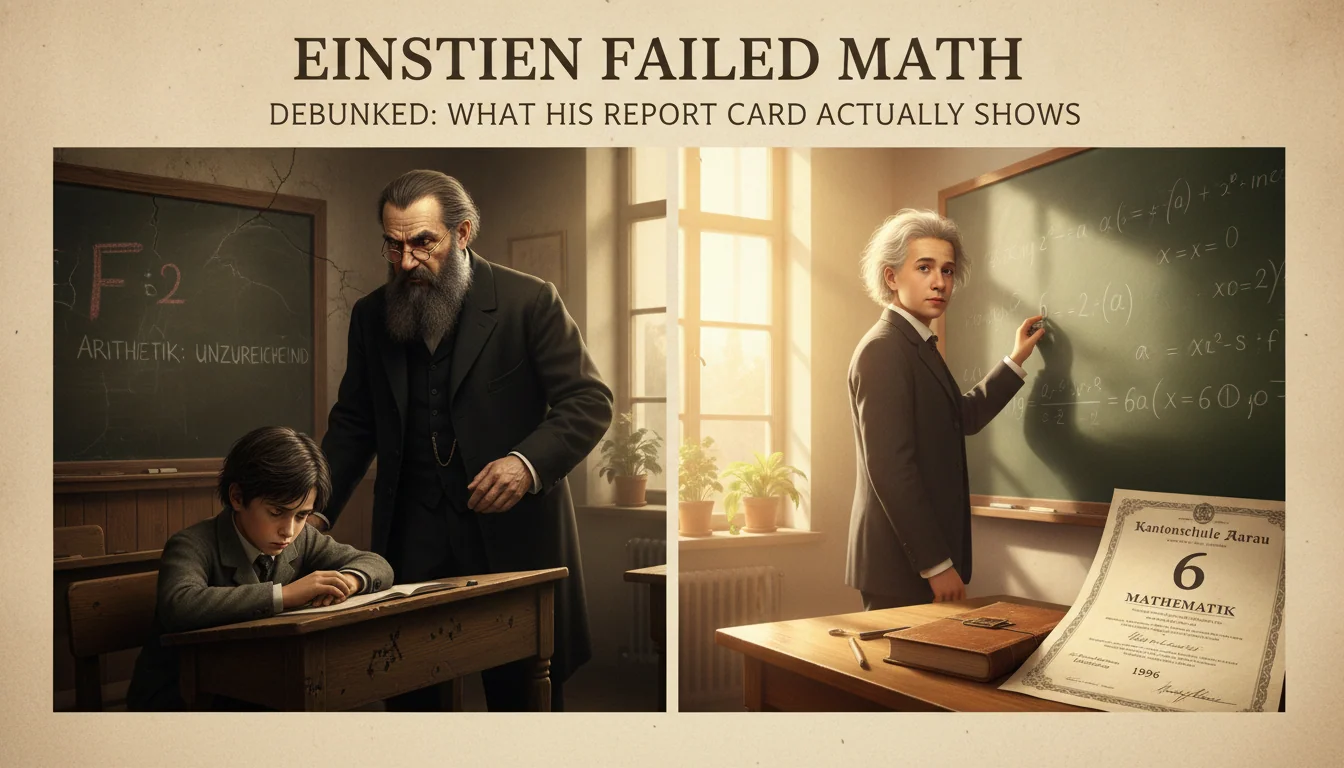
Ask a room of adults for one fact about Einstein and a solid half of them will reach for the same one: he flunked math as a kid. It turns up in graduation speeches, in listicles about famous "late bloomers," in the pep talk a parent gives a kid staring at a bad report card. It has been repeated by so many well-meaning people for so long that it has become its own kind of common knowledge, the sort nobody checks because everybody already knows it.
It did not happen. And the paper trail proving it did not happen has been sitting in plain sight for decades.
Did Einstein Fail Math? The Myth, Stated Fairly
The story, at its most convincing, goes something like this: the man who rewrote physics was, as a boy, actually terrible at arithmetic. He brought home failing marks. Maybe he was held back a year. Maybe a teacher told him he would never amount to anything. Either way, the moral is irresistible: greatness does not announce itself early, grades do not predict destiny, and the kid struggling in the back row might grow up to reshape how humanity understands the universe.
It is a good story. It is also, on the specific factual claim at its center, false.
Why It Is So Believable
A few real things make the myth land. Einstein really did cultivate, later in life, the image of the rumpled, absent-minded genius, wild hair and all, which primes people to imagine an unpromising, scattered child underneath it. He really did clash with his early schooling, a rigid, rote-memorization gymnasium in Munich that he came to despise so much he left before finishing, a genuine episode of friction that gets blended into the failing-grades legend even though it was not about grades at all. And the underdog structure of the myth is exactly the kind of thing teachers and parents want to be true, because "even Einstein struggled" is a more comforting thing to tell a discouraged ten-year-old than "some people are just unusually good at this early." A myth that is this useful does not need to be checked before it gets repeated.
Where the Myth Actually Came From
The traceable origin is a 1935 installment of Ripley's Believe It or Not!, the newspaper panel built entirely on startling one-line claims, syndicated to papers across the country. That year's Einstein entry stated, in effect, that the greatest living mathematician had failed mathematics as a student, a claim built for shock value rather than accuracy and apparently not checked against any actual school record before it ran.
According to later accounts, a rabbi in Princeton, where Einstein was then living, showed him the clipping. Einstein's reply is the closest thing this story has to a smoking gun in his own words: he said he had never failed in mathematics, and that before he was fifteen he had already mastered differential and integral calculus. It is about as direct a denial as a myth ever gets from the person it is about.
How It Spread
The trouble is that a denial rarely travels as fast or as far as the claim it is denying. Ripley's column ran in newspapers nationwide, which meant the "failed math" line reached a much wider audience in a single day than Einstein's private correction ever could. Once a fact that vivid and that flattering to ordinary readers is in print, it develops its own momentum: it gets repeated in classrooms, quoted in encouragement columns, and later reprinted endlessly in motivational-quote compilations and forwarded chain emails, each retelling stripped further from any source. Nobody forwarding it was being dishonest. They were repeating something that felt true, was rhetorically useful, and had, by then, been in circulation for generations. It is the same pattern behind other stubborn classroom legends, like the claim that Napoleon was unusually short or that the Great Wall of China is visible from space: a good line outruns the correction every time.
It also had help from a second, entirely true story that made the false one feel plausible by association. Einstein really did spend years after graduating working an unglamorous day job as a patent clerk in Bern, evaluating other people's inventions, before publishing the papers on relativity and the photoelectric effect that made his name. That is a genuine "ordinary beginnings, extraordinary result" arc, and it is easy to see how a public already primed to enjoy one underdog chapter of Einstein's life waved through a second, invented one without checking it. The patent-office job was real modesty. The failing math grade was not, but they rhyme well enough that people stopped noticing the difference.
What the Primary Sources Say
The most direct evidence is Einstein's own graduation certificate, or Matura, from the Argovian cantonal school in Aarau, Switzerland, dated 1896 and preserved among his papers. Reproduced in facsimile by biographers and archives, it records his marks subject by subject on a six-point scale used at the school, and in algebra, geometry, and physics his grade is a 6, the highest mark available, not the lowest.
That numeral 6 is part of why the myth has legs. To a modern eye skimming an old document, a "6" out of some unstated maximum reads as unremarkable, maybe even mediocre, and readers unfamiliar with the school's grading convention, where 6 sat at the top rather than the bottom, could plausibly misread a superb transcript as an ordinary one. It is a small, almost bureaucratic quirk of one Swiss school's scoring system, and it is a more interesting explanation for a persistent myth than "someone made it up," even though the someone-made-it-up part is also true.
The myth also survives on a real, adjacent fact that gets pulled out of context: in 1895, at sixteen, two years younger than the usual minimum age, Einstein sat the entrance exam for the Swiss Federal Polytechnic in Zurich and did not pass it overall. That part is accurate. What gets dropped is which sections he struggled with. By the accounts of his examiners and later biographers, his mathematics and physics results were outstanding, strong enough that the school's physics professor took a personal interest in him. His weaker marks were in the exam's general and language sections. Rather than retake the whole exam, he spent one more year finishing secondary school in Aarau and was admitted to the Polytechnic in 1896 on the strength of that diploma, the same one carrying the 6 in algebra and geometry.
So the one documented exam Einstein actually failed was not a math exam. It was a general entrance exam he sat two years earlier than anyone expected him to, and the subjects that sank his overall score were the ones furthest from the field he would go on to remake.
What Is True Instead
The real story is stranger and, honestly, better than the myth it replaced. Around age twelve, a family friend, a medical student who visited the Einsteins regularly and introduced the boy to serious books, gave him a geometry textbook. Einstein later called it his "holy little geometry book," and by his own account he tore through it and kept going, working out an original proof of the Pythagorean theorem on his own before his thirteenth birthday and teaching himself algebra and calculus over the next couple of years. By his mid-teens, on his own telling, he had mastered differential and integral calculus, material most students would not see until university. That family friend later recalled that within a short time the boy's grasp of mathematics had flown past anything he himself could still follow.
His genuine schooling troubles were not about ability. They were about temperament. He resented the militaristic discipline and memorization-first style of his gymnasium in Munich badly enough that he left before completing it there, a real and documented friction that has nothing to do with grades and everything to do with a restless, self-directed learner colliding with an institution built for obedience rather than curiosity. That is a far more interesting story than a late bloomer redeeming himself: a kid who had already outpaced the curriculum, bored by a system not built to notice, and impatient with teachers who wanted recitation rather than understanding.
The report card is still out there, in archival facsimile, with a very legible 6 next to Algebra. The myth had eighty years head start and a much better slogan. The paperwork, as it turns out, was the more interesting story all along.
Quick Answers
Common questions about this topic
Is it true that Einstein failed math in school?
No. It is one of the most repeated but least true facts in popular history. Einstein's surviving school certificate shows top marks in algebra, geometry, and physics, and he had already taught himself calculus years before finishing secondary school.
Where did the 'Einstein failed math' myth come from?
It traces to a 1935 Ripley's Believe It or Not! newspaper feature that ran a line to the effect that the greatest living mathematician had failed mathematics as a student. Einstein was shown the clipping directly and denied it, but the claim had already gone out through newspaper syndication.
What do Einstein's actual school grades show?
His 1896 graduation certificate from the cantonal school in Aarau, Switzerland, records a 6 out of 6, the top mark on that school's scale, in algebra, geometry, and physics. The certificate survives and has been reproduced by biographers and archives.
Did Einstein ever fail an exam?
Yes, in one specific sense. In 1895, at sixteen and two years younger than the usual admission age, he sat the entrance exam for the Swiss Federal Polytechnic in Zurich and did not pass overall, though his mathematics and physics results were excellent. His weaker marks came in the exam's general and language sections.

Ask What Really Happened
Chat with the figures behind the myths everyone still believes.
Create your free account →No card required. Some figures and features require a paid plan.
Join the HistorIQly Club
Get smarter about the past.
Weekly stories, deep dives, and exclusive content straight to your inbox.