The Halifax Explosion: The Blast That Flattened a City
The Halifax Explosion in 1917 unleashed the largest man-made blast before the atomic bomb, killing nearly 2,000 people after two ships collided in the harbour.
Read Wikipedia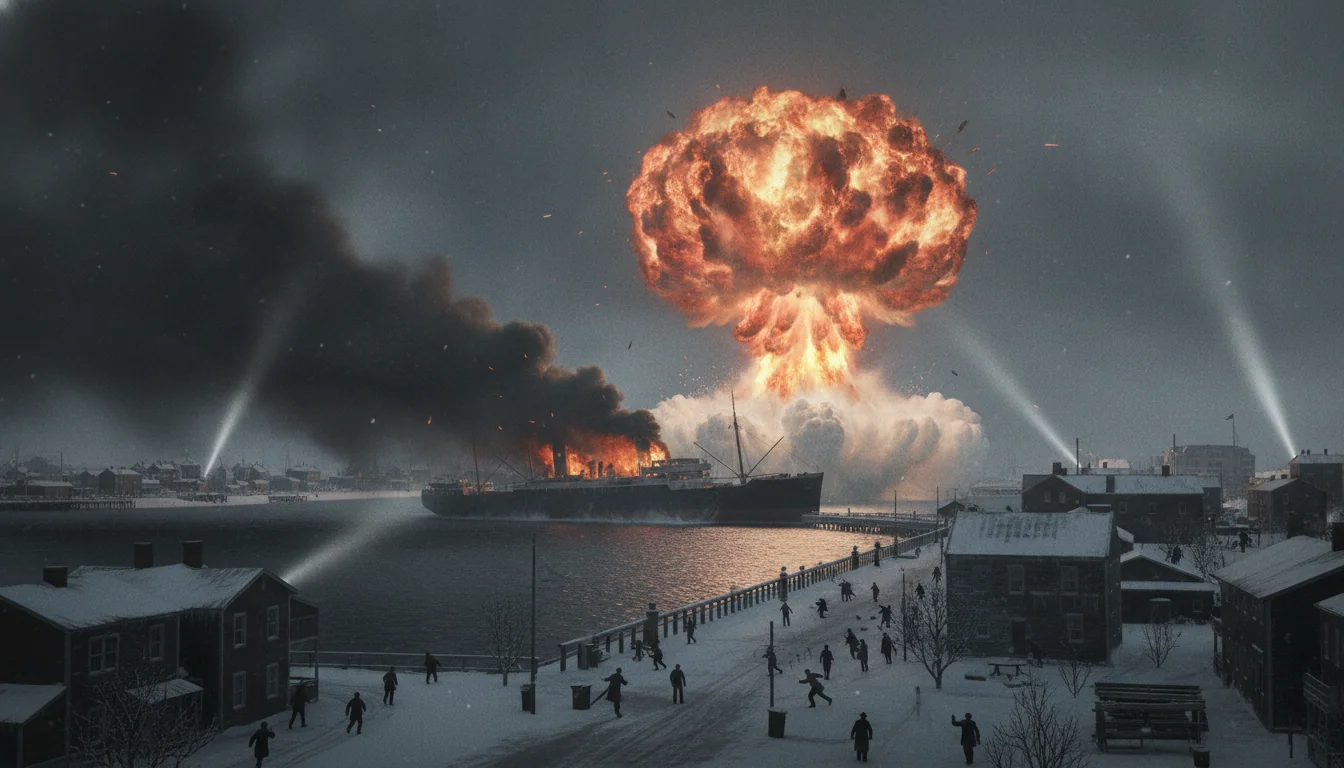
Halifax on the morning of December 6, 1917, was a city running on wartime traffic. Its harbor, one of the deepest ice-free ports on the Atlantic coast, was crowded with troop transports, supply ships, and the escorts that gathered them into convoys before the run across the ocean to a continent still fighting World War I. Nobody in the crowds walking to work or the children heading to school had any reason to think that morning would be different from any other. Within moments, a large part of the city no longer existed.
The war had turned Halifax into one of the busiest ports in the British Empire almost overnight. A city built for a modest colonial trade was suddenly processing munitions, troops, horses, and relief cargo bound for a continent that could not get enough of any of them. That volume meant more ships passing through the Narrows on any given day than the harbor's layout was really designed to handle safely, and it meant more captains and pilots working under wartime pressure to keep schedules that left little room for caution.
The setting
The Narrows is the tightest stretch of Halifax Harbour, a choke point between the open basin and Bedford Basin where ships had to pass close enough to read each other's flags. That morning two vessels were converging on it from opposite directions. Inbound was the SS Mont-Blanc, a French cargo ship arriving to join a convoy, her holds packed with picric acid, TNT, guncotton, and, lashed on deck in drums, benzol, a highly flammable fuel. Outbound was the SS Imo, a Norwegian ship chartered to carry relief supplies toward Belgium, running late after a delay the day before and pushing to make up time.
Neither ship was where harbor procedure expected it to be. Imo was on the wrong side of the channel, passing traffic she should have let go by. Mont-Blanc, loaded with cargo dangerous enough that her captain later said he had chosen not to fly the flag that would normally have warned other ships off, was easing forward at a cautious crawl. The two vessels exchanged a confusing series of whistle signals, each altering course to try to avoid the other, and by the time both reversed engines it was too late to matter.
The timeline
Shortly before nine that morning, Imo's bow struck Mont-Blanc's starboard side. The impact itself was almost gentle, not enough to sink either ship. But it tore open drums of benzol on Mont-Blanc's deck, and sparks from the grinding hulls ignited the spilled fuel almost immediately. Within minutes the French ship was burning along her forward deck, black smoke pouring skyward.
Mont-Blanc's crew knew exactly what was in her holds and what was about to happen. They abandoned ship fast, rowing for the Dartmouth shore and shouting warnings as they went. Almost nobody understood them. Most spoke French, and Halifax's wharves that morning were full of English speakers with no idea the burning ship drifting toward Pier 6 was a bomb.
For what the calmer reconstructions place at somewhere around twenty minutes, the abandoned Mont-Blanc drifted against the Halifax pier, burning steadily and drawing a crowd rather than dispersing one. Dockworkers stopped to watch. Office workers came to their windows. Schoolchildren pressed against classroom glass to see the spectacle, some of them cheering. None of them knew what the smoke meant. At 9:04 that morning, Mont-Blanc detonated.
The decisions
Two decisions in those final minutes still stand out. The first belonged to Vince Coleman, a railway dispatcher working near the harbor who learned from a sailor that the burning ship was carrying explosives. Rather than run, he stayed at his telegraph key long enough to send a warning down the line to stop an incoming passenger train before the blast reached his own office. The train heeded the warning and held outside the danger zone. Coleman did not survive the explosion.
The second was less heroic and more institutional: the string of misjudgments that put two ships on a collision course in the first place. Investigators would spend the next few years arguing over whose call was worse, Imo running against the normal flow of traffic or Mont-Blanc failing to signal her cargo, but in the moment neither ship's watch fully grasped how badly the other had misread the situation until the hulls were already touching.
The survivors and the toll
The blast leveled the Richmond district in Halifax's North End almost completely and did severe damage across the harbor in Dartmouth as well. It generated a shock wave that shattered windows for miles and a surge of displaced water that acted like a small tsunami, sweeping over the shoreline on both sides of the Narrows. A chunk of Mont-Blanc's anchor, weighing well over a thousand pounds by most accounts, was found more than two miles from the blast site.
Roughly 2,000 people were killed and about 9,000 were injured, a staggering toll for a city of Halifax's size. A disproportionate share of the injuries were to the eyes: thousands of people had been standing at windows to watch the fire when the blast blew the glass in on them, and Halifax's doctors treated an unusual wave of blindness and eye trauma in the weeks that followed, work that fed directly into new Canadian efforts to care for the blind in the years after the war.
Entire streets of wood-frame houses in Richmond simply ceased to exist, reduced to splinters and ash within seconds. Survivors described the sky itself seeming to catch fire, then a wave of pressure that flattened whatever was standing before the sound of the blast even arrived. Families were separated in an instant, some pulled from wreckage hours later, others never found at all. The Mont-Blanc herself was blown apart so thoroughly that fragments of her hull rained down over a wide radius of the city and the harbor beyond, a detail rescue workers found almost impossible to process alongside everything else they were seeing.
Rescue efforts the next day were made brutally harder by a blizzard that dumped heavy snow over the ruined city, burying survivors trapped in wreckage and slowing relief trains trying to reach Halifax from around the region. Boston, hearing the news within hours, dispatched a train loaded with medical staff and supplies that arrived through the storm, the beginning of a relationship between the two cities that Nova Scotia still marks today with an annual gift of a Christmas tree to Boston. Relief money and materials arrived from across Canada, the United States, and Britain in the weeks that followed, and a dedicated relief commission was set up to rebuild housing and distribute aid, work that stretched on for years rather than months.
The inquiry
A wreck commission convened almost immediately to assign responsibility, under wartime pressure to produce a fast answer. It found Mont-Blanc's captain and the harbor pilot guilty of causing the collision through negligent navigation, and for a time criminal charges were pursued against them, though those charges did not ultimately result in convictions. Imo's crew, many of whom had died in the blast including her own captain and pilot, were largely spared blame in that first finding.
The verdict did not hold. On appeal, the case reached Britain's Judicial Committee of the Privy Council, then the highest court of appeal for Canada, which took a more measured view of the evidence. The Privy Council found that both ships had made navigational errors in the Narrows that morning and that responsibility for the collision should be shared between them, a conclusion that better matched the tangle of misread signals and wrong-side movements that had actually put the two vessels on a collision course.
The reversal mattered beyond the courtroom. The first finding had landed squarely on the French crew of Mont-Blanc at a moment when wartime allies were supposed to be presenting a united front, and it left a bitter taste among those who felt a foreign crew had been made a convenient scapegoat for a Canadian harbor's failures. The later, shared verdict was a quieter but more honest reckoning: neither watch had behaved recklessly by the standards of the day, but a wartime harbor jammed with traffic and an unmarked cargo of explosives left almost no margin for the ordinary kind of misjudgment that ships' captains made every week without consequence.
What the inquiry could not undo was the damage itself, or the fact that a war-crowded harbor, a cargo of unmarked explosives, and a few minutes of miscommunication between two ships' watch officers had combined to produce the Halifax Explosion, for a few decades the largest man-made blast the world had ever recorded. That record stood until the atomic bombings of 1945. Halifax rebuilt, slowly and with outside help, but the Narrows never stopped being the place where the city's clocks are set against that one December morning.
For two other disasters where a small window for a different outcome closed fast, see the Hindenburg disaster and the Tenerife runway collision, another catastrophe caused by two vehicles that should never have been on the same path.
Quick Answers
Common questions about this topic
What caused the Halifax Explosion?
On the morning of December 6, 1917, the French cargo ship Mont-Blanc, loaded with wartime explosives, collided at low speed with the Norwegian ship Imo in the Narrows of Halifax Harbour. The collision sparked a fire aboard Mont-Blanc that reached her cargo about twenty minutes later, detonating with a force estimated at roughly the equivalent of a few thousand tons of TNT.
How many people died in the Halifax Explosion?
Roughly 2,000 people were killed and about 9,000 more were injured, many of them children watching the burning ship from windows that shattered in the blast. The Richmond district in Halifax's North End was almost entirely destroyed, and Dartmouth across the harbor suffered severe damage as well.
Was the Halifax Explosion really the largest man-made explosion before the atomic bomb?
Among widely cited pre-nuclear explosions it is generally ranked as the largest, or close to it, until the atomic bombings of Hiroshima and Nagasaki in 1945. Its blast wave, fireball, and tsunami-like harbor surge were unprecedented for a single accidental detonation.
What did the official inquiry find?
A Canadian wreck commission initially placed full blame on Mont-Blanc's captain and the harbor pilot. That finding was appealed, and Britain's Judicial Committee of the Privy Council later ruled that both ships had made navigational errors and shared responsibility for the collision.

Talk to the Survivors
Hear firsthand accounts from people who lived through history's darkest days.
Create your free account →No card required. Some figures and features require a paid plan.
Join the HistorIQly Club
Get smarter about the past.
Weekly stories, deep dives, and exclusive content straight to your inbox.