The Final Hours of Anne Boleyn
An hour-by-hour account of the Anne Boleyn execution: her arrest, trial, and death by a specially summoned swordsman inside the Tower of London on 19 May 1536.
Read Wikipedia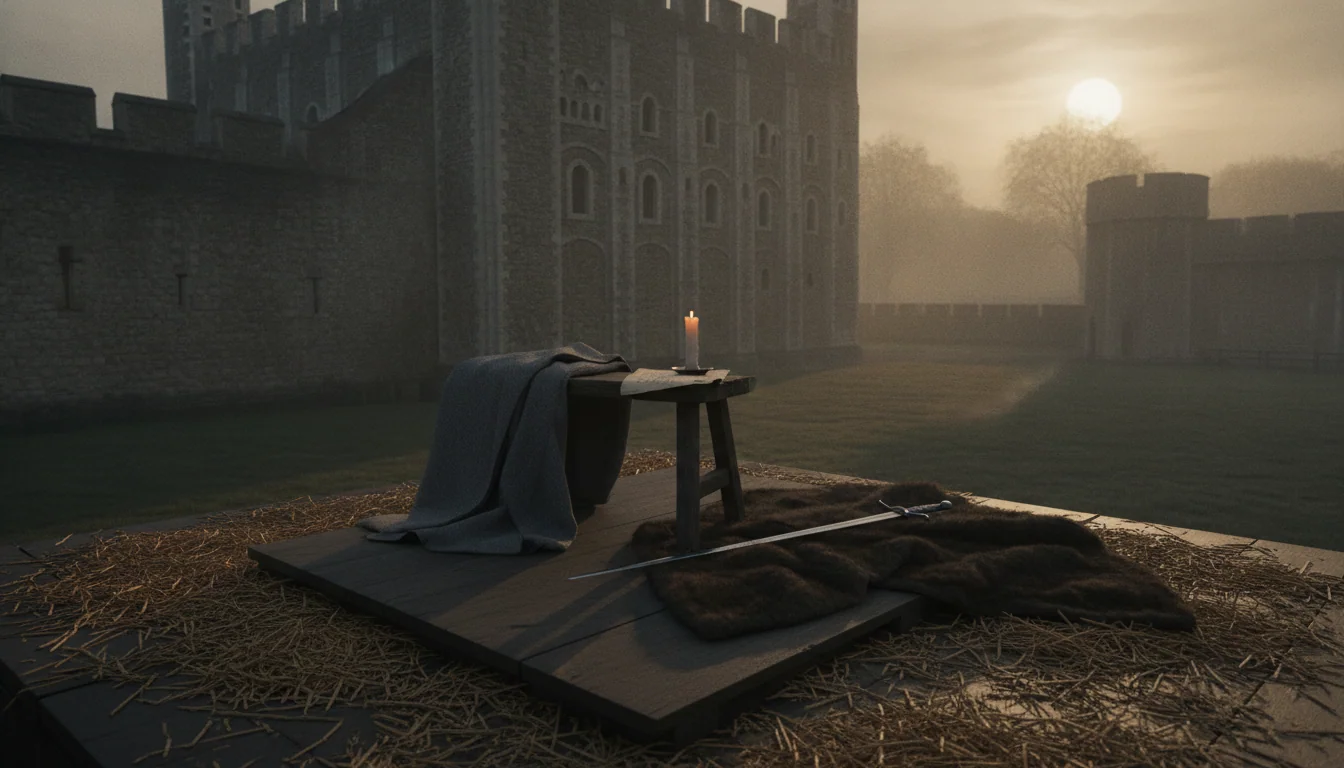
The Anne Boleyn execution took place at roughly eight in the morning on Friday, 19 May 1536: a woman who had been queen of England for barely three years knelt upright on a scaffold inside the Tower of London and was killed by a single stroke of a sword. Henry VIII had gone to unusual lengths to arrange that sword. It was a small mercy, if it can be called that, inside an execution built almost entirely on manufactured evidence.
Seventeen days that ended a queenship
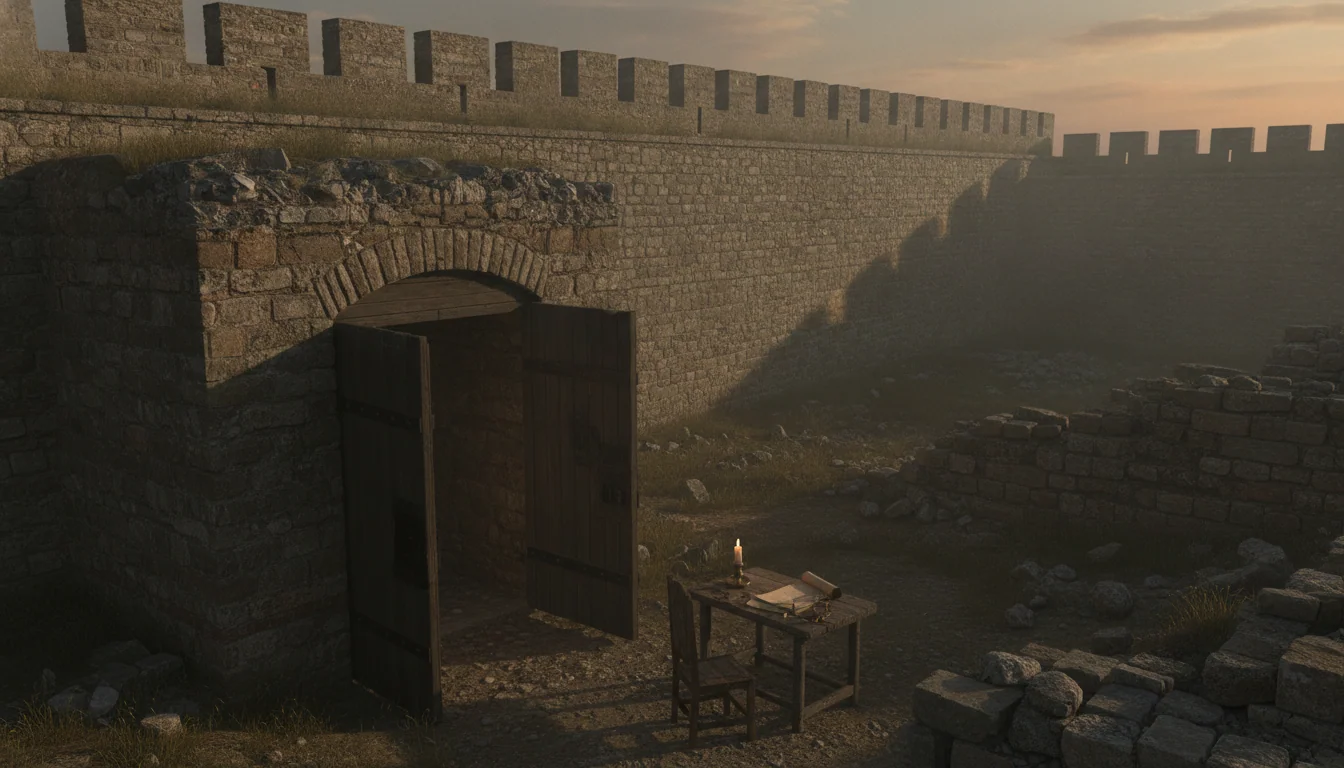
Anne Boleyn was arrested on 2 May 1536 and brought to the Tower by barge, entering, as tradition holds, through the water gate now popularly known as Traitors' Gate. The charges were extraordinary even by Tudor standards: adultery with five men, incest with her own brother George, and conspiring the king's death. Modern historians view the case as essentially fabricated, likely engineered by Thomas Cromwell after Anne became a political liability and Henry's interest had already turned toward Jane Seymour.
The machinery moved fast. On 12 May, four commoners accused alongside her, including the court musician Mark Smeaton, whose confession may have been extracted under pressure, were tried and convicted. On 15 May, Anne and her brother George were tried separately in the King's Hall of the Tower before a jury of peers presided over by her own uncle, the Duke of Norfolk. Both were found guilty and sentenced to death, the manner left to the king's discretion.
One detail historians return to often: arrangements to bring an executioner over from Calais appear to have been set in motion before the verdict was even delivered. Henry, it seems, was confident about how the trial would end.
On 17 May, George Boleyn and the four convicted men were executed on Tower Hill. That same day, at Lambeth, Archbishop Thomas Cranmer declared Anne's marriage to Henry null and void, on grounds never fully explained in the surviving record. The result was a legal absurdity that Tudor lawyers apparently felt no need to resolve: Anne was two days from being executed for adultery within a marriage the church had just ruled never legally existed.
The last full day
Anne's execution had originally been set for the morning of 18 May. It was postponed, most historians believe, because the swordsman's crossing from Calais, an English-held enclave on the French coast where sword executions were more familiar than in England, had been delayed. For a woman told to prepare herself to die, an extra day of waiting was its own small cruelty.
Sir William Kingston, the Constable of the Tower, wrote regularly to Cromwell throughout Anne's imprisonment, and his letters are the closest thing historians have to a contemporary diary of her state of mind. Some pages were damaged in a fire that struck the Cotton Library in the eighteenth century, so parts of the record survive only in fragments, but enough remains to show a woman moving between fear, dark humor, and resignation. She reportedly remarked, on hearing that death would come later than expected, that she had thought she would already be past her pain by then.
She made her final confession and received the sacrament, and according to Kingston's account she swore her innocence of the charges before the Eucharist, not once but twice. For a devout sixteenth-century Christian, lying while taking communion meant risking damnation. Many historians cite this as one of the stronger indications that Anne genuinely believed herself innocent, whatever the court had decided. She spent her last evening with four of her ladies-in-waiting in the same royal lodgings where she had stayed before her coronation three years earlier.
Dawn on Tower Green
Anne rose before dawn on 19 May, prayed, and heard Mass. Rather than the public execution ground on Tower Hill, outside the walls, Henry had the scaffold built on Tower Green, within the Tower's own precincts. The choice kept the crowd small, perhaps a thousand people rather than the mob a public beheading could draw, and spared her the worst of the jeering. Present were Thomas Cromwell, the Duke of Suffolk, the Lord Mayor of London and members of the city's aldermen, and, by some accounts, Henry Fitzroy, the king's teenage illegitimate son. Henry VIII himself was not there; he had already left London.
By several accounts she wore a loose grey damask gown over a red kirtle, red being the traditional color of Christian martyrdom. Kingston escorted her from her lodgings across the green, accompanied by her four ladies. She climbed the scaffold and addressed the crowd in words that survive in more than one near-identical version, differing slightly in phrasing but not in substance. She said she had come to die according to the law, that she would accuse no one, that she asked the crowd to judge her kindly, and that she prayed for the king, calling him a good and gentle prince. She asked everyone present to pray for her soul.
It was, by the standards of the genre, a fairly conventional scaffold speech, the kind Tudor authorities expected of the condemned. What struck witnesses was how composed she managed to sound while delivering it.
She removed her mantle, and her ladies removed her headdress, replacing it with a plain linen cap. She was blindfolded. Because the sword method required the condemned to kneel upright rather than lay their head on a block, there was no block on this scaffold at all. Anne knelt, praying. The swordsman had reportedly kept the blade hidden beneath straw so she would not see it approach. Tradition holds that he called out to an assistant to fetch the sword, a deliberate distraction that caused her to turn her head, and struck as she did. No contemporary source confirms this detail with certainty, but the single stroke itself is not in dispute: multiple accounts describe a clean, immediate death, and observers who had witnessed other executions remarked specifically on the swordsman's skill.
The gun, and what came after
Moments after the stroke fell, a gun was fired from the Tower, the standard signal used to announce that a sentence had been carried out. It would have carried across the city and beyond the walls long before any official word could travel. A popular story holds that Henry, out hunting in the countryside, heard a distant gun and reacted with cold relief. That anecdote appears in later retellings rather than in any document from 1536, and most historians treat it as embellishment rather than fact.
No coffin had been prepared. Anne's body and head were reportedly placed into an old chest, by some accounts one that had held bow staves, and she was buried without ceremony in the chapel of St Peter ad Vincula, inside the Tower walls, near where her brother had been laid two days before. The grave went unmarked for more than three centuries, and her remains were only tentatively identified, based on skeletal evidence rather than documentary proof, during renovations to the chapel in the Victorian era.
Eleven days later, on 30 May 1536, Henry married Jane Seymour. The timing has fueled centuries of comment about how much of the outcome had been decided well before the trial began.
What the record does and does not settle
The broad sequence, arrest, trial, annulment, execution, remarriage, rests on solid documentation: court records, Kingston's letters, and the eyewitness account preserved in the Chronicle of Calais. What remains uncertain are the finer human details: the exact wording of her final speech, whether the sword-in-the-straw trick actually happened or was added by a later storyteller, and precisely what passed through her mind in that last quarter hour. Historians work carefully around those gaps rather than filling them with invented certainty.
What is not in dispute is the manner of the woman who died. Facing a charge nearly everyone at court understood to be false, Anne Boleyn is not recorded as having railed against her judges or her husband. She thanked strangers, asked for prayers, and knelt still. Whatever else the Tudor court manufactured that spring, it could not manufacture that.
Anne Boleyn's daughter would grow up to rule England as Elizabeth I, and she was not the only teenage queen Henry VIII would later send to the block; see also the downfall of Catherine Howard.
Quick Answers
Common questions about this topic
What were Anne Boleyn's last words?
According to witnesses, she thanked the crowd, asked them to judge her kindly, prayed for the king, and asked for prayers for her own soul. The fullest surviving version comes down through more than one near-contemporary transcription, so historians treat the exact wording as close but not word-perfect.
Why was a swordsman used instead of an axe to execute Anne Boleyn?
Henry VIII arranged for an expert swordsman to be brought from Calais, since beheading by sword was a French and Calaisian specialty, faster and generally considered less brutal than the English axe. It was presented, and is usually read by historians, as a deliberate mercy.
What signaled that Anne Boleyn's execution was complete?
A gun was fired from the Tower of London immediately after the execution, a standard practice used to announce that a sentence had been carried out to the city beyond the walls.
How do historians know what happened in Anne Boleyn's final hours?
The main sources are letters the Tower's constable, Sir William Kingston, sent to Thomas Cromwell describing her behavior in custody, and an eyewitness account preserved in the Chronicle of Calais. Kingston's letters were damaged in an eighteenth-century fire, so some details survive only in fragments.

Ask Them About the End
Chat with historical figures about their final days, in their own words.
Create your free account →No card required. Some figures and features require a paid plan.
Join the HistorIQly Club
Get smarter about the past.
Weekly stories, deep dives, and exclusive content straight to your inbox.