The Final Hours of Marie Antoinette
The final hours before Marie Antoinette's execution: a letter to her sister-in-law, her hair cropped short, and a cart ride through a jeering Paris to the guillotine.
Read Wikipedia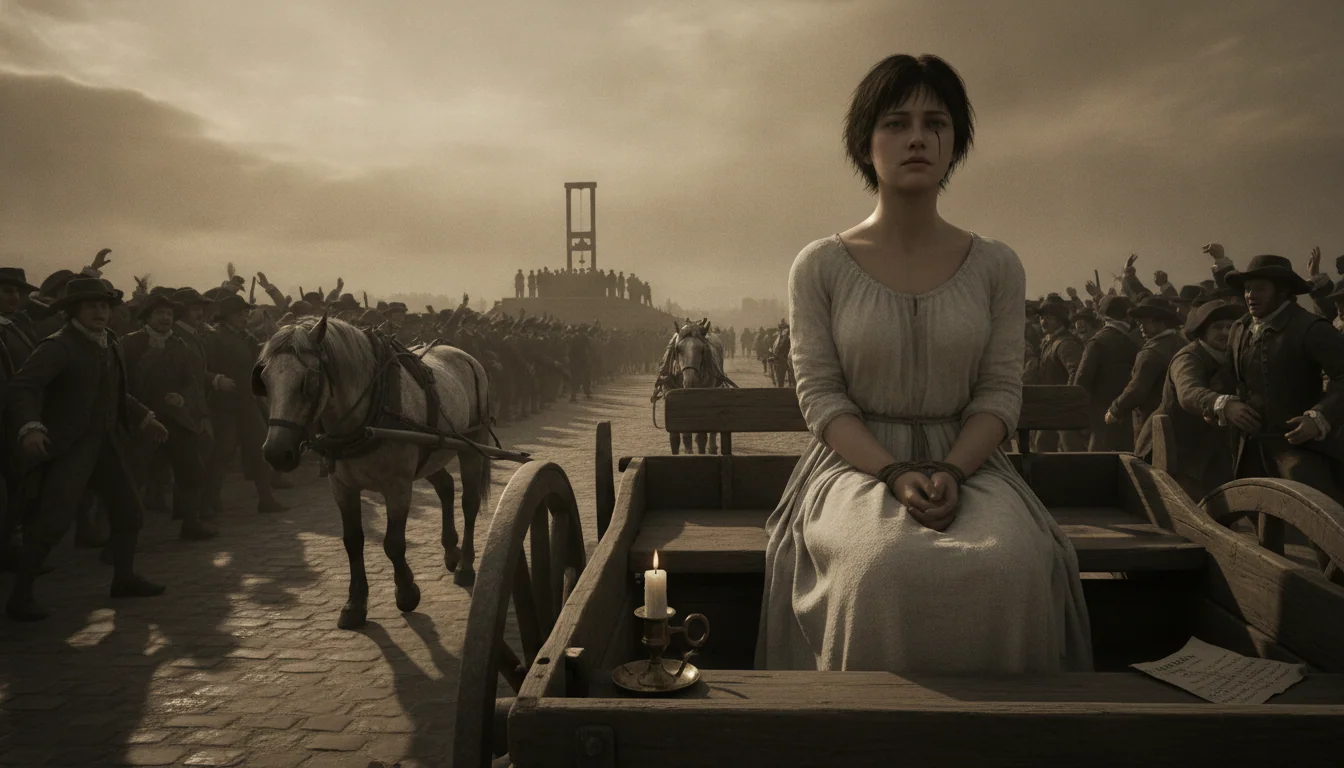
By the second week of October 1793, Marie Antoinette had already lost almost everything a person can lose without dying. Her husband had been executed in January. Her young son had been taken from her cell and coached into signing testimony against her. She was thirty-seven years old, held in a damp cell at the Conciergerie prison known to inmates as the antechamber of the guillotine, and by her jailers' own notes she was bleeding heavily and often too weak to stand for long. Whatever illusions she still held about surviving the Revolution, the woman who had once been the most extravagantly dressed figure in Europe now owned almost nothing: a few plain dresses, some books, and the company of a young servant named Rosalie Lamorliere, whose later recollections became one of the main sources for what followed.
Her trial before the Revolutionary Tribunal opened on October 14, 1793, and ran nearly continuously for two days. The prosecutor, Antoine Quentin Fouquier-Tinville, built a case around treason: secret correspondence with the Austrian court, encouragement of foreign invasion, drains on the treasury during years of famine. He also introduced a charge so lurid that even sympathetic revolutionaries were unsettled, accusing her of abusing her own son, based on a statement the eight-year-old boy had been pressured into signing. When pressed to answer it in open court, she is recorded as turning to the room and appealing to every mother present to judge whether such a thing was believable. It is one of the rare moments in the transcript where the defendant, not the prosecutor, controls the room.
The verdict
The tribunal deliberated through the night of October 15 into the small hours of October 16. Sometime around four in the morning, the jury returned a unanimous verdict: guilty, sentenced to death within twenty-four hours, per the law that governed such cases. There was no appeal to file and no clemency to request. She was walked back to her cell knowing, for the first time with total certainty, exactly how many hours remained to her.
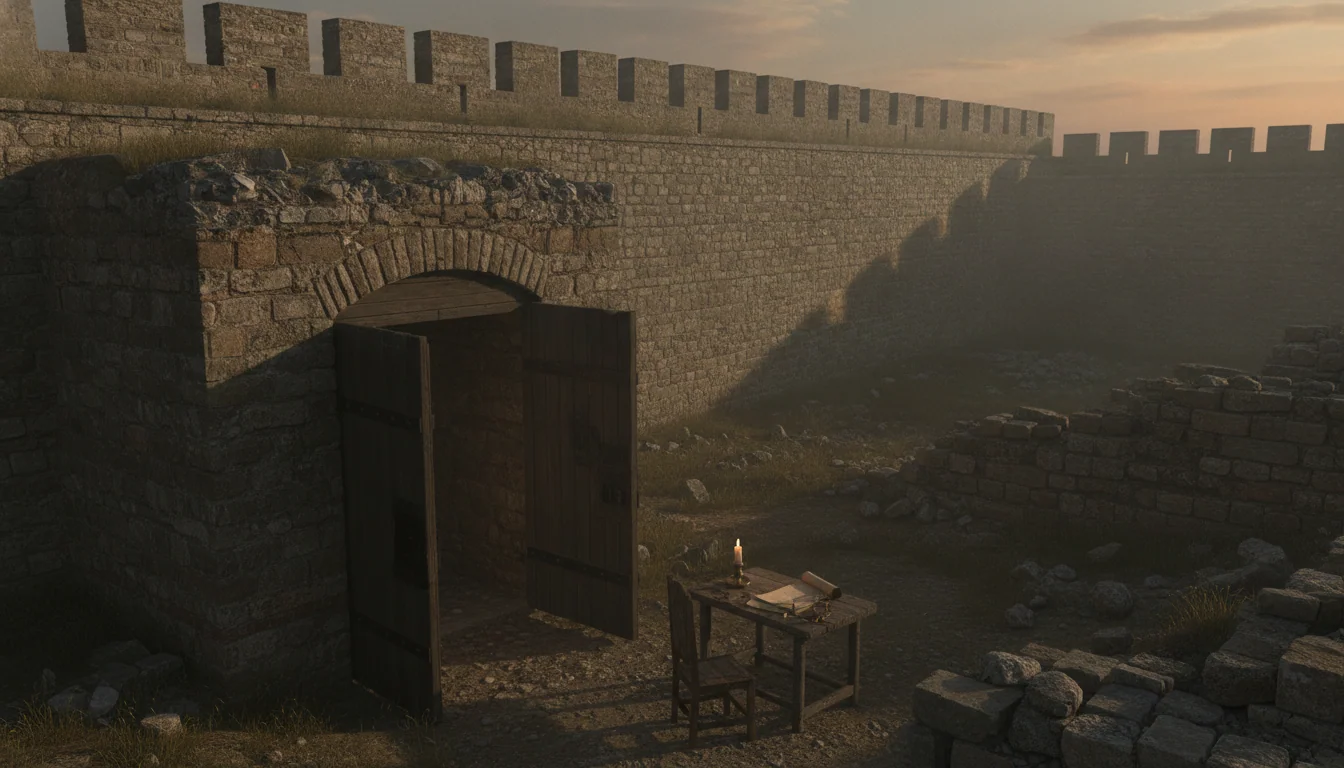
She did not sleep. Sometime around 4:30 that same morning, by candlelight, she wrote what she knew would be her last letter. It was addressed to Madame Elisabeth, the younger sister of her executed husband, who had remained close to the family and was still, at that hour, alive in a separate cell across Paris. The letter asked Elisabeth to look after her surviving children, forgave those who had wronged her, and explained a decision that still unsettles readers: she had chosen not to ask to see her son and daughter one last time, reasoning that the pain of parting again would be crueler than a clean absence. She professed her Catholic faith, insisted she had never intended harm to anyone, and closed with the hope that the letter would somehow reach its recipient.
It did not, at least not in time to matter. The letter never reached Madame Elisabeth, who was herself sent to the guillotine the following spring. It surfaced only later, discovered among the papers of Maximilien Robespierre after his own fall from power, apparently intercepted and never forwarded. Marie Antoinette had spent some of her last free hours writing to a woman who would be dead within the year, in a letter that neither of them would ever see delivered.
The final morning
The hours between dawn and the execution followed a routine used for every prisoner condemned by the tribunal, applied to her with no allowance made for who she had been. A priest who had sworn the constitutional oath required of clergy under the new regime was assigned to accompany her, though by her own understanding of the Catholic Church such a priest held no valid authority, and she is described as giving him little attention. Some accounts hold that a non-juring priest, one who had refused the oath and was in hiding, managed to hear her confession in secret before she left the Conciergerie, though the record on this point rests on later, uncorroborated tradition rather than a documented eyewitness.
Around eleven in the morning, an assistant to the executioner performed the standard preparation: her hair was cropped short at the nape of the neck and her collar cut away, clearing the path a blade would need, and her hands were bound behind her back. It was the same procedure applied to every person the Tribunal sent to the scaffold that week, clerk and aristocrat alike, but for a woman once famous across Europe for towering, elaborate hairstyles, the plainness of the act landed as its own form of sentence.
Louis XVI had been taken to his execution in January in a closed carriage, a small mercy that preserved something of royal ceremony even in death. His widow received no such courtesy. She was put into an open cart, the kind normally used to haul prisoners and goods, seated with her hands tied, and driven out of the Conciergerie toward the Place de la Revolution, the square known today as the Place de la Concorde.
The ride through Paris
The route ran along crowded streets, and the cart moved slowly enough that the journey of roughly a mile took close to an hour. Crowds lined the way, some silent, many hostile, calling out insults toward the woman Parisians had spent years mocking in pamphlets as a foreign spendthrift who had bankrupted the country, a reputation cemented years earlier by the Affair of the Diamond Necklace. Somewhere along the rue Saint-Honore, the painter Jacques-Louis David, a committed revolutionary, watched the cart pass from a window and made a quick pencil sketch on the spot. It survives today: a gaunt woman in a plain white cap and dress, hands bound, her famous profile reduced to hollow cheeks and a straight, composed mouth. It is the only image of her from that morning drawn from life rather than imagination, and it shows none of the theatrical terror later artists would invent for her.
She arrived at the Place de la Revolution shortly after noon. The guillotine stood on the same square where a royal statue of Louis XV, her husband's grandfather, had once stood before revolutionaries tore it down, a square that had already seen her husband die nine months earlier. She climbed the scaffold steps quickly, by most accounts, without needing to be helped or dragged, a detail contemporaries on both sides of the revolutionary divide seem to have noted with something like grudging respect.
The end
The execution itself is recorded plainly and briefly in the surviving accounts, in keeping with how the Tribunal's daily business was logged: an identity confirmed, a sentence carried out, a time noted. She reportedly stepped on the foot of the executioner, Charles-Henri Sanson, the same man who had presided over her husband's death, and is said to have apologized, telling him she had not meant to do it. That line, repeated in nearly every account of her death since, comes from a memoir published by the Sanson family decades later, and historians generally treat it the way they treat most famous last words: plausible, widely repeated, but resting on a single retrospective source rather than a contemporary witness. She was executed at approximately 12:15 in the afternoon on October 16, 1793. Her head was shown to the crowd, as was customary, and accounts describe a reaction more muted than the roar that had greeted her husband's death in January, though hostile shouting is recorded as well.
Aftermath
Her body was taken to the small Madeleine cemetery, already the resting place of Louis XVI, and buried without ceremony in an unmarked grave, packed with lime to hasten decomposition. She remained there for more than two decades. In January 1815, after the restoration of the Bourbon monarchy, the graves were opened, remains believed to be hers and her husband's were identified, and both were reinterred with full royal honors at the Basilica of Saint-Denis, the traditional burial site of French kings.
What we know of her final hours comes from a patchwork of sources of uneven reliability: the official trial transcripts, which are solid documentary record; the surviving text of her last letter, a primary source in her own hand; David's sketch, drawn from direct observation; and the memoirs of people close to the events, including Rosalie Lamorliere and the Sanson family, published years or decades after the fact and shaped, inevitably, by hindsight and legend. The broad sequence, trial, verdict, letter, cart, scaffold, is not in serious dispute. The precise wording of her very last sentence, like so much about how condemned people meet their end, is tradition dressed as fact, repeated so often it has become almost impossible to separate from the record itself.
Quick Answers
Common questions about this topic
What were Marie Antoinette's last words?
The most repeated line has her apologizing to the executioner after accidentally stepping on his foot, saying she had not meant to do it. That account comes from the executioner's own family, published decades after her death, so historians treat it as tradition rather than a verified quote.
What happened to her last letter to Madame Elisabeth?
Marie Antoinette wrote it around 4:30 in the morning on October 16, 1793, to her sister-in-law Madame Elisabeth, but it was never delivered. It resurfaced later among the papers of Maximilien Robespierre, by which time Elisabeth herself had also been executed.
Why was Marie Antoinette's hair cut before her execution?
Cropping the hair at the nape of the neck and cutting away the collar was standard procedure for every prisoner sent to the guillotine, regardless of rank, so the blade had a clear path. For a former queen, the routine indignity carried extra weight.
How do historians know what happened in her final hours?
The account is reconstructed from the Revolutionary Tribunal's trial transcripts, the memoir of Rosalie Lamorliere, a servant who attended her at the Conciergerie, Jacques-Louis David's eyewitness sketch of the cart ride, and the surviving text of her last letter.

Ask Them About the End
Chat with historical figures about their final days, in their own words.
Create your free account →No card required. Some figures and features require a paid plan.
Join the HistorIQly Club
Get smarter about the past.
Weekly stories, deep dives, and exclusive content straight to your inbox.