Gladiator II vs. History: How Accurate Is the Rome Sequel?
Gladiator 2 accuracy breakdown: Ridley Scott's 2024 sequel invents its hero and distorts Macrinus, but gets Caracalla's violence and the Praetorian Guard right.
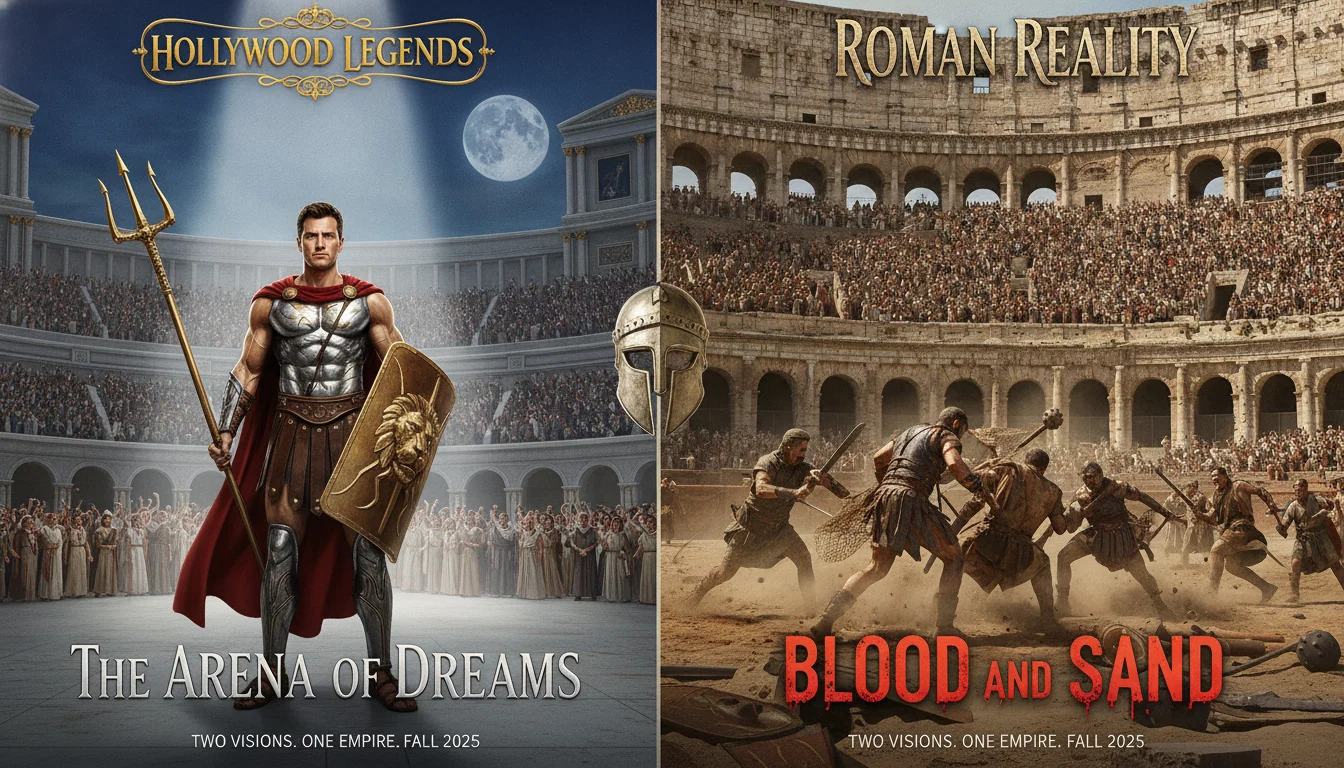
Ridley Scott has now made two films about ancient Rome, and in both of them he has decided that the actual history is merely a starting point. The first Gladiator invented a fictional general and had him fight a distorted version of the emperor Commodus, whose real career was strange enough without embellishment. The sequel, released in November 2024, goes further: it invents not only its hero but recasts a real historical figure - the emperor Macrinus - as a scheming former slave with a private gladiatorial empire, placed decades before he would have existed in anything like that capacity.
The film is visually impressive. The production design captures something of the scale and spectacle culture of imperial Rome. Paul Mescal commits fully to a role built on fabricated foundations. But Gladiator II is less historically grounded than the first film, which was not especially grounded to begin with.
Historical accuracy: 4/10
What Hollywood Got RIGHT
The joint reign of Caracalla and Geta
The film's premise - a Rome ruled by two brothers who despise each other - is grounded in real events. When the emperor Septimius Severus died in York in February 211 AD while campaigning in Britain, he left the empire to his sons Caracalla and Geta. They were long-term rivals and temperamental opposites.
The sources that survive, primarily Cassius Dio and the unreliable Historia Augusta, describe a co-reign so hostile that the brothers divided the imperial palace in half and placed guards on every connecting door. They reportedly considered splitting the empire geographically, an idea their mother Julia Domna talked them out of.
The film exaggerates their dysfunction into cartoonish villainy - they attend the games in matching costumes and behave like bored sadistic children - but the underlying reality of a dysfunctional and dangerous imperial partnership is real.
Caracalla's violence
The film's Caracalla is impulsive, cruel, and surrounded by sycophants. The historical Caracalla fits closely enough. After murdering Geta in December 212 AD - killed in their mother's arms after Caracalla arranged a supposed reconciliation - Caracalla launched a purge. Cassius Dio estimated that roughly 20,000 people connected to Geta were killed in the aftermath: soldiers, freedmen, and anyone who had publicly supported him.
Caracalla also massacred the citizens of Alexandria in 215 AD after they composed verses mocking him. The death toll is disputed but was significant. The film does not make Caracalla worse than the record; if anything, it simplifies a more complicated paranoia.
Exotic animals in the arena
The film features a rhinoceros in gladiatorial combat, which attracted attention as one of its more audacious sequences. While the specific scenario is invented, the presence of exotic animals in Roman arena events is thoroughly documented. Emperors regularly staged venationes - beast hunts - featuring lions, bears, hippopotamuses, crocodiles, elephants, and on occasion rhinoceroses. The emperor Commodus, directly preceding the Severan dynasty, is recorded to have personally shot a rhinoceros with arrows in the arena.
Whether rhinos were used in gladiatorial combat the way the film depicts is unknowable from the surviving record, but exotic animal spectacle in the Colosseum is not Hollywood invention.
The Praetorian Guard as political actor
The film repeatedly shows the Praetorian Guard as a political force rather than purely a protective one. This is historically accurate. By the Severan period, the Guard had already been involved in the assassination of multiple emperors and would be central to placing Macrinus on the throne in 218 AD after Caracalla's death. The transactional and occasionally lethal relationship between emperors and their own guard was one of the structural features of the late Roman imperial system.
What Hollywood Got WRONG
Lucius is entirely fictional
The film's protagonist, Lucius, is identified as the son of Maximus from the first film - who was himself a fictional character. There is no historical figure in the Severan period who matches Lucius's background, role, or identity. The film threads him through real events, but he appears in no source because he never existed.
This is not inherently a problem for drama. Historical fiction routinely invents protagonists to carry real narratives. But it means the film's entire central arc unfolds in a vacuum of historical grounding, and everything plausible in the setting surrounds a character who is pure invention.
Macrinus as a former slave is invented
The film's most significant historical distortion is its treatment of Macrinus, played by Denzel Washington as a charismatic, wealthy former slave who controls Rome's gladiatorial network and is secretly engineering the downfall of the Severan dynasty.
The real Macrinus was born in Caesarea Mauretaniae, in what is now northern Algeria, and rose through imperial administrative service to become Praetorian Prefect under Caracalla. No credible ancient source identifies him as a former slave. He was a trained jurist who gained influence through bureaucratic competence and political calculation, not the gladiatorial trade.
The real Macrinus did arrange Caracalla's assassination in 218 AD and became emperor - but by then he was an established imperial official, not an outsider. His reign lasted roughly 14 months before forces backing Caracalla's cousin Elagabalus overthrew him. None of that resembles the film's version.
The flooded Colosseum
The film stages a sequence in which the Colosseum is flooded for a naval battle. The Romans did hold naumachia - elaborate sea battle spectacles - in purpose-built arenas or flooded artificial lakes. Julius Caesar flooded a basin on the Campus Martius. Augustus constructed a dedicated naumachia lake.
Whether the Colosseum itself was ever flooded for full-scale naval combat remains debated among archaeologists and historians. The drains and channel infrastructure exist in the substructure. But the engineering challenge of waterproofing a structure that size at the required depth, and the lack of direct documentary evidence, make many scholars skeptical. The film presents a massive, convincingly realized naval battle inside the Colosseum as historical fact. The actual evidence is far more ambiguous.
Compressed and rearranged chronology
The film collapses events from different points in the Severan dynasty into a single dramatic sequence. Characters who would have been active at different decades share scenes. The political rise of Macrinus, which in real history happened years after the events the film depicts, is pulled back into the Caracalla-Geta co-reign.
Chronological compression is unavoidable in historical cinema. But Gladiator II presses the compression until the resulting story does not map onto any coherent period of Roman history. It is a film about an imaginary Rome that happens to share some names with the real one.
The real Severan dynasty is stranger than the film suggests
The irony of Gladiator II's inventions is that the actual Severan dynasty did not need embellishment. For another ancient-world epic that plays fast with history, see 300 vs. History. Caracalla's successor, Elagabalus, who came to power in 218 AD, was a teenager who installed himself as a high priest of the Syrian sun god, married a Vestal Virgin (a profound sacrilege in Roman religion), reportedly cross-dressed, and was eventually murdered by the Praetorian Guard after four years on the throne. Caracalla himself, who extended Roman citizenship to virtually all free people of the empire via the Constitutio Antoniniana, remains one of history's most contradictory rulers - genuine reformer and genuine monster in the same reign. None of this appears in the film. Ridley Scott had richer material available and opted for invention instead.
Quick Answers
Common questions about this topic
Is Lucius from Gladiator II a real person?
No. Lucius, the child seen in the first Gladiator who grows up to be the sequel's protagonist, is a fictional character. No historical figure matching his background exists in the record. The film uses him as a narrative device to continue the story of Maximus, who was himself a fictional composite.
Was Macrinus really a former slave who ran the gladiatorial trade?
No. The real Macrinus was a Berber-born jurist and Praetorian Prefect who became emperor in 218 AD after arranging Caracalla's assassination. He had no connection to the gladiatorial business. The film's portrayal of him as a wealthy former slave managing a private gladiatorial empire is entirely invented.
Did Caracalla and Geta really co-rule as shown in the film?
Yes - briefly and disastrously. After Septimius Severus died in 211 AD, his sons Caracalla and Geta were meant to rule jointly. They despised each other, divided the imperial palace in half, and the arrangement lasted only months before Caracalla murdered Geta in their mother Julia Domna's arms in 212 AD.
Was the Colosseum ever flooded for naval battles?
The Romans staged naumachia - artificial sea battles - on flooded arenas and purpose-built lakes, but whether the Colosseum itself was ever successfully flooded for full naval combat is disputed among scholars. The plumbing infrastructure exists in the substructure, but evidence for large-scale naval battles inside it specifically remains uncertain. The film treats it as established fact.

Debate the Accuracy with the Real Figures
Ask the real people what Hollywood got wrong about their lives.
Chat with HistoryJoin the HistorIQly Club
Get smarter about the past.
Weekly stories, deep dives, and exclusive content straight to your inbox.