If Winston Churchill Lived Today: The Last Rhetorician in a World of Talking Points
Imagining if Winston Churchill lived today reveals a podcast host and columnist whose oratory, imperial legacy, and Black Dog are all incompatible with modern politics.
Read Wikipedia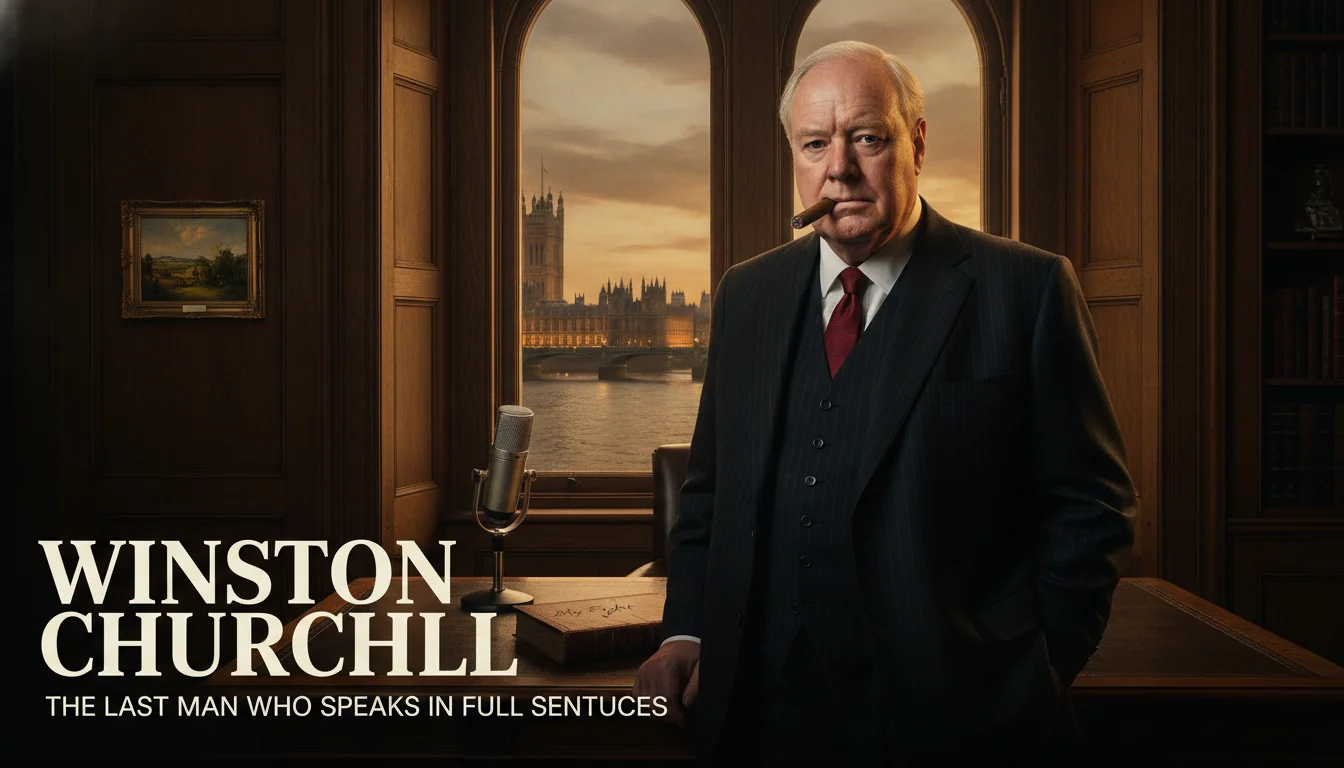
Before he was Prime Minister, Winston Churchill was a war correspondent who charged with the 21st Lancers at Omdurman, escaped from a Boer War prisoner-of-war camp, wrote more than a dozen books, served in multiple Cabinet posts, returned Britain to the gold standard (an error he acknowledged), was largely ignored by his own party for a decade, and then, at 65, became the most important man in the free world.
He was also, in his way, the last person to hold a major democratic office primarily on the strength of his sentences.
Drop Churchill into 2026 and the first problem is not his politics or his record. He does not fit into any existing category of public figure, and the machine built to process public figures does not know what to do with someone who operates outside its taxonomy.
The historical figure
Churchill was born on November 30, 1874, at Blenheim Palace in Oxfordshire, the ancestral home of the Dukes of Marlborough. His father, Lord Randolph Churchill, was a mercurial and brilliant Conservative politician who burned out early and died young. His mother, Jennie Jerome, was American - from New York, spirited and ambitious - and Churchill inherited something from each of them, the political electricity from his father and the transatlantic ease from his mother.
He was not a distinguished schoolboy at Harrow. He had a stammer and struggled with academic subjects that did not interest him. He went to the Royal Military College at Sandhurst after failing entrance examinations twice, graduated, and spent the next several years contriving to get himself into every small war the Empire had available, while simultaneously filing dispatches for London newspapers.
Cuba in 1895, India in 1897-98, Sudan in 1898 where he rode in the last significant cavalry charge in British military history at Omdurman, South Africa in 1899-1900 where he was captured, escaped from a Boer prisoner-of-war camp in Pretoria, and turned the episode into a bestselling book within the year. He entered Parliament in 1900 at 25. He had already published four books.
His Parliamentary career over the next four decades was varied enough to be unclassifiable. He crossed the floor from Conservative to Liberal in 1904, became a competent Home Secretary, then a controversial First Lord of the Admiralty. He was widely blamed for the Gallipoli campaign of 1915, in which Allied forces attempted and failed to force the Dardanelles, at enormous cost. He was removed from the Admiralty, joined an infantry battalion in France for a period, returned to government, served in Lloyd George's Cabinet, and eventually worked his way back to the Conservatives.
The Nobel Prize in Literature came in 1953 for The History of the English-Speaking Peoples and The Second World War, six volumes he wrote largely between 1948 and 1953 while also serving as Prime Minister. He painted in oils throughout his adult life. He was a genuinely skilled amateur who exhibited under a pseudonym for years and whose work has sold at auction for substantial sums. He wrote to survive financially, painted to survive emotionally, and spoke because he believed what he was saying and was very good at it.
The modern role
In 2026, Churchill is a podcast host, a newspaper columnist, a Parliamentary backbencher, and a former defence minister who has written six books that reviewers call overlong, and readers keep buying.
The podcast - called something like The Long View - is released twice weekly and runs approximately two hours per episode. Churchill does not do short. Guests include historians, serving generals, foreign ministers who owe him a favor, and occasional novelists he has decided are interesting. The audience is substantial, older than average, and extremely willing to pay for premium subscriptions to hear a man in his sixties discuss the Ottoman entry into WWI for forty minutes.
He is a Conservative Member of Parliament for a safe rural seat, held for decades. He does not hold a Cabinet position in the current government. He was offered one and turned it down on the grounds that the brief was insufficiently serious. The Prime Minister was relieved and annoyed in equal measure.
The skills that carry
Churchill's three great practical competencies were writing under pressure, speaking to multiple audiences simultaneously, and maintaining a public posture of certainty at moments when certainty was the one thing nobody else could provide.
The writing is effortless to translate. Churchill dictated his books to secretaries at a rate that would alarm most modern publishers, and the prose, while not economical, is muscular and rhythmically intelligent. In 2026 he writes a long-form column for one of the serious newspapers, a quarterly essay for a defence-policy journal, and the memoir-in-progress that has been in-progress for seven years because he keeps stopping to add a chapter on something else.
The oratory is more complicated. Churchill's speeches were built for a room: a Commons chamber, a large public hall, a broadcast radio microphone. They were not built for a thirty-second clip on social media. The sentences are too long, the constructions too deliberate, the silences too carefully timed for compression without loss. His podcast audience hears the full version and finds it revelatory. His two-minute social media clips are shared, but more by people who find them amusing than by people who find them persuasive.
The certainty is the most transferable skill and the most dangerous one. Churchill's capacity to project absolute confidence in an hour of maximum uncertainty was what 1940 required. In 2026, with no Hitler and no Blitz, the same posture registers as intransigence in ordinary times and briefly as gravitas when genuine crisis emerges.
The complications
The 2026 Churchill has the same complicated legacy as the historical one, and social media has made the argument continuous.
His views on empire, on India, on the management of the 1943 Bengal famine - in which approximately 2 to 3 million people died, with wartime policy decisions among the contributing factors - are documented and not reducible to their historical context. The historical Churchill acknowledged almost none of this publicly. The 2026 Churchill, operating in an environment where the documentary record is fully accessible to anyone who wants to look, faces these questions constantly.
His responses are not satisfying to critics. He knows the history, cites mitigating factors that historians dispute, and eventually delivers a short statement that is eloquent, partially evasive, and generates another week of argument. He is not incapable of self-reflection - his private correspondence suggests more than his public statements - but self-criticism in public feels to him like weakness, and he has never made his peace with that particular modern requirement.
The depression is real and continuous. The Black Dog, as he has called it privately, is present in the 2026 version as it was in the historical one. He manages it through work and does not discuss it in any interview. This is not sustainable as a media strategy but it is, he would insist, his business.
Where he lives and how
A house in Kent - not as grand as Chartwell, which the National Trust took over in 1966 in the original timeline, but something with enough grounds to walk, a studio for painting, and sufficient distance from London to feel like separation from the machinery.
An apartment in Westminster when Parliament sits. He does not maintain a social media presence directly; a researcher posts the podcast links and column headlines. His private view of Twitter is that it is the worst thing to happen to public argument since the pamphlet.
He drinks openly. He smokes a cigar at events where he calculates he can get away with it and slightly more often than that. In an era where politicians perform wellness by posting gym selfies, this is either catastrophic branding or brilliant anti-branding, depending on the week.
What goes wrong
The problem with Churchill in ordinary times has always been scale. He is calibrated for extraordinary circumstances, and in ordinary circumstances he generates friction in every direction.
He alienates the party apparatus because he does not follow the line. He alienates the media because he refuses to be brief. He alienates younger members of his own party who have read the India dispatches and cannot reconcile them with the wartime saint. He alienates nobody on the left because they hated him to begin with and he returns the compliment without embarrassment.
He waits for the crisis that will require him. In 1940, it came. In 2026, it has not come yet. He fills the waiting with the podcast, the columns, the memoir, the paintings, and the considered view that the people currently running things are not exactly rising to the moment.
He is not wrong about this. He is also not improving the situation by being right about it in this particular register.
When it matters
The modern Churchill is most himself not in the 24-hour news cycle but in the singular moment when things have gone genuinely wrong and everyone else has settled for language that softens the reality. That is when the sentences he has been building for forty years suddenly become the only ones that tell the truth at the volume the occasion requires.
That is also the only thing that will save him from the accumulated resentments his career has generated. The crisis clears the ledger. The oratory does the work. The sackcloth-and-ashes he refuses to wear for the empire while it is an abstraction somehow matters less when the bombs are falling and he is the only one willing to say exactly how bad it is and what it will take.
If Churchill lived today, he would be difficult, expensive, occasionally wrong, and periodically indispensable. He would be accused of things for which the evidence is mixed and other things for which it is not. He would write too much, drink too much, and speak at precisely the right length at precisely the wrong moments and vice versa.
And then the right moment would come, and he would speak at exactly the right length, and everyone would remember why he was there.
Until the next morning's news cycle.
For a similar treatment of historical leaders reimagined in the present, see If Napoleon Lived Today and If Elizabeth I Lived Today. For Churchill's finest hour dramatized on screen, see Dunkirk vs. History.
Quick Answers
Common questions about this topic
Who was Winston Churchill?
Winston Churchill (1874-1965) was a British statesman, military officer, journalist, and writer who served as Prime Minister from 1940 to 1945 and again from 1951 to 1955. He led Britain through the Second World War, was awarded the Nobel Prize in Literature in 1953, and is widely considered one of the most significant figures of the 20th century. He was also an accomplished amateur painter and one of the most prolific political writers of his era.
What made Churchill such an effective speaker?
Churchill worked obsessively on his speeches, sometimes spending hours on a single phrase. He had a speech impediment as a young man and overcame it through deliberate practice. His technique combined classical rhetorical devices - tricolon, anaphora, the short declarative sentence after a long complex one - with an ear for rhythm that was partly musical. He read his speeches aloud to himself repeatedly before delivering them.
What is Churchill's complicated legacy?
Churchill's legacy involves significant moral complexity. Alongside his wartime leadership, he held views on race and empire that reflected and in some cases exceeded the prejudices of his era. His handling of the 1943 Bengal famine, in which approximately 2-3 million people died partly due to wartime policy decisions, has drawn sustained historical criticism. His opposition to Indian independence was vehement and documented. Any complete account of Churchill includes both.
What was Churchill's 'Black Dog'?
Churchill referred to his recurring depression as his 'Black Dog.' He experienced what modern clinicians would likely diagnose as clinical depression throughout his life, including extended periods of low mood during his 'Wilderness Years' in the 1930s. He managed it through activity, writing, painting, and company - and was typically reluctant to acknowledge it publicly beyond the metaphor.

Meet Them in Person
Chat with the historical figures behind these modern reimaginings.
Create your free account →No card required. Talk to anyone in history with 8 free credits a day. Some features require a paid plan.
Join the HistorIQly Club
Get smarter about the past.
Weekly stories, deep dives, and exclusive content straight to your inbox.