If Spartacus Lived Today: The Labor Organizer Rome Could Not Kill
If Spartacus lived today, he'd be the most effective labor organizer in Europe - same tactical genius, same coalition problems, and the same unstoppable grievance against exploitation.
Read Wikipedia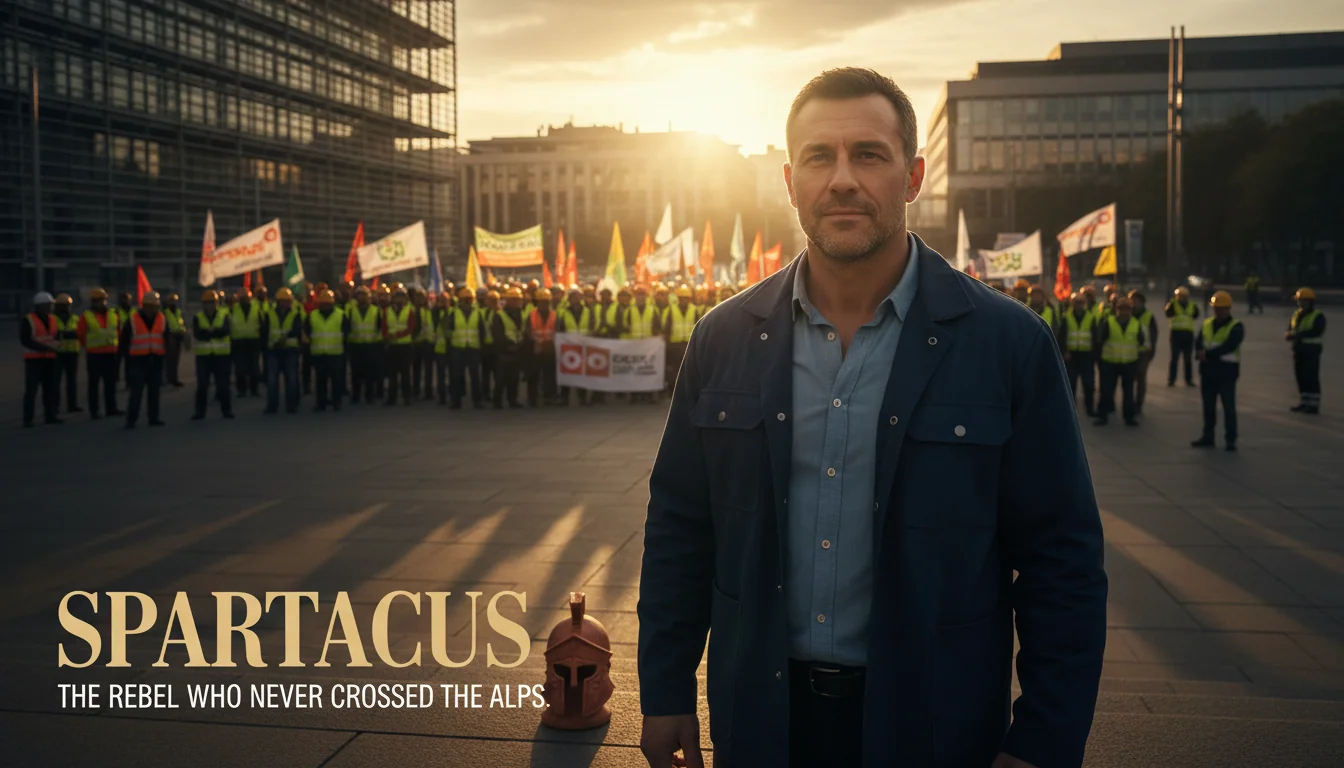
Rome threw two consular armies at Spartacus and he destroyed both of them in the same year. He built an organized military force out of escaped gladiators, agricultural slaves, and the desperately poor, and for two years he made the most powerful state in the Mediterranean world look incompetent. He did all of this while simultaneously managing the political tensions of an army that contained at least three ethnic groups, multiple competing agendas, and no formal logistics chain.
Then Crassus mobilized six legions, and it ended. It always ends.
Drop Spartacus into 2026 and the question is not whether he is dangerous - obviously he is dangerous - but where his particular combination of skills and grievances finds its outlet. The answer is messier than the popular image, and considerably more interesting.
The historical figure
Spartacus was born in Thrace, the region roughly corresponding to modern Bulgaria and the northeastern corner of Greece. Plutarch says he had served in the Roman auxiliary military before his enslavement - a detail that, if accurate, explains a great deal about his tactical competence. He understood Roman formations from the inside. He knew what the legions would do, and at what distance, and with what timing.
He ended up at the gladiatorial school of Gnaeus Cornelius Lentulus Batiatus in Capua. The exact circumstances of his enslavement are not recorded. In 73 BCE, he and approximately 70 others escaped from the school using kitchen implements as weapons, seized a cart of actual gladiatorial arms on their way out, and retreated to Mount Vesuvius.
The numbers grew quickly. Slaves from the agricultural estates of Campania - where conditions were notoriously brutal - joined in large numbers. So did the rural poor, free people who had nothing to lose. At its peak, Spartacus's force may have numbered anywhere from 70,000 to 120,000 people, though the ancient sources vary and the higher figures are probably exaggerations. Even the conservative estimates represent an extraordinary organizational achievement for a force built from scratch in hostile territory.
He defeated the praetor Gaius Claudius Glaber, then another praetor, then the two consuls of 72 BCE in sequence. Roman commanders consistently underestimated him. The standard playbook - contain the rabble, don't engage in force, wait them out - kept failing because Spartacus moved too fast, picked his ground too well, and kept his force organized enough to fight on Roman tactical terms.
He also, according to Appian, tried to march north toward the Alps twice. Both times his army refused to follow. This tension - a leader who understood the strategic exit and a force too large and too diverse to take it - defines his eventual defeat as much as Crassus's legions. He was leading an army that had become its own political problem.
Crassus defeated him in 71 BCE in southern Italy. Spartacus died fighting in the final battle. His body was never definitively identified.
The modern role
Born in 2026 into a working-class Bulgarian family with a grandfather who still talks about the Rhodope Mountains, he emigrates to Germany at nineteen on a construction visa. He is physically extraordinary - not just strong but coordinated, disciplined, and constitutionally incapable of staying quiet when he thinks someone is being exploited.
He spends three years in construction, two more in a food-processing plant in the Ruhr Valley. He files a wage-theft complaint at twenty-four and wins. He organizes his shift at twenty-five. By twenty-seven he is the most effective shop-floor organizer that the IG Metall regional office has encountered in a decade, and they are simultaneously grateful for his results and anxious about his methods.
His methods: he prepares meticulously - which they like - and he is completely unbothered by the prospect of a strike lasting longer than management thinks the workers can hold - which they do not like. He understands leverage. He has studied the supply chains of the companies he negotiates against with the same intensity that the historical Spartacus appears to have studied Roman troop dispositions.
He moves to Brussels at thirty and becomes involved in cross-border organizing drives in logistics and platform work - the gig-economy sector where workers have the fewest protections and the most grievances. He is not a theorist. He does not publish manifestos. He has opinions about Gramsci but he holds them privately. What he does is organize: contact, conversation, trust, action, result.
By thirty-five he is known in three languages in six countries and despised by an equal number of logistics firms.
The skills that translate
Three things carry directly from Capua to the 21st century.
Tactical reading. Spartacus understood the Roman formation's weakness - it needed flat ground and room to deploy, it slowed in broken terrain, and it was psychologically brittle when its assumptions were violated. The 2026 version has the same instinct applied to labor negotiations: he reads the company's supply chain dependencies, identifies the chokepoints, and targets action precisely where the cost of disruption is highest. He does not call strikes across an entire workforce when a targeted action at a critical node produces the same pressure at a fraction of the cost.
Coalition management. The original Spartacus held together an army of Thracians, Gauls, Germans, and Italian-born slaves who wanted different things. He could not always contain the centrifugal forces - the Gallic and German factions that broke away from his army on at least one occasion. The modern Spartacus is better at this, having grown up in the multicultural complexity of European migrant labor rather than the slightly less nuanced environment of a Capuan gladiatorial school. He keeps his coalitions intact through patient relationship work and a studied refusal to privilege any single group's agenda.
Personal credibility. Spartacus fought in the front rank. There is no ancient source that places him behind his lines. The 2026 version does the same equivalent: he takes the worst shifts during a strike, he stands at the factory gate in the rain, he goes to the hearings and sits through the depositions. People follow him because he never asks anyone to accept conditions he has not himself accepted.
Where he lives and who he is
He lives in a two-bedroom apartment in Duisburg, which he shares with a partner who is a secondary school history teacher and who takes genuine pleasure in the fact that she teaches the Third Servile War to fourteen-year-olds. They have one child, a daughter who will grow up with an unusual amount of family dinner conversation about ancient Roman military logistics.
He does not own a car. He takes the train everywhere and uses the travel time to read, make calls, and prepare. His phone is full of contacts whose legal names he cannot always render correctly in Latin script, which he considers a reasonable problem to have.
He exercises every day before dawn, the same way he has since the construction years. Physical conditioning is not vanity. He has been in situations where the ability to hold a picket line for ten hours in February, without appearing cold or tired, was a meaningful signal to both his members and the company's security contractors.
He has been arrested twice, both times for peaceful actions that crossed technical legal lines, both times acquitted. He has been sued three times by employers and prevailed each time. He is on watchlists at two private intelligence firms retained by the companies he organizes against. He is aware of this. He considers it a reasonable occupational indicator.
What goes wrong
The historical Spartacus's defeat came from a structural problem he could not solve: his army was too large and too politically heterogeneous to maintain a single strategic direction. He won the tactical battles and lost the strategic war.
The modern version faces a version of the same problem. At some point, the coalition he has built across multiple countries and sectors becomes too diverse to maintain coherence. The national unions have their own institutional interests. The platform workers he organized in Belgium want things the German manufacturing workers find irrelevant. The migrant workers he brought in from outside the formal union structure have been partly absorbed into the official movement, and in being absorbed, they have been partly demobilized.
He handles this for a long time through sheer force of personal presence and tactical intelligence. Eventually, around his mid-forties, the institutional pressure to compromise, to accept a slower pace, to work within the system's preference for incrementalism, becomes impossible to resist from the outside. He is offered a senior position in the Brussels apparatus of the European Trade Union Confederation. It is an enormous salary, genuine institutional leverage, and a comfortable end to the decade of cold mornings at factory gates.
He takes it. He is effective at it. He is also, visibly, less dangerous. This is, of course, the point.
Why it matters
What made Spartacus threatening to Rome was not his army's size - Rome had faced larger rebellions. It was his combination of military competence with a legitimate grievance that every enslaved and poor person in Italy recognized. He could not be dismissed as a bandit. He could not be contained as a regional disturbance. He was raising a question about the foundation of the Roman economy that Rome could only answer by force, and then had to answer again twice more that century.
The 2026 version raises a quieter version of the same question in a regulatory context where force is not an available answer. The question is: at what point does the cost of organizing against workers exceed the cost of treating them adequately? The companies he fights have modeled this. His job is to keep shifting the math.
He is not going to march on Rome. He knows it, and they know it. But he has read Appian carefully enough to understand that the march was never the point. The point was whether the army held together long enough to make Rome's best generals look ordinary. By that metric, he has already succeeded.
The 6,000 crucifixions along the Appian Way are not available as a threat in 2026. He has that going for him, at least.
If Spartacus lived today, he'd recognize the other ancient figures who translate just as uncomfortably into the present. See If Cleopatra Lived Today and If Hannibal Barca Lived Today.
Quick Answers
Common questions about this topic
Who was the real Spartacus?
Spartacus was a Thracian-born slave who led the Third Servile War against Rome from 73 to 71 BCE. He escaped from a gladiatorial training school in Capua with roughly 70 fellow slaves, gathered an army that grew to perhaps 70,000 or more at its peak, defeated several Roman armies including consular forces, and was finally defeated and killed by Marcus Licinius Crassus in 71 BCE in a battle in what is now southern Italy.
Did Spartacus really want to overthrow Rome?
Ancient sources disagree about Spartacus's ultimate goals. Appian and Plutarch suggest he initially wanted to lead his forces north through the Alps and allow them to disperse to their homelands. His army, however, refused to leave Italy - possibly because many of the enslaved people who joined him were Italian-born with no homeland to return to. Whether he ever seriously intended a march on Rome itself is contested by historians.
What happened to Spartacus's followers after his death?
Spartacus was killed in the final battle in Lucania (modern Basilicata) in 71 BCE. Approximately 6,000 surviving rebels were crucified by Crassus along the Appian Way from Capua to Rome, a distance of roughly 130 miles. Their bodies were left in place as a warning. Pompey arrived from Spain and intercepted some fleeing survivors, taking credit for finishing the war despite Crassus having done the decisive fighting.
Where was Spartacus from?
Ancient sources identify Spartacus as a Thracian, from the region that roughly corresponds to modern Bulgaria and parts of Greece, Turkey, and North Macedonia. Plutarch writes that he had served previously in the Roman auxiliary forces before being enslaved, which would explain his understanding of Roman military tactics - an understanding that made him a uniquely effective adversary.

Meet Them in Person
Chat with the historical figures behind these modern reimaginings.
Create your free account →No card required. Some figures and features require a paid plan.
Join the HistorIQly Club
Get smarter about the past.
Weekly stories, deep dives, and exclusive content straight to your inbox.